Yemen's Govt Slams Houthis For Creating Fuel Crisis, Hints at Imposing New Measures

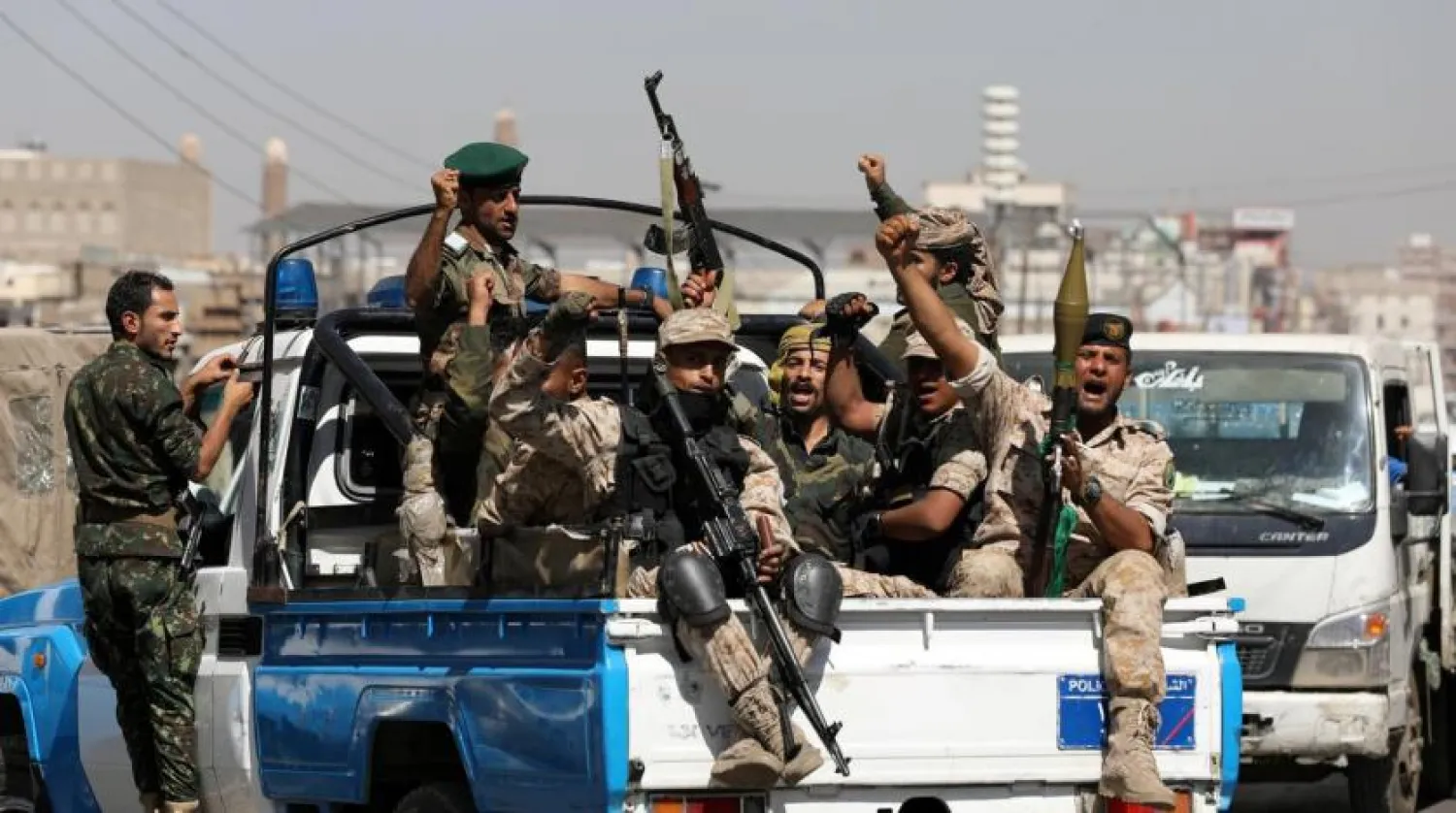
Houthi troops ride on the back of a police patrol truck after participating in a Houthi gathering in Sanaa, Yemen February 19, 2020. REUTERS/Khaled Abdullah/File Photo
TT

Yemen's Govt Slams Houthis For Creating Fuel Crisis, Hints at Imposing New Measures

Houthi troops ride on the back of a police patrol truck after participating in a Houthi gathering in Sanaa, Yemen February 19, 2020. REUTERS/Khaled Abdullah/File Photo

Yemen’s legitimate government denounced on Thursday the new fuel crisis created by the Houthi militias in Sanaa and areas under their control.

The crisis will double the suffering of millions of Yemenis and exacerbate the humanitarian situation amid the current coronavirus outbreak and revival of the black market, the government stressed.

It hinted that new measures will be taken per consultations with the United Nations.

This came in response to the militias’ violation of a previous agreement on regulating the import of oil derivatives and allocating fees for financial revenues from the ports of Hodeidah.

According to official Yemeni sources, the Supreme Economic Council addressed in a video conference chaired by Prime Minister Maeen Abdulmalik the Iranian-backed group’s evasion of earlier understandings reached under the UN auspices.

These include importing oil derivatives to the port of Hodeidah, implementing international controls to combat money laundering and terrorist financing, drying out the war economy, and limiting the illegal trade in oil in Yemen.

The council also discussed the militias’ looting of the Central Bank revenues in Hodeidah, which both sides earlier agreed to disburse as salaries for public sector employees.

“The group attempts to mislead the public opinion by claiming that oil derivative ships are being held by the legitimate government and the coalition to support legitimacy,” it noted in a statement.

It also said that the militias are proceeding with their approach to deepen the humanitarian catastrophe and use it as a political blackmail without taking the citizens’ suffering into account.

The council called on the UN to take a clear position on the militias’ renunciation from the agreement and their intentional delay in unloading fuel and food shipments in the port of Hodeidah and preventing their entry with the aim of causing crises and exploiting citizens’ suffering to serve their coup project.

During the meeting, a number of alternative options and measures were discussed and approved to address these issues.

Participants agreed to coordinate and consult with the UN envoy to Yemen Martin Griffiths regarding the coming steps.


Geagea: Negotiations Must Deliver Lasting Stability on Border, Not Temporary Calm

Leader of the Lebanese Forces Samir Geagea - AFP
TT

Geagea: Negotiations Must Deliver Lasting Stability on Border, Not Temporary Calm

Leader of the Lebanese Forces Samir Geagea - AFP

The leader of the Lebanese Forces, Samir Geagea, said Lebanon “is facing an extremely complex dilemma, to the extent that merely observing developments is no longer enough to resolve it, because the root of the problem remains unresolved without effective treatment.”

In an interview with Asharq Al-Awsat, Geagea stressed that any negotiations or settlements currently under way “must lead to ending the state of open confrontation on Lebanon’s southern border once and for all, not to temporary calm or theoretical solutions.” He said what is required is “to restore normal conditions in Lebanon as an independent and sovereign state, away from external interventions and conflicts.”

Geagea said the objective of the Lebanese-Israeli negotiations due to begin next Thursday should be “to reach a normal and lasting situation on Lebanon’s southern border, not temporary calm followed by renewed confrontations every few months or years.” He said the Lebanese could no longer endure repeated cycles of escalation and anxiety, stressing the need to establish stability permanently.

He said how this objective could be achieved “should be left to the course of negotiations and the political authority, represented by the president, the prime minister and official institutions,” adding that the outcome of the talks would become clearer over time.

Geagea described the negotiations taking place in Washington as the most significant development at the current stage, “not because of a desire for negotiations in themselves, but because there is no serious alternative capable of pulling the country out of its current crisis.”

He said any party that had another “practical and serious” proposal should present it, considering negotiations to be the only available option for now.

Leader of the Lebanese Forces Samir Geagea speaking after parliamentary elections in 2022 (File- AFP)

Regional complexities

Geagea said the regional scene currently appeared highly complex amid the major uncertainty surrounding the US-Iran confrontation, adding that it remained difficult to predict how the confrontation might end or what its repercussions on the region would be.

As for Lebanon, Geagea said Iranian influence had entered a phase of decline, arguing that the “Iranian phase” in Lebanon was almost over or nearing its end, and that regional and international circumstances no longer allowed the previous reality to continue as it had.

He said Lebanon could not continue as an arena tied to external conflicts, but instead needed to reposition itself as a normal state with independent national decision-making, adding that any foreign role, whether Iranian or otherwise, should not come at the expense of Lebanese sovereignty and state institutions.

Asked about Lebanon’s red lines in the negotiations, Geagea said a realistic approach required looking for what can succeed with the fewest losses and complications, adding that any settlement must begin from Lebanon’s interests first.

Asked whether what was happening today was limited to security arrangements aimed at controlling the border and preventing escalation, or whether it could become a prelude to a broader process extending beyond security toward peace or political normalization in the future, Geagea said it was still impossible to determine the nature of the path events might ultimately take.

He said the current approach was based on testing the minimum steps needed to achieve stability, but that in the end it would be necessary to move forward with the option that was viable and implementable.

Lebanese President Joseph Aoun and Lebanese Forces Party leader Samir Geagea at the Presidential Palace in June 2025 (File- Lebanese Presidency)

Official meetings after conditions are met

Geagea said the negotiations were being managed by President Joseph Aoun “in a proper manner,” explaining that no understanding with Israel would be announced before it included all Lebanese demands.

“The understanding is prepared first at the level of substance, and once practical results that meet Lebanese conditions become clear, it becomes possible to move to the stage of official meetings and the announcement or signing of the agreement,” he said.

Geagea said the president was handling this issue in a “good and organized” manner at the current stage, arguing that alternatives tested over the past 20 years “had not produced real solutions,” despite some parties continuing to cling to them.

He said Lebanon’s southern border had, over the past 60 years, been the main gateway to every crisis and period of instability the country had witnessed, and that resolving this issue permanently therefore constituted a national necessity.

Geagea added that the nature of the results the current negotiations might produce remained unclear, saying it was still too early to judge their final outcome.

Lebanese Prime Minister Nawaf Salam and Geagea at the Grand Serail in Beirut (File -NNA)

National cover for negotiations

Geagea rejected claims that the negotiations lacked national backing, saying President Aoun enjoyed full constitutional and popular legitimacy. He noted that Aoun had been elected by a large majority of 98 votes in the 128-member parliament, reflecting broad Lebanese consensus around him.

He said this legitimacy was no less important than any democratic legitimacy elsewhere in the world, noting that US President Donald Trump had come to power with around 52 percent of the vote while fully exercising his constitutional powers.

Geagea added that Prime Minister Nawaf Salam also enjoyed similar legitimacy because he had been designated according to constitutional procedures and his government had won the confidence of a parliament elected through genuine competitive elections. He said Lebanon today possessed “a fully legitimate authority” representing the Lebanese at this stage, even if there was no complete consensus within any democratic system.

“Political divisions are normal in democracies,” Geagea said, citing the United States, where some Americans opposed Trump’s policies without stripping him of the legitimacy to negotiate and make decisions on behalf of the state. He concluded by stressing that the Lebanese delegation negotiating in Washington was doing so on the basis of this official legitimacy representing the Lebanese state.

Geagea said the Lebanese state, at the political level, had implemented what had been requested of it, citing a number of government decisions he described as “strategic,” in addition to measures taken at specific times over the past period.

“Deep state”

According to Geagea, the core problem remained what he called the “deep state” inside Lebanon, which he said delayed implementation of political decisions. He argued that this structure made any confrontation with it extremely complicated, because anyone entering into conflict with it faced two equally difficult options: submission or exclusion.

Hezbollah

Regarding Hezbollah’s position toward whatever the negotiations might produce, Geagea said the decisive moment had not yet arrived, unless an “unexpected change” prompted party officials to reconsider their approach. He also expressed pessimism about the possibility of such a shift, arguing that the party’s final decision was entirely linked to Iran, including for fighters on the ground who might understand the reality of the situation but did not control their own decision-making.

Geagea said it was natural in pluralistic democracies for there to be a party, even one with significant popular support, that adopted a different political approach, adding that this in itself was not a problem. He stressed, however, that political differences did not justify obstructing the work of the state or delaying implementation of its decisions.

“What is happening now gives the impression that there is more than one authority managing decision-making in the country,” he said, adding that each side appeared to be acting separately from the others. He described this situation as unacceptable, saying the state must be the sole decision-maker and the only authority in managing national affairs.

Geagea said a broad segment of this environment had lived for more than 40 years within a specific political and ideological climate for various historical, spiritual, emotional, material and economic reasons. He said exiting this reality could not happen overnight, but instead required time and gradual transformations.

At the same time, he stressed that this reality did not mean ignoring or bypassing other Lebanese components, saying that in a pluralistic country like Lebanon, it was natural for other groups to hold different views and approaches.

“How can the country be run if one side imposes its vision while other components oppose it?” he asked, in reference to the need to respect internal balances and abide by the logic of the state and institutions.

Leader of the Lebanese Forces, Samir Geagea( Lebanese Forces website)

Managing disagreements through Taif

Geagea said having Lebanese groups with differing views required a return to constitutional mechanisms and official institutions to manage those differences. He noted that the Lebanese had originally agreed to regulate their disputes through the Taif Agreement, which produced a constitution placing authority in state institutions, from parliament to the cabinet and the presidency.

Geagea said Lebanon had lived for nearly 60 years in a state of permanent confrontation, particularly along its southern border, which remained “open” to various conflicts and armed organizations. He noted that the southern arena had moved from the presence of Palestinian factions to other Lebanese factions, eventually culminating in Hezbollah’s full control of the scene after sidelining other parties. This, he argued, turned Lebanon into an arena for settling regional and international scores, particularly after the Iraq war.

Geagea said this reality had left the Lebanese state, and Lebanon as a whole, in a constant state of fragility, leading over past decades to a major drain of younger generations searching for a future and opportunities for a normal life.

He stressed that Lebanese youth, despite education and hard work, found themselves facing a lack of job opportunities and absence of prospects because of the continuing political and security conditions.

State legitimacy and unified authority

Geagea stressed that having official legitimacy and state institutions remained far preferable to chaos or multiple competing authorities, arguing that any legitimate system, regardless of criticisms against it, was still capable of providing a minimum level of stability and governance.

The core issue lay in finding a final solution to Lebanon’s legitimacy crisis, so that the state alone would hold decision-making authority and sovereignty, he noted.

Geagea stressed that the continuation of ungoverned spaces and open fronts could not build a stable country, but instead kept Lebanon vulnerable to constant instability and conflict, and warned that building the state in Lebanon required courage, decisions and sacrifices, arguing that no one would hand the Lebanese a ready-made state if they did not take the initiative to build it themselves.

“The opportunity still exists,” he said, “but what is required is to seize it and carry it through to the end, instead of merely managing crises or waiting for external solutions.”

No risk of civil war

Regarding the internal Lebanese situation and divisions linked to the war imposed on the country, especially given the absence of a unified Lebanese position on the conflict and the charged atmosphere that continually revives memories of civil war and sectarian tensions, Geagea said he saw no real indications of the outbreak of civil war.

He argued that any war of this kind required two willing sides, and said he did not sense a desire among other parties to enter such a path.

According to Geagea, even if Hezbollah had different calculations, what mattered more was that state institutions, including what he had previously described as the “deep state,” moved quickly whenever internal tensions emerged to prevent the situation from spiraling out of control.

He cited shooting incidents in Beirut’s southern suburbs during the funeral of one fighter, saying the intervention of the security agencies and the containment of the situation indicated that there is a real decision to prevent any slide into chaos.

Geagea concluded by saying that although he believed the Lebanese state had not yet imposed its full authority across all Lebanese territory, he did not believe matters would be left to slide into internal confrontation, but rather that the state would intervene to prevent any friction that could lead to sectarian strife or civil conflict.


Israel Carries Out Air Strikes in South Lebanon after Evacuation Warning

09 May 2026, Lebanon, Arnoun: Smoke billows from an Israeli airstrike on the southern Lebanese village of Arnoun. Photo: Stringer/dpa
TT

Israel Carries Out Air Strikes in South Lebanon after Evacuation Warning

09 May 2026, Lebanon, Arnoun: Smoke billows from an Israeli airstrike on the southern Lebanese village of Arnoun. Photo: Stringer/dpa

Lebanese state media reported Israeli strikes on the country's south on Saturday after Israel's army issued an evacuation warning to several villages, as well as in other areas despite a ceasefire with Hezbollah.

"In light of the terrorist Hezbollah's violation of the ceasefire agreement, the IDF is compelled to act against it forcefully," the Israeli military's Arabic-language spokesman Avichay Adraee posted on X, listing nine villages.

"For your safety, you must evacuate your homes immediately and stay away from the villages and towns by a distance of no less than 1,000 meters to open areas," he added.

Israeli warplanes "launched a strike on the town of Zrariyeh after the morning warning,” the state-run National News Agency said, also reporting strikes on several other areas included in the Israeli warning, in which the army said it would act against Hezbollah.

The agency also reported Israeli airstrikes and artillery shelling on other areas of the country's south not mentioned in the warning, along with casualties in several locations.


Syria Says Arabic Remains Sole Official Language after Hasakah Unrest

People gather as prisoners from the Syrian Democratic Forces (SDF) arrive after being released under an agreement between the SDF and the Syrian government, in Hasakah, Syria, April 11, 2026. REUTERS/Orhan Qereman
TT

Syria Says Arabic Remains Sole Official Language after Hasakah Unrest

People gather as prisoners from the Syrian Democratic Forces (SDF) arrive after being released under an agreement between the SDF and the Syrian government, in Hasakah, Syria, April 11, 2026. REUTERS/Orhan Qereman

Syrian authorities released a new group of SDF-linked detainees on Friday, in a sign that the government is pressing ahead with a prisoner release clause under an integration agreement with the Syrian Democratic Forces.

The move came as the government insisted Arabic remains Syria’s only official language under current laws, a position that drew renewed attention after SDF-affiliated Revolutionary Youth attacked the Justice Palace in Hasakah and its staff on Thursday.

The incident coincided with arrangements to hand the building over to the government and formally reopen it.

The detainees, SDF members held by the state after being arrested during law enforcement operations, left on Friday afternoon for the Melabiya area south of Hasakah ahead of their release.

The Hasakah Media Directorate said the move was supervised by the presidential team and came in implementation of the Jan. 29 agreement.

Sources had told the ANHA agency that the government was expected to release about 300 prisoners on Thursday or Friday. They said intensive preparations had been underway since Tuesday to speed up the release of a new batch.

At the time, ANHA quoted sources as saying the number of detainees still held by the government was estimated at between 500 and 600. No exchanges had been recorded since April 11.

The release went ahead despite Thursday’s disruption of the planned handover of the Justice Palace in Hasakah.

Members of the SDF-affiliated Revolutionary Youth attacked the building and its staff as arrangements were underway to hand it over to the government and reopen it.

Kurdish websites said dozens of residents had protested after Kurdish was removed from the Justice Palace sign, leaving only Arabic and English.

Hasakah Deputy Governor Ahmad al-Hilali, spokesman for the presidential team tasked with implementing the integration agreement, said in a Facebook statement that the Justice Palace is an official institution bound by Syrian state laws.

“Regarding what has been misunderstood about placing a sign on the Justice Palace building in Hasakah that does not include the Kurdish language, it is important to clarify that the Justice Palace represents an official institution that embodies justice and commitment to the laws in force in the Syrian state,” Hilali said.

He said Decree No. 13 recognizes Kurdish as a national language and allows it to be taught in public and private schools in areas where Kurds make up a notable share of the population, through optional curricula or cultural and educational activities.

But Hilali said Arabic remains the only official language of the Syrian Arab Republic under the constitution and current legislation, and must be used in official institutions, education, legal documentation, and state transactions.

He said protecting Arabic and using it exclusively in official correspondence and transactions were part of state sovereignty and public order.

These laws, he added, cannot be bypassed at this stage under the constitutional declaration except through future constitutional and legal amendments approved by the relevant legislative bodies, foremost among them the Syrian People’s Assembly, which is expected to convene soon.

The Justice Ministry strongly condemned the unrest and vandalism targeting the Justice Palace in Hasakah, saying in a statement on its official accounts that the acts violated public order, state authority and the rule of law.

It said it would take all necessary legal measures against those involved.

The integration of judicial institutions has been faltering since its implementation began in April.

Shalal Kedo, head of the Kurdish Left Party in Syria, said the attack by dozens of members of the Revolutionary Youth, affiliated with the SDF and the Autonomous Administration linked to the Democratic Union Party, pointed to divisions within that structure over the integration agreement.

Kedo, whose party is part of the Kurdish National Council, told Asharq Al-Awsat that some parties within the structure were moving toward implementing the agreement and integrating institutions, while others were trying to obstruct it.

“It is clear that there are parties within this structure moving toward implementing the agreement and integrating institutions, as we are seeing on the ground, while other parties, such as the Revolutionary Youth, are trying to create obstacles and put sticks in the wheels to disrupt the course of understandings,” he said.

Kedo said the Kurdish language issue, which sparked Thursday’s events in Hasakah, remains a natural and legitimate right for Syria’s Kurds. Kurdish, he said, should be the country’s second official language.

He said Decree No. 13 on Kurdish rights carries important implications that should be built on, developed and included in the new Syrian constitution.

“In all cases, the Kurdish language issue cannot be reduced to the integration agreement, because the Kurdish issue is much older and deeper than that. It has existed since the emergence of the modern Syrian state,” Kedo said.

“As for the SDF issue, that is a different matter. The SDF, as a military faction, signed an agreement to integrate into the Syrian army, while the institutions affiliated with the Autonomous Administration are being integrated into Syrian state institutions,” he said.

“For our part, we support normalization, the Jan. 29 agreement, and the integration of the Autonomous Administration’s institutions and its security and military formations into Syrian state institutions and the Syrian army,” Kedo added.

“At the same time, however, the demand to establish Kurdish as a second official language and as a language of education, culture and media is a legitimate demand.”