

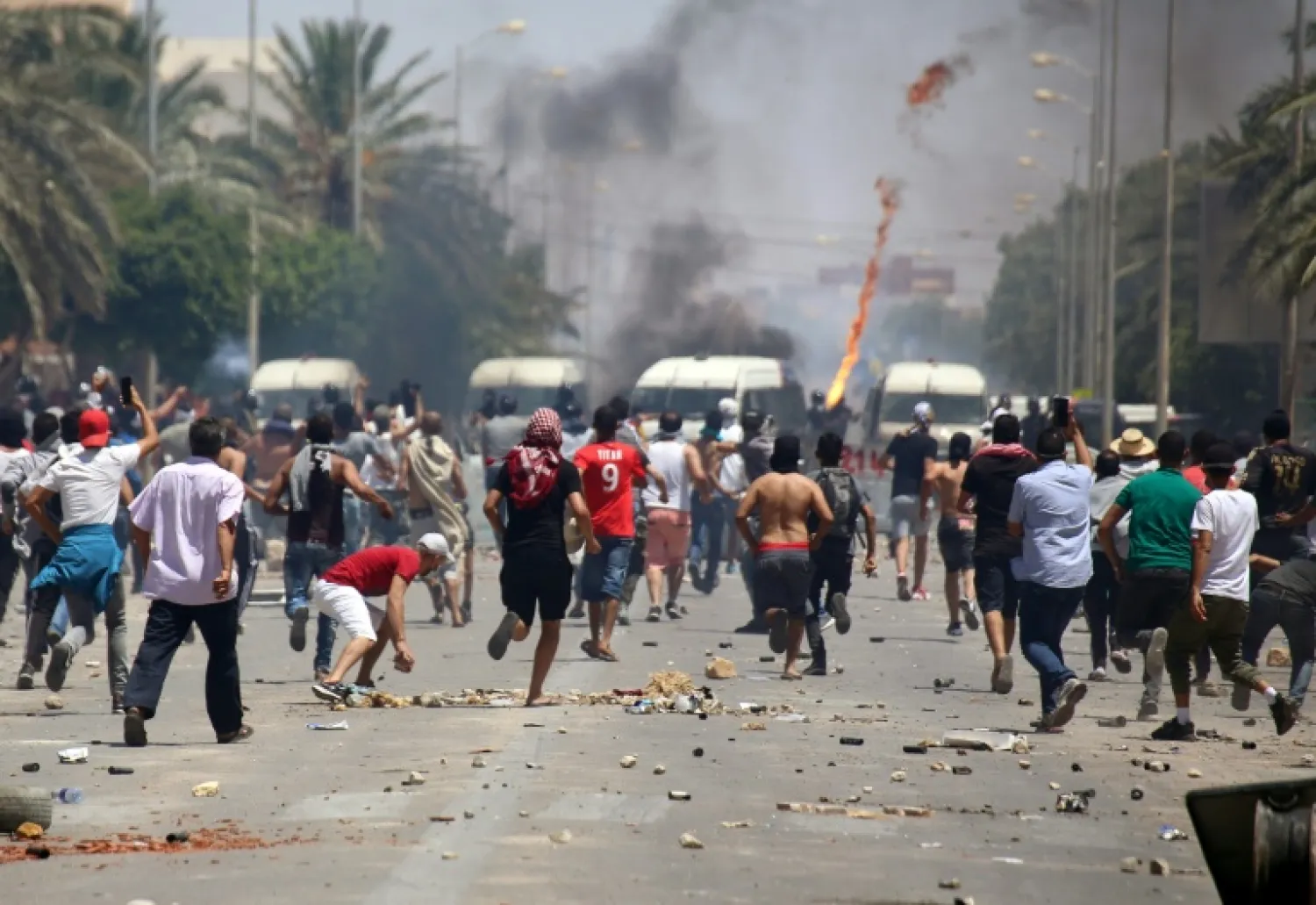

Renewed Clashes in Tunisia's Deprived South

Tunisian protesters clash with security forces as they demonstrate in the southern city of Tataouine demanding authorities make good on a 2017 promise to provide jobs in the gas and oil sector | AFP
TT

Renewed Clashes in Tunisia's Deprived South

Tunisian protesters clash with security forces as they demonstrate in the southern city of Tataouine demanding authorities make good on a 2017 promise to provide jobs in the gas and oil sector | AFP

Protesters demanding jobs and the release of an activist in Tunisia's marginalized south clashed Monday with security forces for a second straight day.

Police fired tear gas to disperse hundreds of protesters in the center of Tataouine city, an AFP correspondent said.

Defense ministry spokesman Mohamed Zekr said the army was deployed outside state establishments.

Demonstrators at a protest camp in the region have been demanding authorities make good on a 2017 promise to provide jobs in the gas and oil sector to thousands of unemployed.

For weeks they have blocked roads around the remote El-Kamour pumping station to prevent tanker trucks from entering the facility, but the protest had been largely peaceful.

On Sunday, protesters in Tataouine city burned tires and pelted security forces with stones to demand jobs and the release of activist Tarek Haddad, who was arrested the previous day, as security forces responded with tear gas.

Haddad is a key figure in the protest movement.

The governor of Tataouine, Adel Werghi, said Haddad was "wanted" by the authorities, without providing further details.

The interior ministry said 10 people were arrested Sunday after a group of protesters tried to attack police stations with Molotov cocktails.

Denouncing an "excessive and unjustified" use of force against protesters, the powerful Tunisian trade union confederation UGTT had called for a general strike in Tataouine.

Shops were open on Monday but public services and state institutions remained closed in adherence to the strike, AFP correspondents said.

In 2017, protesters blockaded Tataouine's El-Kamour pumping station for three months demanding jobs.

The sit-in ended after the employment minister signed a deal with representatives of the protesters, brokered by the UGTT, pledging to invest 80 million Tunisian dinars a year (almost $28 million) in Tataouine.

The UGTT branch in Tataouine said the promise was never kept.

The protests come as Tunisia, until now largely spared the worst of the novel coronavirus, faces tensions within its coalition government and the impact of restrictions imposed to combat the spread of the pandemic that have deepened inequalities.



UN: Sudan Drone Strikes Killed at Least 880 Civilians between January and April

Sudanese Army elements celebrate after seizing control of an area in northern Khartoum Bahri on January 25, 2025 (Reuters)
TT

UN: Sudan Drone Strikes Killed at Least 880 Civilians between January and April

Sudanese Army elements celebrate after seizing control of an area in northern Khartoum Bahri on January 25, 2025 (Reuters)

At least 880 civilians were killed in drone strikes in Sudan between January and April this year, the UN said Monday, warning such strikes were pushing the conflict towards a "new, even deadlier phase".

Drone attacks by both Sudan's army and paramilitary group Rapid Support Forces (RSF), which have been at war since April 2023, have intensified across the country in recent months, reported AFP.

The United Nations rights office said that its Sudan team had determined that "drone strikes accounted for at least 880 civilian deaths -- more than 80 percent of all conflict-related civilian deaths -- between January and April this year".

"Armed drones have now become by far and away the leading cause of civilian deaths," UN rights chief Volker Turk said in the statement.

A growing use of drones allows fighting to continue "unabated" in the rainy season, which in the past has seen a lull, he said.

"An intensification of hostilities in the coming weeks... risks hostilities expanding even further to central and eastern states, with lethal consequences for civilians across enormous areas," he said.

More than three years of civil war in Sudan have already killed tens of thousands, displaced over 11 million and thrust several areas into famine.

But now, Turk warned that "unless action is taken without delay, this conflict is on the cusp of entering yet another new, even deadlier phase".

Most of the civilian deaths attributed to drone strikes in the first three months of the year were recorded in the Kordofan region and Darfur.

Those strikes have continued, with most recently on May 8 drones striking Al Quoz in South Kordofan and near El-Obeid in North Kordofan, reportedly killing 26 civilians and injuring others, the rights office said.

It said belligerents had used drones to repeatedly strike civilian objects and infrastructure, "diminishing access to sufficient food, clean water and health care".

Markets have been repeatedly targeted, with at least 28 such attacks resulting in civilian casualties in the first four months of the year.

Health facilities have been hit at least 12 times, it added.

Now, the rights office said, drone strikes by the RSF and the Sudanese army were increasingly spreading beyond Kordofan and Darfur, to Blue Nile, White Nile and Khartoum.

Turk warned that heightened violence would disrupt provision of critical humanitarian assistance. 

"Much of the country, including Kordofan, is now facing an increased risk of famine and acute food insecurity," he said, adding that the situation was being exacerbated by fertilizer shortages linked to the Middle East war. 


Israel Says Soldier Killed Near Border with Lebanon

This photograph taken from the southern Lebanese area of Tyre shows smoke rising from the site of Israeli bombardment that targeted the village of Tair Harfa on May 11, 2026. (AFP)
TT

Israel Says Soldier Killed Near Border with Lebanon

This photograph taken from the southern Lebanese area of Tyre shows smoke rising from the site of Israeli bombardment that targeted the village of Tair Harfa on May 11, 2026. (AFP)

Israel's military said Monday that one of its soldiers had died in fighting near the border with Lebanon, bringing its losses to 18 personnel since the war with Hezbollah began in early March.

Sergeant Major Alexander Glovanyov, 47, "fell during combat near the Israel-Lebanon border", the military said.

He was killed on Sunday.

Since the war began, one Israeli civilian contractor has also been killed in addition to the 18 soldiers.

Israel and Iran-backed armed group Hezbollah have been trading fire in south Lebanon despite a ceasefire in place since April 17 between Israel and Lebanon that aimed to halt the fighting.

Hezbollah drew Lebanon into the Middle East conflict on March 2 when it launched rockets at Israel to avenge the killing of Iran's supreme leader in US-Israeli strikes.

Israel responded with airstrikes and a ground invasion. Its troops are operating behind an Israeli-declared "yellow line" that runs around 10 kilometers (six miles) north of Lebanon's border.


Sudden ‘Veto’ from Iran Thwarts Govt Formation Efforts in Iraq

From right to left: Prime Minister-designate Ali al-Zaidi, Coordination Framework member Hadi al-Amiri, and caretaker Prime Minister Mohammed Shia al-Sudani. (Coordination Framework)
TT

Sudden ‘Veto’ from Iran Thwarts Govt Formation Efforts in Iraq

From right to left: Prime Minister-designate Ali al-Zaidi, Coordination Framework member Hadi al-Amiri, and caretaker Prime Minister Mohammed Shia al-Sudani. (Coordination Framework)

Two Iraqi officials revealed on Sunday that a sudden “veto” from Iran has thwarted efforts to form a new Iraqi government. Iran has expressed its objection to keeping pro-Tehran armed factions out of the new government.

Tehran has demanded that the ruling Shiite Coordination Framework refrain from voting in favor of a cabinet lineup that “harms the influence of its allies” in the Iraqi state, the officials told Asharq Al-Awsat.

Amid these developments, reports said that Esmail Qaani, commander of Iran’s Quds Force, the foreign arm of the Iranian Revolutionary Guards Corps (IRGC), made a surprise visit to Baghdad as Prime Minister-designate Ali al-Zaidi had reportedly been making progress in the government formation process.

Significant throughout these developments is the United States’ pressure on al-Zaidi to keep the armed factions out of the new government, reflecting mounting tensions with Tehran that are playing out on a larger scale in the region over Hormuz and the war on Iran.

Sources said Qaani had arrived in Baghdad in recent hours with a message that “Tehran objects” to Iraq’s “complete subservience to Washington.”

An official compared to Asharq Al-Awsat the tensions in Iraq over the government to the tensions between Washington and Tehran over Hormuz.

‘Purely American government’

The two officials said Iran wants to prevent Iraq from forming a “purely American government,” amid US pressure on Baghdad to curb the activity of the pro-Iran armed factions.

Al-Zaidi was named PM-designate on April 27, receiving unprecedented American backing from President Donald Trump himself, who described his appointment as a victory for the Washington administration.

A PM-designate has no more than 30 days to present a cabinet lineup to parliament for a vote of confidence. Time is of the essence with several MPs travelling to Saudi Arabia for the Hajj, meaning the necessary quorum for the parliament session to be held may not be met.

American officials are expected to arrive in Baghdad within days. Sources said Washington not only wants the armed factions out of the government, but it wants to ensure that they will not seek “alternate arrangements” that would get them in the cabinet. This prompted Iran to resort to its “veto” and throttle the government negotiations.

The disagreements over the government in Iraq largely reflect the negotiations between the US and Iran in the region that have been ongoing for weeks without reaching a final settlement.

One of the Iraqi officials quoted a prominent member of the Framework as describing as “unprecedented” the US involvement in the formation of the government. He warned that the differences could turn into an “open conflict” between Washington and Tehran, concerns that were heightened with Qaani’s arrival in Baghdad ahead of American officials who are expected there soon too.

Should Iran resort to informing the Framework MPs to refrain from voting for al-Zaidi's cabinet, Washington may in turn increase pressure on Baghdad, such as imposing sanctions and cutting off support, to get its way, a senior advisor in an influential Shiite party told Asharq Al-Awsat.

The ongoing dispute between Washington and Tehran may lead to al-Zaidi quitting as PM-designate, he warned.

The Iraqi officials, who are involved in the government formation efforts, revealed that al-Zaidi had received messages from several parties, including the US, over the need to from a cabinet that “does not have Iranian influence.”

Negotiators have said that Washington “is now interfering in the tiniest detail” in the formation process and it has “accurate information about how the factions operate to try to outmaneuver” American conditions.

The conditions are not only limited to the government, but also include restricting the factions’ economic and political connections with Tehran, especially issues related to water resources, oil, and independence of political decision-making, revealed political sources.

Al-Zaidi has tried to keep sovereign portfolios out of the hands of the armed factions and granting them “lesser” ministries. The move has angered Iran, which was hoping that it would retain influence over powerful ministries.

An informed source said noted the Asa’ib Ahl al-Haq movement, which boasts 27 MPs in parliament and has been demanding that its political weight be reflected in cabinet. It has been demanding that it be granted the Oil Ministry, putting it at great odds with Washington.