


Tunisian Inflation Drops to Below 6 Percent

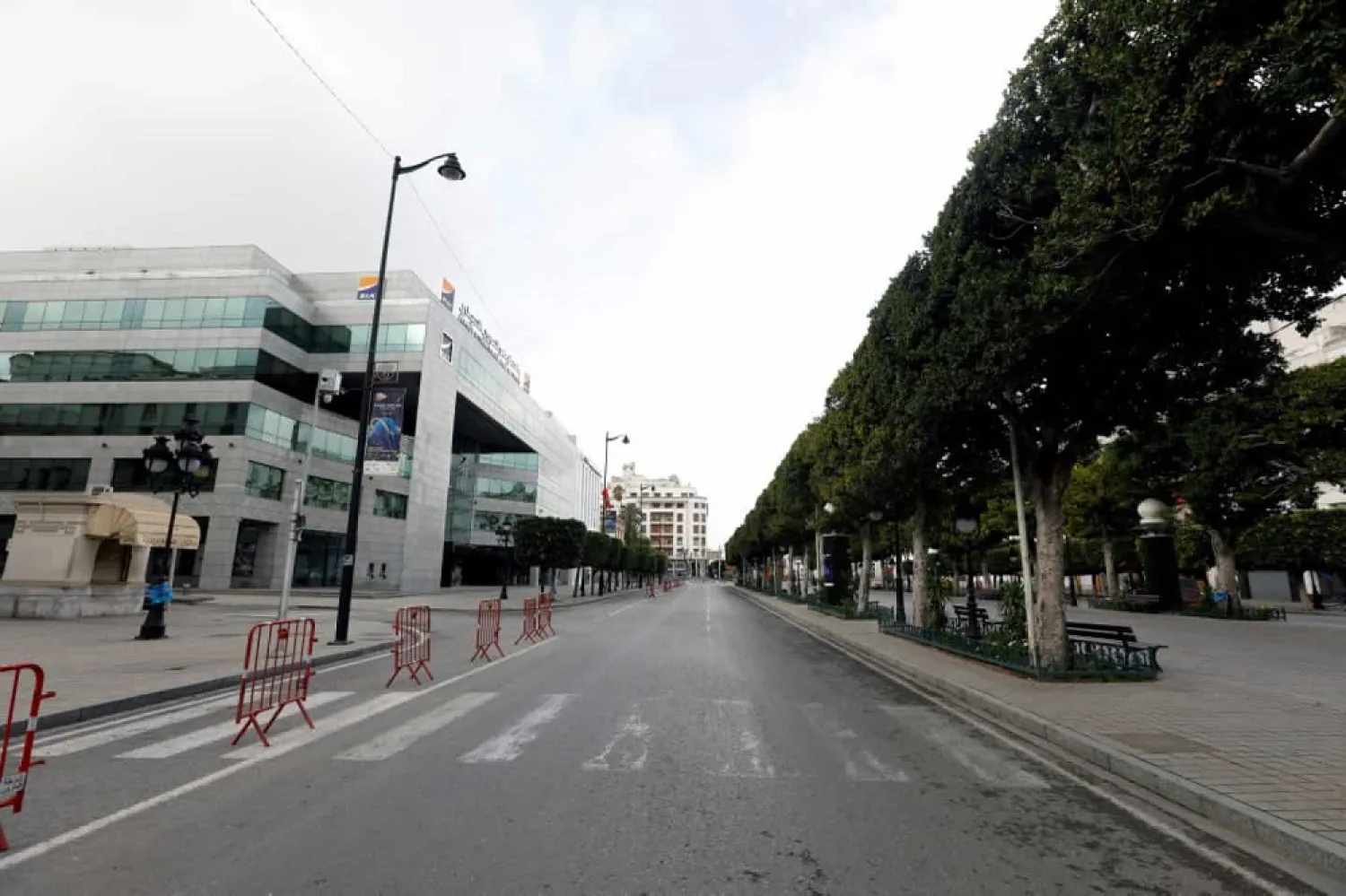
A general view of Habib Bourguiba Avenue in downtown Tunis, virtually deserted on the first day of a general lockdown to stop the spread of COVID-19, March 22, 2020. (Reuters)
TT

Tunisian Inflation Drops to Below 6 Percent

A general view of Habib Bourguiba Avenue in downtown Tunis, virtually deserted on the first day of a general lockdown to stop the spread of COVID-19, March 22, 2020. (Reuters)

Tunisia’s annual inflation rate in June slowed to less than 6 percent from 6.3 percent in May, official data showed on Monday.

The slowdown is due to a drop in prices of food (4.3 compared to 4.7 percent in May), transport products and services (1.6 compared to 3.3 percent), clothing and footwear prices (6.7 compared to 7.6 percent), said the National Statistics Institute (INS).

Several economists saw this as a circumstantial decline linked to the abundance of vegetables, crops and most food items during this period. They predicted that the situation will only be temporary.

Tunisian economists Jannat bin Abdullah and Ezzedine Saidane said that the slowdown of inflation is linked to the drop in local demand for various products because of the weakening of the Tunisians’ purchasing power.

Separately, the government launched an economic rescue plan for 2021. It includes a program to restructure and rescue five strategic public institutions including: Tunisian Chemical Group, Gafsa Phosphate Company, Tunisair, Tunisian Company of Electricity and Gas and National Company of Water Exploitation and Distribution.

The plan aims to boost the economy through public investment.

The government – which succeeded in containing the COVID-19 pandemic – announced that the program is committed to supporting major institutions through providing additional funding to combat unemployment (a total of TND100 million or USD34 million).

Tunisia will also continue to establish government funds aimed at restructuring institutions through allocating TND700 million to guarantee the continuity of their operations.



Egypt to Launch First Nationwide Aerial Survey of Mineral Wealth in 40 Years

Sisi during his meeting with the prime minister and the minister of petroleum on Saturday. (Egyptian Presidency)
TT

Egypt to Launch First Nationwide Aerial Survey of Mineral Wealth in 40 Years

Sisi during his meeting with the prime minister and the minister of petroleum on Saturday. (Egyptian Presidency)

Egypt is preparing to launch its first comprehensive nationwide aerial survey of mineral resources in four decades, scheduled for the first quarter of this year, the government announced on Saturday.

Minister of Petroleum and Mineral Resources Karim Badawi said the survey aims to update geological data and establish a modern, integrated database to attract Arab and international investment in the mining sector.

Egypt has a diverse and extensive mineral base, both in terms of type and geographic distribution. Its resources include solid minerals such as coal found above phosphate formations in the Red Sea and New Valley governorates; radioactive materials such as uranium in the Eastern Desert and Sinai; metallic ores including iron; non-metallic minerals; and precious metals such as gold, silver, and platinum.

The country possesses large quantities of raw materials used in chemical industries and fertilizers, as well as construction materials including granite, marble, white sand, and limestone.

Many of these resources are available in significant volumes and are already being exploited for domestic production and export, according to official investment data.

Saturday’s announcement was made during a meeting chaired by President Abdel Fattah al-Sisi and attended by Prime Minister Mostafa Madbouly, which reviewed recent developments in Egypt’s mining sector, the size of its geological reserves, and investment trends.

Presidential spokesperson Mohamed El-Shennawy said the meeting reviewed Badawi’s participation in the fifth International Mining Conference that was held in Riyadh from January 13-15.

During the conference, Egypt presented a package of legislative and regulatory reforms designed to improve the investment climate, including the adoption of globally competitive models for exploiting gold and other minerals, new incentives for international exploration companies, and simplified licensing procedures.

The meeting also addressed coordination between the ministries of petroleum, mineral resources, electricity, and renewable energy to secure Egypt’s natural gas needs, particularly during the summer.

Sisi stressed the importance of continuing to meet financial obligations to oil and gas companies operating in Egypt, saying this is essential to boosting domestic production.

He called for intensifying exploration activities, expanding incentives for investors in the oil, gas, and mining sectors, and accelerating field development in order to meet growing consumption and development needs and reinforce the country’s ambition to become a regional energy and gas trading hub.


EU and Mercosur Sign Trade Deal after 25 Years of Negotiations

Panama's President Jose Raul Mulino, from left, Bolivian President Rodrigo Paz, European Council President Antonio Costa, European Commission President Ursula von der Leyen, Paraguay's President Santiago Pena, Argentina's President Javier Milei, Uruguay's President Yamandu Orsi and Brazilian Minister of Foreign Affairs Mauro Vieira, pose for a group photo during a meeting to sign a free trade deal between the European Union and Mercosur in Asuncion, Paraguay, Saturday, Jan. 17, 2026. (AP Photo/Jorge Saenz)
TT

EU and Mercosur Sign Trade Deal after 25 Years of Negotiations

Panama's President Jose Raul Mulino, from left, Bolivian President Rodrigo Paz, European Council President Antonio Costa, European Commission President Ursula von der Leyen, Paraguay's President Santiago Pena, Argentina's President Javier Milei, Uruguay's President Yamandu Orsi and Brazilian Minister of Foreign Affairs Mauro Vieira, pose for a group photo during a meeting to sign a free trade deal between the European Union and Mercosur in Asuncion, Paraguay, Saturday, Jan. 17, 2026. (AP Photo/Jorge Saenz)

Top officials from the EU and the South American bloc Mercosur signed a free trade agreement on Saturday in Paraguay, ⁠paving the way for the European Union's largest ever trade accord after 25 years of negotiations.

The agreement, ⁠which has been highly contested in Europe, must now gain the consent of the European Parliament. It also must be ratified by legislatures of Mercosur members ⁠Argentina, Brazil, Paraguay and Uruguay, which is expected to be a smoother process.

The signing ceremony in Paraguay’s humid capital of Asunción marks a major geopolitical victory for the EU in an age of American tariffs and surging Chinese exports, expanding the bloc’s foothold in a resource-rich region increasingly contested by Washington and Beijing.

It also sends a message that South America cultivates diverse trade and diplomatic relations even as US President Donald Trump declares dominance in the Western Hemisphere.

European Commission President Ursula von der Leyen and European Council President Antonio Costa joined the presidents of Mercosur countries at Saturday's ceremony, with the exception of Brazilian President Luiz Inacio Lula da Silva, who sent his foreign minister.

The ⁠deal was signed after receiving the green light from most European nations last week, despite concerns from farmer and environmental groups, who fear a surge of inexpensive South American imports and increased deforestation.

Von der Leyen, who met with Lula before heading to Asuncion for the signing, said the deal would create the largest free trade zone in the world.

"This agreement sends a very strong message to the world. ⁠It reflects a clear and deliberate choice. We choose fair trade over tariffs. We choose a productive, long-term partnership over isolation," she said on Saturday.

Trade between the two blocs, which encompasses a market of 700 million people, reached a value of 111 billion euros in 2024. European Union exports mainly consist of machinery, chemical products, and transport equipment, whereas Mercosur's exports are concentrated in agricultural goods, minerals, wood pulp, and paper.


Trump: 8 EU Countries will be Charged 10% Tariff for Opposing US Control of Greenland

A military vessel HDMS Knud Rasmussen of the Royal Danish Navy docked in Nuuk, Greenland, on Saturday, Jan. 17, 2026. (AP Photo/Evgeniy Maloletka)
TT

Trump: 8 EU Countries will be Charged 10% Tariff for Opposing US Control of Greenland

A military vessel HDMS Knud Rasmussen of the Royal Danish Navy docked in Nuuk, Greenland, on Saturday, Jan. 17, 2026. (AP Photo/Evgeniy Maloletka)

President Donald Trump said Saturday that he would charge a 10% import tax starting in February on goods from eight European nations because of opposition to US control of Greenland.

He said in a social media post that Denmark, Norway, Sweden, France, Germany, the United Kingdom, the Netherlands, and Finland would face the tariff, which would be raised to 25% on June 1 if a deal is not in place for “the Complete and Total purchase of Greenland” by the United States.

Earlier Saturday, hundreds of people in Greenland's capital braved near-freezing temperatures, rain and icy streets to march in a rally in support of their own self-governance in the face of threats of an American takeover.

The Greenlanders waved their red-and-white national flags and listened to traditional songs as they walked through Nuuk's small downtown. Some carried signs with messages like “We shape our future,” “Greenland is not for sale” and “Greenland is already GREAT.” They were joined by thousands of others in rallies across the Danish kingdom.

Meanwhile, Danish Maj. Gen. Søren Andersen, leader of the Joint Arctic Command, told The Associated Press that Denmark doesn't expect the US military to attack Greenland, or any other NATO ally, and that European troops were recently deployed to Nuuk for Arctic defense training.

“I will not go into the political part, but I will say that I would never expect a NATO country to attack another NATO country,” he told the AP on Saturday aboard a Danish military vessel docked in Nuuk. “For us, for me, it’s not about signaling. It is actually about training military units, working together with allies.”

Trump has insisted for months that the US should control Greenland, a semiautonomous territory of NATO ally Denmark, and said earlier this week that anything less than the Arctic island being in US hands would be “unacceptable.”

During an unrelated event at the White House about rural health care, he recounted Friday how he had threatened European allies with tariffs on pharmaceuticals.

“I may do that for Greenland, too,” Trump said, before his announcement Saturday about his targeted tariffs. “I may put a tariff on countries if they don’t go along with Greenland, because we need Greenland for national security. So I may do that."

He had not previously mentioned using tariffs to try to force the issue.