Iraqi Grocer’s Eviction Sparks Gentrification Fight in London

Nour Cash & Carry in the Brixton neighborhood of London has the crammed charm of a classic New York bodega, but with a standout food selection that has made it popular with local restaurant chefs.Credit...Andrew Testa for The New York Times
TT

Iraqi Grocer’s Eviction Sparks Gentrification Fight in London

Nour Cash & Carry in the Brixton neighborhood of London has the crammed charm of a classic New York bodega, but with a standout food selection that has made it popular with local restaurant chefs.Credit...Andrew Testa for The New York Times

Saja Shaheen is walking the aisles of Nour Cash & Carry, explaining the eclectic inventory of the popular grocery store her family has owned inside Brixton Market for more than 20 years. As new immigrant communities arrive in the diverse area of south London, she said, foods are added to match their tastes.

Bags of rice are piled six feet high near the entrance, next to 15-liter jugs of various cooking oils. Spiced plantain chips and eight varieties of jerk sauce are imported from the Caribbean. There are bags of egusi, ground prawns and dried crayfish used for African dishes. Date syrups, tahini and okra cater to Middle Eastern customers.

Nour has the crammed charm of a classic New York bodega, but with a standout food selection that has made it popular with local restaurant chefs. (“It’s Whole Foods without the eye-watering prices, for real people,” said a local blog.) The store is not designed for comfort — or social distancing. Elbowing someone aside to reach a bag of beans or cornmeal is acceptable. There are no discernible checkout lines. The staff is savvy at defusing arguments.

“Some people say they come here for the fight,” said Ms. Shaheen, walking through a spice aisle that stretches toward the ceiling, filled with curry powders, cardamom, nutmeg, paprika and peppercorns (green, red, black, white and pink). “It’s an authentic shop. It doesn’t look fancy. It’s been built organically.”

Nour’s beloved status in Brixton, a vibrant, occasionally chaotic, multicultural hub, made it a shock in January when the Shaheen family received an eviction notice. New landlords, Hondo Enterprises, run by a 39-year-old multimillionaire from Texas who moonlights as a house-music D.J., said the tenants needed to move out by July 22. A new power substation was being built on the premises to provide electricity for other shops in the increasingly upmarket shopping area where Nour is.

When the Shaheen family refused to strike a deal, a gentrification fight began. A group of customers organized to save the store, saying Nour’s fate was a referendum about broader changes in Brixton. And like many such battles — whether in San Francisco, New York or Paris — those being displaced in Brixton are disproportionately lower income and from minority communities, raising issues of race in a country that has long struggled to address the topic head on.

“The shop became emblematic of something more,” said Hiba Ahmad, who helped organize the campaign, called Save Nour. “Everyone has seen this story over and over.”

The Shaheen family is originally from Iraq but was forced out in 1980 by Saddam Hussein’s regime. The family stayed in Iran for a decade before eventually going to London in 1990.

“We thought Europe was heaven,” said Salam Shaheen, Saja’s father, who drives every evening to a London wholesale market to hand-select produce for the store.

The family settled near Brixton, an area with a reputation for welcoming immigrant families. Starting in the 1940s, Brixton was the center of the Windrush Generation, the people who moved from Jamaica and other colonies to help rebuild the country after World War II.

Many welcomed development of Brixton when investors began putting money into the area. The community had long been neglected and developed a rough reputation, particularly after riots in 1981 that were in part a result of racial tensions and aggressive police tactics.

Two glass-covered pedestrian arcades in the center of Brixton, dating from the 1920s and 1930s, became run down and were nearly turned into apartments in 2008. Now a registered heritage site, Brixton Market, including the arcades, is a shopping and nightlife destination, with independent shops, restaurants and bars opening next to older merchants like Nour, fishmongers and butchers.

But locals have watched warily as the change accelerated, fueled by Brixton’s once relatively affordable cost of living, public transportation links, boisterous nightlife, and enviable music, art and food scenes. A mural of David Bowie, who was born in Brixton, is a popular Instagram stop for tourists.

“All the local people, ethnic minorities, are being driven away,” said Folashade Akande, owner of Iya-Ibadan, a store that has sold African food and crafts in the market for more than 20 years. As new shops like the “plant-based cheesemonger” opened nearby, her rents have increased. “I’ll try to stay as long as I can,” she said.

In the Nour campaign, anti-gentrification activists found a seemingly perfect foil in Taylor McWilliams, Hondo’s chief executive. With financial backing from the American hedge fund Angelo Gordon, Mr. McWilliams bought the covered markets in 2018 for more than 37 million pounds, about $46 million today, along with a popular nightclub and another property he plans to convert into a 20-story office building, which would be Brixton’s tallest.

“He’s buying up Brixton,” said Anees Matooq, a Nour customer who is active in the Save Nour group.

Mr. Matooq said a prevailing view was that Mr. McWilliams, who dated an ex-girlfriend of Prince Harry and is a regular on the Ibiza club scene as a D.J. in the house-music group Housekeeping, wanted to make Brixton into an area where he and his friends want to hang out on weekends. For many, he represents what Brixton is not.

Mr. McWilliams said he wasn’t interested in changing Brixton. He wondered why he was cast as the villain, given that he had already spent more than £2 million, or $2.5 million, to fix plumbing problems, refurbish bathrooms and install a heating system that will keep the market busy during winter. He suspended rents for all tenants for three months after the pandemic broke out.

In April, while at home obeying Britain’s lockdown orders, the Save Nour campaigners infiltrated an online charity concert Mr. McWilliams was playing. The activists dressed up as clubgoers until Mr. McWilliams’s set began, when they revealed themselves and began heckling and criticizing him with signs in front of more than a thousand internet onlookers. Suddenly club music websites were writing about the effort to save Nour.

Many in Brixton said the campaigners had a false sense of nostalgia. Ian Riley, a Scotsman who owns a plant and homewares store, Cornercopia, remembers finding dead rats and human feces when he took over a unit in the market more than a decade ago.

Marsha Smith, a local D.J. who grew up going to Nour with her mother, said that while she was frustrated that new shops were tailored more to well-heeled customers, Brixton had gone through different waves of change.

“You’ve got the original yuppies who don’t like the new yuppies,” she said.

In June, facing a drop in sales as a result of the pandemic, the Shaheen family was preparing a court challenge to save Nour. Local celebrities like the chef Yotam Ottolenghi spoke out on the store’s behalf, and more than 55,000 people signed an online petition.

But on June 19, after a flurry of negotiations, a deal was reached. Nour would move to a new location in the market with a slightly lower rent.

“It feels like a big, giant hug,” Ms. Shaheen said at the store the next morning, as customers stopped in to congratulate the family. “It validated us, an immigrant family coming here to this country and not being British.”

The New York Times


Scottish Antiques Auction Selling Neck Shackles Accused of ‘Profiting from Slavery’

“I think it’s important not to upset and offend, but shock people into learning the whole truth,” the auctioneer, Marcus Salter, said. (Cheeky Auctions Tain)
TT

Scottish Antiques Auction Selling Neck Shackles Accused of ‘Profiting from Slavery’

“I think it’s important not to upset and offend, but shock people into learning the whole truth,” the auctioneer, Marcus Salter, said. (Cheeky Auctions Tain)

An antiques auction selling chains linked to the enslavement of African people in Zanzibar has been accused of “profiting from slavery,” according to The Guardian.

The shackles, dated to 1780 and valued at about £1,000, are among objects listed in the auction, called “Challenging History.”

The auctioneer Marcus Salter, of Cheeky Auctions in Tain, Ross, said he wanted to ensure history was confronted with the sale of the “sensitive artifact” and did not wish to offend.

“I think it’s important not to upset and offend, but shock people into learning the whole truth,” Salter said. “There are certain things we’re not allowed to sell at auction. We had to check with the platform we’re selling with that we could do this. They consider the slave chains to be a historical artefact, therefore we can.

But Labour MP Bell Ribeiro-Addy, who chairs the all-party parliamentary group for Afrikan reparations, said trading in such items meant people were “continuing to profit from the slave trade.”

She said, “If they were to be put in a museum I would understand, but buying and selling them like oddities is the same thing that people do when it comes to human remains– treating them as collector’s items, something to be fetishized rather than items that should be looked at in horror.”

Salter said he was selling the chains for a dealer whose father had owned them for 50 years, adding: “No matter what happens there’s going to be money made out of it from somewhere.”

He claimed if the item was donated to a museum, it could be “put into storage and never seen again”, and that slavery-linked mahogany was sold and used without controversy.

In 2024, the Antiques Roadshow expert Ronnie Archer-Morgan refused to value an ivory bangle linked to enslavement.

Caecilia Dance, an associate at London law firm Wedlake Bell, has advised on the restitution of Nazi-looted art. Dance said she could not comment on the auction, but that there was “no specific law against” trading objects linked to slavery.

She added that “public interest stewardship” – donation, sale, or long-term loan to a museum with relationships with affected communities – would be the “ideal management pathway” for an item linked to slavery.


Crews Recover Bodies of 9 Backcountry Skiers Days after California Avalanche

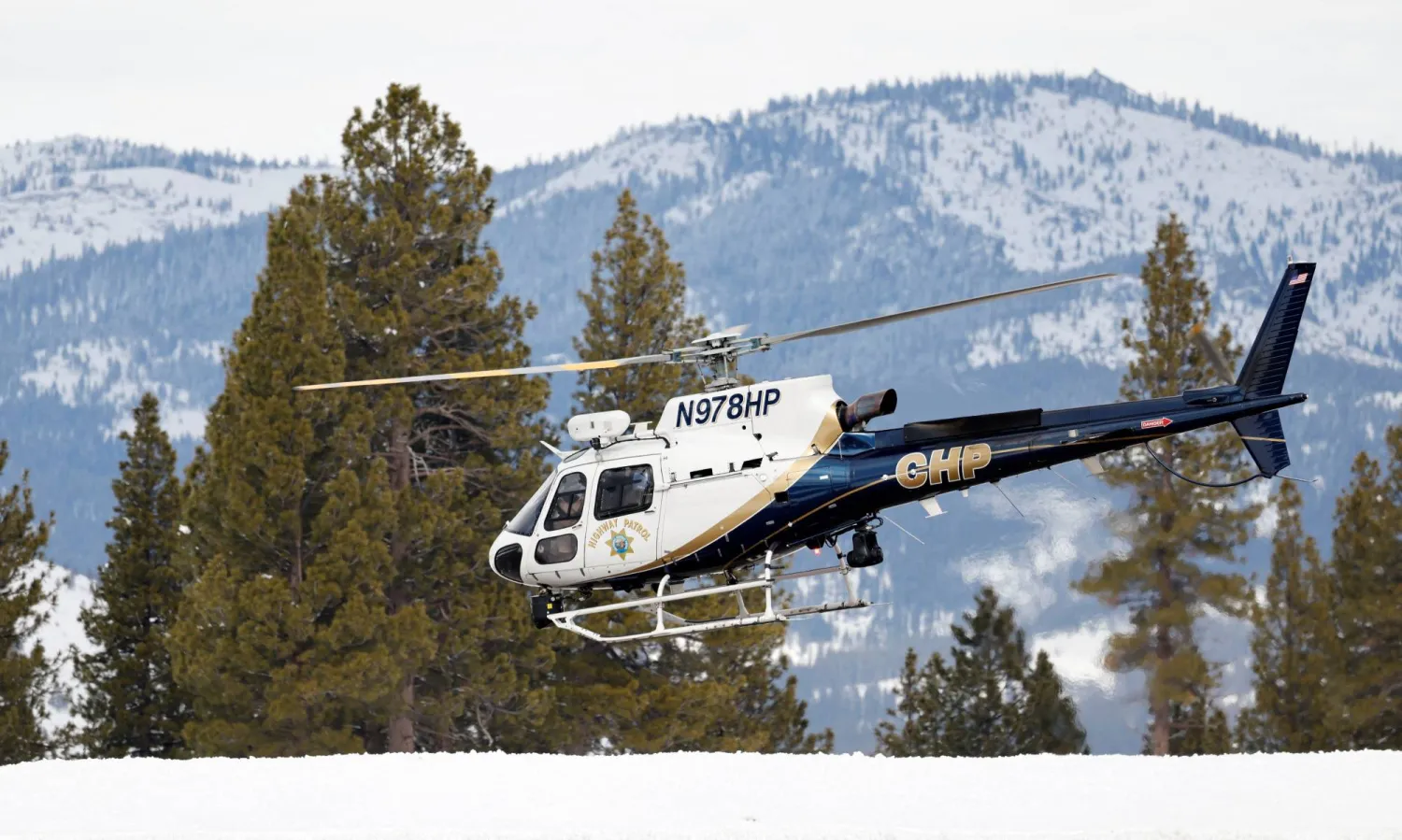
A California Highway Patrol helicopter lifts off from Truckee Tahoe Airport while taking part in recovery efforts for the skiers that died in an avalanche in the Sierra Nevada mountains, in Truckee, California, US February 21, 2026.  REUTERS/Fred Greaves
A California Highway Patrol helicopter lifts off from Truckee Tahoe Airport while taking part in recovery efforts for the skiers that died in an avalanche in the Sierra Nevada mountains, in Truckee, California, US February 21, 2026. REUTERS/Fred Greaves
TT

Crews Recover Bodies of 9 Backcountry Skiers Days after California Avalanche

A California Highway Patrol helicopter lifts off from Truckee Tahoe Airport while taking part in recovery efforts for the skiers that died in an avalanche in the Sierra Nevada mountains, in Truckee, California, US February 21, 2026.  REUTERS/Fred Greaves
A California Highway Patrol helicopter lifts off from Truckee Tahoe Airport while taking part in recovery efforts for the skiers that died in an avalanche in the Sierra Nevada mountains, in Truckee, California, US February 21, 2026. REUTERS/Fred Greaves

Crews recovered the bodies of nine backcountry skiers who were killed by an avalanche in California's Sierra Nevada, authorities said Saturday, concluding a harrowing operation that was hindered by intense snowfall.

A search team reached the bodies of eight victims and found one other who had been missing and presumed dead since Tuesday’s avalanche on Castle Peak near Lake Tahoe. The ninth person who was missing was found “relatively close” to the other victims, according to Nevada County Sheriff’s Lt. Dennis Hack, but was impossible to see due to whiteout conditions at that time.

At a news conference, Sheriff Shannon Moon praised the collective efforts of the numerous agencies that helped recover the bodies — from the California Highway Patrol to the National Guard to the Pacific Gas & Electric utility company — and 42 volunteers who helped on the last day of the operation.

“We are fortunate in this mountain community that we are very tight-knit, and our community shows up in times of tragedy,” The Associated Press quoted Moon as saying.

The sheriff named for the first time the three guides from Blackbird Mountain Company who died: Andrew Alissandratos, 34, Nicole Choo, 42, and Michael Henry, 30.

According to biographies on the company's website, Alissandratos was originally from Tampa, Florida, and moved to Tahoe roughly a decade ago. He enjoyed a wide array of adventure activities, from backcountry exploration to rock climbing.

Henry moved to Colorado in 2016 and then to Truckee three years later. He was described as “laid back” and devoted to sharing his knowledge and love of the mountains with others.

There was no bio for Choo on the website.

“This was an enormous tragedy, and the saddest event our team has ever experienced,” Blackbird Mountain founder Zeb Blais said Wednesday in a statement.

“We are doing what we can to support the families who lost so much,” he said, “and the members of our team who lost treasured friends and colleagues.”

The six other fatal victims were women who were part of a close-knit group of friends who were experienced backcountry skiers and knew how to navigate the Sierra Nevada wilderness, their families said this week.

They were identified as Carrie Atkin, Liz Clabaugh, Danielle Keatley, Kate Morse, Caroline Sekar and Kate Vitt, all in their 40s. They lived in the San Francisco Bay Area, Idaho and the Lake Tahoe area.

“We are devastated beyond words,” the families said in a statement. “Our focus right now is supporting our children through this incredible tragedy and honoring the lives of these extraordinary women. They were all mothers, wives and friends, all of whom connected through the love of the outdoors.”

The families asked for privacy while they grieve and added that they “have many unanswered questions.”

Two of the friends got out alive and were rescued along with four others, including one guide, after Tuesday’s avalanche. Their names have not been released.

The avalanche struck on the last day of the 15 skiers’ three-day tour, when the group decided to end the trip early to avoid the impending snowstorm.

Officials have said the path they took is a “normally traveled route” but declined to specify what that meant.

At around 11:30 a.m. Tuesday, the six survivors called for help, describing a sudden and terrifying slide that was approximately the length of a football field. In the aftermath they discovered the bodies of three fellow skiers, according to Hack.

Rescuers were not able to reach them until roughly six hours after the initial call for help, Hack said, and took two separate paths to arrive. They found five other bodies, leaving only one person unaccounted for.

But it was immediately clear to rescuers that it was too dangerous to extract the bodies at that time due to the heavy snowfall and threat of more avalanches.

Those conditions persisted on Wednesday and Thursday.

A breakthrough on Friday Authorities used two California Highway Patrol helicopters, with the help of Pacific Gas & Electric Company, to break up the snow and intentionally release unstable snowpack to reduce the avalanche risk.

Crews were then able to recover five victims that evening before it got too dark to access the last three.

Rescuers used helicopters and ropes to hoist the last four bodies from the mountain the following morning, fighting through severe winds that forced them to make multiple trips. The bodies were then taken to snowcats — trucks that are outfitted to drive on snow — for further transport.

“We cannot say enough how tremendously sorry we are for the families that have been affected by this avalanche,” Moon said.

Initial reports indicated that at least two of the surviving skiers were not swept away by the avalanche, Hack said. The others were standing separately and relatively close together and were hit.

Hack declined to offer information about what might have set off the avalanche.

Authorities close the area The terrain will be off-limits to visitors until mid-March, said Chris Feutrier, forest supervisor for the Tahoe National Forest. Officials intended to restore public access once the investigation is complete.

“This is the public’s land, and they love to recreate on it,” Feutrier said. “The Forest Service doesn’t close public land for every hazard or every obstacle. We trust the American people to use their best judgment when recreating.”


Riyadh Municipality Decorates Capital with Over 5,000 Lights for Founding Day

The capital's streets have transformed into vibrant displays of national pride, embodying 299 years of continuous development and progress - SPA
TT

Riyadh Municipality Decorates Capital with Over 5,000 Lights for Founding Day

The capital's streets have transformed into vibrant displays of national pride, embodying 299 years of continuous development and progress - SPA

The Riyadh Municipality has illuminated the capital's main streets, vital thoroughfares, and public squares with over 5,000 decorative lights in celebration of Saudi Founding Day.

The project involved installing 5,481 decorative lights across various locations to enhance the festive atmosphere throughout Riyadh's neighborhoods, giving the city a harmonious visual character that reflects profound pride in the nation's rich history, SPA reported.

As light and identity intertwine, the capital's streets have transformed into vibrant displays of national pride, embodying 299 years of continuous development and progress.

The transformation reflects the deep significance of Founding Day in the hearts of citizens and translates their loyalty to the leadership's blessed journey.