


Sacrifices of Saudi Volunteers Help Careful Return to Normal Life

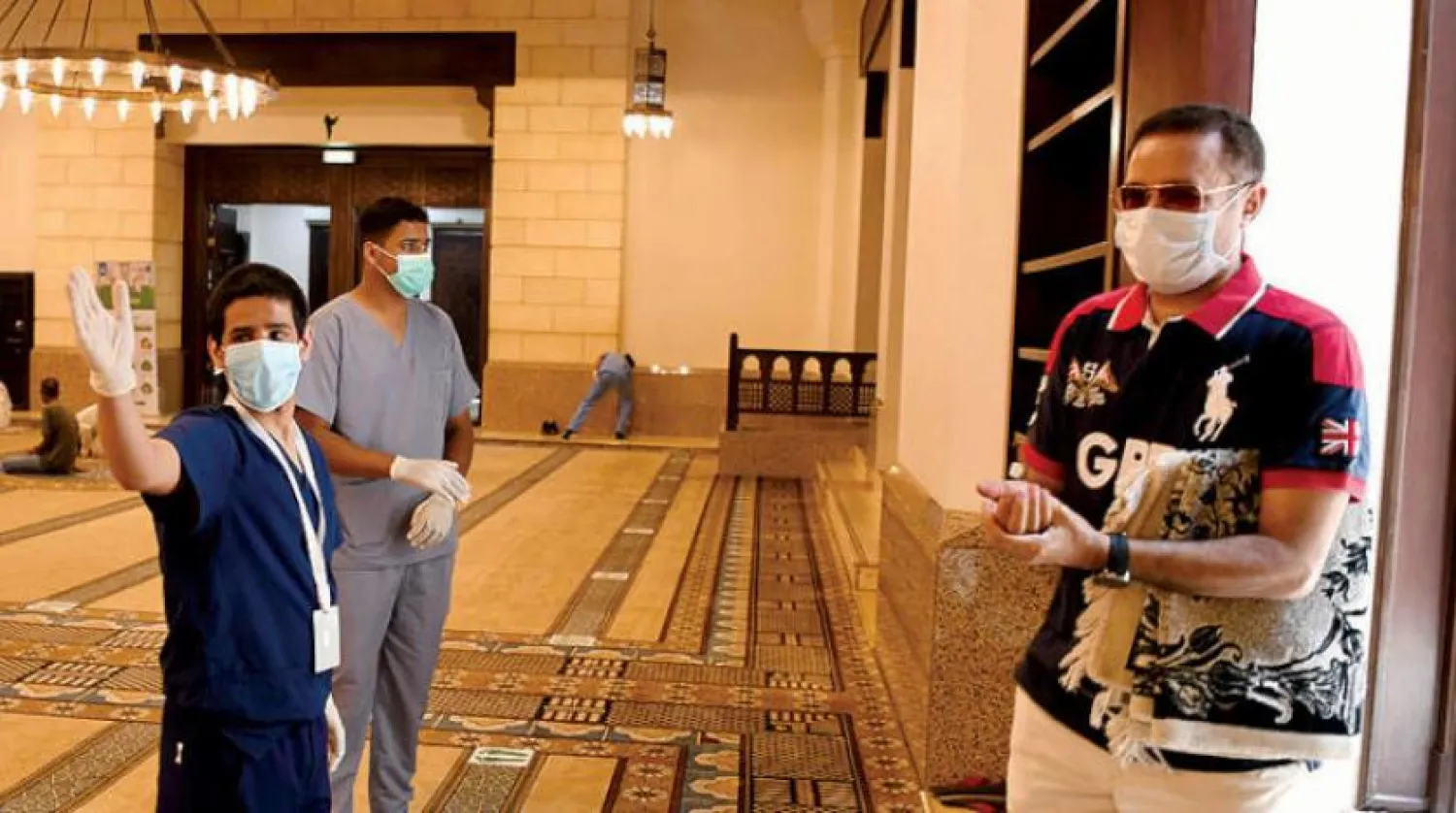
Volunteers enforce precautionary measures at a Saudi mosque. Photo by Bashir Salih
TT

Sacrifices of Saudi Volunteers Help Careful Return to Normal Life

Volunteers enforce precautionary measures at a Saudi mosque. Photo by Bashir Salih

Although the need for volunteering is not limited to health crises, with the spread of the novel coronavirus (COVID-19), the need for volunteers has become even more glaring in different countries to help contain the outbreak alongside government efforts.

During the last few years, the Saudi government has worked within the framework of the 2030 Vision to prepare an environment for volunteering. It has reaped the benefits of these efforts during the pandemic, with thousands of experts in different fields having wanted to provide their services to society.

This was confirmed by the figures published by the Health Volunteer Platform that received more than 72,000 persons ready to provide their services in the fight against the pandemic across the Kingdom.

Many activities that fall under the framework of the plan to return to life in Saudi Arabia relied on volunteers to raise awareness among people and ensure their safety, such as the return of Friday prayers in mosques where volunteers were organizing the entry and exit of individuals and were ensuring that proper health guidelines were being followed.

The number of volunteers in Saudi Arabia did not exceed 11,000 five years ago, whereas now, through the Health Volunteer Platform, there are more than 72,000 volunteers, in addition to 90,000 individuals who have expressed a desire to volunteer but did not move beyond the preparatory program.

Osama al-Shbeili, an expert in youth and voluntary programs, says that while still in its beginnings, government organization through the Health Volunteer Platform and health volunteering has created an enabling environment for volunteering.

However, Shbeili sees that voluntary work in interested institutions needs to adopt a law for volunteers so that they are not taken advantage of to provide services to certain entities for free and to unite voluntary efforts between institutions and linking them to society’s needs.

On the importance of volunteering and preparing and training volunteers, Shbeili told Asharq Al-Awsat, “Interest in volunteering largely contributes to activating the role of the youth to lead society, and enabling it allows for the creation of an appropriate environment for volunteering through organized and developed training per the ambitions and needs of our society, and providing awareness-raising initiatives that are of massive benefits.”




GCC Sec-Gen Condemns Iran's Continued Destabilizing Behavior, Repeated Attacks on Member States

Secretary-General of the Gulf Cooperation Council (GCC) Jasem Albudaiwi. SPA
TT

GCC Sec-Gen Condemns Iran's Continued Destabilizing Behavior, Repeated Attacks on Member States

Secretary-General of the Gulf Cooperation Council (GCC) Jasem Albudaiwi. SPA

Gulf Cooperation Council (GCC) Secretary-General Jasem Albudaiwi expressed his condemnation and denunciation in the strongest terms of Iran's continued destabilizing behavior regarding regional security and stability, its repeated brutal targeting of the United Arab Emirates (UAE), the Kingdom of Bahrain, the Sultanate of Oman, the State of Qatar, the State of Kuwait, and the Hashemite Kingdom of Jordan, as well as its dangerous attacks on commercial vessels.

Albudaiwi stated that Iran's behavior constitutes a grave violation of the principles of international law, the United Nations Charter, and UN Security Council Resolution 2817, as well as a direct undermining of maritime security and freedom of navigation, SPA reported.

He noted that these repeated, brutal Iranian attacks not only hinder all endeavors aimed at achieving security and stability in the region, but also reveal a systematic insistence on perpetuating chaos, in blatant defiance of international law and the international community's shared will to establish peace.

He underlined that the GCC supports all measures taken by the UAE, Bahrain, Oman, Qatar, Kuwait, and Jordan to bolster their security, safeguard their sovereignty, and protect their peoples and residents across their territories.


Saudi Leadership Offers Condolences to Emir of Qatar on Passing of Former Emir Sheikh Hamad bin Khalifa Al Thani

Joint photo of King Salman bin Abdulaziz Al-Saud and Saudi Crown Prince Mohammed bin Salman bin Abdulaziz Al-Saud - File Photo
TT

Saudi Leadership Offers Condolences to Emir of Qatar on Passing of Former Emir Sheikh Hamad bin Khalifa Al Thani

Joint photo of King Salman bin Abdulaziz Al-Saud and Saudi Crown Prince Mohammed bin Salman bin Abdulaziz Al-Saud - File Photo

Custodian of the Two Holy Mosques King Salman bin Abdulaziz Al Saud sent a cable of condolences to Emir of the State of Qatar Sheikh Tamim bin Hamad Al Thani on the passing of former Emir of Qatar Sheikh Hamad bin Khalifa Al Thani.

The Custodian of the Two Holy Mosques said in his cable that Sheikh Hamad bin Khalifa Al Thani dedicated much of his life to serving his country and people.

He extended his heartfelt condolences and sincere sympathies to Sheikh Tamim bin Hamad Al Thani, the late emir's family, and the people of Qatar, praying that the deceased be granted Allah's mercy and forgiveness and that his family be granted patience and solace.

For his part, Prince Mohammed bin Salman bin Abdulaziz Al Saud, Crown Prince and Prime Minister of Saudi Arabia, also sent a cable of condolences to Emir of the State of Qatar Sheikh Tamim bin Hamad Al Thani on this sad incident.

In his cable, the Crown Prince said that Sheikh Hamad bin Khalifa Al Thani had played a significant role in Qatar's development and prosperity.

He extended his heartfelt condolences to Sheikh Tamim bin Hamad Al Thani and the late emir's family, praying that Allah Almighty grant the deceased mercy and forgiveness and reward him for his service to his country and people.


Gulf States Condemn Repeated Iranian Attacks, Tehran's Destabilizing Behavior

Air defense interceptions are seen in the sky above Doha on July 12, 2026. AFP
TT

Gulf States Condemn Repeated Iranian Attacks, Tehran's Destabilizing Behavior

Air defense interceptions are seen in the sky above Doha on July 12, 2026. AFP

Gulf states condemned on Sunday repeated Iranian attacks targeting Qatar, Bahrain, Kuwait, Oman, the United Arab Emirates, and Jordan, saying such assaults represent a blatant violation of state sovereignty and a direct threat to regional security and stability.

The Saudi Ministry of Foreign Affairs expressed the Kingdom's condemnation and denunciation, in the strongest terms, of Iran's continued destabilizing behavior toward regional security and stability, its violations of the principles of international law, the UN Charter, the Charter of the Organization of Islamic Cooperation, and the principles of good neighborliness.

This includes Iran's repeated attacks on commercial vessels, threatening the security and freedom of navigation, and its continued heinous assaults on Kuwait, Bahrain, Qatar, the UAE, Oman, and Jordan.

The Kingdom reaffirmed its categorical rejection of Iran's violation of the sovereignty of brotherly states and its continued threats to regional security and stability.

The Omani government also lambasted on Sunday an attack on its territory, state media announced, with Iran's Guards saying they targeted it during a barrage aimed at countries across the Gulf.

The Oman News Agency said on X that "the Sultanate of Oman affirms its condemnation and denunciation of this attack,” which came just hours after the country hosted Iran's foreign minister to address security issues in the Strait of Hormuz.

Doha too condemned the Iranian attacks against its territory and its neighbors.

"Qatar condemns in the strongest possible terms the renewed attacks carried out by the Islamic Republic of Iran," the foreign ministry said in a statement, also referring to the targeting of Jordan, the UAE, Bahrain, Oman and Kuwait and calling the barrages a "dangerous escalation.”

In Kuwait, the Ministry of Foreign Affairs expressed the country's strongest condemnation and denunciation of the egregious Iranian attacks that targeted it. It affirmed that these repeated assaults reflect a persistent hostile approach, constituting a grave violation of Kuwait's sovereignty and territorial integrity, and a direct threat to its security, stability, and the safety of its citizens and residents.

Furthermore, they represent a clear breach of international law, the United Nations Charter, and Security Council Resolution 2817.

The ministry stressed in a statement that the continuation of attacks constitutes an extremely dangerous escalation, which will increase tension and instability in the region, threaten regional peace and security, and undermine diplomatic efforts aimed at de-escalation and peaceful resolution of crises.

The ministry reiterated that Kuwait's security, sovereignty, and territorial integrity are inviolable, and that Kuwait reserves its full rights to take necessary measures to protect its security and preserve its sovereignty, in accordance with the provisions of international law and the UN Charter.