


Paris Meeting Sets Three Priorities to Back Lebanese Army

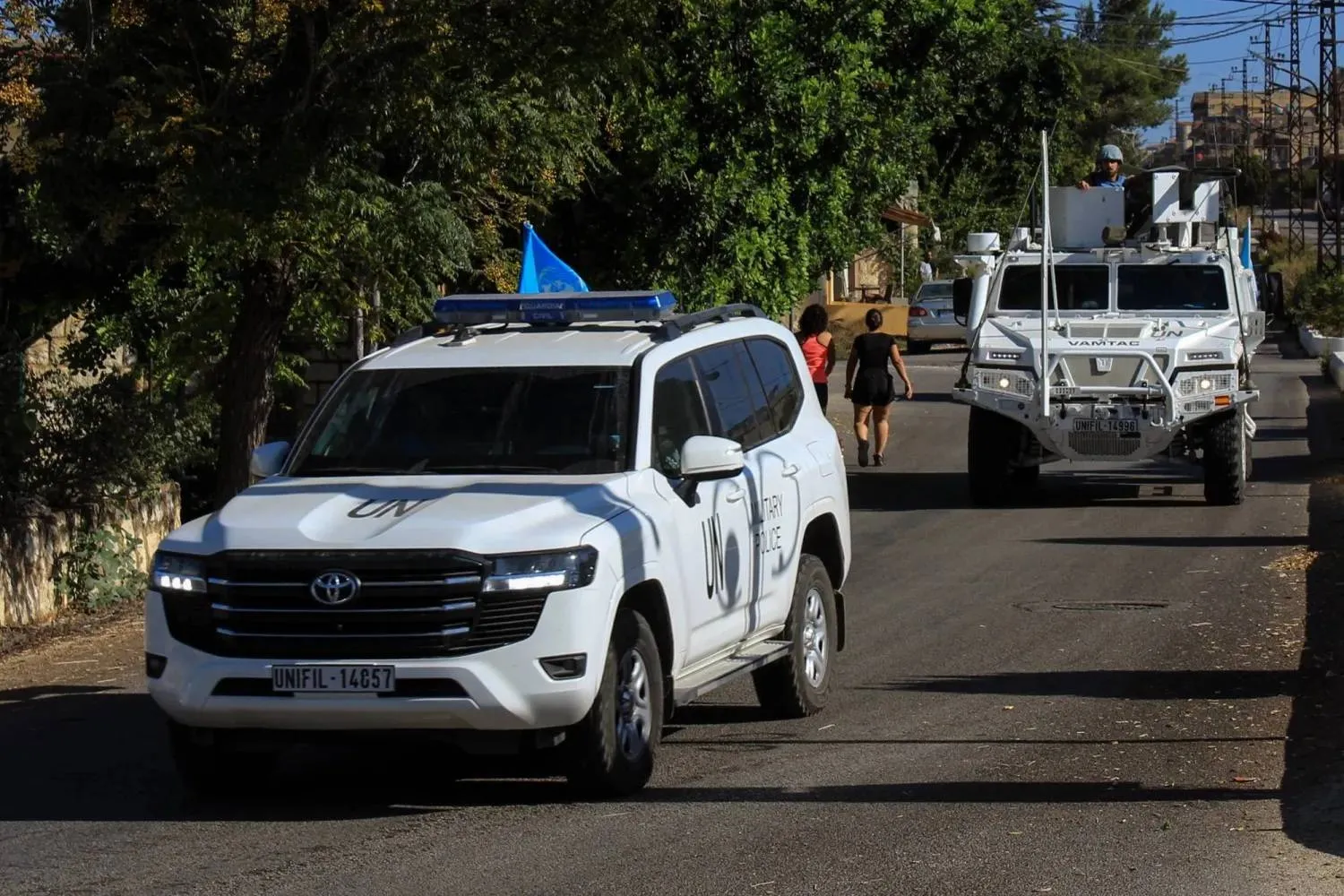
A convoy of the Spanish battalion of the United Nations Interim Force in Lebanon passes through Qlayaa in southern Lebanon on Oct. 12, 2024 (DPA)
TT

Paris Meeting Sets Three Priorities to Back Lebanese Army

A convoy of the Spanish battalion of the United Nations Interim Force in Lebanon passes through Qlayaa in southern Lebanon on Oct. 12, 2024 (DPA)

Paris will host a four party meeting on Thursday bringing together representatives of France, Saudi Arabia, the United States and Lebanon, amid fears that an Israeli escalation could upend a ceasefire agreement in place for more than a year.

French officials say Paris senses an imminent threat facing Lebanon in light of repeated and public Israeli threats to resume the war.

France is also concerned about uncertainty surrounding the US position on Israel’s intentions, with a prevailing French view that President Donald Trump’s administration is not inclined to restrain Israel.

Israel accuses the Lebanese army of failing to carry out commitments made by the government under the first phase of a plan to disarm Hezbollah in the area south of the Litani River.

Caught between Israeli pressure on one side and Hezbollah’s refusal to hand over its weapons on the other, Paris has been searching for a way out and for a clear, visible means of protecting Lebanon.

French officials want to demonstrate that the Lebanese army, contrary to prevailing claims, is doing what is required of it regarding Hezbollah’s weapons.

A new mechanism to track disarmament

Against this backdrop, France has put forward a proposal to establish a new “mechanism” to clearly document the actions taken by the Lebanese army, based on tangible and verifiable evidence.

Paris has also suggested that elements of the United Nations Interim Force in Lebanon, UNIFIL, accompany army units during inspection and seizure operations, document them and make the results public. The aim is to provide concrete proof of the army’s seriousness and of the outcomes achieved.

French Foreign Minister Jean-Noel Barrot summed up the proposal by saying France is “working on a second mechanism to monitor the disarmament of Hezbollah.”

A large scale tour organized by the army leadership in the south on Dec. 15, led by army commander General Rodolphe Haykal and attended by several ambassadors and military attachés, along with an earlier visit by representatives of UN Security Council member states and a separate tour for Lebanese and international media, were all part of efforts to show the government’s and the army’s commitment to implementing UN Security Council Resolution 1701 and to rebut claims of government foot dragging and military shortcomings.

In recent weeks, Paris has stepped up its engagement on the Lebanese file. Thursday’s meeting caps a diplomatic push that has included, in less than a month, two visits by Anne Claire Legendre, President Emmanuel Macron’s adviser for Middle East and Arab affairs, and Jean-Yves Le Drian, a former foreign minister and Macron’s personal envoy to Lebanon.

As part of this effort, Legendre has made regional visits, most notably to Saudi Arabia.

Macron himself has held a series of key calls focused on two tracks: a conference expected in the coming weeks to support the Lebanese army and security forces, and a separate conference on economic support and reconstruction.

No dates have yet been set for either event.

Importance of Haykal’s participation

Well informed sources in Paris say Thursday’s meeting will focus on three main priorities.

The first is reviewing the work of the “mechanism” tasked with monitoring the cessation of hostilities between Israel and Lebanon, and considering how to enhance it through the new mechanism outlined by Barrot.

Another development concerns the mechanism’s expanded membership, which now includes a Lebanese diplomat, former ambassador Simon Karam, and an Israeli representative, Yuri Resnik, director of foreign policy at Israel’s National Security Council.

Israel and Washington are pressing to broaden the scope of discussions to include economic and political issues, a move that has raised Lebanese concerns and drawn opposition from Hezbollah.

US envoy for Lebanon Morgan Ortagus and Le Drian, both attending the Paris meeting, are expected to travel to Lebanon afterward to take part in a meeting of the mechanism.

That adds to the importance of the five party committee, which has failed, more than a year after its creation, to halt near daily Israeli operations.

The US ambassador to Beirut, Michel Issa, will also attend Thursday’s meeting, his first such gathering since formally taking up his post.

Curbing Israeli escalation in Lebanon is the second priority of the meeting, which Haykal will attend alongside a series of engagements at the foreign ministry, defense ministry and presidential palace.

Haykal’s participation is seen as especially significant, as it will give him the opportunity to present a comprehensive account of the difficulties facing army units in carrying out their missions, foremost among them Israel’s refusal to withdraw from five additional positions it still holds on Lebanese territory.

The Lebanese army commander is also expected to outline the achievements of his forces over the past four months south of the Litani River, as well as his plan for other parts of Lebanon, aimed at restricting weapons to the hands of the Lebanese state.

Attention will also focus on Ortagus’s presentation on US plans for Lebanon, including efforts to push Lebanon toward negotiations with Israel on political and economic issues, as well as the timelines Washington is setting for Lebanon to complete the process of placing weapons exclusively under state control.

The long awaited army support conference

The central theme of Thursday’s Paris meeting, however, is expected to be support for the Lebanese army and security forces as an essential preparatory step that cannot be bypassed ahead of the long promised conference to back the army.

Two key questions remain unanswered: where the conference will be held, whether in Paris or another capital, and when it will take place. It had previously been expected before the end of the year, but that now appears unlikely.

Paris does not hide its concern that confidence in Lebanon has been badly damaged in the past, not only among potential donors in the Gulf but also elsewhere.

As a result, external parties are increasingly insisting on evaluating results and are linking military and economic assistance to concrete outcomes, whether on the security front or in economic reforms.

Another issue that could make its way onto the Paris agenda is the Lebanese Syrian border, which has seen sporadic tensions. Paris believes the border needs to be demarcated to prevent it from being used by Hezbollah as an additional justification for retaining its weapons.

France says it is ready to help both Lebanon and Syria, but stresses the need to rebuild trust between the two. Lebanon wants assurances that Syria will not again become a party that routinely violates its sovereignty, while Damascus fears Hezbollah could play a destabilizing role inside Syria.


Iraq PM Vows to Prevent Attacks After French Soldier Killed

Iraqi Prime Minister Mohammed Shia al-Sudani attends an event in Baghdad, Iraq, Jan. 9, 2024. (Reuters)
TT

Iraq PM Vows to Prevent Attacks After French Soldier Killed

Iraqi Prime Minister Mohammed Shia al-Sudani attends an event in Baghdad, Iraq, Jan. 9, 2024. (Reuters)

Iraq's Prime Minister Mohammed Shia al-Sudani vowed on Friday to prevent attacks after the killing of a French soldier in an attack in the autonomous Kurdistan region.

Sudani expressed his "solidarity" with France in a phone call with French President Emmanuel Macron.

He said that "the necessary measures will be taken to prevent the recurrence of such incidents", and an investigation will be conducted into the attack.

The president of Iraq's Kurdistan region Nechirvan Barzani, in a call with Macron, also expressed his condolences and called for the Iraqi government to "set limits on outlaw groups".


Report: Lebanon’s Offer for Direct Talks with Israel Falls on Deaf Ears

A fireball erupts from the site of an Israeli airstrike that targeted a building in the southern Lebanese village of Abbasiyeh on March 13, 2026. (AFP)
TT

Report: Lebanon’s Offer for Direct Talks with Israel Falls on Deaf Ears

A fireball erupts from the site of an Israeli airstrike that targeted a building in the southern Lebanese village of Abbasiyeh on March 13, 2026. (AFP)

Israel has rebuffed a historic offer of direct talks from Lebanon, deeming it too little too late from a government that shares its goal of disarming Hezbollah but cannot act against the heavily armed Lebanese group without risking a civil war.

Lebanese President Joseph Aoun expressed the state's willingness to begin direct negotiations with Israel this week, seeking to secure an end to the conflict that erupted on March 2 when Hezbollah entered the regional war in support of its patron Iran.

Two sources familiar with Aoun's position said he has begun appointing a negotiating delegation and in some private meetings, he went as far as to say he was ready to move toward normalizing ties.

"Everything is on the table," a third source familiar with his position told Reuters, when asked about normalization.

The Lebanese state's stance reflects unprecedented levels of domestic opposition to Hezbollah's status as an armed group: the government last week banned the group from military activities.

But with Hezbollah still wielding a powerful arsenal and backed by a significant portion of Lebanon's Shiite community, carrying out the order ‌is easier said than ‌done for a fragile Lebanese state now facing one of its most precarious moments since the 1975-90 ‌civil ⁠war.

On Friday, Aoun ⁠told United Nations Secretary-General Antonio Guterres that he had not received a response to his offer, according to a statement from the presidency.

LEBANON SEEN AS LACKING CREDIBILITY

Just a few years ago, such an offer from a Lebanese president would have been a major diplomatic overture - and a chance for the United States to claim success in ending nearly 80 years of hostilities between the two countries.

But Aoun's proposal generated little interest from either Israeli or US officials, according to the two sources, a Lebanese official and two foreign officials.

The sources all said Lebanon's inability to rein in Hezbollah over the last year and prevent the group's March 2 attack left Beirut with little credibility and nothing tangible to offer at a negotiating table.

Israel's Foreign ⁠Minister Gideon Saar told the Times of Israel this week that his country was ready for ‌dialogue with the Lebanese government to normalize ties.

"But the current problem is that dialogue with ‌the Lebanese government cannot stop the fire from Lebanese territory," he said.

Israel's ambassador to the United Nations Danny Danon told the UN Security Council this week ‌that Israel could not negotiate with Lebanon "while rockets are flying into our northern border."

"The time has come to decide: will Lebanon stick ‌to declarations or actually act?" he said.

Lebanon's presidency, Israel's foreign ministry and the office of Israeli Prime Minister Benjamin Netanyahu did not immediately respond to requests for comment.

A State Department spokesperson said the US government regularly communicates with its Lebanese counterparts and does not comment on private diplomatic communications.

US SEES WINDOW AS CLOSED, OFFICIAL SAYS

Over the last year, Lebanese authorities have been treading carefully to confiscate the group's weapons in the country's south.

The moves would have previously been unimaginable, ‌when Hezbollah was at the zenith of its power and exercised immense sway over Lebanon's multi-sectarian political system.

The measures have had mixed results.

Hezbollah was still able to spend months re-arming, even stationing new ⁠rockets in southern Lebanon as the ⁠Lebanese army said it had secured full operational control of the area.

After the new war started, Lebanese authorities detained around 50 people for carrying arms without a license in southern Lebanon and near Beirut, Lebanese security sources told Reuters, saying the detained men were suspected of being Hezbollah members.

But several were swiftly released after paying a small fine, the sources said.

When Lebanon tried to reach out to US officials this week to make the offer on negotiations, they were rebuffed, a Lebanese official said.

"They said that 2025 was our window to confront Hezbollah and we didn't, so there's nothing they can do now," the official said.

Three people familiar with US policymaking on the Middle East told Reuters that Washington also had little bandwidth to deal with Lebanon given its current war on Iran and was allowing Israel to deal with Lebanon as it saw fit.

WAR WITH ISRAEL, OR WAR AT HOME

Israel still wants to see Lebanese troops dismantle Hezbollah's rocket and drone launch sites and seize the group's weapons, Danon told the Security Council.

The army has avoided directly confronting Hezbollah, worried about inflaming tensions with the Shiite community and fracturing the army, which split during Lebanon's 15-year civil war.

"That is the problem: Lebanon cannot deliver. And I understand that. This is a multi-sectarian society and Lebanon cannot afford to declare war on a community," the Carnegie Middle East Center's Michael Young told Reuters.


UN Seeks $308 Million for Lebanon as War Displaces 800,000 People

 In this photo released by the Lebanese Presidency press office, Lebanese President Joseph Aoun, right, meets with United National Secretary-General Antonio Guterres, at the presidential place in Baabda, east of Beirut, Lebanon, Friday, March 13, 2026. (Lebanese Presidency press office via AP)
In this photo released by the Lebanese Presidency press office, Lebanese President Joseph Aoun, right, meets with United National Secretary-General Antonio Guterres, at the presidential place in Baabda, east of Beirut, Lebanon, Friday, March 13, 2026. (Lebanese Presidency press office via AP)
TT

UN Seeks $308 Million for Lebanon as War Displaces 800,000 People

 In this photo released by the Lebanese Presidency press office, Lebanese President Joseph Aoun, right, meets with United National Secretary-General Antonio Guterres, at the presidential place in Baabda, east of Beirut, Lebanon, Friday, March 13, 2026. (Lebanese Presidency press office via AP)
In this photo released by the Lebanese Presidency press office, Lebanese President Joseph Aoun, right, meets with United National Secretary-General Antonio Guterres, at the presidential place in Baabda, east of Beirut, Lebanon, Friday, March 13, 2026. (Lebanese Presidency press office via AP)

The United Nations launched a $308 million flash appeal on Friday to help Lebanon cope with the fallout of a war that has forced more than a seventh of its population from their homes.

"Solidarity in words must be matched by solidarity in action," UN Secretary-General Antonio Guterres said as he announced the campaign from Beirut.

Israel launched an offensive against Hezbollah last week after the Iran-backed Lebanese group opened fire on it ‌on March 2, ‌saying it was avenging the killing of Iran's ‌supreme leader.

Hezbollah ⁠has kept up ⁠daily rocket and drone attacks, while Israel has expanded its ground operations and air strikes, bombing the capital on Thursday along with other parts of the country on Friday.

Nearly 700 people have been killed in the attacks and more than 800,000 displaced by Israel's orders for people to leave ever larger swathes of Lebanon.

But aid organizations say funding constraints have already forced ⁠them to ration supplies and that substantial new contributions ‌are essential.

"We're only targeting those who ‌are really on the verge of starvation or in starvation," said Carl Skau, ‌the World Food Program's deputy executive director.

"There isn't any more margin, ‌so with needs going up, resources will have to come up - and they can certainly not drop," Skau told Reuters.

'TIGHT FUNDING LANDSCAPE'

Humanitarian organizations say global crises have restricted their response in Lebanon, a country already hit hard by a 2019 economic ‌collapse, the 2020 Beirut port explosion and the 2024 war between Hezbollah and Israel.

Skau said the WFP ⁠fears donor ⁠governments will face new budget constraints following the spike in global energy prices triggered by the Iran war.

The UN's refugee agency UNHCR last September said it had only received 25% of the resources required for Lebanon in 2025, forcing it to slash cash assistance programs.

"The current spike or the current escalation of hostilities compounds an already tight funding landscape," said Kirollos Fares, Lebanon country director at humanitarian organization Medair.

Aid group Solidarités International had already seen a drop in both the number and size of grants, said Lebanon country director Daniele Regazzi.

“...Unless fresh money comes out, what we are deploying now as emergency response...will be gone in the next roughly couple of weeks," he said.
