


Putin Says Russian Navy to Get Hypersonic Nuclear Strike Weapons

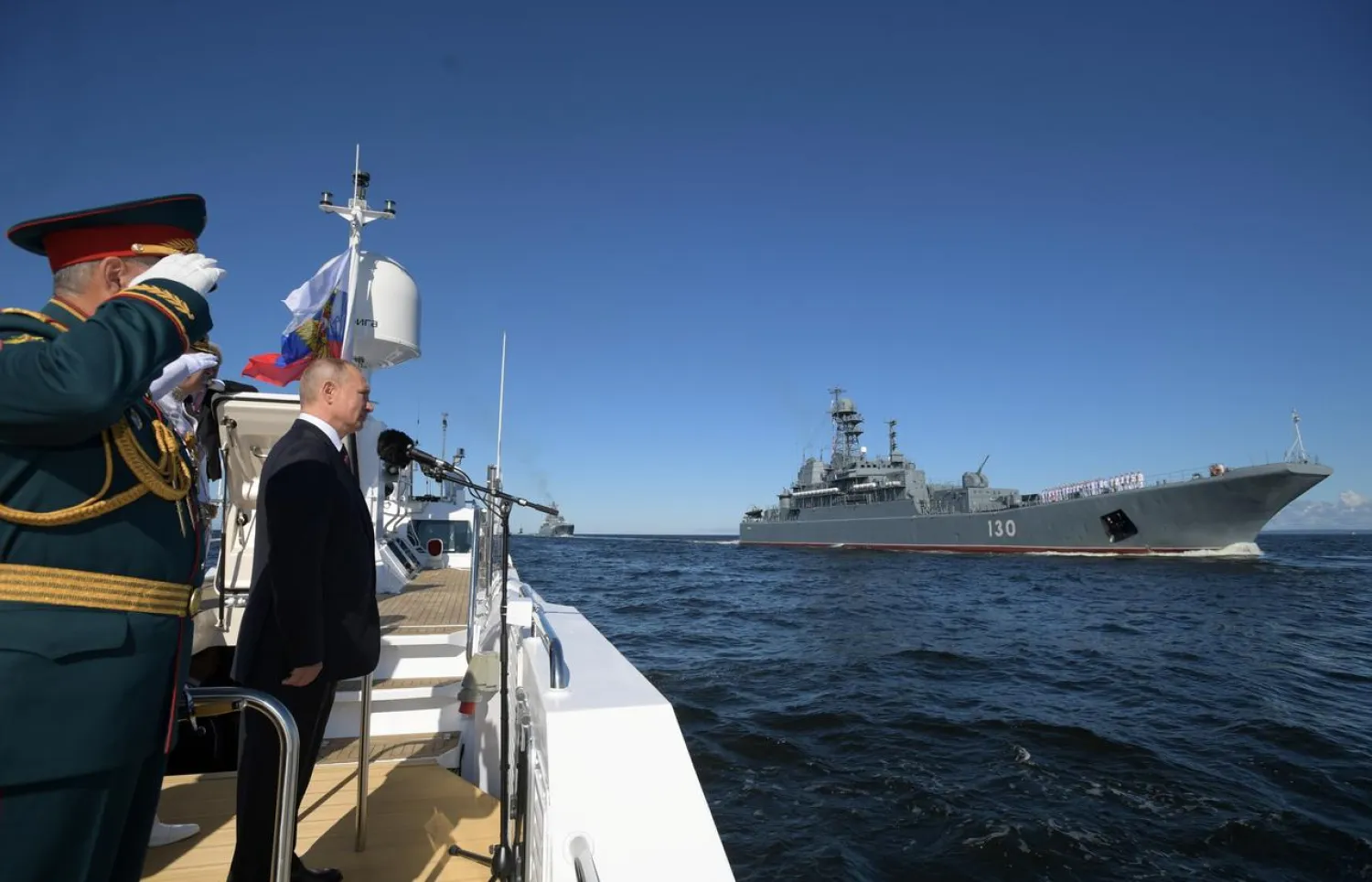
Russia's President Vladimir Putin inspects warships before the Navy Day parade in Saint Petersburg, Russia July 26, 2020. (Reuters)
TT

Putin Says Russian Navy to Get Hypersonic Nuclear Strike Weapons

Russia's President Vladimir Putin inspects warships before the Navy Day parade in Saint Petersburg, Russia July 26, 2020. (Reuters)

Russian President Vladimir Putin said on Sunday the Russian Navy would be armed with hypersonic nuclear strike weapons and underwater nuclear drones, which the defense ministry said were in their final phase of testing.

Putin, who says he does not want an arms race, has often spoken of a new generation of Russian nuclear weapons that he says are unequalled and can hit almost anywhere in the world. Some Western experts have questioned how advanced they are.

The weapons, some of which have yet to be deployed, include the Poseidon underwater nuclear drone, designed to be carried by submarines, and the Tsirkon (Zircon) hypersonic cruise missile, which can be deployed on surface ships.

The combination of speed, maneuverability and altitude of hypersonic missiles, capable of travelling at more than five times the speed of sound, makes them difficult to track and intercept.

Speaking in St. Petersburg at an annual naval parade that showcases Russia’s best ships, nuclear submarines and naval aviation, Putin said the navy’s capabilities were growing and it would get 40 new vessels this year.

He did not specify when it would receive new hypersonic weapons, but suggested that day was drawing closer.

“The widespread deployment of advanced digital technologies that have no equals in the world, including hypersonic strike systems and underwater drones, will give the fleet unique advantages and increased combat capabilities,” Putin said.

In a separate statement released via Russian news agencies, the defense ministry said testing of the Belgorod, the first submarine capable of carrying the Poseidon drones, was underway and testing of the weapons systems was nearing completion.

“Work is being successfully completed to create modern weapons systems for the Navy,” it was cited as saying.

Putin last year threatened to deploy hypersonic missiles on ships and submarines that could lurk outside US territorial waters if the United States moved to deploy intermediate-range nuclear weapons in Europe.

Washington has not deployed such missiles in Europe, but Moscow is worried it might.


Kremlin Says US Has Not Responded to Its Nuclear Arms Control Offer

Russian President Vladimir Putin delivers his traditional televised New Year's Address to the people of Russia, in Moscow, Russia, 31 December 2025.  EPA/MIKHAIL METZEL/SPUTNIK/KREMLIN POOL
Russian President Vladimir Putin delivers his traditional televised New Year's Address to the people of Russia, in Moscow, Russia, 31 December 2025. EPA/MIKHAIL METZEL/SPUTNIK/KREMLIN POOL
TT

Kremlin Says US Has Not Responded to Its Nuclear Arms Control Offer

Russian President Vladimir Putin delivers his traditional televised New Year's Address to the people of Russia, in Moscow, Russia, 31 December 2025.  EPA/MIKHAIL METZEL/SPUTNIK/KREMLIN POOL
Russian President Vladimir Putin delivers his traditional televised New Year's Address to the people of Russia, in Moscow, Russia, 31 December 2025. EPA/MIKHAIL METZEL/SPUTNIK/KREMLIN POOL

The Kremlin said on Thursday that the United States had not responded to President Vladimir Putin's proposal to informally extend for ‌a year ‌the ‌provisions of ⁠the last ‌remaining nuclear arms pact between Moscow and Washington, the New START treaty, which is ⁠due to expire ‌in three weeks.

Kremlin spokesman ‍Dmitry ‍Peskov was responding ‍to a question about comments made by US President Donald Trump, who has said that he ⁠instead wants a more ambitious nuclear arms control treaty which includes China - something Beijing has so far shown no interest in.


German Air Traffic Control Advises Avoiding Iranian Airspace until Feb 10

Reuters file photo of an IranAir plane
TT

German Air Traffic Control Advises Avoiding Iranian Airspace until Feb 10

Reuters file photo of an IranAir plane

Germany's air traffic control authority said Thursday it was recommending planes avoid Iranian airspace after the United States has in recent days warned of a possible military intervention in Iran.

A spokesman for Germany's Flight Safety Office told AFP in a statement it had issued a recommendation "that Iranian airspace not be overflown... until February 10," adding that the advice had been issued "on the instruction of the transport ministry".


Türkiye Calls for Dialogue to Resolve Iran Unrest

Turkish Foreign Minister Hakan Fidan speaks during an interview with Reuters at the 23rd edition of the annual Doha Forum, in Doha, Qatar, December 6, 2025. REUTERS/Ibraheem Abu Mustafa
TT

Türkiye Calls for Dialogue to Resolve Iran Unrest

Turkish Foreign Minister Hakan Fidan speaks during an interview with Reuters at the 23rd edition of the annual Doha Forum, in Doha, Qatar, December 6, 2025. REUTERS/Ibraheem Abu Mustafa

Türkiye's top diplomat on Thursday called for dialogue to the crisis in Iran, rocked by mass protests which rights group say have left thousands dead and which prompted US warnings to Tehran.

"We absolutely want problems to be resolved through dialogue," Foreign Minister Hakan Fidan told journalists in Istanbul.

"Hopefully, the United States and Iran will resolve this issue among themselves -- whether through mediators, other actors, or direct dialogue. We are closely following these developments."
