


UK Jobs Market Hurtling Toward Cliff-Edge Moment in October

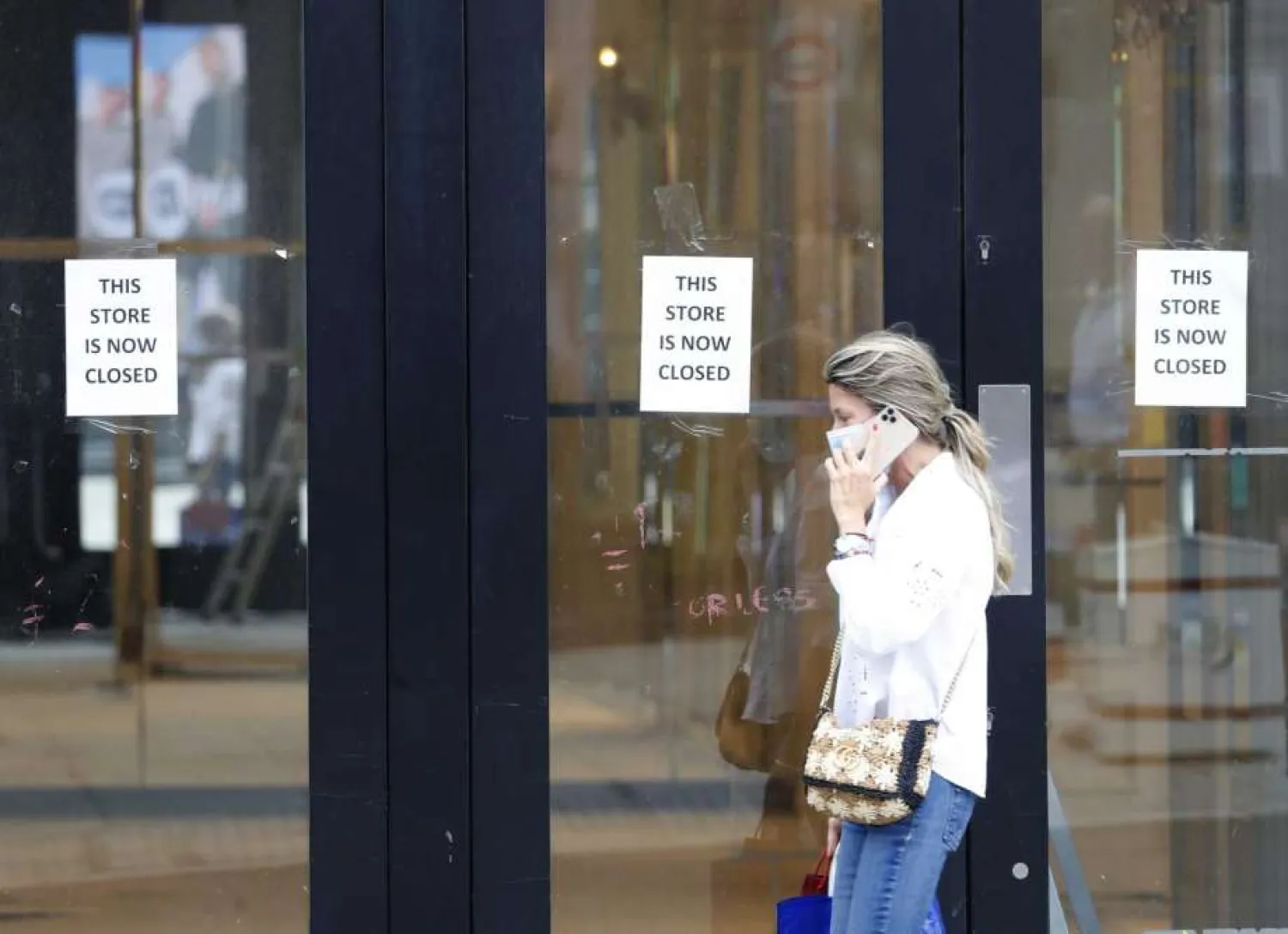
A woman walks by a closed store, in London, Thursday, July 16, 2020. Unemployment across the UK has held steady during the coronavirus lockdown as a result of a government salary support scheme, but there are clear signals emerging that job losses will skyrocket over coming months. The Office for National Statistics said Thursday there were 649,000 fewer people, or 2.2%, on payroll in June when compared with March when the lockdown restrictions were imposed. (AP Photo/Alastair Grant)
TT

UK Jobs Market Hurtling Toward Cliff-Edge Moment in October

A woman walks by a closed store, in London, Thursday, July 16, 2020. Unemployment across the UK has held steady during the coronavirus lockdown as a result of a government salary support scheme, but there are clear signals emerging that job losses will skyrocket over coming months. The Office for National Statistics said Thursday there were 649,000 fewer people, or 2.2%, on payroll in June when compared with March when the lockdown restrictions were imposed. (AP Photo/Alastair Grant)

The UK has kept a lid on the unemployment rate so far during the coronavirus pandemic but, scratch beneath the surface, and there are worrying trends that will likely see the jobless total soaring by the end of the year.

Official figures released Tuesday showed that the number of people working fell in the April-June quarter by the most since the global financial crisis more than a decade go, even as the unemployment rate held steady at a historically low 3.9% in June.

The stable jobless rate is largely due to a government salary support scheme that will end in October, a cliff-edge moment that many economists think will lead to an almost immediate doubling in unemployment. The number of jobseekers could rise to over 3 million, a level not seen since the 1980s.

The UK has been partly spared the sharp rises in unemployment seen in the United States, for example, because of the Coronavirus Job Retention Scheme, under which the government has been paying a large chunk of the salaries of workers who have not been fired. Some 1.2 million employers have taken advantage of the program during the lockdown to furlough 9.6 million people at a cost to the government of 33.8 billion pounds ($44 billion).

Though these employees have not been working over the past few months, they are not counted as unemployed. The government has started phasing out the furlough program, with firms now having to cover some of the costs of the plan. The government has said it will end the program in October on the grounds it gives "false hope" to furloughed workers while at the same time limiting their prospects of getting new jobs as their skills fade.

While admitting that not every job can be saved, Treasury chief Rishi Sunak said Tuesday's figures said the support measures, have helped to "safeguard millions of jobs and livelihoods that could otherwise have been lost."

The big question is how many of those furloughed workers will be kept on payroll after October as many parts of the economy are still operating way below potential.

"A wide range of indicators suggest that job losses will crystallize from August, when employers must start to cover some of the costs of furloughed staff," said Samuel Tombs, chief UK economist at Pantheon Macroeconomics.

He noted that surveys of employment intentions are "at least as weak" as they were at the worst point of the global financial crisis in 2008-9.

In a sign of the weakness of the UK's labor market, employment fell in the April to June quarter by 220,000, its biggest three-month decline since the 2009 recession. Official figures due for release on Wednesday are set to show the economy contracted by nearly 25% in the second quarter of the year from the previous three-month period.

The Office for National Statistics on Tuesday also reported that the number of people on payroll in the UK fell by a further 81,000 in July to 28.27 million. The number of people coming off the payroll since March is now 730,000, with the falls in employment greatest among younger and older workers, along with those in lower-skilled jobs.

Unions are urging the government to at least extend the furlough scheme to those sectors that are still suffering because of lockdown restrictions.

"The alarm bells couldn´t be ringing any louder," said Frances O´Grady, general secretary of the Trades Union Congress.



Microsoft Arabia: Saudi Arabia Accelerates AI Adoption, Turns It Into Competitive Edge

A Microsoft logo is seen a day after Microsoft Corp's $26.2 billion purchase of LinkedIn Corp, in Los Angeles, California, US, June 14, 2016. REUTERS/Lucy Nicholson
TT

Microsoft Arabia: Saudi Arabia Accelerates AI Adoption, Turns It Into Competitive Edge

A Microsoft logo is seen a day after Microsoft Corp's $26.2 billion purchase of LinkedIn Corp, in Los Angeles, California, US, June 14, 2016. REUTERS/Lucy Nicholson

Saudi Arabia has cemented its global standing in artificial intelligence after pouring significant investments into the sector in 2025, accelerating digital transformation and expanding real-world applications across government and the wider economy.

From education and manufacturing to energy and public services, AI is being deployed to advance the diversification goals of Saudi Vision 2030.

Turki Badhris, president of Microsoft Arabia, said the kingdom is experiencing unprecedented momentum in adopting AI as a strategic lever to raise competitiveness and improve performance across vital sectors.

Artificial intelligence has become central to the national transformation journey, he told Asharq Al-Awsat.

Linking transformation

Saudi Arabia’s overhaul spans digital government modernization, the construction of megacities and large-scale projects, industrial development, and the creation of new economic sectors, Badhris said.

AI, he added, is the connective tissue binding these efforts together by enabling smarter infrastructure and more efficient public services.

In 2025, Microsoft expanded cooperation with government and regulatory bodies, as well as major companies, to accelerate the adoption of AI and cloud computing across education, industry, financial services, and government operations.

Turning point year

Badhris described 2025 as a watershed for AI in the kingdom, marked by a shift to broad, sector-wide deployment.

In digital government, training programs implemented with the Digital Government Authority aim to equip more than 100,000 public sector employees with cloud and AI skills, enhancing service delivery and user experience.

In education, AI literacy initiatives have been scaled up in partnership with the Ministry of Education and the Ministry of Communications and Information Technology, alongside the rollout of generative AI tools and digital learning technologies in schools.

Manufacturers have adopted AI-driven predictive maintenance and real-time operational data analysis, cutting downtime and improving efficiency and reliability.

In energy and sustainability, AI solutions are being used to optimize water and energy asset management, including predictive maintenance and intelligent process control, delivering operational savings while supporting emissions reduction and sustainability targets.

Sovereign cloud push

Badhris said the launch of Microsoft’s cloud region in Saudi Arabia, planned for 2026, will mark a qualitative leap by allowing government entities and regulated sectors to run critical workloads in a secure local environment, ensuring data sovereignty and enabling low-latency innovation.

He added that regulatory frameworks developed by relevant authorities have bolstered trust in AI adoption by balancing individual protection with incentives for innovation.

From tools to partners

Looking ahead, Badhris said 2026 will see AI evolve from support tools into “work partners” capable of collaboration and initiative in complex tasks.

The shift will be felt across government services, industry, megaprojects such as Qiddiya and The Red Sea Project, and healthcare.

Advanced AI systems, he said, will sharpen operational efficiency, lift productivity, and enhance service quality, while moving from reactive oversight to proactive governance frameworks that ensure safe and responsible use.

Saudi Arabia, Badhris said, is not simply adopting AI but helping shape its future, investing in sovereign infrastructure, building national capabilities, and embedding responsible-use principles to drive sustainable economic growth and entrench its position as a global technology power.


Lockheed Martin: Saudi Arabia Is Strategic Choice for Global Defense Hub

Lockheed Martin took part in the recent World Defense Show in Riyadh. (Asharq Al-Awsat)
TT

Lockheed Martin: Saudi Arabia Is Strategic Choice for Global Defense Hub

Lockheed Martin took part in the recent World Defense Show in Riyadh. (Asharq Al-Awsat)

Saudi Arabia’s push to localize half of its defense spending under Vision 2030 is drawing deeper commitments from US defense giant Lockheed Martin, which says it will expand local manufacturing, transfer advanced technologies, and further integrate the Kingdom into its global aerospace and defense supply chains.

Building Saudi partnerships

Steve Sheehy, vice president for international business development at Lockheed Martin’s aeronautics division, said the company is stepping up efforts to partner with both established and emerging Saudi aerospace firms.

Lockheed Martin is looking to build partnerships across maintenance, repair and overhaul, as well as component manufacturing and repair, particularly in advanced avionics, Sheehy told Asharq Al-Awsat.

Speaking after the company’s participation in the World Defense Show in Riyadh, he said Lockheed Martin is also targeting emerging fields such as additive manufacturing, from plastics to metals, and advanced composite materials.

The goal, he said, is twofold: plug gaps in the company’s global supply chain while transferring know-how and strengthening local capabilities in a mutually beneficial model.

Sheehy described the Saudi aerospace sector as established and growing. He also noted that it has a solid base in maintenance and manufacturing, as well as a clear shift toward advanced technologies, creating room for deeper collaboration between national firms and global industry leaders.

Alignment with Vision 2030

Retired Brigadier General Joseph Rank, chief executive of Lockheed Martin in Saudi Arabia and Africa, said the company’s strategy in the Kingdom is rooted in a long-term partnership aligned with Vision 2030, especially the target of localizing 50 percent of defense spending.

Lockheed Martin, he said, is focused on transferring knowledge and advanced technologies, developing local industrial capabilities and building an integrated defense ecosystem that positions Saudi Arabia firmly within global supply chains.

Rank said the company is working closely with government entities and national companies to strengthen local manufacturing, empower Saudi talent and establish a sustainable industrial base that supports innovation and creates high-quality jobs.

Lockheed Martin is advancing manufacturing and repair work on defense equipment, including components of the THAAD air defense system, missile launch platforms, and interceptor missile canisters, in cooperation with Saudi partners, Rank said.

The company has also opened a maintenance center in Riyadh for the Sniper Advanced Targeting Pod system, the first of its kind in the Middle East, to enhance maintenance and technical support capabilities.

Beyond hardware, Lockheed Martin is investing in transferring and localizing advanced technologies in air defense, command and control, and digital manufacturing. It is also supporting science, technology, engineering and mathematics programs and hands-on training in cooperation with national universities.

Broad local network

Rank said the company relies on a wide network of partners in the Kingdom. At the forefront are the General Authority for Military Industries, the main government partner in localization agreements, and Saudi Arabian Military Industries, a key manufacturing and technology transfer partner.

Other collaborators include the Advanced Electronics Company for advanced systems maintenance, the Middle East Propulsion Company and AIC Steel for producing THAAD components and platforms, and the National Company for Mechanical Systems for advanced manufacturing technologies.

Academic partnerships extend to King Abdullah University of Science and Technology, King Saud University, King Fahd University of Petroleum and Minerals, and Princess Nourah bint Abdulrahman University, supporting research and developing national talent.

Localizing aerospace manufacturing

Rank said localizing aerospace manufacturing is a strategic priority. Lockheed Martin has launched projects to produce interceptor missile launch platforms and canisters inside the Kingdom and awarded contracts for key components to Saudi companies, qualifying them to join its global supply network beyond the US.

The company is evaluating and qualifying hundreds of Saudi firms to produce defense equipment to international standards, focusing on technology transfer and building local expertise as a step toward manufacturing more integrated systems in the future.

Company officials said the approach goes beyond supplying systems. It centers on technology transfer, digital manufacturing, and command-and-control systems, laying the groundwork for the production of integrated systems in the Kingdom and strengthening Saudi Arabia’s position as a regional hub for aerospace and defense.


Türkiye TPAO, Shell Sign Deal to Carry out Exploration Work offshore Bulgaria

A Shell logo is seen at a gas station in Buenos Aires, Argentina, March 12, 2018. (Reuters)
TT

Türkiye TPAO, Shell Sign Deal to Carry out Exploration Work offshore Bulgaria

A Shell logo is seen at a gas station in Buenos Aires, Argentina, March 12, 2018. (Reuters)

Türkiye Petrolleri (TPAO) has signed a partnership agreement with Shell to carry out exploration work in Bulgaria's maritime zone, the Turkish energy ministry and British oil major said on Wednesday.

European Union member Bulgaria, which had been totally dependent on Russian gas until 2022, has been seeking to diversify its gas supplies and find cheaper sources, Reuters reported.

TPAO and Shell will jointly explore the Khan Tervel block, located near Türkiye's Sakarya gas field, and will hold a five-year licence in Bulgaria's exclusive economic zone, Minister Alparslan Bayraktar said.

Shell will continue as operator of the block, while TPAO will take a 33% interest in the licence, a Shell spokesperson said.

Since the start of this year, TPAO has signed energy cooperation agreements with ExxonMobil, Chevron and BP for possible exploration work in the Black Sea and the Mediterranean.

In April, Shell signed a contract with Bulgaria's government to allow the oil major to explore 4,000 square metres in the block.