



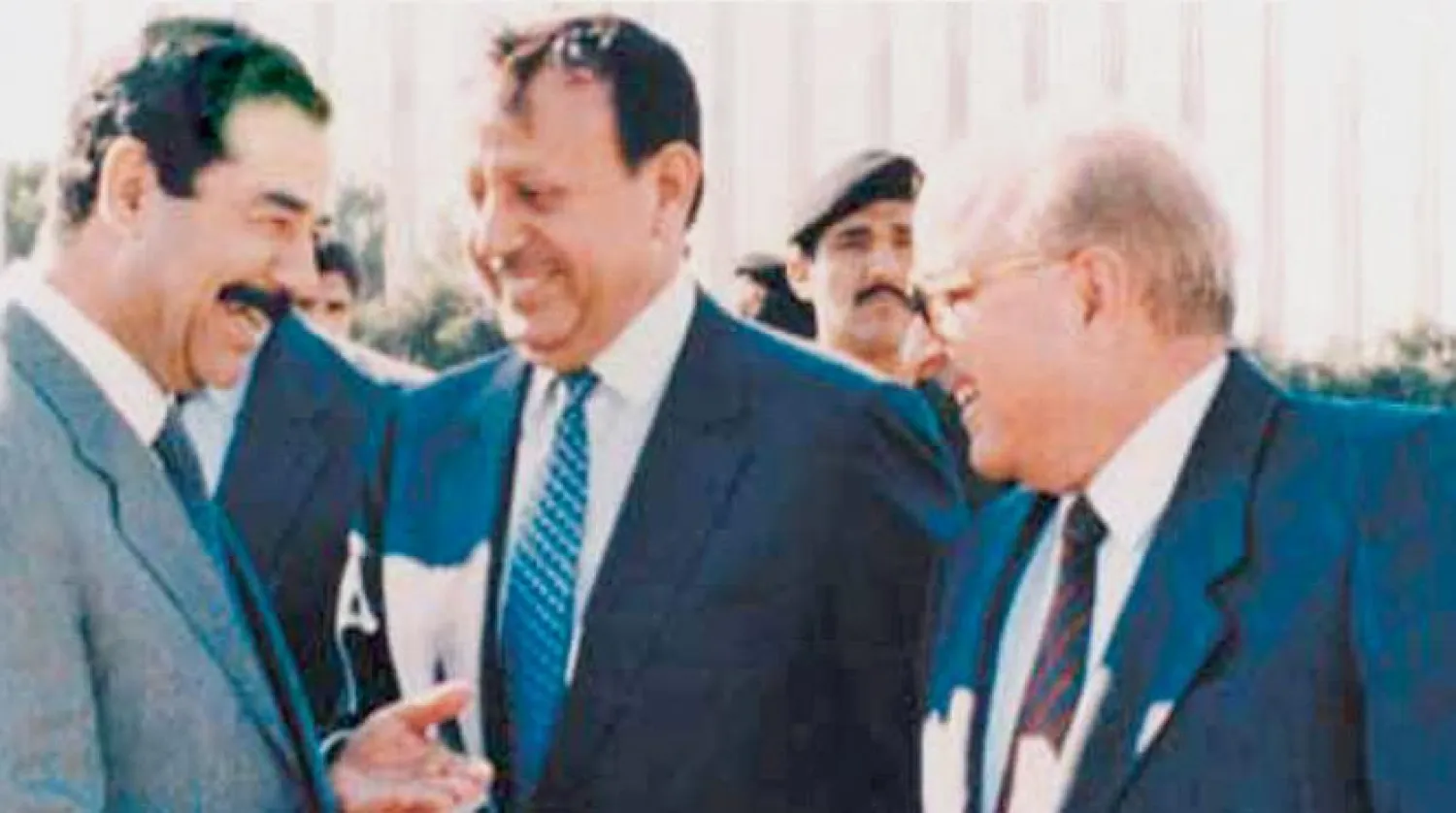

Asharq Al-Awsat is exclusively publishing excerpts from a new memoir, “Al-Qarar” (The Decision), by former Jordanian Prime Minister Mudar Badran. The book will be officially released in Amman on August 17. The memoirs are filled with developments and stances that will be revealed for the first time, including moments Jordan experienced in the last quarter of the 20th Century.
In the second part of the series, Badran recalls Jordan’s preparations to confront the impact of the Iraqi invasion of Kuwait on Jordan, including allowing Islamists to join the government he was heading in an attempt to avert the economic crisis caused by the halt in oil supplies from Iraq. He also recalls the dangerous trip he made to Baghdad on the second day of the war and his meetings with Taha Yassin Ramadan and Tariq Aziz and how he realized how ill-prepared the Iraqi military was for the war.
Saddam Hussein continued to cling on to his position that the Iraqi army will withdraw from Kuwait only if Israel withdrew from Jerusalem and occupied territories. of course, that was an opportunity for Israel to destroy Iraq with American weapons.
I reached the conclusion early on that initiatives will be futile in resolving the crisis. After the failure of the initiatives proposed by late King Hussein and Algerian President Chadli Bendjedid, the United States informed our ambassador and their ambassador informed me that initiatives will not pass and that the Americans and their army were already on the ground.
From that point on, we began to witness the impact of the international position towards Iraq. We realized that the war was imminent and we began to take our precautions. Some optimism remained, but that, of course, is not enough.
In order to strengthen our internal front, I carried out a government reshuffle on January 1, 1990. I allowed lawmakers from the Islamist movement to join my cabinet at a time the drums of war were being beaten. I realized the need for collective work and had since becoming prime minister been committed to King Hussein’s instructions to include the Islamists in government. I believed the time was right to include them. King Hussein had even told me to grant them the education portfolio if they wanted it.
I was reluctant to meet their demands and refused to give them the education portfolio. I spent three days negotiating with them and each day they would approach me with names. I told them: “I am asking you for portfolios. I am in charge of choosing names, not you.”
The most important development to take place before the new cabinet’s first meeting was John Major’s election as British prime minister, defeating Margaret Thatcher, who had adopted a very hardline position against Saddam, in sharp contrast with her successor. Our primary concern during that first meeting was making the necessary preparations for any military development. We did not want the people to be affected by any shortage in basic goods. We therefore, prepared necessary supplies of essential goods. My main concern was oil and that the war would cut off Iraqi supplies from us. I resorted to a ship in Aqaba port where we stored enough oil to last us 18 days, which was enough time to find an alternative to the Iraqi supplies.
We were also preparing for any potential danger from Israel. We were reassured from trusted sources, however, that the Israeli army was acting normally and had deployed anti-aircraft systems on the West Bank mountains, in a defensive, not offensive, move. We said that any Israeli attack on Aqaba that would target food supplies will be met with attacks on Eilat, where their oil supplies were being stored.
I was shocked when parliament later demanded to discuss military plans. How could I allow it? Military plans are not discussed at parliament or in front of the media. We would not repeat the same mistake as the 1967 war. I explained to them our media plan and told them that Iraq does not display its military might on television. Why should I display this power when Baghdad itself does not?
To war
Despite all the efforts that were exerted to resolve the crisis peacefully, military preparations were the sign that war was upon us. Despite this, we continued to pursue a peaceful solution. We did not want to lose hope. (US President George) Bush visited Europe and we planned a meeting between him and King Hussein in Paris. King Hussein indeed contacted the White House, but the Americans cancelled the meeting. He wanted to propose to Bush the possibility of meeting with Saddam. After our efforts failed, we tried to arrange a meeting between US Secretary of State James Baker and his Iraqi counterpart Tariq Aziz. We hoped that this meeting, if it yielded a positive outcome, could pave the way for a meeting between Bush and Saddam.
As the situation began to unravel on the ground, we sensed that the Baker-Aziz meeting will be futile. The US had become more extreme in its position and its soldiers were headed to war. The Baker-Aziz meeting was set for January 3 in a hope that a Bush-Saddam meeting would be held nine days later. We were certain that the meeting, had it been held, would have eased the tense political statements about war. The Iraqis were prepared to discuss the peaceful option.
Ultimately, the two meetings were never held. Instead, Baker and Aziz met on January 9 and we had hoped that the meeting would have a positive impact on the crisis.
The situation continued to unravel rapidly. King Hussein had just returned from a trip to Britain, Germany and Luxembourg and he continued to advocate Jordan’s peaceful resolution of the crisis and the need to show the same great attention to other Middle Eastern affairs. Such an approach would play into the political solution to the Iraqi crisis in Kuwait.
I was meeting with parliament and (then United Nations Secretary-General Javier Pérez) de Cuéllar was about to hold his second meeting with Saddam. The first had ended without any cause for optimism. All we needed from the Iraqis was for the leadership to take a position that would take away the opportunity to carry out any military operation the US was planning. Such an opportunity meant that we would be allowing the Soviet Union, as an eastern bloc, to return to its maneuvers against the western bloc.
This was followed by a dangerous development: The US Congress’ approval to grant George Bush the authority to declare war. This confirmed that the US was headed to war against Iraq. That day was January 15.
January 17, 1991 was a sad, painful, long and difficult day. It was the day when peaceful efforts failed and war was declared.
Immediately, King Hussein met with the emergency committees at the national assembly and government. I had never seen him so sad before. He revealed to us all efforts carried out by head of the Royal Court, Prince Zeid bin Shaker, to avert the war. He had paid a visit to Riyadh in a last-ditch effort to reach a solution based on Iraqi-Saudi dialogue. The Saudis informed him that he should head to Iraq and demand their immediate withdrawal (from Kuwait). If the Iraqis refuse to make such a declaration, then he should instead.
The meeting was difficult, but King Hussein gave us strength and lifted our spirits and spoke about the values and principles of Arabism. He remained optimistic that the nation would emerge free and victorious from the crisis. He also revealed his latest political push, which was a message he received from Mikhail Gorbachev, who informed him that he tried to delay the military strike by a day or two to persuade Baghdad to withdraw. The air strike, however, was faster than Russia.
During our meeting, we presented Hussein with our assessment of the crisis. We predicted that some 200,000 people would flee to Turkey, 200,000 to Iraq, 100,000 to Syria and 750,000 to Jordan, forcing us to deal with a dangerous challenge. We informed King Hussein that the Iraqis expected the Americans to drop 18,000 tons of explosives and bombs over them, during some 2,500 air raids.
At 2 am on the second day of the attack on Baghdad, Iraq attacked Israel. It fired eight rockets at Tel Aviv, seven of which exploded. Observers said Israel would use Jordanian airspace to retaliate, which we would not allow. We were ordered that any attack on Aqaba would be met with a strike on Eilat.
We feared that the oil refinery may be targeted. It was a matter of life or death for us. So, it was suggested that it be shut down and emptied to avert any danger should the worst-case scenario unfold. We suggested that the oil be stored at gas stations.
As for Israeli violations of our airspace, we were ordered to fire at any attempt and the Americans were informed of this.
To Baghdad under fire
On the second day of the war on Iraq, I carried out a secret visit to Baghdad. I arranged the visit despite the uneasiness of King Hussein and Prince Zeid bin Shaker due to its high security risk and high political risk if it was uncovered. I forged ahead, however. I prepared two vehicles and had them loaded with enough fuel and brought in gallons more that were stored in the trunks.
We began the journey without knowing anything about the route. We didn’t know how long the trip would take. I didn’t even tell my family.
The route was deserted. It was dangerous because two fast-traveling vehicles could be easily detected and targeted. We resorted to two cars in case one of them broke down. We drove at 200 kilometers an hour in armored vehicles on the international highway. It was a risk as any problem on the road would be difficult to avoid by such heavy cars. I did not sleep a minute throughout the trip. I wanted to memorize the route to ensure a safe return home.
It was a dangerous adventure. We could see the fighter jets overhead, flying towards Baghdad where they would strike before returning to their bases. We used to pass Iraqi checkpoints and they used to ask us for bread. I wondered at this. How could the Iraqi army not take into account the need to feed its soldiers while they were at war?
We drove ahead at high speed and reached Baghdad. We stopped at our embassy and found it closed. The guards informed us that the employees were on their lunchbreak and contacted them to return. I asked: “How can you shut the embassy?” They said that they were not informed of my visit and that if they did not head out for lunch at this hour, restaurants and shops will be closed. They told me that the only food available was bulgur, because bread and flour could no longer be found in Baghdad.
I told them to contact (foreign minister) Tariq Aziz and (first Vice President) Taha Yassin Ramadan to inform them that I was in Baghdad and wanted to meet them.
I left behind the armored vehicles and was transported by an Iraqi pickup truck to meet with Aziz and Ramadan. I was shocked with these weak measures in confronting an international war. Aziz did not have enough fuel. I asked: “How am I supposed to return to Amman? My cars have run out of fuel.”
I wondered how they could wage a war without ensuring they had a sufficient food, fuel or energy supply. I told them that even Jordan, which was not involved in the war, had completed its precautions even before the conflict began. I advised them to secure all logistic precautions and draw up a comprehensive plan to ensure that Baghdad is supplied with its food, medicine and fuel needs. Indeed, I broke the siege on Baghdad in several ways. I guaranteed that they would continue to receive all essential goods and even sent them oil that was refined in Jordan.
I met with Ramadan for four hours. He informed me that they were doing well and that the developments were less than what they expected. He said they were very well organized militarily. I criticized their administrative management, whereby shops were closed, no police was deployed on the streets and the people were left without water, electricity, bread and fuel. There was but one gas station that was operating by hand because of a power outage in Baghdad. Despite all this, the people were going about their normal lives. When a strike happens, they head to bomb shelters.
I was told that some residents of Baghdad had headed north and to the Iranian border. Ramadan told me that the military strikes missed 80 percent of their targets, assuring me that Iraq can shoot down a number of coalition jets and that their pilots will be captured, dead or alive.
Two raids took place as I was in Baghdad. The anti-aircraft defenses kept the jets at bay. The Iraqis were seeking to lure the coalition forces into a ground battle. I was told that the attack against Israel was not planned, but it was a response to American false claims that Iraq’s missile launch platforms had been destroyed. Ramadan told me that the platforms were taken from the Soviet Union and that Iraq had built new ones because the figures were stolen from the Russians and leaked to the US.
The third and final part of the series of excerpts concludes on Tuesday.


