
China Teenage Climate Warrior Fights a Lonely Battle

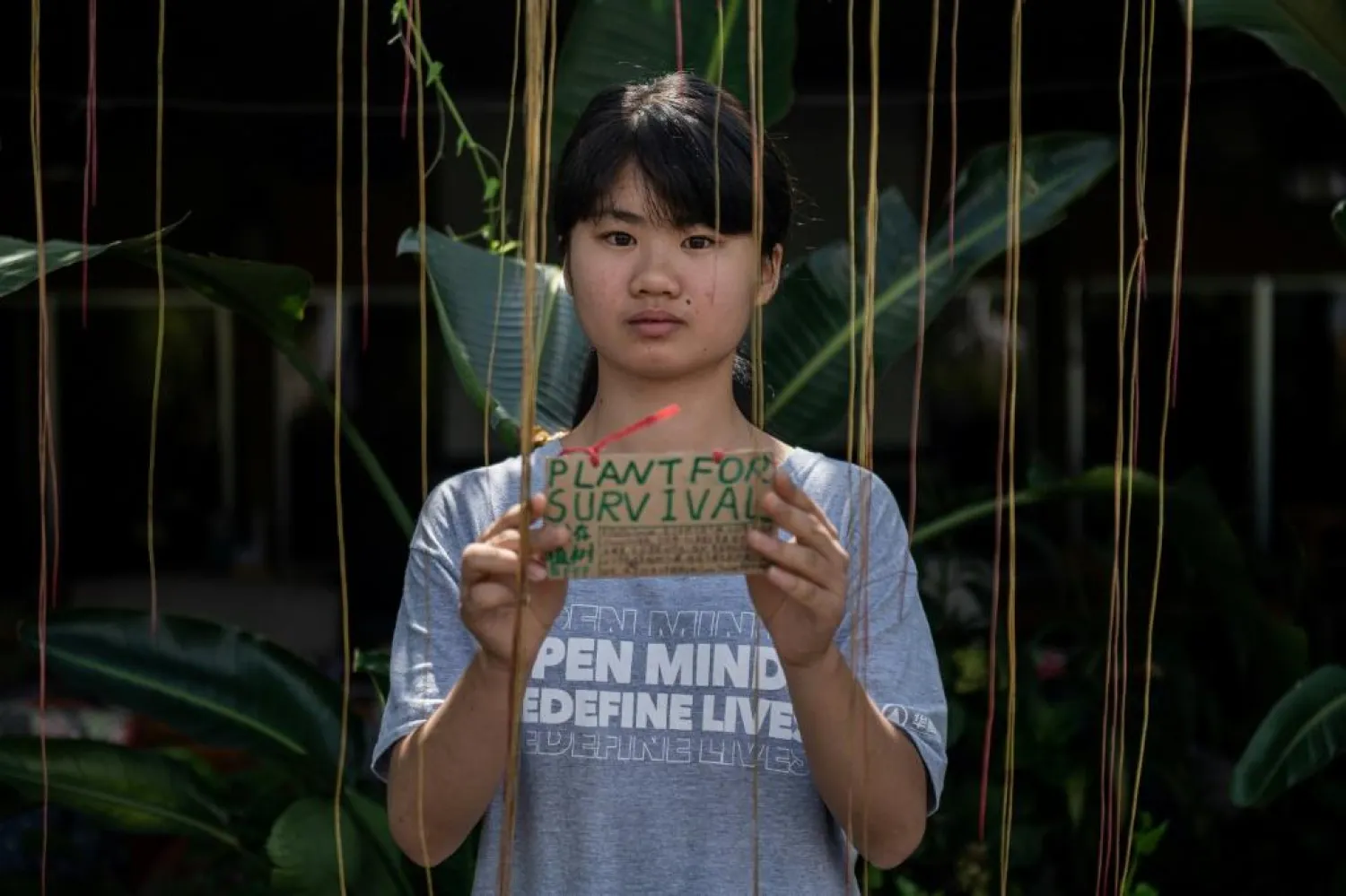
Young Chinese climate activist Howey Ou says she was inspired by Greta Thunberg but has struggled to find wider support in China | AFP
TT

China Teenage Climate Warrior Fights a Lonely Battle

Young Chinese climate activist Howey Ou says she was inspired by Greta Thunberg but has struggled to find wider support in China | AFP

While most of her peers are preparing for university or enjoying summer vacation, 17-year-old Howey Ou is braving intimidation and criticism in China to save the world from climate catastrophe.

Young environmental activists around the world have skipped school to attend marches in protest at global inaction over climate change.

But in China, grassroots social movements are heavily suppressed by the government, and the movement is severely lacking in participants.

It has changed Ou's life though. She was inspired by Swedish teenage climate campaigner Greta Thunberg, and held her own week-long solo protest in May last year outside her local government buildings, gaining international recognition.

"The climate emergency is the biggest threat to the survival of mankind. I feel anxious every day about the climate and the extinction of animal species," said Ou, an intense figure who speaks in a fast monotone, reeling off a trove of scientific data from memory.

"I feel like we're all on a sinking ship but everyone is still eating, drinking, and being merry."

While Thunberg has addressed global leaders at the UN Climate Action Summit and received awards for her work, the Chinese activist has been kicked out of school for refusing to give up her campaigning.

Known as Ou Hongyi in China, she has also faced run-ins with police, family pressure, and harsh online criticism.

But the teenager says it is her "life mission" to sound the alarm before it is too late.

She told AFP that although she "wasn't scared of the police", her parents were under pressure from authorities.

"After I was interrogated by the police, my parents tried to stop me by all means, such as by keeping me at home, not letting me accept interviews or take part in the climate movement, and searching my electronic devices," she said.

"One day I argued with them for eight hours. I found it very difficult and painful."

After her protest outside the government offices, she started planting trees in the surroundings of Guilin, the southern Chinese city where she lives, and studied methods of non-violent protest, poring over the works of Mahatma Gandhi.

She has also tried to recruit more young people to join her cause, but most of the time she is a lone figure, carrying hand-painted placards as people walk by, oblivious.

As her campaigning attracted more attention, Ou chose to move out of her family home -- highly unusual for a minor in China -- and now lives alone at a hostel in Guilin.

Her parents worry about her safety, and her father is anxious that she may be lagging behind her peers due to start university.

"I don't see a future for her if she stays on this road," her father, who did not wish to be named, told AFP.

"I warned her never to oppose the government and the Party in her activism."

Ou, however, insists she is not trying to go against authorities and sees it instead as "a question of morality".

- Lone journey -

Ou has thousands of followers on social media but has struggled to find wider support within China. Last summer she traveled solo around the country on a shoestring, meeting with environmental NGOs and activists.

But she says many had little understanding of the climate crisis -- and the journey formed the loneliest period of her life.

"I didn't know the way and didn't know what kinds of people in China would support me... I felt like I was in a very open and empty place, isolated and cut off from support," she recalled.

Then last October, she faced criticism from millions online when a German media interview with her went viral on Chinese social media.

Many accused her of attention-seeking and "armchair activism", while others made unflattering comparisons to Thunberg, who is a frequent object of ridicule on the Chinese internet.

She avoided social media for several months after that.

During the hardest moments, Ou says she drew comfort and strength from the spectacular natural scenery in her hometown -- something she has enjoyed since childhood.

"My reconnection with nature helped me to see my own value," she said.

Ou believes the Chinese public are either ignorant or dismissive of the climate crisis, but she still hopes to build a youth movement, like her idol Thunberg.

"There are many young Chinese people who may only need a bit of encouragement to bravely step forward. But if my voice does not reach them... we can't unite," she said.

"So right now I am trying my hardest to make sure my voice gets heard."


Norway Aid Group: Sudan, DR Congo Top World's Most Neglected Crises

Sudanese refugees from Al-Fashir, displaced by ongoing conflict in Sudan, gather at sunset at the Tine transit camp in eastern Chad, November 23, 2025. REUTERS/Amr Abdallah Dalsh
TT

Norway Aid Group: Sudan, DR Congo Top World's Most Neglected Crises

Sudanese refugees from Al-Fashir, displaced by ongoing conflict in Sudan, gather at sunset at the Tine transit camp in eastern Chad, November 23, 2025. REUTERS/Amr Abdallah Dalsh

Sudan, the Democratic Republic of Congo and Colombia top the list of the world's most neglected displacement crises, the Norwegian Refugee Council aid group said on Thursday.

Sudan, which since 2023 has been ravaged by a bloody conflict between two rival generals competing for power, has more than nine million internally displaced people, the prominent aid organization said in a statement.

A further four million Sudanese have fled to neighboring countries and nearly 19.5 million people there are also suffering from hunger, the NRC said.

"It is incomprehensible that a displacement crisis of similar proportions to the crises in Syria and Ukraine at their peak can continue to worsen almost unnoticed," NRC chief Jan Egeland said.

"Countries have become much more inward-looking, more nationalist.

Rearmament is now an absolute priority because we have to ensure our own security in Europe. There is Putin threatening us, and so on," Egeland said in comments to the NRK broadcaster.

"But people then forget that there will be pandemics, migratory movements, and enormous loss of human life if we don't invest in hope on other continents."

"Africa is just across the Mediterranean, where we go on holiday. And if the continent collapses, we will also suffer the consequences."

Relatives mourn during the funeral of a person who died of Ebola in Bunia, Ituri Province, Democratic Republic of the Congo, 03 June 2026. EPA/DIEUDONNE DIROLE

The Democratic Republic of Congo, where an Ebola epidemic has added turmoil to the east of the country ravaged by decades of conflict, appears on NRC's list for the 10th year in a row.

In 2025, only 27.4 percent of the funding needed for DR Congo has been secured, leaving more than 21 million people in need, according to the NRC.

"This is a testament to the world's failure to respond to crises that are not regarded as strategically important for rich countries," Egeland said in the NRC statement.

"Millions of people are being abandoned because we have chosen not to act, not because we cannot."

The NGO's list is based on three criteria: lack of humanitarian funding, lack of media coverage, and lack of political will within the international community.

Several African countries -- Burkina Faso, Cameroon, Central African Republic, Mali and Nigeria -- have featured on NRC's list six or more times, pointing to "a systemic pattern of deliberate neglect", NRC said.

The 10 most neglected crises for 2025 are Sudan, the Democratic Republic of Congo, Colombia, Yemen, Afghanistan, Honduras, Ecuador, Cameroon, Nigeria and Mozambique, spanning three continents and tens of millions of people.


Gunmen Kidnap 7 Students from School in Northwestern Nigeria

Nigerian police personnel restrict protesters from convening for the sixth day of anti-government demonstrations against bad governance and economic hardship, in Lagos, Nigeria August 6, 2024. REUTERS/ Francis Kokoroko/File Photo
TT

Gunmen Kidnap 7 Students from School in Northwestern Nigeria

Nigerian police personnel restrict protesters from convening for the sixth day of anti-government demonstrations against bad governance and economic hardship, in Lagos, Nigeria August 6, 2024. REUTERS/ Francis Kokoroko/File Photo

Gunmen raided an off-campus residence in northwest Nigeria and kidnapped seven students, police said.

The attack occurred early Wednesday in the Kaura Namoda area of conflict-battered Zamfara state, police spokesman Yazid Abubakar said in a statement. One of the students escaped and was in custody, The Associated Press said.

The police spokesman said it wasn't clear where the students were taken but efforts were underway to rescue the remaining six.

Zamfara has been a hotspot for armed gangs that carry out kidnappings for ransom, with abductions of students increasing in recent years across the country.

A tally by local news outlet Premium Times found that at least 1,900 students have been kidnapped from 20 schools since the 2014 mass abduction of over 200 schoolgirls from Chibok in Borno state.


Iran's Khamenei Says US, Israel Aim to Sow 'Division' after War Defeat

An Iranian man walks past a billboard carrying a picture of Iran' supreme leader Mojtaba Khamenei erected along a street in Tehran on May 28, 2026. (Photo by AFP)
TT

Iran's Khamenei Says US, Israel Aim to Sow 'Division' after War Defeat

An Iranian man walks past a billboard carrying a picture of Iran' supreme leader Mojtaba Khamenei erected along a street in Tehran on May 28, 2026. (Photo by AFP)

Iran's supreme leader on Thursday accused the US and Israel of trying to sow "division" among Iranians after suffering a "decisive blow" during the Middle East war.

In a written message, Mojtaba Khamenei said "the malicious enemy" was seeking to "plant the seeds of doubt, despair, fear, mistrust and division" among the public, reported AFP.

"In confronting these ill intentions, everyone must, through steadfastness, insight, preserving unity and cohesion... neutralize their sinister plot," his message said.