

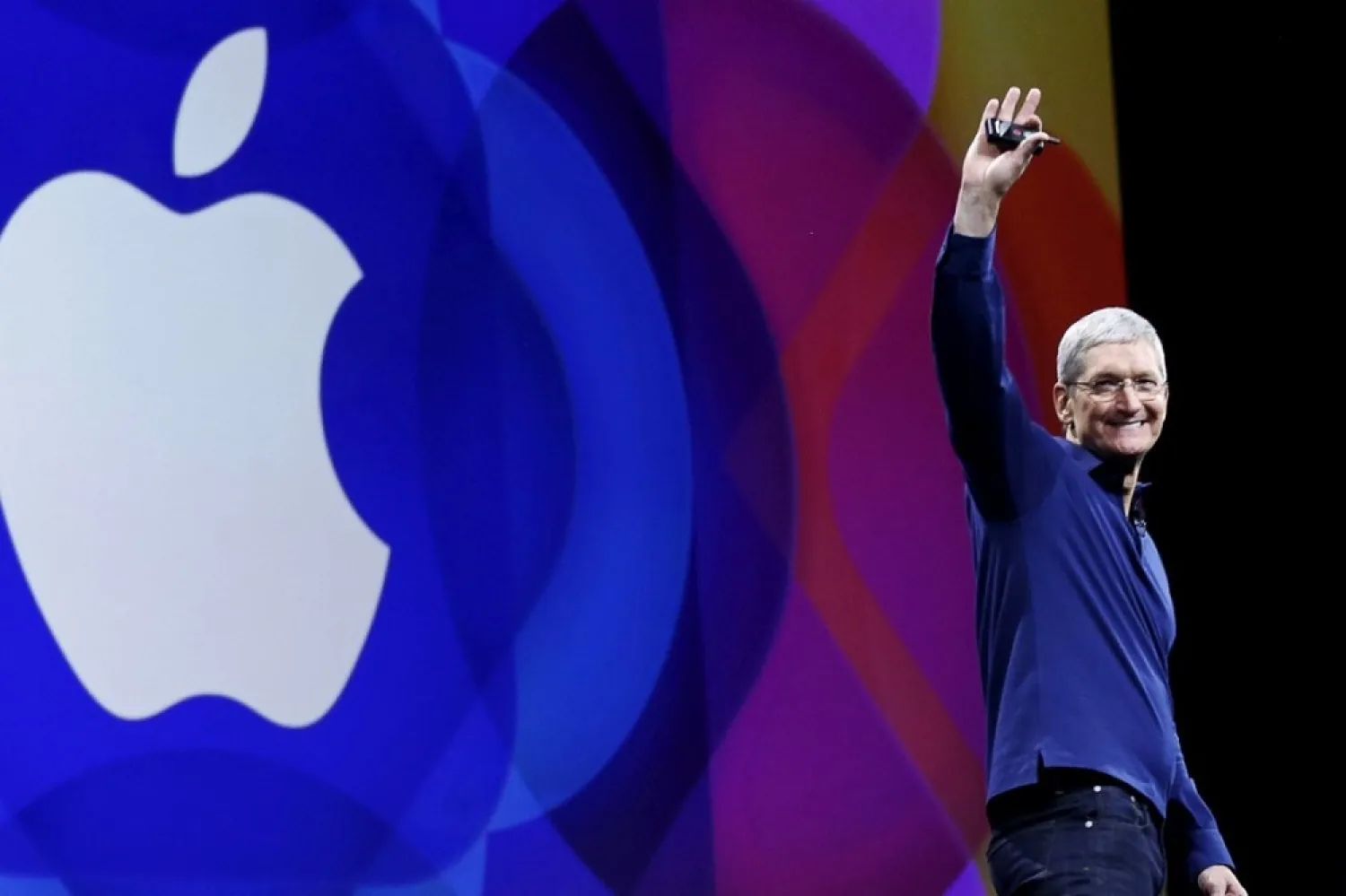

Apple CEO Tim Cook is Fulfilling Another Steve Jobs Vision

Apple CEO Tim Cook. (Reuters)
TT

Apple CEO Tim Cook is Fulfilling Another Steve Jobs Vision

Apple CEO Tim Cook. (Reuters)

Apple co-founder Steve Jobs, who died in 2011, was a tough act to follow. But Tim Cook seems to be doing so well at it that his eventual successor may also have big shoes to fill.

Initially seen as a mere caretaker for the iconic franchise that Jobs built before his 2011 death, Cook has forged his own distinctive legacy. He will mark his ninth anniversary as Apple’s CEO Monday -- the same day the company will split its stock for the second time during his reign.

Grooming Cook as heir apparent was “one of Steve Jobs’ greatest accomplishments that is vastly underappreciated,” said long-time Apple analyst Gene Munster, who is now managing partner of Loup Ventures.

The upcoming four-for-one stock split, a move that has no effect on share price but often spurs investor enthusiasm, is one measure of Apple's success under Cook. The company was worth just under $400 billion when Cook the helm; it's worth five times more than that today, and has just become the first US company to boast a market value of $2 trillion. Its share performance has easily eclipsed the benchmark S&P 500, which has roughly tripled in value during the past nine years.

But it hasn't always been easy. Among the challenges Cook has faced: a slowdown in iPhone sales as smartphones matured, a showdown with the FBI over user privacy, a US trade war with China that threatened to force up iPhone prices and now a pandemic that has closed many of Apple's retail stores and sunk the economy into a deep recession.

Cook, 59, has also struck out in into novel territory. Apple now pays a quarterly dividend, a step Jobs resisted partly because he associated shareholder payments with stodgy companies that were past their prime. Cook also used his powerful perch to become an outspoken advocate for civil rights and renewable energy, and on a personal level came out as the first openly gay CEO of a Fortune 500 company in 2014.

Apple declined to make Cook available for an interview. But it did point to 2009 comments Cook made to financial analysts when he was running the company while Jobs battled pancreatic cancer.

Asked what the company might look like under his management, Cook said that Apple needs “to own and control the primary technologies behind the products we make." It has doubled down on that commitment, becoming a major chip producer in order to supply both iPhones and Macs. He added that Apple would resist exploring most projects “so that we can really focus on the few that are truly important and meaningful to us."

That laser focus has served Apple well. At the same time, though, under Cook's stewardship, Apple has largely failed to come up with breakthrough successors to the iPhone. Its smartwatch and wireless ear buds have emerged as market leaders, but not game-changers.

Cook and other executives have dropped hints that Apple wants make a big splash in the field of augmented reality, which uses phone screens or high-tech eyewear to paint digital images into the real world. Apple has yet to deliver, although neither have other companies that have hyped the technology.

Apple also remains a laggard in artificial intelligence, particularly in the increasingly important market for voice-activated digital assistants. Although Apple's Siri is widely used on Apple devices, Amazon's Alexa and Google’s digital assistant have made major inroads in helping people manage their lives, particularly in homes and offices.

Apple also has stumbled a few times under Cook's leadership.

In 2017, it alienated customers by deliberately but quietly slowing the performance of older iPhones via a software update, ostensibly to spare the life of aging batteries. Many consumers, though, viewed it as a ploy to boost sales of newer and more expensive iPhones. Amid the furor, Apple offered to replace aging batteries at a steep discount; later it paid $500 million to settle a class-action lawsuit over the matter.

Apple has also faced government investigations into its aggressive efforts to minimize its corporate taxes and complaints that it has abused control of its app store to charge excessive fees and stifle competition to its own digital services. On the tax front, a court ruled in July that Apple did nothing wrong.

Cook has turned the app store into the cornerstone of a services division that he set out to expand four years ago. At the time, it was growing clear that sales of the iPhone -- Apple’s biggest money maker -- were destined to slow down as innovations grew sparse and consumers kept their old devices for longer.

To help offset that trend, Cook began to emphasize recurring revenue from app commission, warranty programs and streaming subscriptions to music, video, games and news sold for the more 1.5 billion devices already running on the company’s software.

Apple’s services division now generates $50 billion in annual revenue, more than all but 65 companies in the Fortune 500. Ives estimates Apple’s services division by itself is worth about $750 billion -- about the same as Facebook currently is in its entirety.

That division could be worth even more now had Cook done something many analysts believe Apple should have done at least five years ago by dipping into a hoard of cash that at one point surpassed $260 billion to buy Netflix or a major movie studio to fuel its video streaming ambitions.

Buying Netflix seemed like within the realm of possibility five years ago when the video streaming service was valued at around $40 billion. Now that Netflix is worth more than $200 billion today, that idea seems off the table, even for a company with Apple's vast resources.



US Allows Nvidia to Send Advanced AI Chips to China with Restrictions

An Nvidia logo and a computer motherboard appear in this illustration taken August 25, 2025. (Reuters)
TT

US Allows Nvidia to Send Advanced AI Chips to China with Restrictions

An Nvidia logo and a computer motherboard appear in this illustration taken August 25, 2025. (Reuters)

The US Commerce Department on Tuesday opened the door for Nvidia to sell advanced artificial intelligence chips in China with restrictions, following through on a policy shift announced last month by President Donald Trump.

The change would permit Nvidia to sell its powerful H200 chip to Chinese buyers if certain conditions are met -- including proof of "sufficient" US supply -- while sales of its most advanced processors would still be blocked.

However, uncertainty has grown over how much demand there will be from Chinese companies, as Beijing has reportedly been encouraging tech companies to use homegrown chips.

Chinese officials have informed some firms they would only approve buying H200 chips under special circumstances, such as development labs or university research, news website The Information reported Tuesday, citing people with knowledge of the situation.

The Information had previously reported that Chinese officials were calling on companies there to pause H200 purchases while they deliberated requiring them to buy a certain ratio of AI chips made by Nvidia rivals in China.

In its official update on Tuesday, the US Commerce Department's Bureau of Industry and Security said it had changed the licensing review policy for H200 and similar chips from a presumption of denial to handling applications case-by-case.

Trump announced in December an agreement with Chinese President Xi Jinping to allow Nvidia to export its H200 chips to China, with the US government getting a 25-percent cut of sales.

The move marked a significant shift in US export policy for advanced AI chips, which Joe Biden's administration had heavily restricted over national security concerns about Chinese military applications.

Democrats in Congress have criticized the move as a huge mistake that will help China's military and economy.

- Chinese chips -

Nvidia chief executive Jensen Huang has advocated for the company to be allowed to sell some of its more advanced chips in China, arguing the importance of AI systems around the world being built on US technology.

The chips -- graphic processing units or GPUs -- are used to train the AI models that are the bedrock of the generative AI revolution launched with the release of ChatGPT in 2022.

The GPU sector is dominated by Nvidia, now the world's most valuable company thanks to frenzied global demand and optimism for AI.

H200s are roughly 18 months behind the US company's most state-of-the-art offerings, which will still be off-limits to China.

Nvidia's Huang has repeatedly warned that China is just "nanoseconds behind" the United States as it accelerates the development of domestically produced advanced chips.

On Wednesday, leading Chinese AI startup Zhipu said it had used homegrown Huawei chips to train its new image generator.

Zhipu AI described its tool as "the first state-of-the-art multimodal model to complete the entire training process on a domestically produced chip".

The startup went public in Hong Kong last week and its shares have since soared 75 percent -- one of several dazzling recent initial public offerings by Chinese chip and generative AI companies, as high hopes for the sector outweigh concerns of a potential market crash.


Apple Rolls Out Creator Studio to Boost Services Push, Adds AI Features

A customer compares his old iPhone with the newly launched iPhone 17 pro max at an Apple retail store in Delhi, India, September 19, 2025. (Reuters)
TT

Apple Rolls Out Creator Studio to Boost Services Push, Adds AI Features

A customer compares his old iPhone with the newly launched iPhone 17 pro max at an Apple retail store in Delhi, India, September 19, 2025. (Reuters)

Apple on Tuesday unveiled Apple Creator Studio, a new subscription bundle of professional creative software priced at $12.99 a month or $129 a year, as the iPhone maker steps up its push into paid services for creators, students and professionals.

The company has used its services business, which includes its Apple ‌Music and ‌iCloud services, to drive ‌growth ⁠in recent ‌years, helping counter slower hardware growth and generate recurring revenue.

Apple Creator Studio bundles some of the company's best-known creative tools into a single subscription, including Final Cut Pro, Logic Pro ⁠and Pixelmator Pro across Mac and iPad.

The ‌package also adds premium ‍content and ‍new AI-powered features to Apple's productivity apps ‍Keynote, Pages and Numbers, while digital whiteboarding app Freeform will gain enhanced features later.

Final Cut Pro will offer new tools such as transcript-based search, visual search and beat detection to ⁠speed up video editing, while Logic Pro introduces AI-powered features like Synth Player and Chord ID to assist with music creation.

The company's Photoshop-alternative Pixelmator Pro will be available on iPad for the first time and will offer Apple Pencil support.

The subscription launches January 28 on ‌the App Store, Apple said.


Social Media Harms Teens, Watchdog Warns, as France Weighs Ban

The TikTok app logo is seen in this illustration taken January 16, 2025. (Reuters)
TT

Social Media Harms Teens, Watchdog Warns, as France Weighs Ban

The TikTok app logo is seen in this illustration taken January 16, 2025. (Reuters)

Social media harms the mental health of adolescents, particularly girls, France's health watchdog said Tuesday as the country debates banning children under 15 from accessing the immensely popular platforms.

The results of an expert scientific review on the subject were announced after Australia became the first country to prohibit big platforms including Instagram, TikTok and YouTube for under 16s last month, while other nations consider following its lead.

Using social media is not the sole cause of the declining mental health of teenagers, but its negative effects are "numerous" and well documented, the French public health watchdog ANSES wrote in its opinion, the result of five years of work by a committee of experts.

France is currently debating two bills, one backed by President Emmanuel Macron, that would ban social media for under 15s.

The ANSES opinion recommended "acting at the source" to ensure that children can only access social networks "designed and configured to protect their health".

This means that the platforms would have to change their personalized algorithms, persuasive techniques and default settings, according to the agency.

"This study provides scientific arguments for the debate about social networks in recent years: it is based on 1,000 studies," the expert panel's head Olivia Roth-Delgado told a press conference.

Social media can create an "unprecedented echo chamber" that reinforces stereotypes, promotes risky behavior and promotes cyberbullying, the ANSES opinion said.

The content also portrays an unrealistic idea of beauty via digitally altered images that can lead to low self-esteem in girls, which creates fertile ground for depression or eating disorders, it added.

Girls -- who use social media more than boys -- are subjected to more of the "social pressure linked to gender stereotypes," the opinion said.

This means girls are more affected by the dangers of social media -- as are people with pre-existing mental health conditions, it added.

On Monday, tech giant Meta urged Australia to rethink its teen social media ban, while reporting that it has blocked more than 544,000 Instagram, Facebook and Threads accounts under the new law.

Meta said parents and experts were worried about the ban isolating young people from online communities, and driving some to less regulated apps and darker corners of the internet.