

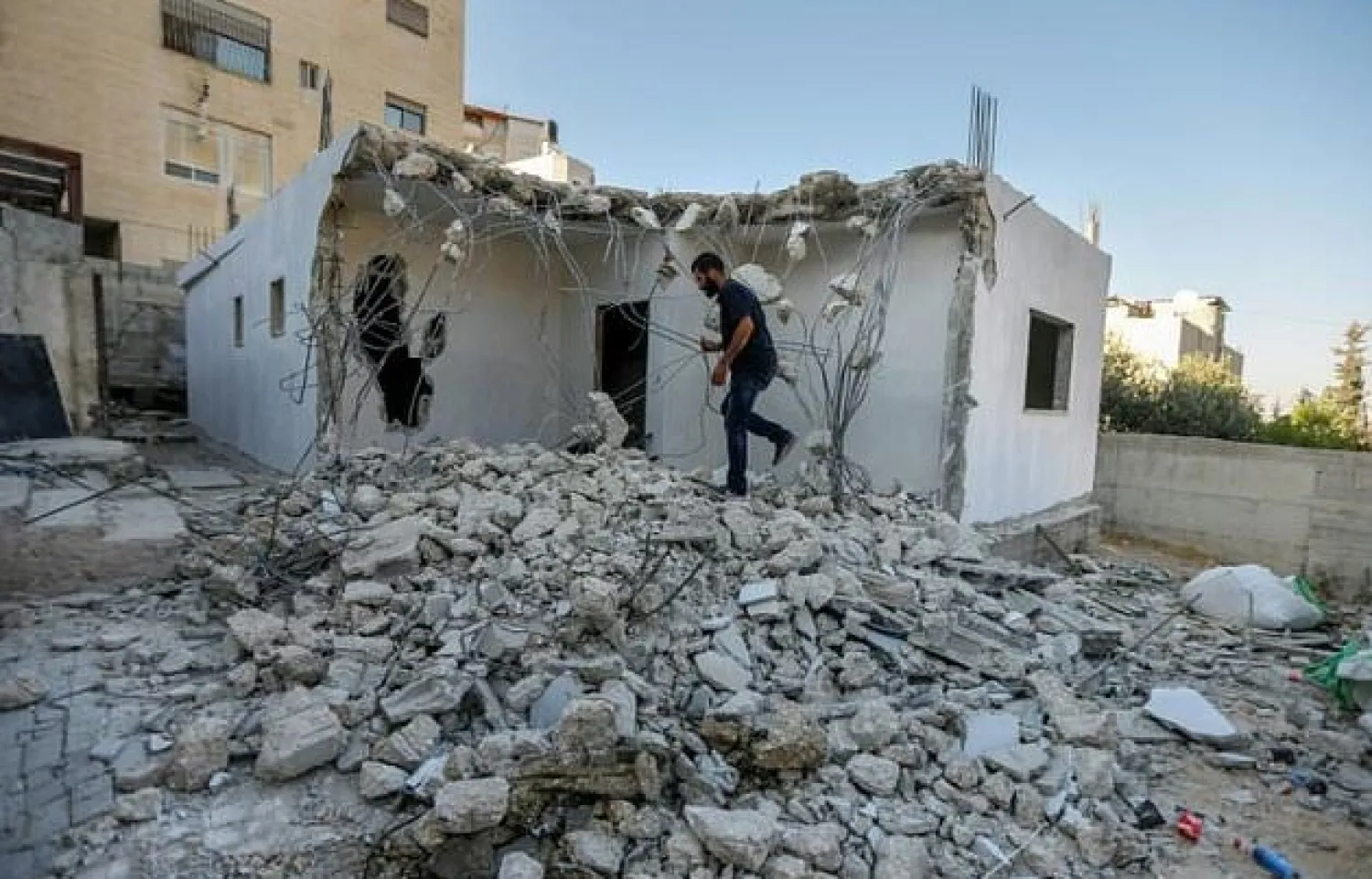

Denied Permits, Palestinians Raze Own Homes in Jerusalem

The Israeli authorities regularly raze homes built by Palestinians on their own lands in east Jerusalem and the occupied West Bank if they lack Israeli construction permits. AFP
TT

Denied Permits, Palestinians Raze Own Homes in Jerusalem

The Israeli authorities regularly raze homes built by Palestinians on their own lands in east Jerusalem and the occupied West Bank if they lack Israeli construction permits. AFP

Palestinian Alaa Borqan preferred to tear down his own house in Israeli-annexed east Jerusalem after a court ruled that it was constructed illegally and must be demolished.

The 35-year-old was given two options: to destroy his four-bedroom home in the Jabal Mukaber neighborhood himself, or to let the city council do it and then send him the bill.

The Israeli authorities regularly raze homes built by Palestinians on their own lands in east Jerusalem and the occupied West Bank if they lack Israeli construction permits.

The catch, according to an UN study, is that such permits are "virtually impossible" to obtain and the result is a chronic housing shortage.

"I applied to city hall for a building permit, but without success," Borqan told AFP.

"I spent around 75,000 shekels ($22,000, 18,700 euros) on legal fees and on a ground survey," he said.

Ben Avrahami, an advisor to the city authorities on east Jerusalem, said that every case is handled strictly according to the law.

"The demolitions are being carried out by order of an Israeli court and are subject to careful legal scrutiny," he said.

Borqan, a father of four, however said he was dismayed after he hired a bulldozer that tore down his own house in front of his eyes.

He said he had invested all his savings in the building, taking on a debt of 800,000 shekels and putting in four years of work.

The court, which ruled the structure illegal because it was built without a permit, fined him 60,000 shekels for the offence.

He now lives with his family in a house that he rents for 2,800 shekels a month.

Standing in the rubble of his former house, he recounted "how difficult it is to demolish (a home) with one's own hands".

- 'Psychological effects' -

According to city hall, 44 houses have been demolished in east Jerusalem since the start of this year.

Some owners prefer to raze their homes themselves to avoid having to pay sometimes thousands of shekels to the city's demolition crews.

The UN's Office for Humanitarian Affairs (OCHA) noted in an April 2019 report that in east Jerusalem "a restrictive planning regime applied by Israel makes it virtually impossible for Palestinians to obtain building permits".

"At least one-third of all Palestinian homes in east Jerusalem lack an Israeli-issued building permit, potentially placing over 100,000 residents at risk of displacement," it added.

OCHA says that only 13 percent of east Jerusalem is designated for Palestinian construction, much of which is already built up, while 35 percent has been allocated to Israeli settlements, which are illegal under international law.

- Housing shortage -

On July 2, the Shalalda family also demolished their home, a two-bedroomed apartment in A-Tur.

It is "very difficult, a dream has been destroyed," lamented Sara Shalalda, a mother of six.

"We were about to move in, we didn't want to have to pay rent anymore."

According to OCHA, 65 children were displaced and 85 others variously affected by self-demolitions in east Jerusalem in the first six months of the year.

Palestinians lack 30,000 to 40,000 housing units, rents are high, and building permits are expensive, said Mahmud Zahaykeh of the Jerusalem Housing Union.

"The average rent is $800 and a building permit for an apartment can cost $50,000," he added.

"Only 20 percent of residents obtain permits, and the process can take five years."

Avrahami says the city grants around 250 building permits to Palestinians each year.

Borqan had hoped to be among the lucky ones but his hopes were dashed.

"They don't want us to stay," he said, referring to Israel.

"But we are not going to move."


IOM Warns of 'Alarming' Risk of Long-term Mass Displacement in Lebanon

The rubble of a destroyed building, seen from inside a heavily damaged building, after an Israeli strike, amid escalating hostilities between Israel and Hezbollah, as the US-Israeli conflict with Iran continues, in Tyre, Lebanon, April 2, 2026. REUTERS/Yara Nardi
TT

IOM Warns of 'Alarming' Risk of Long-term Mass Displacement in Lebanon

The rubble of a destroyed building, seen from inside a heavily damaged building, after an Israeli strike, amid escalating hostilities between Israel and Hezbollah, as the US-Israeli conflict with Iran continues, in Tyre, Lebanon, April 2, 2026. REUTERS/Yara Nardi

International Organization for Migration chief Amy Pope told AFP on Thursday in Beirut that the prospects for prolonged mass displacement in Lebanon, where Israel and Hezbollah are at war, were "very alarming".

"I think those prospects are very alarming because you look right now at the level of destruction that's happening and... the further destruction that has been threatened," she said when asked about the possibility of prolonged mass displacement.

"There are parts of the south that are being completely flattened... even if the war ends tomorrow, that destruction remains and there needs to be a rebuilding," she said, noting that reconstruction would require funding, resources and peace.

"Unless we start to see those things come into place, that means that people will be displaced now for who knows how long," she added.

Lebanon says more than one million people have been displaced since the country was drawn into the Middle East war last month when the Tehran-backed Hezbollah launched rockets at Israel to avenge the US-Israeli attack that killed Iran's supreme leader Ali Khamenei.

Israel has responded with massive strikes across Lebanon and a ground invasion, and has issued sweeping evacuation warnings for swathes of south Lebanon and Beirut's densely populated southern suburbs.

Authorities say more than 136,000 people are staying in collective shelters including schools and stadiums, while some people are sleeping on the streets.

Israeli Defense Minister Israel Katz has said his country's military would occupy a swathe of southern Lebanon even after the war ends, and that the return of hundreds of thousands of displaced Lebanese would be "completely prevented" until northern Israel's security was ensured.

- 'Shocking' -

Pope said the current displacement crisis was "far more severe" than during the previous hostilities between Hezbollah and Israel which a 2024 ceasefire sought to end.

She noted the high number of displaced people, shelters struggling to cope and the fact that some people had been unable to return home after being displaced during the previous round of fighting.

People outside Lebanon "absolutely do not understand the scale" of the displacement crisis, which is "coming at a time where resources for humanitarian response are more limited than ever", she said.

The UN has launched a flash humanitarian appeal for more than $300 million for Lebanon, including an IOM appeal for around $19 million, Pope said, "but very, very little of that has now come in".

"We're seeing some of the most basic life-saving support really be needed," she said, including shelter and blankets.

Pope also said a strike this week on Beirut's Jnah district damaged the IOM premises nearby, shattering windows and rendering the agency's health clinic for migrants "basically unusable".

Authorities said the strike killed seven people, while Israel said it killed a senior Hezbollah commander.

Israel has also carried out several strikes on locations near where displaced people have been sheltering or on hotels or apartments reportedly rented by displaced people.

Pope said such strikes were "shocking".

"If people can't find safety, they move. And if they can't find safety at home, they move across borders," she warned.


Arab League Urges Action to Force Israel to Repeal Prisoner Execution Law

Meeting at Palestine’s request, the Arab League Council, at the level of permanent representatives, convened an extraordinary session in Cairo on Thursday. (Arab League)
TT

Arab League Urges Action to Force Israel to Repeal Prisoner Execution Law

Meeting at Palestine’s request, the Arab League Council, at the level of permanent representatives, convened an extraordinary session in Cairo on Thursday. (Arab League)

The Arab League strongly condemned on Thursday the Israeli Knesset’s approval of a law allowing the execution of Palestinian prisoners.

It urged the international community, particularly the United Nations Security Council and the United Nations Human Rights Council, to act urgently to compel Israel to repeal it.

Meeting at Palestine’s request, the Arab League Council, at the level of permanent representatives, convened an extraordinary session in Cairo, chaired by Bahrain, to address what it described as a “racist and invalid” law, and to discuss Arab and international steps to confront systematic Israeli violations in Jerusalem.

A 21-point resolution adopted at the meeting said limiting the death penalty to Palestinian prisoners amounted to “entrenching an apartheid system imposed by Israel,” holding “Israel, the illegal occupying power, fully responsible for the legal and humanitarian consequences.”

The Arab League called for listing Israel’s National Security Minister Itamar Ben-Gvir and members of his party, along with Finance Minister Bezalel Smotrich and their party members, on “international, regional, and national terrorism lists,” and welcomed condemnations of the law by several countries and the European Union.

It urged states party to the Fourth Geneva Convention to annul the law, and called on the International Criminal Court to open an urgent investigation and prosecute Israeli officials responsible for its approval, describing it as a “war crime.”

The Arab League also called for activating a legal monitoring unit to document any implementation of the law for use before international courts, and urged Arab parliamentary bodies to work toward suspending the Knesset’s membership in the Inter-Parliamentary Union.

Foreign ministers from Saudi Arabia, Türkiye, Egypt, Indonesia, Jordan, Pakistan, Qatar, and the United Arab Emirates also condemned the law, warning it entrenches an apartheid system and promotes rhetoric denying the Palestinian people’s inalienable rights and presence in occupied territory.

Regarding Jerusalem, the Arab League condemned what it described as unprecedented Israeli measures to close Al-Aqsa Mosque, calling it a “flagrant violation of international law” and an unprecedented provocation to Muslims worldwide, as well as an assault on freedom of worship. It also condemned measures targeting the Christian presence in the city.

The Arab League denounced Israeli efforts to dismantle the United Nations Relief and Works Agency for Palestine Refugees in the Near East and shut its offices and schools in Jerusalem, calling it an attempt to erase the refugee issue from final status talks.

It called for coordinated Arab, Islamic, and international action, political, diplomatic, economic, and legal, to protect Jerusalem and its holy sites, urging the international community, including the UN Security Council, to take a firm stance obliging Israel to halt its violations.

The Arab League reiterated its rejection of any move to alter Jerusalem’s legal status, including relocating diplomatic missions, and warned Argentina against moving its embassy to the city, saying such a move would damage Arab-Argentine relations.

Arab League Assistant Secretary-General for Palestine Affairs Faed Mustafa told the Cairo meeting that developments in Jerusalem and measures targeting Palestinian prisoners are “two facets of one policy,” urging a shift from condemnation to concrete action and impact.

Former Egyptian assistant foreign minister Mohamed Hegazy told Asharq Al-Awsat the meeting was a necessary step toward unifying the Arab stance and moving beyond political condemnation.

He called for a serious international debate on sanctions against Israel if violations continue.


Israel Says Hezbollah Chief to Pay ‘Heavy Price’ for Jewish Holiday Attacks

First responders clear the rubble from the site of an Israeli airstrike that targeted a building in the southern Lebanese village of Hanouiyeh, east of Tyre, on March 30, 2026. (AFP)
TT

Israel Says Hezbollah Chief to Pay ‘Heavy Price’ for Jewish Holiday Attacks

First responders clear the rubble from the site of an Israeli airstrike that targeted a building in the southern Lebanese village of Hanouiyeh, east of Tyre, on March 30, 2026. (AFP)

Israeli Defense Minister Israel Katz on Thursday warned that Hezbollah chief Sheikh Naim Qassem would pay an "extraordinarily heavy price" for escalating attacks during the ongoing Jewish holidays.

"I have a clear message for Naim Qassem... you and your associates will pay an extraordinarily heavy price for the intensified rocket fire directed at Israeli citizens as they gathered to celebrate Passover Seder," Katz said in a video statement.

"You will be consigned to the depths of hell alongside Nasrallah, Khamenei, Sinwar and the other fallen figures of the axis of evil," he said, referring to the former leaders of Hezbollah, Iran, and the Palestinian Hamas movement, who have been assassinated by Israel over the past two and half years.

"The Hezbollah terrorist organization you now lead, and its supporters in Lebanon, will bear the full and severe consequences," Katz added.

His warning followed claims by Hezbollah that it had carried out a series of rocket attacks on northern Israel late Wednesday and early Thursday, as Israeli Jews began marking the Passover holidays.

Katz also reiterated that Israeli forces "will clear Hezbollah and its supporters from southern Lebanon, maintain Israeli security control throughout the Litani area, and dismantle Hezbollah's military capabilities across Lebanon."

Lebanon was drawn into the Middle East war in early March when Tehran-backed Hezbollah launched rockets towards Israel to avenge the attack that killed Iran's supreme leader Ali Khamenei.

Israel has responded with massive strikes across Lebanon and a ground offensive.
