

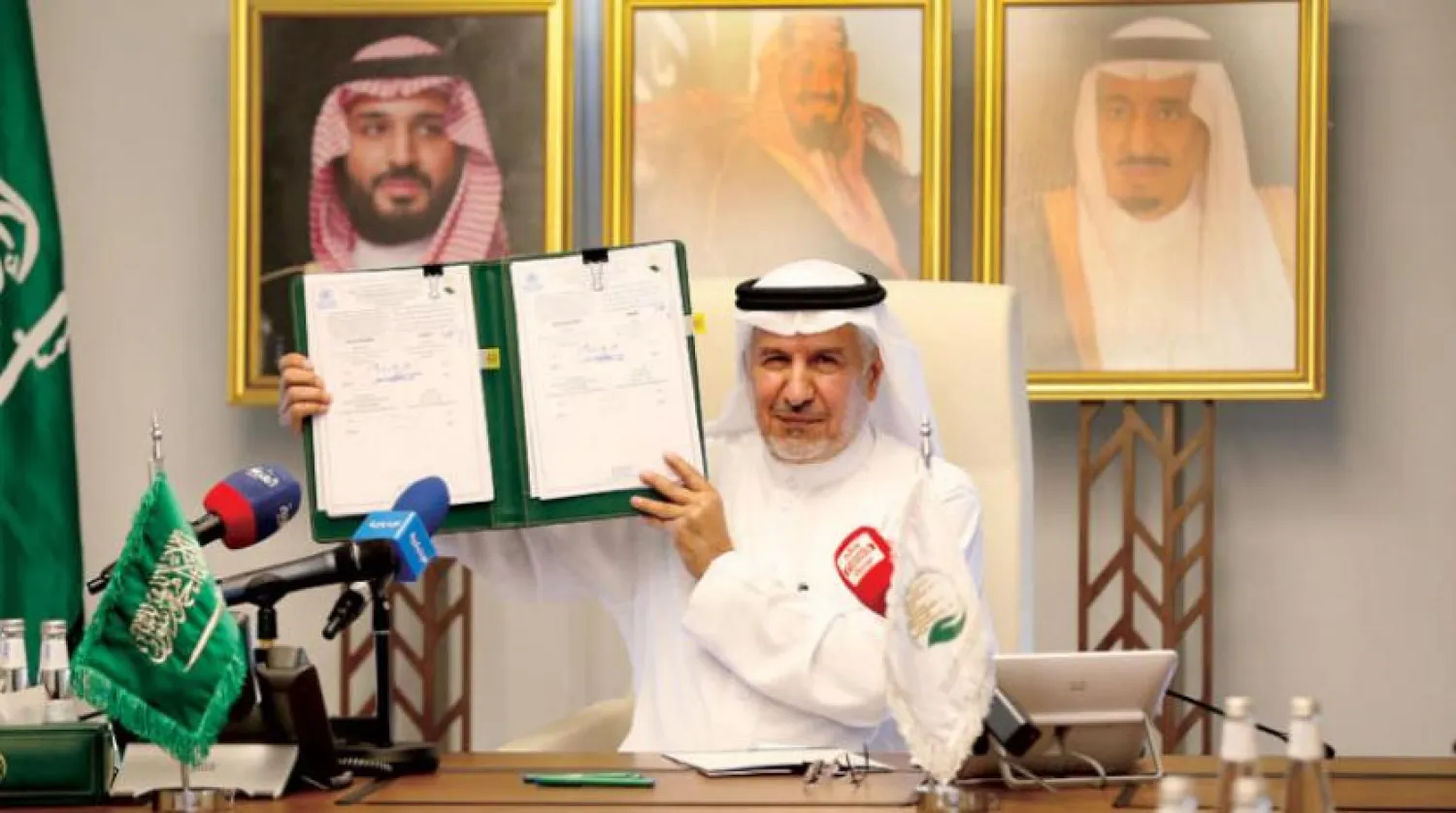

Saudi Arabia Backs Relief Programs in Yemen with over $200M

KSRelief Supervisor General Abdullah Al-Rabeeah signs funding agreements with UN agencies, Photo Credit: Saad Al-Dossari
TT

Saudi Arabia Backs Relief Programs in Yemen with over $200M

KSRelief Supervisor General Abdullah Al-Rabeeah signs funding agreements with UN agencies, Photo Credit: Saad Al-Dossari

The King Salman Humanitarian Aid and Relief Centre (KSRelief) on Thursday signed three agreements with United Nations aid agencies — the World Food Program (WFP), the World Health Organization (WHO) and the United Nations High Commissioner for Refugees (UNCHR).

According to the agreements, KSRelief will provide more than $200 million of assistance to Yemen as part of Saudi Arabia’s contribution to the 2020 high-level pledging event for Yemen, which was hosted virtually in Riyadh in June.

KSRelief Supervisor General Abdullah Al-Rabeeah, answering a question posed by an Asharq Al-Awsat correspondent about the time of implementation for these programs, said that application concerning the aid programs is the responsibility of UN agencies.

He pointed out that KSRelief maintains strict monitoring mechanisms and will closely oversee the implementation of the aid programs to ensure that they are executed swiftly and efficiently so that help reaches all the needy in Yemen.

Al-Rabeeah affirmed the Kingdom’s pioneering role in the field of global relief and humanitarian work, adding that Saudi Arabia has always sought to stand with people in need, especially Yemenis.

For the past several years, the Kingdom has been the largest supporter and financial contributor to humanitarian response plans in Yemen, he said, stressing that Saudi Arabia’s ongoing impartial support had helped the UN and its agencies save and improve the lives of millions of needy people in Yemen.

Al-Rabeeah concluded by stating that the programs signed on Thursday with the UN agencies would contribute significantly to supporting the medical, food and WASH sectors and would help to provide vital services to Yemeni IDPs and others living under extremely challenging circumstances.

The $138 million programs signed with WFP include the provision of urgent food aid to all parts of Yemen — 81,963 metric tons of wheat flour, vegetable oils, legumes, salt, preventive, and curative nutritional supplements, enriched wheat-soya, date biscuits, and high-energy biscuits. These food items will be purchased and distributed to some 8,900,000 people suffering from food insecurity across Yemen.

The program signed by KSRelief with the WHO has a total value of $46 million, and includes health-related initiatives such as WASH projects, programs to combat COVID-19, and anti-malnutrition initiatives.

The program will also support 25 central hospitals across Yemen, providing medical equipment such as ventilators, monitoring devices, and intensive care equipment for COVID-19 patients. It will also support the operation of 223 health facilities, providing fuel to generate electricity, and supporting health education activities, health services packages, and coordination between partners in this field.

In the WASH field, the program covers several projects to combat cholera, improve WASH services in 45 health centers, and support WASH activities in 117 directorates to improve public access to safe drinking water, and improve medical waste management practices to reduce disease risks and enhance water-quality monitoring.

In the area of combating malnutrition, the program supports 90 nutrition centers to provide ongoing nutritional services for people with severe acute malnutrition; the program will also provide treatment for medical complications, reduce the number of deaths from malnutrition, and spread awareness about safe food-handling practices in 222 directorates in 22 Yemeni governorates.

Treatment stations will also be opened and supplied to treat cases of malnutrition and to build local health care capacities in this regard. This project will benefit 23,428 Yemeni children. Isolation units to combating the spread of COVID-19 will be established and supplied with all necessary equipment and other requirements to fight the virus.

The third program was signed with the UNHCR with a total funding amount of $20 million. The program includes two projects: the first is the provision of shelter support, site management services, and non-food items to displaced families, returnees, and vulnerable host communities in Yemen.

This project will benefit 421,384 people in the governorates of Hajjah, Ibb, Hodeidah, Dhamar, Saada, Al Mahwit, Amran, Sanaa, Al-Bayda, Taiz, Marib, Al-Jawf, Al-Dhalea, Shabwa, Lahj, Aden, and Al-Mahra.

The second project provides support for COVID-19 health response for refugees and displaced persons and will benefit 371,950 people in the governorates of Aden, Lahij, Hadramout, and Hodeidah.

These programs are being funded by KSRelief as part of Saudi Arabia’s ongoing commitment to alleviating the suffering of the Yemeni people, in accordance with the generous directives of the government of Custodian of the Two Holy Mosques King Salman bin Abdulaziz Al Saud, Crown Prince Mohammad Bin Salman.



Saudi Foreign Minister, Egyptian Counterpart Discuss Regional Developments

Saudi Minister of Foreign Affairs Prince Faisal bin Farhan bin Abdullah
TT

Saudi Foreign Minister, Egyptian Counterpart Discuss Regional Developments

Saudi Minister of Foreign Affairs Prince Faisal bin Farhan bin Abdullah

Saudi Minister of Foreign Affairs Prince Faisal bin Farhan bin Abdullah received a phone call on Saturday from Egypt's Minister of Foreign Affairs, Emigration and Egyptian Expatriates Dr. Badr Abdelatty.

They discussed the latest regional developments and agreed to maintain bilateral coordination and consultation on these issues.


Albudaiwi: GCC States Consistently Seek to Enhance Global Security and Stability

Secretary-General of the Gulf Cooperation Council (GCC) Jasem Albudaiwi. SPA
TT

Albudaiwi: GCC States Consistently Seek to Enhance Global Security and Stability

Secretary-General of the Gulf Cooperation Council (GCC) Jasem Albudaiwi. SPA

Secretary-General of the Gulf Cooperation Council (GCC) Jasem Albudaiwi said that the GCC member states consistently seek to enhance security, stability, development, and prosperity to serve the mutual interests of the region's peoples and the entire world.

This comes in light of the rapid geopolitical shifts as well as growing security and economic challenges facing the globe, according to SPA.

During his participation in a panel session on GCC-European strategic links, held today in the Czech capital, Prague, on the sidelines of the GLOBSEC Global Security Forum 2026, the GCC secretary-general said: "The GCC General Secretariat’s participation in the GLOBSEC Global Security Forum 2026 embodies its keenness to maintain an active presence in regional and international forums. This engagement aims to bolster communication and exchange perspectives with international partners, decision-makers, and experts, thereby supporting efforts to maintain regional and international security while keeping pace with rapid global changes."

He also pointed out that the region has recently witnessed several events that have heavily impacted security and stability, adding that the GCC states have sustained their continuous diplomatic efforts to de-escalate and defuse tensions in the region, promoting paths of dialogue and diplomacy to protect regional security, stability, and the safety of its peoples.

The GCC secretary-general underscored the paramount importance of protecting the security of air and maritime corridors, ensuring freedom of navigation, the safety of supply chains, and the stability of global energy market.

"The stability of the Gulf region remains a fundamental pillar for the stability of the global economy and international maritime security," he reiterated.

Albudaiwi explained that recent developments have proven that the security of Europe and the Middle East has become unprecedentedly interconnected, asserting that any disruption in the Gulf region and its surrounding maritime passages directly affects the European economy, global energy security, supply chains, and international stability as a whole. He stressed that Gulf stability is no longer merely a regional matter, but has become a shared international interest.

Discussing the future of Gulf-European relations, Albudaiwi mentioned that both sides aspire to elevate their ties to broader horizons.

He added that the upcoming GCC-EU Summit will contribute to cementing cooperation across numerous fields and achieving the mutual interests of both parties, emphasizing the significance of reaching tangible results that serve both sides and elevate their ongoing cooperation.


Saudi Arabia Says Will Not Allow Practices That Deviate Hajj from its Objectives

Security commanders are seen at the press conference in Makkah on Friday (Bashir Saleh)
TT

Saudi Arabia Says Will Not Allow Practices That Deviate Hajj from its Objectives

Security commanders are seen at the press conference in Makkah on Friday (Bashir Saleh)

Saudi Arabia said it would not allow the Hajj to be used for any activity that strays from its religious purpose, as more than 1.5 million pilgrims arrived from abroad by Friday afternoon.

He made his statement during a press conference by Hajj security commanders at the Unified Security Operations Center (911) in the Makkah region.

Officials outlined security, traffic, and organizational plans for this year’s holy pilgrimage, along with related instructions and guidelines.

Lt. Gen. Mohammed Al-Bassami, director of Public Security, said the Hajj security system was fully ready to carry out its duties.

“Our goal is for pilgrims to reach their destination, perform their rituals, and return home safely,” he stressed.

Al-Bassami said crowd management plans focused on regulating pilgrim flows and minimizing overlap between routes. Technology, he said, was playing a key role alongside security personnel on the ground.

He said authorities were prepared for various scenarios based on risk assessments, following extensive drills and field exercises to test the readiness of all security agencies.

Lt. Gen. Mohammed Al-Omari, commander of the Special Emergency Forces at the Presidency of State Security, described the security plans as “integrated, proactive and flexible.” He said security forces were deployed in the central area and the holy sites to protect pilgrims.

Maj. Gen. Dr. Hammoud Al-Faraj, director general of Civil Defense, said preparations for the Hajj season were complete.

“We trained all bodies involved in serving pilgrims on self-protection,” he said, adding that male and female volunteers were working alongside Civil Defense personnel across all tasks and operations.

Maj. Gen. Dr. Saleh Al-Murabba, commander of the Passports Forces for Hajj, said the “Makkah Route” initiative accounted for 30% of arriving pilgrims. He said 1,518,153 pilgrims had arrived from outside Saudi Arabia by Friday afternoon.