


Fires on Slopes of Kilimanjaro Threaten a Diverse Ecosystem

Fires on Slopes of Kilimanjaro Threaten a Diverse Ecosystem
TT

Fires on Slopes of Kilimanjaro Threaten a Diverse Ecosystem

Fires on Slopes of Kilimanjaro Threaten a Diverse Ecosystem

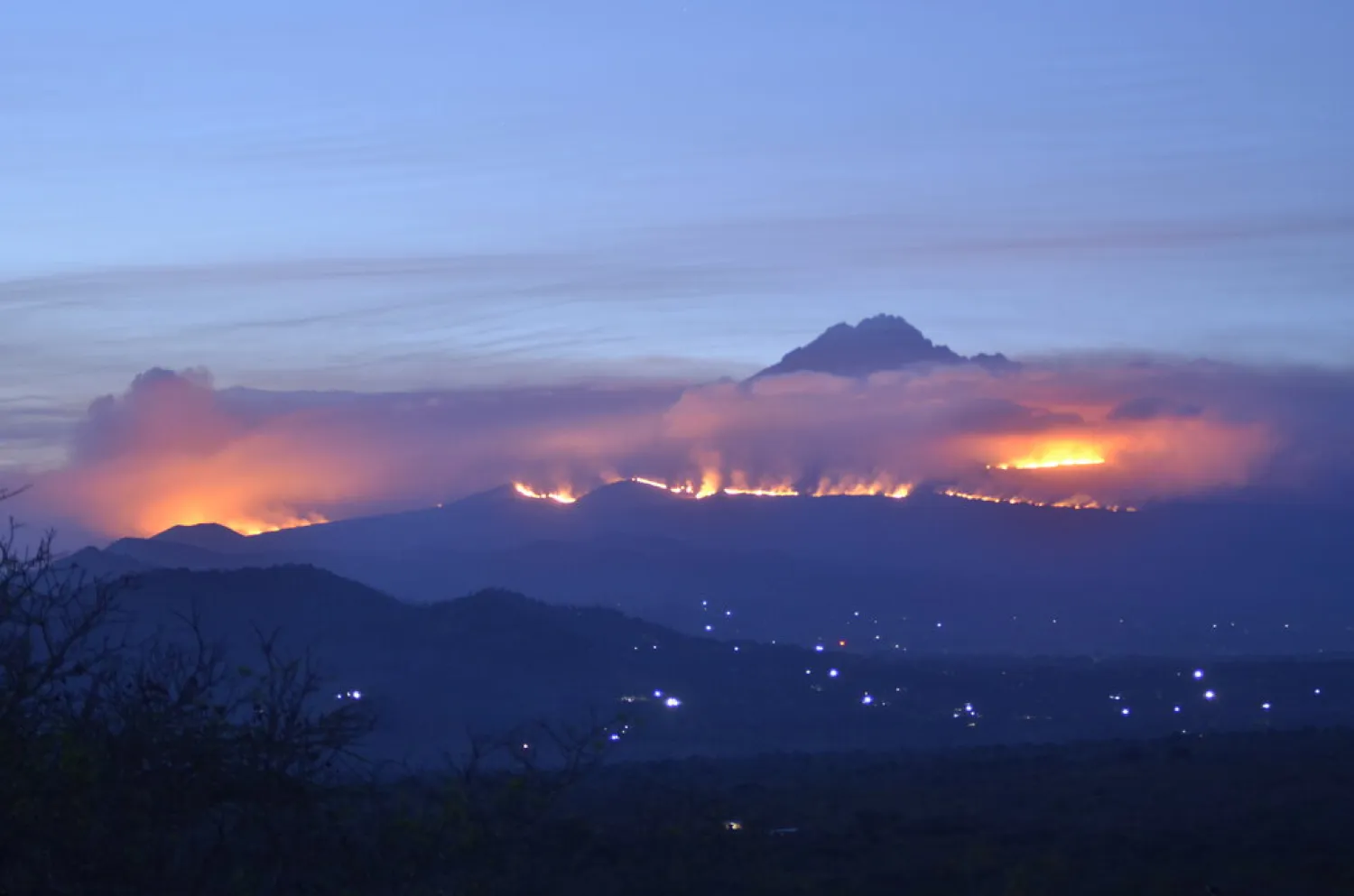
As fires swept up the slopes of Mount Kilimanjaro, Africa’s tallest mountain, for the fifth day on Thursday, hundreds of volunteers from local villages joined firefighters racing to stop a blaze threatening to ravage one of the world’s richest and most diverse ecosystems.

The fires, which first started to burn at a rest stop for climbers, have been raging for five days with dry grass and strong winds hampering efforts to bring the flames under control.

“This devastating fire is cutting through the most prestigious natural space in the whole of Tanzania,” Padili Mikomangwa, an environmentalist based in the port city of Dar es Salaam, said in a telephone interview. “The nation at large is following this seriously and shocked.”

Already, vast areas of forest and low shrubs have been reduced to embers. Videos and images from the scene showed volunteers struggling to put out the fires as thick white smoke hung heavy in the sky behind them.

Helicopters were set to be deployed on Thursday for the first time to help stop the fires.

With a summit of 5,895 meters, or 19,341 feet, Mount Kilimanjaro is the highest point in Africa and is considered the highest free-standing volcanic mass in the world. The mountain’s snow-capped peaks and the surrounding national park were declared a UNESCO World Heritage Site in 1987, with endemic plants and dozens of animal species, including endangered ones, calling it home.

In recent years, the mountain and the surrounding ecosystem have faced challenges including water and air pollution, intrusion on the park’s perimeters, illegal logging, and poaching. Climate change has also pushed the mountain’s glaciers and icecaps to thaw.

With thousands of climbers arriving each year, concern has grown in recent years that overtourism threatens the natural splendor of Kilimanjaro.

“The extent of the fire which we see today is at a new level,” Marcell Peters, a senior lecturer at the University of Würzburg in Germany who has studied the ecosystems of Kilimanjaro since 2010, said in an email.

He said that the loss of plant life — particularly Erica and Podocarpus trees — could leave the area more vulnerable to fire in the coming years.

Tanzanian parks officials said the fires began on Sunday at the Whona rest area, which is popular with mountaineers using the Mandara and Horombo routes to scale the mountain.

The authorities said an investigation into the origin of the blaze was underway, but preliminary evidence suggested that it was sparked accidentally by porters warming food for visitors.

“It was all bad luck,” Pascal Shelutete, an official with Tanzania National Parks, told journalists this week. “But we will continue to follow the issue in depth.”

In addition to the plants and forests that have been destroyed, the fires have also razed facilities used by tourists at the Horombo Center.

No deaths or injuries have been reported.

Officials estimate that the fire has so far destroyed an alpine area stretching over roughly two miles.

“We are still in the midst of putting out the fire,” Hamisi Kigwangalla, Tanzania’s minister of natural resources and tourism, said on Twitter on Thursday, a day after visiting the site of the fire. “The task is harder and bigger than it is thought to be.”

The mountain has long held a special place in the imagination of the world, written about extensively by visitors awed by its majesty.

For those who live in its shadow, it has been both a source of income and pride. When Tanzania gained its independence in December 1961, the new leader, Julius K. Nyerere, dispatched a team of climbers to ascend the continent’s highest peak.

They planted a torch, meant to serve as a metaphor for the aspirations of a nation.

However, with presidential elections set for Oct. 28, there is concern that the nation is sliding into autocratic rule.

Since President John Magufuli was elected in 2015, the government has cracked down on the media and civil society, passing laws targeted at silencing critical voices.

“It’s no coincidence that the Tanzanian government has increased its repression of the opposition, activists groups, and the media so close to the elections,” Oryem Nyeko, Africa researcher at Human Rights Watch, said in a statement. “Instead of upholding the right to free expression at this critical time, authorities have instead adopted measures that raise concerns about the elections being free and fair.”

He is facing off a slew of candidates, including Tundu Lissu, an opposition figure who survived an assassination attempt three years ago and is now back in the country. No one has ever been arrested in the case.

The nation of roughly 58 million people depends heavily on tourism, and Mr. Magufuli has been eager to draw people back to the country after the coronavirus pandemic ground everything to a halt around the world.

Five months ago, he declared the nation coronavirus-free, an announcement that public health officials and neighboring nations alike greeted with skepticism. Mr. Magufuli’s government has restricted reporting about the virus in Tanzania, according to Human Rights Watch.

Tourism has been allowed to resume, including at Mount Kilimanjaro.

Mr. Mikomangwa said that the authorities could learn from the disaster by better equipping parks and firefighters to respond to fires. “They are now scrambling for a few helicopters,” he said. “But this episode shows that we need to take robust measures to better care for our resources and ensure we end this fire once and for all.”

(The New York Times)


Iranians Chant Slogans Against Supreme Leader at Memorials for Slain Protesters

An Iranian man holds the Iranian national flag during a memorial ceremony for those killed in anti-government protests earlier last month, at the Mosalla mosque in Tehran, Iran, 17 February 2026. (EPA)
TT

Iranians Chant Slogans Against Supreme Leader at Memorials for Slain Protesters

An Iranian man holds the Iranian national flag during a memorial ceremony for those killed in anti-government protests earlier last month, at the Mosalla mosque in Tehran, Iran, 17 February 2026. (EPA)

Iranians shouted slogans against Supreme Leader Ali Khamenei on Tuesday as they gathered to commemorate protesters killed in a crackdown on nationwide demonstrations that rights groups said left thousands dead, according to videos verified by AFP.

The country's clerical authorities also staged a commemoration in the capital Tehran to mark the 40th day since the deaths at the peak of the protests on January 8 and 9.

Officials acknowledge more than 3,000 people died during the unrest, but attribute the violence to "terrorist acts", while rights groups say many more thousands of people were killed, shot dead by security forces in a violent crackdown.

The protests, sparked by anger over the rising cost of living before exploding in size and anti-government fervor, subsided after the crackdown, but in recent days Iranians have chanted slogans from the relative safety of homes and rooftops at night.

On Tuesday, videos verified by AFP showed crowds gathering at memorials for some of those killed again shouting slogans against the theocratic government in place since the 1979 revolution.

In videos geolocated by AFP shared on social media, a crowd in Abadan in western Iran holds up flowers and commemorative photos of a young man as they shout "death to Khamenei" and "long live the shah", in support of the ousted monarchy.

Another video from the same city shows people running in panic from the sounds of shots, though it wasn't immediately clear if they were from live fire.

In the northeastern city of Mashhad a crowd in the street chanted, "One person killed, thousands have his back", another verified video showed.

Gatherings also took place in other parts of the country, according to videos shared by rights groups.

- Official commemorations -

At the government-organized memorial in Tehran crowds carried Iranian flags and portraits of those killed as nationalist songs played and chants of "Death to America" and "Death to Israel" echoed through the Khomeini Grand Mosalla mosque.

Iranian President Masoud Pezeshkian attended a similar event at the Imam Reza shrine in Mashhad.

Authorities have accused sworn enemies the United States and Israel of fueling "foreign-instigated riots", saying they hijacked peaceful protests with killings and vandalism.

Senior officials, including First Vice President Mohammad Reza Aref and Revolutionary Guards commander Esmail Qaani, attended the ceremony.

"Those who supported rioters and terrorists are criminals and will face the consequences," Qaani said, according to Tasnim news agency.

International organizations have said evidence shows Iranian security forces targeted protesters with live fire under the cover of an internet blackout.

The US-based Human Rights Activists News Agency (HRANA) has recorded more than 7,000 killings in the crackdown, the vast majority protesters, though rights groups warn the toll is likely far higher.

More than 53,500 people have been arrested in the ongoing crackdown, HRANA added, with rights groups warning protesters could face execution.

Tuesday's gatherings coincided with a second round of nuclear negotiations between Iran and the United States in Geneva, amid heightened tensions after Washington deployed an aircraft carrier group to the Middle East following Iran's crackdown on the protests.


Independent UN Body Condemns ‘Vicious Attacks’ on UN Expert on Palestinian Rights

United Nations (UN) Special Rapporteur on the occupied Palestinian territories Francesca Albanese looks on at the end of a press conference on the human rights situation in Gaza in Geneva on September 15, 2025. (AFP)
TT

Independent UN Body Condemns ‘Vicious Attacks’ on UN Expert on Palestinian Rights

United Nations (UN) Special Rapporteur on the occupied Palestinian territories Francesca Albanese looks on at the end of a press conference on the human rights situation in Gaza in Geneva on September 15, 2025. (AFP)

An ‌independent United Nations body on Tuesday condemned what it described as vicious attacks based on disinformation by several European ministers against the organization's special rapporteur for Palestine, Francesca Albanese.

In the past week several European countries, including Germany, France and Italy, called for Albanese’s resignation over her alleged criticism of Israel. Albanese, an Italian lawyer, denies making the remarks.

On Friday, the Czech Republic's Foreign Minister Petr Macinka quoted Albanese on X as having called Israel a "common enemy of humanity", and he ‌also called for ‌her resignation.

A transcript of Albanese's remarks ‌made ⁠in Doha on ⁠February 7 seen by Reuters did not characterize Israel in this way, although she has consistently criticized the country in the past over the Gaza conflict.

The UN Coordination Committee - a body of six independent experts which coordinates and facilitates the work of Special Rapporteurs - accused European ministers of relying on "manufactured ⁠facts".

"Instead of demanding Ms. Albanese's resignation ‌for performing her mandate...these government representatives ‌should join forces to hold accountable, including before the International Criminal Court, ‌leaders and officials accused of committing war crimes and ‌crimes against humanity in Gaza," the Committee said.

It said the pressure exerted on Albanese was part of an increasing trend of politically motivated and malicious attacks against independent human rights experts, UN officials ‌and judges of international courts.

US President Donald Trump's administration imposed sanctions on Albanese after she wrote ⁠letters ⁠to US companies accusing them of contributing to gross human rights violations by Israel in Gaza and the West Bank.

UN experts are commissioned by the Geneva-based Human Rights Council to monitor and document specific human rights crises but are independent of the organization itself.

There is no precedent for removing a special rapporteur during their term, although diplomats said that states on the 47-member council could in theory propose a motion to do so.

However, they said strong support for Palestinian rights within the body means that such a motion was unlikely to pass.


US Plans to Deploy More Missile Launchers to the Philippines Despite China’s Alarm 

A US M142 High Mobility Artillery Rocket System (HIMARS) fires a missile during a Combined Joint Littoral Live Fire Exercise at the joint military exercise called "Balikatan", Tagalog for shoulder-to-shoulder in a Naval station in Zambales province, northern Philippines on Wednesday, April 26, 2023. (AP)
TT

US Plans to Deploy More Missile Launchers to the Philippines Despite China’s Alarm 

A US M142 High Mobility Artillery Rocket System (HIMARS) fires a missile during a Combined Joint Littoral Live Fire Exercise at the joint military exercise called "Balikatan", Tagalog for shoulder-to-shoulder in a Naval station in Zambales province, northern Philippines on Wednesday, April 26, 2023. (AP)

The United States plans to deploy more high-tech missile systems to the Philippines to help deter aggression in the South China Sea, where the treaty allies on Tuesday condemned what they called China’s "illegal, coercive, aggressive, and deceptive activities."

Beijing has repeatedly expressed alarm over the installation in the northern Philippines of a US mid-range missile system called the Typhon in 2024 and of an anti-ship missile launcher last year. It said the US weapons were aimed at containing China’s rise and warned that these were a threat to regional stability.

China has asked the Philippines to withdraw the missile launchers from its territory, but officials led by President Ferdinand Marcos Jr. have rejected the demand.

US and Philippine officials held annual talks Monday in Manila on broadening security, political and economic engagements and boosting collaboration with regional security allies.

The US and the Philippines outlined in a joint statement Tuesday specific defense and security plans for this year, including joint military exercises, Washington's support to help modernize the Philippine military and efforts "to increase deployments of US cutting-edge missile and unmanned systems to the Philippines."

The longtime allies "underscored their support for preserving freedom of navigation and overflight, unimpeded lawful commerce and other lawful uses of the sea for all nations," the statement said.

"Both sides condemned China’s illegal, coercive, aggressive and deceptive activities in the South China Sea, recognizing their adverse effects on regional peace and stability and the economies of the Indo-Pacific and beyond," it added.

Confrontations between Chinese and Philippine coast guard forces have spiked in the disputed waters in recent years. Vietnam, Malaysia, Brunei and Taiwan are also involved in the territorial standoffs.

Neither side elaborated on the planned missile deployments but Philippine ambassador to Washington, Jose Manuel Romualdez, who took part in Monday’s talks, said US and Filipino defense officials discussed the possible deployment this year of "upgraded" types of US missile launchers that the Philippines may eventually decide to purchase.

"It’s a kind of system that’s really very sophisticated and will be deployed here in the hope that, down the road, we will be able to get our own," Romualdez told The Associated Press.

The Typhon missile system that the US Army deployed to the main northern Philippine region of Luzon in April 2024 and an anti-missile launcher called the Navy Marine Expeditionary Ship Interdiction System that was deployed in April last year also to Luzon have remained in the Philippines, Romualdez said.

During joint drills, US forces have exhibited the missile systems to batches of Filipino forces to familiarize them with the weapons’ capabilities and usage, military officials said.

Romualdez said the US missile deployments to the Philippines did not aim to antagonize any country.

"It’s purely for deterrence," he said. "Every time the Chinese show any kind of aggression, it only strengthens our resolve to have these types."

The Typhon missile launchers, a land-based weapon, can fire the Standard Missile-6 and the Tomahawk Land Attack Missile. Tomahawk missiles can travel over 1,000 miles (1,600 kilometers), which places China within their target range, from the northern Philippine region of Luzon.

Last year, the US Marines deployed the anti-ship missile launcher, the Navy Marine Expeditionary Ship Interdiction System, to Batan island in the northernmost Philippine province of Batanes, which faces the Bashi Channel just south of Taiwan.

The sea passage is a critical trade and military route that the US and Chinese militaries have tried to gain strategic control of.
