


Satellite Photos Show Construction at Iran Nuclear Site

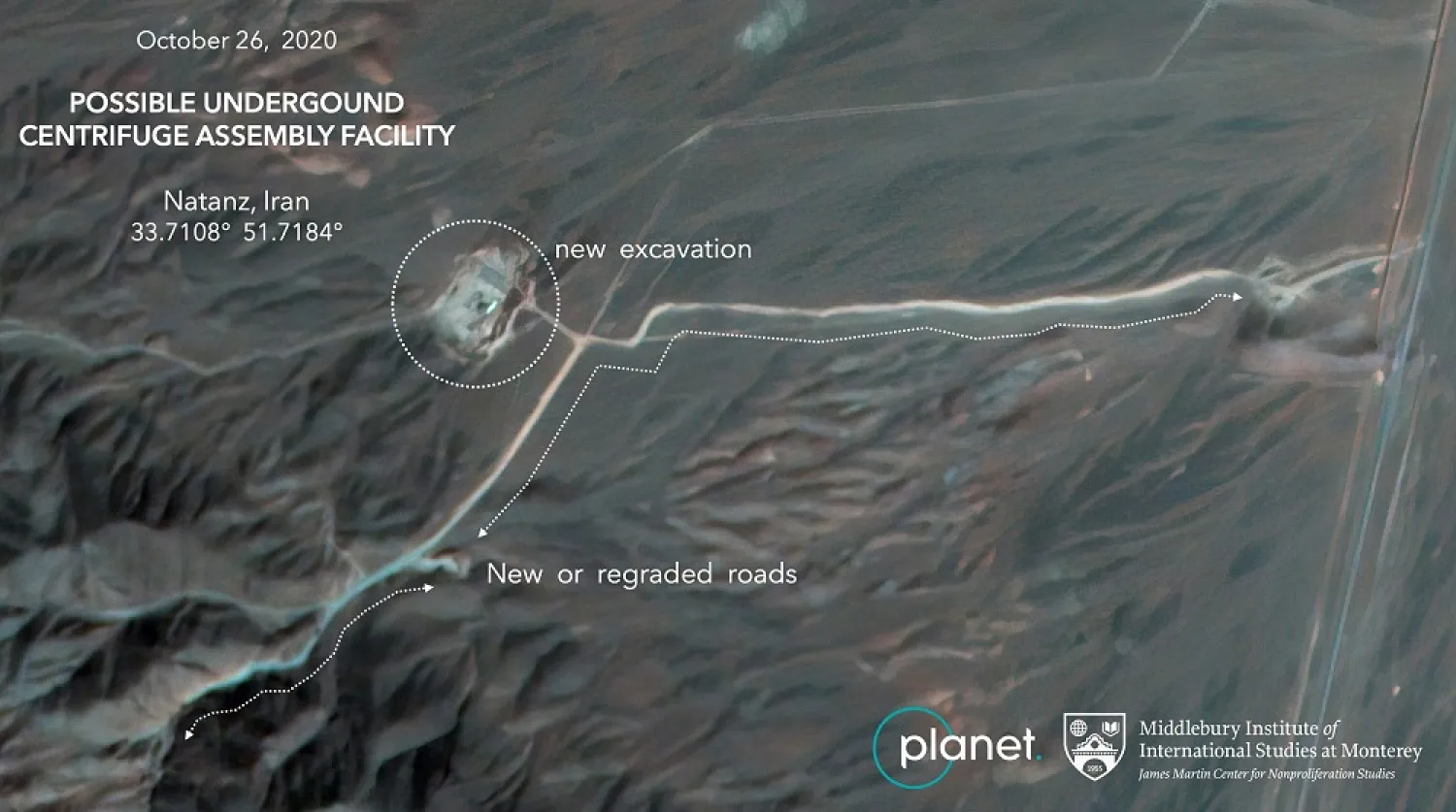
This Oct. 26, 2020, satellite image that has been annotated by experts at the James Martin Center for Nonproliferation Studies at Middlebury Institute of International Studies shows construction at the Natanz nuclear facility. (Planet Labs Inc. via AP)
TT

Satellite Photos Show Construction at Iran Nuclear Site

This Oct. 26, 2020, satellite image that has been annotated by experts at the James Martin Center for Nonproliferation Studies at Middlebury Institute of International Studies shows construction at the Natanz nuclear facility. (Planet Labs Inc. via AP)

Iran has begun construction at its Natanz nuclear facility, satellite images released Wednesday show, just as the UN nuclear agency acknowledged Tehran is building an underground advanced centrifuge assembly plant after its last one exploded in a reported sabotage attack last summer.

The construction comes as the US nears Election Day in a campaign pitting President Donald Trump, whose maximum pressure campaign against Iran has led Tehran to abandon all limits on its atomic program, and Joe Biden, who has expressed a willingness to return to the accord. The outcome of the vote likely will decide which approach America takes. Heightened tensions between Iran and the US nearly ignited a war at the start of the year.

Since August, Iran has built a new or regraded road to the south of Natanz toward what analysts believe is a former firing range for security forces at the enrichment facility, images from San Francisco-based Planet Labs show. A satellite image Monday shows the site cleared away with what appears to be construction equipment there.

Analysts from the James Martin Center for Nonproliferation Studies at the Middlebury Institute of International Studies say they believe the site is undergoing excavation.

“That road also goes into the mountains so it may be the fact that they’re digging some kind of structure that’s going to be out in front and that there’s going to be a tunnel in the mountains," said Jeffrey Lewis, an expert at the institute who studies Iran's nuclear program. "Or maybe that they’re just going to bury it there.”

Iran's mission to the United Nations did not immediately respond to an Associated Press request for comment. Ali Akbar Salehi, the head of the Atomic Energy Organization of Iran, last month told state television the destroyed above-ground facility was being replaced with one “in the heart of the mountains around Natanz.”

Rafael Grossi, the director-general of the International Atomic Energy Agency, told the AP on Tuesday that his inspectors were aware of the construction. He said Iran had previously informed IAEA inspectors, who continue to have access to Iran's sites despite the collapse of the nuclear deal.

“It means that they have started, but it’s not completed. It’s a long process," Grossi said.

Trump in 2018 unilaterally withdrew the US from Iran's nuclear deal with world powers, in which Tehran agreed to limit its uranium enrichment in exchange for the lifting of economic sanctions. When the US ramped up sanctions, Iran gradually and publicly abandoned those limits as a series of escalating incidents pushed the two countries to the brink of war at the beginning of the year.

Iran now enriches uranium to up to 4.5% purity, and according to the last IAEA report, had a stockpile of 2,105 kilograms (2.32 tons). Experts typically say 1,050 kilograms (1.15 tons) of low-enriched uranium is enough material to be re-enriched up to weapons-grade levels of 90% purity for one nuclear weapon.

Iran’s so-called “breakout time” — the time needed for it to build one nuclear weapon if it chose to do so — is estimated now to have dropped from one year under the deal to as little as three months. Iran maintains its nuclear program is for peaceful purposes, though Western countries fear Tehran could use it to pursue atomic weapons.

Natanz, built underground to harden it against airstrikes, long has been at the center of those fears since its discovery in 2002. Centrifuges there still spin in vast halls under 7.6 meters (25 feet) of concrete. Air defense positions surround the facility in Iran's central Isfahan province.

Despite being one of the most-secure sites in Iran, Natanz was targeted by the Stuxnet computer virus — believed to be the creation of the US and Israel — before the nuclear deal.

In July, a fire and explosion struck its advanced centrifuge assembly facility in an incident Iran later described as sabotage. Suspicion has fallen on Israel, despite a claim of responsibility by a previously unheard-of group.

There have been tensions with the IAEA and Iran even at Natanz, with Tehran accusing one inspector of testing positive for explosives last year. However, so far inspectors have been able to maintain their surveillance. something Lewis described as very important.

“As long as they declared to the IAEA in the proper time frame, there’s no prohibition on putting things underground,” he said. “For me, the real red line would be if the Iranians started to stonewall the IAEA."

For now, it remains unclear how deep Iran will put this new facility. And while the sabotage will delay Iran in assembling new centrifuges, Lewis warned the program ultimately would regroup as it had before and continue accumulating ever-more material beyond the scope of the abandoned nuclear deal.

“We buy ourselves a few months," he said. "But what good is a few months if we don’t know what we’re going to use it for?”



Trump Hints at Land Strike as Venezuela Pressure Mounts

A US Air Force C-130J Super Hercules aircraft approaches for landing at Rafael Hernandez Airport, amid tensions between US President Donald Trump's administration and the government of Venezuelan President Nicolas Maduro, in Aguadilla, Puerto Rico, December 28, 2025. (Reuters)
TT

Trump Hints at Land Strike as Venezuela Pressure Mounts

A US Air Force C-130J Super Hercules aircraft approaches for landing at Rafael Hernandez Airport, amid tensions between US President Donald Trump's administration and the government of Venezuelan President Nicolas Maduro, in Aguadilla, Puerto Rico, December 28, 2025. (Reuters)

A throwaway remark last week by President Donald Trump has raised questions about whether US forces may have carried their first land strike against drug cartels in Venezuela.

Trump said the US knocked out a "big facility" for producing trafficking boats, as he was discussing his pressure campaign against Venezuelan President Nicolas Maduro in an interview broadcast Friday.

"They have a big plant or a big facility where they send, you know, where the ships come from," Trump said in an interview with billionaire supporter John Catsimatidis on the WABC radio station in New York.

"Two nights ago we knocked that out. So we hit them very hard."

Trump did not say where the facility was located or give any other details. US forces have carried out numerous strikes in both the Caribbean Sea and eastern Pacific Ocean since September, killing more than 100 people.

The Pentagon referred questions about Trump's remarks to the White House. The White House did not respond to requests for comment from AFP.

There has been no official comment from the Venezuelan government.

Trump has been saying for weeks that the United States will "soon" start carrying out land strikes targeting drug cartels in Latin America, but there have been no confirmed attacks to date.

The Trump administration has been ramping up pressure on Maduro, accusing the Venezuelan leader of running a drug cartel himself and imposing an oil tanker blockade.

Maduro has accused Washington of attempting regime change.


UN Chief Says ‘Get Serious’ in Grim New Year Message

 UN Secretary-General Antonio Guterres. (AFP)
UN Secretary-General Antonio Guterres. (AFP)
TT

UN Chief Says ‘Get Serious’ in Grim New Year Message

 UN Secretary-General Antonio Guterres. (AFP)
UN Secretary-General Antonio Guterres. (AFP)

The United Nations urged global leaders Monday to focus on people and the planet in a New Year's message depicting the world in chaos.

"As we enter the new year, the world stands at a crossroads. Chaos and uncertainty surround us. Division. Violence. Climate breakdown. And systemic violations of international law," UN Secretary-General Antonio Guterres said in a video message.

In 2026, as war rages in Ukraine and elsewhere, world leaders must work to ease human suffering and fight climate change, he added.

"I call on leaders everywhere: Get serious. Choose people and planet over pain," said Guterres, criticizing the global imbalance between military spending and financing for the poorest countries.

Military spending is up nearly 10 percent this year to $2.7 trillion, which is 13 times total world spending on development aid and equivalent to the entire gross domestic product of Africa, he said.

Wars are raging at levels unseen since World War II, he added.

"In this New Year, let's resolve to get our priorities straight. A safer world begins by investing more in fighting poverty and less in fighting wars. Peace must prevail," said Guterres, who will be serving his last year as secretary general.


Türkiye and Armenia Agree to Simplify Visa Procedures to Normalize Ties

Türkiye’s President Recep Tayyip Erdogan, right, and Armenia's Prime Minister Nikol Pashinyan shake hands before a meeting at Prague Castle in Prague, Czech Republic, Thursday, Oct. 6, 2022. (Turkish Presidency via AP, File)
TT

Türkiye and Armenia Agree to Simplify Visa Procedures to Normalize Ties

Türkiye’s President Recep Tayyip Erdogan, right, and Armenia's Prime Minister Nikol Pashinyan shake hands before a meeting at Prague Castle in Prague, Czech Republic, Thursday, Oct. 6, 2022. (Turkish Presidency via AP, File)

Türkiye and Armenia have agreed to simplify visa procedures as part of efforts to normalize ties, Türkiye’s Foreign Ministry announced Monday, making it easier for their citizens to travel between the two countries.

Relations between Türkiye and Armenia have long been strained by historic grievances and Türkiye’s alliance with Azerbaijan. The two neighboring countries have no formal diplomatic ties and their joint border has remained closed since the 1990s.

The two countries, however, agreed to work toward normalization in 2021, appointing special envoys to explore steps toward reconciliation and reopening the frontier. Those talks have progressed in parallel with efforts to ease tensions between Armenia and Azerbaijan.

Türkiye supported Azerbaijan during its 2020 conflict with Armenia for control of the Karabakh region, known internationally as Nagorno-Karabakh, a territorial dispute that had lasted nearly four decades.

The Turkish Foreign Ministry said in a statement posted on social platform X that Ankara and Yerevan agreed that holders of diplomatic, special and service passports from both countries would be able to obtain electronic visas free of charge as of Jan. 1.

“On this occasion, Türkiye and Armenia reaffirm once again their commitment to continue the normalization process between the two countries with the goal of achieving full normalization without any preconditions,” the ministry said.

Türkiye and Armenia also have a more than century-old dispute over the deaths of an estimated 1.5 million Armenians in massacres, deportations and forced marches that began in 1915 in Ottoman Türkiye. Historians widely view the event as genocide.

Türkiye denies the deaths constituted genocide, saying the toll has been inflated and those killed were victims of civil war and unrest. It has lobbied to prevent countries from officially recognizing the massacres as genocide.