



Moscow Turns Ice Rink Into Hospital as Russia's COVID-19 Cases Hit Record

A general view of treatment blocks at a temporary hospital in the Krylatskoye Ice Palace, where patients suffering from the coronavirus disease (COVID-19) are treated, in Moscow, Russia November 13, 2020. REUTERS/Maxim Shemetov
TT

Moscow Turns Ice Rink Into Hospital as Russia's COVID-19 Cases Hit Record

A general view of treatment blocks at a temporary hospital in the Krylatskoye Ice Palace, where patients suffering from the coronavirus disease (COVID-19) are treated, in Moscow, Russia November 13, 2020. REUTERS/Maxim Shemetov

Russia reported a record 22,778 new daily coronavirus cases on Monday as the authorities in Moscow turned to a temporary hospital built inside an ice rink to handle the influx of COVID-19 patients.

The country of about 145 million people has started opening temporary clinics and re-purposing hospitals in the capital and other cities to relieve the strain on its medical system.

In Moscow, the Krylatskoe Ice Palace, known for hosting international speed skating competitions, is now on the frontline after being converted into a temporary hospital for COVID-19 patients. It opened last month.

Though better resourced than other regions, authorities in Moscow are under severe pressure. They reported 6,360 new infections in the Russian capital on Monday.

More than 1,300 hospital beds equipped with oxygen tanks cover the former ice rink's 400-meter speed skating track, with more than 100 doctors and nurses deployed.

"Only its design differentiates it from a regular hospital," Chief Doctor Andrei Shkoda told Reuters, wearing a medical mask and laboratory coat.

The facility, he said, is equipped with all necessary equipment to treat and diagnose the illness, including a CT scanner. It is currently treating about 600 people, with between 60 to 80 new patients being admitted and released every day.

"We prepared very well, which wasn't the case in the spring (at the start of the pandemic)," Shkoda said. "Since then, we have prepared clinical protocols, gained experience in the fight against the coronavirus..."

Despite a recent surge in cases, Russian authorities have resisted imposing lockdown restrictions across the country as they did earlier this year, stressing instead the importance of hygiene, social distancing, and imposing targeted measures in certain regions. Authorities in the Siberian region of Buryatia, which borders Mongolia, on Monday closed restaurants, shopping malls, bars, and public facilities for two weeks in a bid to stem the virus.

The region, which recorded 271 new cases in the last 24 hours, is the first in Russia to impose harsh restrictions in response to the pandemic's second wave.

"The number of patients is not decreasing," Alexei Tsydenov, the regional governor, said in a video address. "There is a shortage of medicine in the pharmacy network. More and more hospital beds are needed every day."

With 1,948,603 infections since the start of the pandemic, Russia has the fifth largest number of cases in the world behind the United States, India, Brazil, and France.

Russian authorities reported 303 coronavirus-related deaths in the last 24 hours, taking the national death toll to 33,489.



Iran Partially Restores Internet Access After Months-Long Shutdown

People walk past shops along Valiasr Square in Tehran on May 26, 2026. (AFP)
TT

Iran Partially Restores Internet Access After Months-Long Shutdown

People walk past shops along Valiasr Square in Tehran on May 26, 2026. (AFP)

Iranian authorities partially restored internet connectivity Tuesday after an almost three-month shutdown imposed against the backdrop of the war against Israel and the US, said a monitor, a senior official and sources inside the country.

The shutdown left Iranians largely cut off from international networks, with only a domestic intranet working for daily tasks like shopping, ride-hailing and education.

"Live metrics show a partial restoration to internet connectivity in Iran on day 88," of the shutdown, monitor Netblocks said on X, saying it was "unclear" if this meant a permanent end to the "longest nationwide internet shutdown in modern history".

Vice President Mohammad Reza Aref said in a post on X that the "first step toward free and regulated access to cyberspace has been taken," adding that the demands of Iranians "will be fulfilled."

State news agency IRNA and Fars news agency said "full international internet connectivity has been restored" for users of fixed broadband services, but this had not been confirmed by internet monitor NetBlocks.

Witnesses inside Iran also told AFP that mobile internet remains cut but home internet with Wi-Fi had been restored, even though VPNs were still needed to access some social media.

"A few minutes ago I could open international websites using my home internet provider," said a 22-year-old woman from the western city of Kermanshah, asking not to be named.

A user in Tehran said the internet service for his company in Tehran has been restored but "mobile connection remained the same" without any access. Others reported that general access remained extremely patchy.

- 'Long way to go' -

The shutdown imposed when war erupted on February 28 followed a similar blackout imposed from January 8 as the country was rocked by mass anti-government protests.

Activists said that the January closure was aimed at masking the scale of a crackdown on the protests, which left thousands dead according to rights groups, as well as preventing more demonstrations.

Doug Madory, head of internet analysis at US network monitoring firm Kentik, said the partial restoration needed to be kept "in perspective".

"Iran has a long way to go to get back to pre-Jan-8 levels of traffic volumes," he wrote on X.

The shutdown had also caused considerable debate inside Iran with the administration of President Masoud Pezeshkian -- regarded as a more moderate figure -- impatient to end a measure which was also hugely damaging for the economy.

However, Pezeshkian by no means has the final say on such issues.

Yaghoub Rezazadeh, member of Iran's national security commission at the parliament, told the Hamshahri daily Monday that the final decision on such issues "rests with the Supreme National Security Council" under hardliner Mohammad Bagher Zolghadr.

Iran's judiciary earlier Tuesday suspended a fledging presidential body that had ordered the restoration of the internet.

The Special Headquarters for Organizing and Governing the Country's Cyberspace was formed on May 12 by Pezeshkian.

The body had on Monday reached a decision to "restore the internet" in Iran, according to government spokeswoman Fatemeh Mohajerani, after local media reported that Pezeshkian had decreed the measure.

Supreme leader Mojtaba Khamenei, who has yet to appear in public since his father and predecessor Ali Khamenei was killed at the start of the war, meanwhile is in theory the country's number one figure.

Some Iranians expressed glee on social media over the restoration of a degree of connectivity.

"YouTube without a VPN!!! Oh my God, am I dreaming?" wrote one on X.

"Hello my dear Twitter," said another, using the former name for X.


Police Fire Tear Gas to Break Up Türkiye Opposition Protest

Türkiye’s Republican People's Party (CHP) ousted leader Ozgur Ozel stands atop of a bus as he delivers a speech during a rally, days after a court dismissed him from office, in Izmir on May 26, 2026. (AFP)
TT

Police Fire Tear Gas to Break Up Türkiye Opposition Protest

Türkiye’s Republican People's Party (CHP) ousted leader Ozgur Ozel stands atop of a bus as he delivers a speech during a rally, days after a court dismissed him from office, in Izmir on May 26, 2026. (AFP)

Riot police in Türkiye fired tear gas and water cannon to break up a rally called by ousted opposition leader Ozgur Ozel Tuesday, days after a court dismissed him from office.

The protest in Izmir came two days after riot police battered their way into the main opposition CHP's headquarters in the capital Ankara, firing tear gas and beating party members before throwing them out, Ozel told AFP on Sunday.

The dramatic scenes followed a shock court ruling on Thursday that overturned a 2023 party primary that elected Ozel.

It was the latest in a string of moves against the CHP, Türkiye's oldest political party, which scored a major political win over President Recep Tayyip Erdogan's ruling AKP in 2024 local elections and has been rising in the polls.

Since the court ruling, the party has been in chaos.

Ozel called the lunchtime rally in Izmir as Türkiye was poised to shut down for the four-day Eid al-Fitr holiday, which begins on Wednesday.

Ahead of the rally, the governorate ordered the closure of the city's central Cumhuriyet Square, deploying a large number of riot police with water cannon trucks who tried to break up the flag-waving crowd, Turkish media reported.

"President Ozgur, free Türkiye!" they shouted in scenes broadcast live on TV.

- 'Let's compete' -

Thursday's shock court ruling overturned the 2023 party primary that elected Ozel, ordering his defeated rival Kemal Kilicdaroglu, a lackluster ineffective politician, to resume his position as CHP leader.

In Izmir, thousands of chanting demonstrators waved flags as Ozel addressed the crowd from the top of a bus, urging Kilicdaroglu to agree to a party congress "immediately" so members could choose their leader.

"Bring whoever you want as a delegate and let's compete," he said, directly challenging Kilicdaroglu to hold a party primary "within a week or two" of Eid al-Fitr which ends Saturday.

The ousting of CHP's elected leadership was "not an internal matter for the party," he said.

"Anyone who sees it that way is deceiving the people... this is between the people and Erdogan," Ozel said.

"The issue is about stopping a party that is on the march toward ultimate power."

The court case concerned allegations of vote-buying at the 2023 primary, but was thrown out by an Ankara court in October for lack of substance only to be overturned on appeal.

The assault on the CHP began in earnest with the jailing of Istanbul mayor Ekrem Imamoglu, Erdogan's main political rival and the party's presidential candidate, on charges widely seen as political.

"Erdogan has lost all restraint," Ozel told AFP late Sunday.

"Just as he imprisoned the presidential candidate who could defeat him, he is now effectively shutting down the political party that could defeat him," he said.

"Türkiye has ceased to be a modern democratic republic and has turned into a one-man regime."


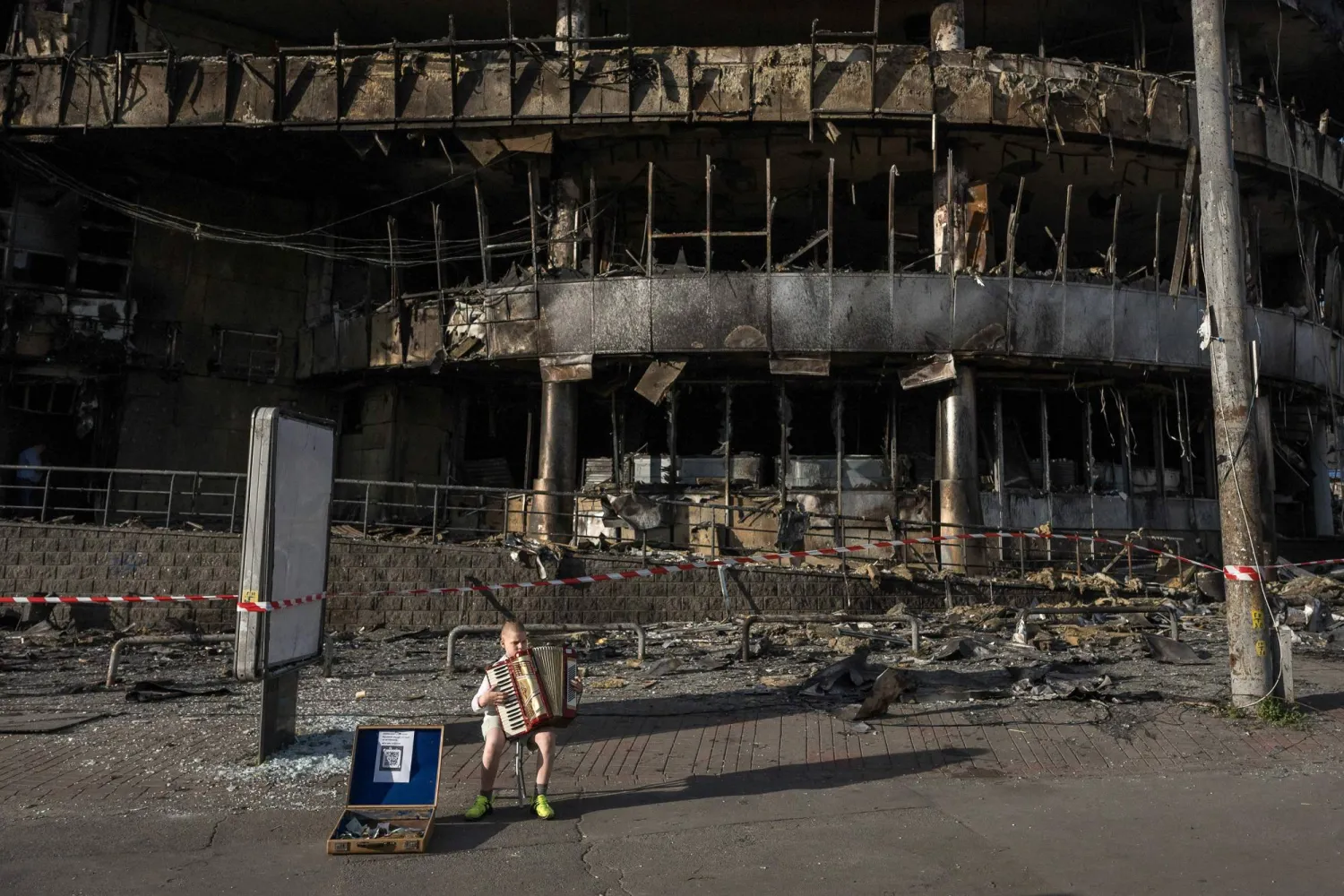
Russian Call for Diplomats to Leave Kyiv Draws Western Backlash

A boy plays the accordion in front of a shopping center damaged by Russian strikes in Kyiv on May 25, 2026, amid the Russian invasion of Ukraine. (AFP)
TT

Russian Call for Diplomats to Leave Kyiv Draws Western Backlash

A boy plays the accordion in front of a shopping center damaged by Russian strikes in Kyiv on May 25, 2026, amid the Russian invasion of Ukraine. (AFP)

Russia's call for diplomats and foreigners to leave Kyiv over the threat of fresh strikes drew a sharp backlash from Western countries on Tuesday, some of whom accused Moscow of escalating the more than four-year war. 

Russia announced Monday it had started a campaign of "systematic" strikes on Kyiv, after battering Ukraine with hundreds of drones and a hypersonic missile over the weekend. 

It said the strikes would target the Ukrainian capital's "decision-making centers" and urged foreign citizens and diplomats "to leave the city as soon as possible", as well as for Kyiv residents to avoid public buildings. 

Ukraine called the threats "blackmail" and encouraged its allies to ignore the warning, while several Western diplomatic missions announced they had no plans to evacuate their staff. 

Almost 50 countries condemned what they said were threats by Russia against embassies in Ukraine in a joint statement at the United Nations on Tuesday. 

"We also condemn recent threats by Russia to diplomatic institutions and embassies in Kyiv. This is something which we cannot accept," the joint statement delivered by Ukrainian UN representative Andriy Melnyk said. 

The statement was signed by European countries, Japan, South Korea and others. 

The European Union also lashed out at Russia's threat, saying it had no plans to move its staff, while Germany and Norway summoned Russia's ambassador over the move. 

A spokesperson for France's foreign ministry said Monday that evacuating diplomatic staff from Kyiv was "out of the question." 

Russia's threat came after weeks of escalating strikes between the two sides, and as US-led talks aimed at ending the conflict remained largely frozen over the Iran war. 

Russia last week accused Ukraine of hitting a vocational school in the Russian-occupied Lugansk region, killing 21 people, while a massive attack on Ukraine's capital the week before killed 24, according to Ukrainian authorities. 

Both sides deny targeting civilians. 

UN Secretary-General Antonio Guterres said on Tuesday he was "deeply concerned" by Russia's announcement. 

"We condemned the attack on the school – as we condemn all attacks on ‌civilians and civilian infrastructure, wherever they occur," he said.  

"Now ⁠more ⁠than ever, it is imperative to avoid any escalation of a conflict that has already exacted a devastating toll on civilians, and that risks making the search for peace even more distant, prolonging the suffering of people," Guterres added. 

US Secretary of State Marco Rubio said Tuesday that Washington remained ready to mediate in the conflict. 

"Every time you see these big strikes from one side or the other, it's a reminder of why this is a terrible war that's now gone on longer than the Second World War, and it needs to come to an end," Rubio told reporters during an official visit to India. 

He was referring to the length of WWII for Moscow, which entered the war in June 1941 when Nazi Germany invaded the USSR, with the conflict ending in May 1945 with Germany's surrender. 

- Drone threats - 

Both Russia and Ukraine exchanged strikes on Tuesday. 

A Ukrainian drone attack killed one person in Russia's Belgorod border region, local authorities said, while Russian strikes on Ukraine left several wounded, according to Ukrainian officials. 

Drones have also routinely crossed the airspace of the three Baltic nations, incidents that have forced citizens to seek shelter and prompted NATO to scramble jets. 

The drones are thought to be of Ukrainian origin but are sometimes deflected into the Baltics by electronic jamming, according to European and Ukrainian officials. 

Russia has accused the Baltics of offering their airspace as a springboard for attacks on Russia, an accusation that NATO and Ukraine deny. 

EU chief Ursula von der Leyen said Tuesday that Russia bore ultimate responsibility for the incidents. 

"People in the Baltic countries have been experiencing what many believed belonged to another era," von der Leyen said, standing alongside the presidents of Lithuania, Latvia and Estonia. 

"Air raid alerts, families sheltering, schools closing, transport interrupted. This is the reality on Europe's eastern border in 2026," she said. 

"These are not isolated incidents. This is a deliberate strategy from Russia, trying to destabilize our democratic societies." 

Since Russia launched its full-scale offensive in 2022, hundreds of thousands of people have died, millions have been forced to flee their homes and parts of eastern and southern Ukraine have been decimated by fighting. 

Russia currently occupies around a fifth of Ukraine: the entirety of the Crimean peninsula, which it annexed in 2014, most of the eastern regions of Donetsk and Lugansk -- collectively referred to as the Donbas -- and large parts of the southern Zaporizhzhia and Kherson regions. 

The conflict has spiraled into Europe's deadliest since World War II.