

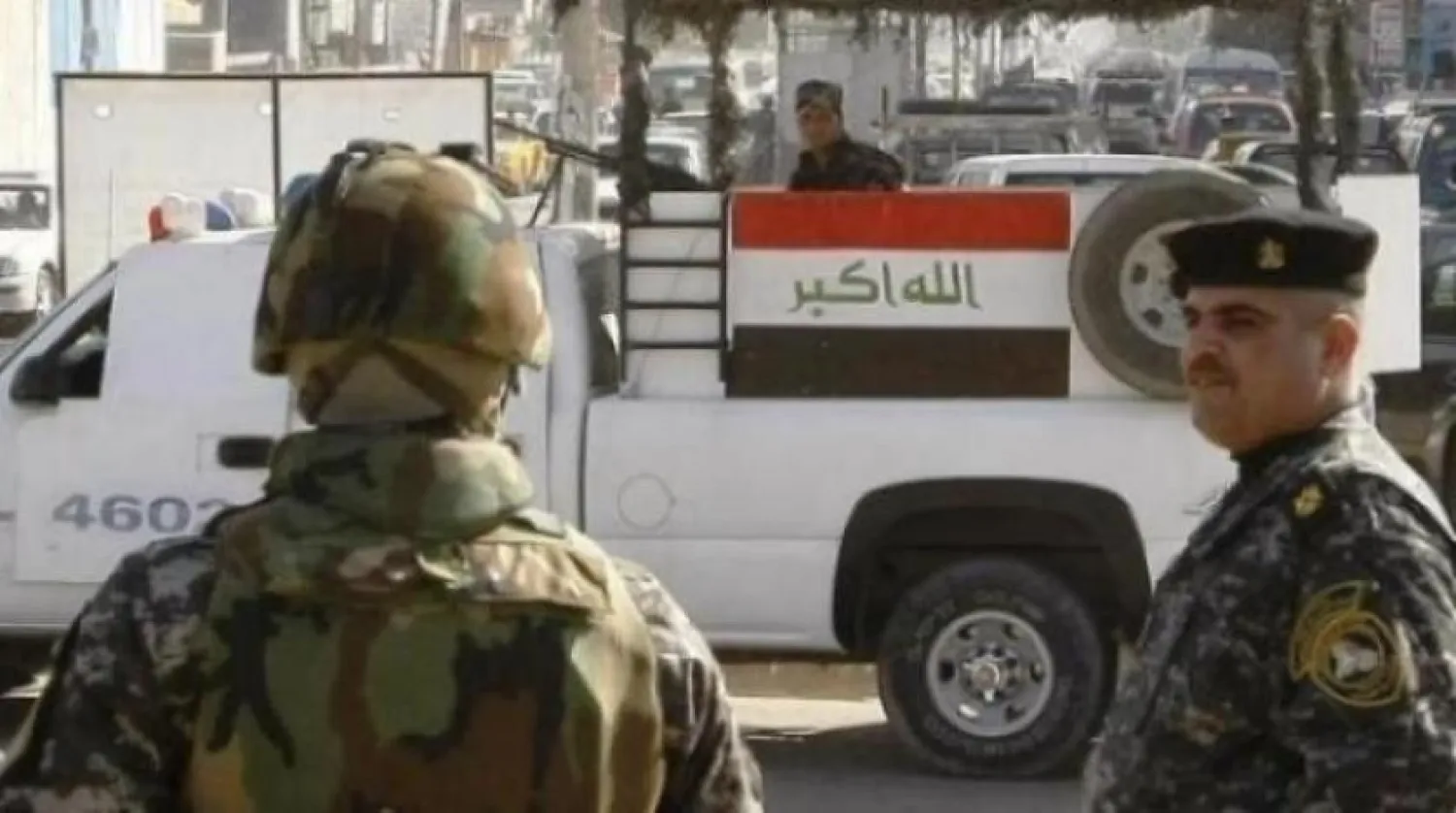

Mourning after Deadly ISIS Attack North of Baghdad

Iraqi security forces. Reuters file photo
TT

Mourning after Deadly ISIS Attack North of Baghdad

Iraqi security forces. Reuters file photo

Iraq's Salahaddin province declared three days of mourning from Sunday over a deadly attack blamed on ISIS, as some criticized the state for failing to fight back extremists.

Late Saturday, a roadside bomb hit a civilian car on an open road about 200 kilometers north of Baghdad, police and a local official said.

When security forces arrived to the scene, militants opened fire on them.

The attack killed at least six Iraqi security personal and four civilians, including one who died of his wounds overnight, according to local medics.

There was no claim by ISIS but both the mayor and police blamed the group, which Iraq's government said it had defeated in late 2017.

Two weeks ago, 11 people were killed in an ISIS attack on a lookout post at Al-Radwaniyah on Baghdad's outskirts.

The attacks have coincided with a new campaign by Iraq's security forces to arrest militants in hiding across the country -- but some say it has not been enough.

"Iraqi security forces just assured us this area had been cleaned," wrote Mashaan al-Jaboury, an MP representing Salahaddin, on Twitter late Saturday.

For Jamal al-Dhari, writing on Twitter, the latest ambush "sheds light on the repeated failures in the fight against terrorism."

"The government of Mustafa al-Kadhimi must seriously put in placed a national strategy... and stop being satisfied with 'investigative committees,'" said Dhari.



Lebanon President Says Israel Must 'Fully Implement Ceasefire' before Talks

 Smoke rises following an Israeli airstrike in a southern Lebanese village, as seen from the Upper Galilee 29 April 2026, amid a ceasefire between Israel and Lebanon.  EPA/ATEF SAFADI
Smoke rises following an Israeli airstrike in a southern Lebanese village, as seen from the Upper Galilee 29 April 2026, amid a ceasefire between Israel and Lebanon. EPA/ATEF SAFADI
TT

Lebanon President Says Israel Must 'Fully Implement Ceasefire' before Talks

 Smoke rises following an Israeli airstrike in a southern Lebanese village, as seen from the Upper Galilee 29 April 2026, amid a ceasefire between Israel and Lebanon.  EPA/ATEF SAFADI
Smoke rises following an Israeli airstrike in a southern Lebanese village, as seen from the Upper Galilee 29 April 2026, amid a ceasefire between Israel and Lebanon. EPA/ATEF SAFADI

Lebanese President Joseph Aoun said Wednesday that Israel must "fully implement" the ceasefire between the two countries before beginning direct negotiations, adding that Beirut was waiting for Washington to set a date for the talks, AFP reported.

Israel "must first fully implement the ceasefire in order to move on to negotiations... Israeli attacks cannot continue as they are," Aoun said in a statement shared by the presidency.

"We are now waiting for the United States to set a date to begin direct negotiations" with Israel.

Despite the ceasefire, Israel and Iran-backed Lebanese militant group Hezbollah have both engaged in fighting, trading blame over violations of the fragile truce.


Over 1.2 mn People in Lebanon to Face Acute Hunger due to War

UN forces operate in southern Lebanon, as seen from northern Israel, Wednesday, April 29, 2026. (AP Photo/Ariel Schalit)
TT

Over 1.2 mn People in Lebanon to Face Acute Hunger due to War

UN forces operate in southern Lebanon, as seen from northern Israel, Wednesday, April 29, 2026. (AP Photo/Ariel Schalit)

A UN-backed report said Wednesday that more than 1.2 million people in Lebanon were expected to face acute hunger due to the latest war between Israel and Hezbollah.

The figure was announced in a joint statement by the UN's Food and Agriculture Organization, the World Food Program and Lebanon's agriculture ministry.

Some "1.24 million people -- nearly one in four of the population analysed -- are expected to face food insecurity" at crisis levels or worse between April and August 2026, they said.

They were referring to analysis from the Integrated Food Security Phase Classification (IPC), a UN-backed group that monitors hunger and malnutrition.

This marks a "significant deterioration" from before the war erupted in March, "when an estimated 874,000 people, roughly 17 percent of the population, were experiencing acute food insecurity", the statement said.

"The deterioration is due to conflict, displacement and economic pressures," it added.

A ceasefire since April 17 has paused six weeks of war between Israel and Iran-backed militant group Hezbollah that has killed more than 2,500 people in Lebanon and displaced more than one million, according to the authorities.

Israeli forces are operating in south Lebanon near the border where residents have been warned not to return, and both sides have been trading fire despite the truce.

"Acute food insecurity is likely to deepen without sustained and timely humanitarian and livelihood support," the statement added.


Syria Says Australia Won't Repatriate Families from Camp for Those with Alleged Ties to ISIS Militants

A brick wall surrounds a tent camp housing people with alleged ties to ISIS militants at Roj Camp in eastern Syria, Friday, April 24, 2026. (AP)
TT

Syria Says Australia Won't Repatriate Families from Camp for Those with Alleged Ties to ISIS Militants

A brick wall surrounds a tent camp housing people with alleged ties to ISIS militants at Roj Camp in eastern Syria, Friday, April 24, 2026. (AP)

A group of Australian women and children who left a camp in Syria that houses people with alleged ties to ISIS group are stuck in the country because Australian authorities have refused to allow their return, Syrian officials said Wednesday.

Thirteen women and children from four families last week left Roj camp, a remote facility near the border with Iraq that houses relatives of suspected militants, on Friday and traveled to Syria's capital.

An official at the camp at the time said that the families were expected to remain in Damascus for around 72 hours and then be sent to Australia.

In response to an Associated Press inquiry about their status, Syria's information ministry said in a statement that after the families left the camp, the foreign ministry was informed that "the Australian government had refused to receive them.”

They were turned back from reaching Damascus International Airport, the information ministry's statement said.

“These families are still awaiting a solution, which can only be achieved through coordination with the relevant international parties.”

Australian Prime Minister Anthony Albanese said at a news conference on Wednesday that “we are providing no support for repatriation and no assistance for these people.”

Syria's information ministry said that the families, through a lawyer, had obtained passports that were delivered by an “individual” that it didn't identify while they were still in northeastern Syria in an area under the control of the Kurdish-led Syrian Democratic Forces, or SDF.

A Lebanese-Australian doctor, Jamal Rifi, previously told Australian media that he was helping to coordinate the repatriation effort. Rifi couldn't be reached for comment.

A previous attempt to return 34 women and children to Australia from the camp in February was turned back by Syrian authorities.

Former ISIS militants from multiple countries, along with their wives and children, were held in a network of camps and detention centers in northeast Syria after the militant group lost control of its territory in Syria in 2019. Though defeated, the group still has sleeper cells that carry out deadly attacks in Syria and Iraq.

The larger al-Hol camp has now been closed down, and thousands of suspected ISIS militants previously held in Syria were transferred to Iraq by the US military to stand trial there.

The moves came after fighting between government forces and the SDF in January. Government forces seized much of the territory formerly held by the SDF. Amid the chaos, many detainees fled al-Hol and some prisoners escaped from a detention center.

Australian governments have repatriated Australian women and children from Syrian detention camps on two occasions. Other Australians have also returned without government assistance.