


Shehbaz Sharif: We Repaid $3.5 Billion in Debt Thanks to Saudi Arabia’s 'Pivotal' Support

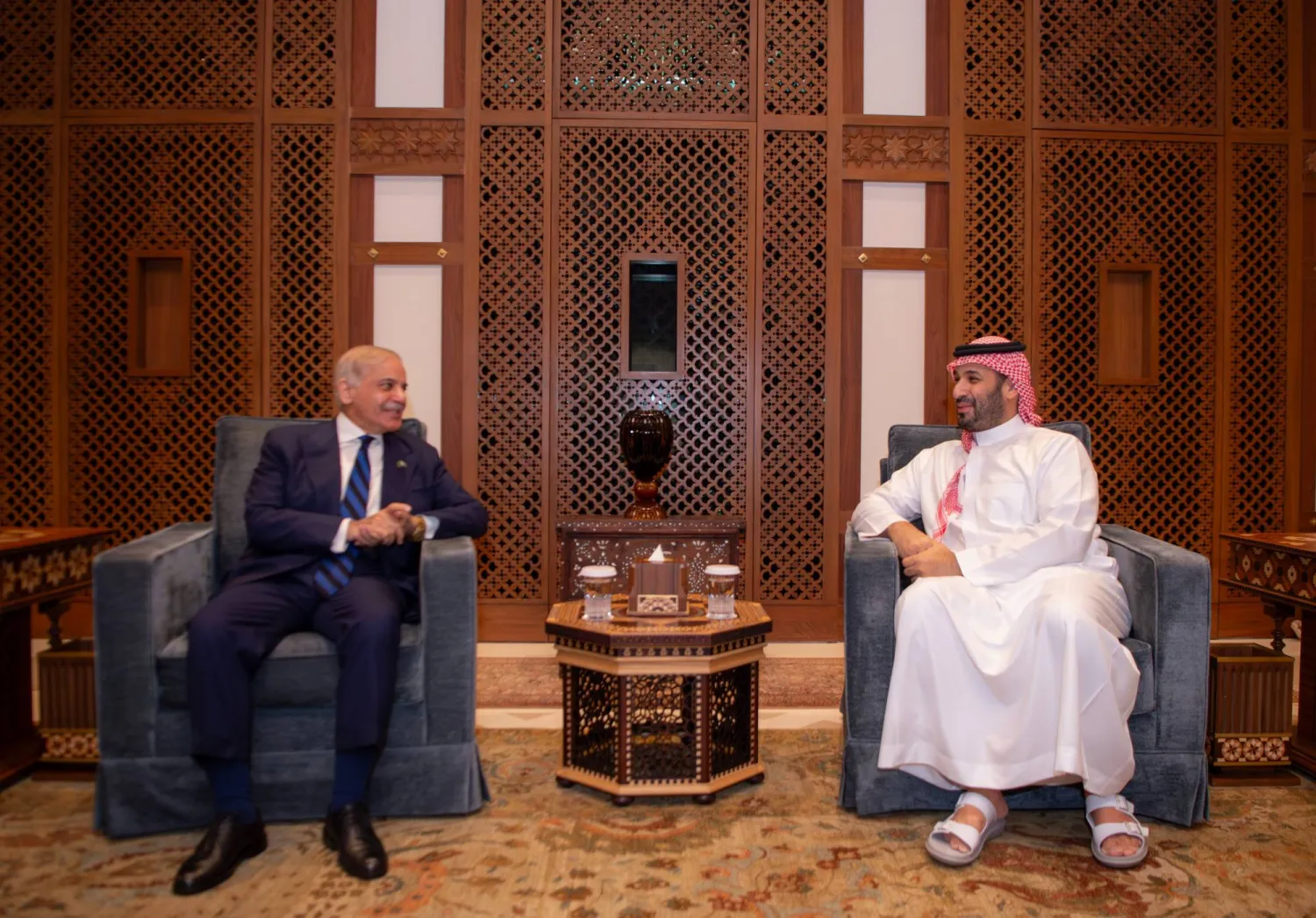
Saudi Crown Prince Mohammed bin Salman holding talks with Pakistan's Prime Minister Shehbaz Sharif in Jeddah on March 12, 2026 (SPA).
TT

Shehbaz Sharif: We Repaid $3.5 Billion in Debt Thanks to Saudi Arabia’s 'Pivotal' Support

Saudi Crown Prince Mohammed bin Salman holding talks with Pakistan's Prime Minister Shehbaz Sharif in Jeddah on March 12, 2026 (SPA).

Pakistan’s Prime Minister Shehbaz Sharif announced on Wednesday that his country had successfully repaid $3.5 billion in mandatory bilateral debt, affirming that this achievement came thanks to the “pivotal” support of the Custodian of the Two Holy Mosques, King Salman bin Abdulaziz, and Crown Prince Mohammed bin Salman.

He clarified that this repayment did not affect the stability of foreign exchange reserves; rather, it strengthened market confidence in Pakistan’s ability to meet its international obligations.

The Kingdom had announced the provision of substantial financial support to Pakistan, including the extension of the term of a previous $5 billion deposit and the provision of an additional $3 billion deposit, aimed at enhancing economic stability and addressing global changes.

On Friday, the State Bank of Pakistan announced that Islamabad had completed the repayment of $3.45 billion in deposits to the United Arab Emirates, settling a final tranche worth $1 billion. The bank had also announced that it had received the Saudi deposit worth $3 billion.

This came after the United Arab Emirates requested that Pakistan return the funds it had deposited in the State Bank of Pakistan in 2018 to bolster its foreign exchange reserves.

This qualitative support aims to enable the Pakistani economy to confront global economic changes and strengthen its financial resilience, in a way that positively reflects on the living conditions of the Pakistani people. It also reaffirms the Kingdom’s consistent and ongoing position of standing alongside Pakistan under all circumstances, embodying the sincere bonds of brotherhood between the leaderships and the peoples.

In an address before the cabinet, the Pakistani Prime Minister clarified the current financial situation, stating: “We have repaid our mandatory external debts (amounting to approximately $3.5 billion in bilateral loans). Our foreign exchange reserves are stable at their current level, and we have fulfilled our obligations and repaid our debts.”

These developments constitute a key pillar in Pakistan’s relationship with international institutions; the stability of liquid reserves at around $20.6 billion (including $15.1 billion held by the central bank) contributes to strengthening Islamabad’s negotiating position with the International Monetary Fund. Pakistan’s success in repaying its bilateral debts, alongside adherence to the requirements of the Fund’s financing program, is seen as a vote of international confidence in the Pakistani economy’s ability to meet its immediate and future financial commitments.

The central bank indicated that its success in managing the outflows required to repay these billions was achieved without causing any shock to the value of the local currency, as the Pakistani rupee remained stable thanks to supportive deposits and cautious monetary policies.

For his part, Sharif explained that this repayment did not come at the expense of monetary stability; rather, it resulted from a coordinated plan between the Ministry of Finance and the central bank to ensure that foreign exchange reserves remained at safe levels, which strengthens Pakistan’s position in its ongoing negotiations with international financial institutions.

Regarding the role played by the Kingdom in securing this financial passage, the Prime Minister expressed his country’s deep appreciation, saying: “We are extremely grateful to the Custodian of the Two Holy Mosques, King Salman bin Abdulaziz, and His Royal Highness Crown Prince Mohammed bin Salman; they played a pivotal role in this matter. I am confident that these major issues will also be resolved, and Pakistan’s peace efforts continue uninterrupted and without relent.”

Sharif noted that this Saudi support was not merely temporary financial assistance, but rather a reflection of the depth of historical ties, adding: “Just as we have strengthened mutual cooperation by removing obstacles at both the joint and institutional levels, positive results have emerged from this.”

It is worth noting that this new Saudi move is not unprecedented. In 2018, the Kingdom provided a $6 billion support package, which included a $3 billion deposit in the State Bank of Pakistan, in addition to deferred oil payment facilities of the same value.



Oman and Yemen Sign Two Cooperation Agreements on Electricity Interconnection

Two cooperation agreements were signed on electricity interconnection between Oman and Yemen (Oman News Agency)
TT

Oman and Yemen Sign Two Cooperation Agreements on Electricity Interconnection

Two cooperation agreements were signed on electricity interconnection between Oman and Yemen (Oman News Agency)

Oman and Yemen signed two joint cooperation agreements on Sunday concerning an electricity interconnection project between the power grid in Oman's Dhofar Governorate and the power grid in Yemen's Al Mahrah Governorate, as part of the two countries' cooperation in the energy sector.

According to the Oman News Agency, the two agreements include supplying electricity to several areas in Al Mahrah, including Hawf and Shahan, as a first phase, through the electricity distribution network.

The planned loads are estimated at 3 megawatts for Hawf and 5 megawatts for Shahan, eventually reaching the city of Al Ghaydah with loads of up to 50 megawatts.

The agency said the project is part of efforts to support the stability and availability of electricity supplies in the beneficiary areas of Al Mahrah by connecting them to the electricity grid in Dhofar.

It added that the agreements aim to strengthen energy infrastructure, address electricity needs in the beneficiary areas, and promote stability, development, and the advancement of the social and commercial sectors.

According to the agency, the first agreement was signed on the Omani side by Ali Shammas, CEO of Nama Dhofar Services, and on the Yemeni side by Othman Owaid, Director General of the Public Electricity Corporation in Al Mahrah Governorate.

The second agreement was signed on the Omani side by Ahmed Al Abri, CEO of Dama Power and Water Procurement Company, while the Yemeni side was represented by engineer Mohsen Ali Balhaf, Director of the Yemeni Oil Company in Al Mahrah Governorate.


Saudi Arabia, Russia, Iraq, Kuwait, Kazakhstan, Algeria, and Oman Reaffirm Commitment to Market Stability

FILE PHOTO: OPEC logo is seen in this illustration taken June 25, 2026. REUTERS/Dado Ruvic/Illustration/File Photo
TT

Saudi Arabia, Russia, Iraq, Kuwait, Kazakhstan, Algeria, and Oman Reaffirm Commitment to Market Stability

FILE PHOTO: OPEC logo is seen in this illustration taken June 25, 2026. REUTERS/Dado Ruvic/Illustration/File Photo

The seven OPEC+ countries, which previously announced additional voluntary adjustments in April and November 2023, namely Saudi Arabia, Russia, Iraq, Kuwait, Kazakhstan, Algeria, and Oman met virtually on September 6, 2026, to review global market conditions and outlook, SPA reported.

The seven participating countries decided to maintain September 2026 required production for October 2026 as detailed in the table below.

The seven countries reiterated their collective commitment to achieve full conformity with the Declaration of Cooperation.

The seven OPEC+ countries will continue to hold monthly meetings to review market conditions.

The next meeting will be held on October 4, 2026.


South Korean Chips Head to Saudi Arabia: From Manufacturing to Computing

An AI chip with the South Korean flag (Reuters
TT

South Korean Chips Head to Saudi Arabia: From Manufacturing to Computing

An AI chip with the South Korean flag (Reuters

Chips are no longer merely electronic components hidden inside devices. They have become the foundation of the artificial intelligence economy, as global competition shifts from developing models to having the capacity to run them efficiently and at scale.

As demand for computing chips rises, the semiconductor industry is converging with energy, data centers, and digital infrastructure, creating a new map of technological power that extends beyond countries that manufacture chips to countries capable of hosting and operating the computing power they require.

In this race, Saudi Arabia is emerging as a growing destination for Asian chip and AI companies, driven by the availability of energy, the rapid expansion of data centers, and its ambition to build a sovereign AI ecosystem. South Korea, meanwhile, is moving to strengthen its position at the heart of the value chain by increasing government spending on chips, AI, and the infrastructure that supports both.

The decision by South Korean AI chipmaker Rebellions to establish its regional headquarters in Riyadh embodies this new intersection between those who make chips and those who have the capacity to run them. Its CEO, Sunghyun Park, told Asharq Al-Awsat that three main factors make Saudi Arabia an attractive destination for the company: high levels of energy availability, a commitment to developing AI infrastructure, and strong ambitions in sovereign AI.

Park added that the combination of these factors makes Riyadh a suitable location for Rebellions to expand its AI chip business.

The Korean company's move comes as Saudi Arabia works to expand its ability to accommodate growing demand for computing, alongside rising investment in data centers and AI projects.

Sunghyun Park, CEO of South Korean AI chipmaker Rebellions (Asharq Al-Awsat)

821 Trillion Won in Spending in 2027

South Korea proposed this week the largest government budget in its history, worth 821 trillion won ($596.92 billion) for 2027, an increase of 12.8 percent from the current year and the largest annual increase ever. A significant portion of the spending will be directed toward AI, semiconductors, and related infrastructure.

Seoul is betting on increased public spending to maintain its position in the semiconductor industry, one of the most important drivers of its economy, as global demand rises for chips used in AI applications.

The proposed budget includes 21.3 trillion won for industrial water systems, electricity grids, and logistics services needed to support the next generation of semiconductor infrastructure, along with 2.6 trillion won in a dedicated semiconductor budget.

South Korea is benefiting from the global surge in demand for high-bandwidth memory (HBM), which is used in AI systems, with Samsung Electronics and SK Hynix reporting strong profits driven by this demand.

"Sovereign AI" Connects Riyadh and Seoul

Park believes that the sovereign dimension of AI has become an important factor in countries' decisions about the technologies they use, particularly as some data and applications are tied to sensitive sectors. He said the need for AI technologies that can be managed locally is linked, among other things, to "national security," noting that sensitive information, such as nuclear energy or weapons programs, requires governments to control how AI is used, set its boundaries, and operate it entirely within the country.

This reflects one of the major trends in the AI market. Governments and companies are no longer focused solely on gaining access to advanced models. They are also concerned with where data is stored, where models are run, and who owns the infrastructure on which they depend.

Aramco and HUMAIN in the Chip Supply Chain

Rebellions already has an investment connection to Saudi Arabia. Park said Aramco invested in the company about two years ago, while Rebellions is in ongoing discussions with HUMAIN about strengthening supply chains for AI infrastructure technologies.

He said HUMAIN has become one of the most important organizations operating in AI in Saudi Arabia and globally, and that cooperation with the company could have a positive impact on the region's AI sector.

These moves come as Saudi Arabia continues to expand its digital infrastructure, including data centers. This provides companies specializing in chips and computing with a potential regional market that goes beyond simply selling components to participating in the construction of the AI ecosystem itself.

Competition Is Shifting From Chip Speed to Operating Cost

Rebellions does not believe that competition in the AI chip market will be decided solely by a chip's ability to process more tokens per second. Instead, it will increasingly come down to the long-term cost of running AI.

Park said the company is focused on developing technologies that deliver "higher AI performance at a lower economic cost," explaining that an important metric for customers is not simply the number of tokens that can be processed per second, but also "cost per token."

The company's model focuses heavily on inference rather than distributing its efforts equally between inference and model training.

Park explained that inference is gradually becoming commoditized, meaning companies and users will increasingly care about obtaining good results at a reasonable cost, regardless of the specific technology used behind the scenes.

Energy Becomes Part of the AI Equation

This factor is becoming particularly important as energy consumption associated with data centers rises. The cost of electricity and chip efficiency have become part of the economic calculation involved in expanding AI use.

This is where the calculations of Riyadh and Seoul meet from two different angles. South Korea is investing in chips, electricity grids, and the industrial infrastructure needed to maintain its position in the value chain. Saudi Arabia, meanwhile, is building the energy supply, infrastructure, and data centers needed to absorb the next wave of computing.

The AI race between countries, therefore, is no longer only about models and software. It is about who makes the chips, who owns the data centers, who can provide the energy, and who can deliver all of it at the lowest possible cost.