Tent and Garden: Displaced Syria Teen Recreates Lost Family Home

Diab rebuilt his library and now has some 85 books including translated works by Dostoyevsky, Murakami and novels by Egyptian author Naguib Mahfouz. (AFP)
TT

Tent and Garden: Displaced Syria Teen Recreates Lost Family Home

Diab rebuilt his library and now has some 85 books including translated works by Dostoyevsky, Murakami and novels by Egyptian author Naguib Mahfouz. (AFP)

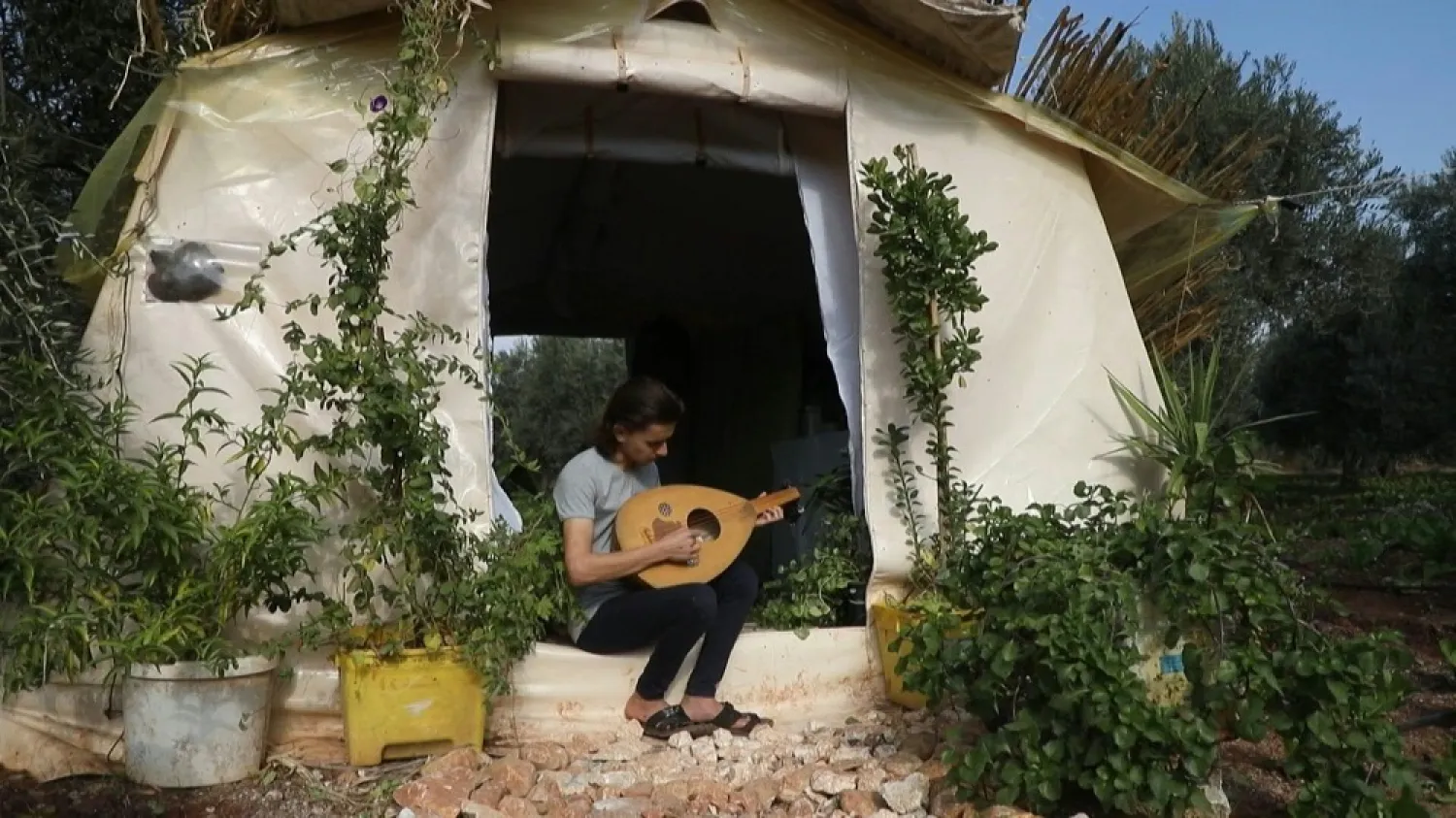
Among the olive trees in northwestern Syria, displaced teenager Wissam Diab plucks an oud outside his new home, a tent surrounded by luscious plants.

Inside, there are more tumbling indoor plants and a collection of tiny cacti, as well as dozens of books lined up on a cloth-covered table from authors such as Fyodor Dostoyevsky, Haruki Murakami and Egypt's celebrated Naguib Mahfouz, the only Arab to win the Nobel Prize for literature.

Syria's war forced the Diab family to flee their village of Kafr Zita in central Hama province, but when 19-year-old Wissam moved into a tent in northwestern Syria he decided to recreate his childhood home.

"It's been four years, and we haven't been able to find a house or go back home," said the young man with green eyes and shoulder-length brown hair.

"What I've done with the tent is me trying to settle down."

And settle down he did in his own tent in an olive grove in the area of Atme, in Idlib province near the Turkish border, while his parents and two sisters have a separate tent next door.

A patterned stone path leads up to the front door and wooden sticks top the canvas roof.

All around, plants and flowering shrubs thrive in large plastic pots, or in neat rows in the soil of his front garden.

Indoors, he has hung a textile curtain along the tarpaulin wall, and made a small living room with a floor-level sofa.

An ornate red carpet pads out his tent underfoot.

"Our home was like this. We had a garden, we had a library, we had a lot of flowers," he said.

It "was like this, but much, much better".

Syria's war has killed more than 380,000 people and displaced millions since starting in 2011.

In Idlib, a major opposition bastion, around half of the three million inhabitants live in tents or shelters, many after losing their homes in other parts of the country now back under government control.

New home 'from scratch'
In October 2016, Diab and his family were forced to flee their home further south, as regime aircraft bombarded the surrounding area in a bloody campaign that killed his only brother.

Scrolling through his smart phone, Diab shows images of their old home in Kafr Zita, which he says was blitzed in the fighting.

The family lived in a displacement camp until eight months ago.

But as fears mounted over the spread there of the novel coronavirus, they decided to move away to somewhere more secluded.

When they ran for their lives four years ago, the Diabs grabbed the bare necessities and Wissam managed to save a few of his precious books.

His collection now contains 85 novels and other books, including translated works by Dostoyevsky or Murakami, he says.

"Here I had to start again from scratch. I bought plants and books, and built the library up again," he said.

To pass the time, he is also teaching himself to play the oud via tutorials on YouTube.

Diab says many of his neighbors were surprised to see how much energy he had poured into transforming his tent.

But the young Syrian says he fears it will be some time before anybody can go home.

"I know we will be here for a while," he said.

So in the meanwhile, he looks after his cacti collection and waters his creeping jasmine.


Macron Leaves Future Open as Political Curtain Nears

 24 April 2026, Cyprus, Nikosia: French President Emmanuel Macron arrives at the informal meeting of the EU heads of state and government. (dpa)
24 April 2026, Cyprus, Nikosia: French President Emmanuel Macron arrives at the informal meeting of the EU heads of state and government. (dpa)
TT

Macron Leaves Future Open as Political Curtain Nears

 24 April 2026, Cyprus, Nikosia: French President Emmanuel Macron arrives at the informal meeting of the EU heads of state and government. (dpa)
24 April 2026, Cyprus, Nikosia: French President Emmanuel Macron arrives at the informal meeting of the EU heads of state and government. (dpa)

With just one year left in his second five-year term, French President Emmanuel Macron has said he will quit politics in 2027 -- leaving observers and supporters guessing about his next moves.

"I wasn't in politics before and I'm not going to be after," Macron said Thursday during a visit to a high school in Cyprus.

He added that at this late stage in office, the "hardest thing" was to strike a balance between defending his record and acknowledging what "didn't work out".

France's political and media world is already abuzz as the race for 2027 has "already begun", said Philippe Moreau-Chevrolet, a communications expert at Sciences Po university.

For now, would-be candidates are playing up their softer sides, with far-right National Rally (RN) party chief Jordan Bardella showing off a romance with Princess Maria Carolina of Bourbon-Two Sicilies in glossy magazine Paris Match.

And Gabriel Attal, one of Macron's string of former prime ministers, has offered personal revelations in a book as he shores up his bid to lead the centrist camp into the 2027 vote.

"Now is a good time for the president-- who in any case won't be in charge of much anymore -- to announce and lay the groundwork for his departure," Moreau-Chevrolet said.

"He needs to tell an alternative story while leaving what's next up to speculation."

- Rear-view mirror -

Macron has sought in recent weeks to spruce up public perceptions of his legacy -- even as would-be successors in his own ranks try to distance themselves from a historically unpopular leader.

The 48-year-old may be hoping to mimic the trajectory of Jacques Chirac, president in the late 1990s and 2000s.

Once out of the cut and thrust of daily politics and with his various scandals fading, conservative Chirac's public image recovered and many now look back on his era with nostalgia.

"At some point there'll be a change in perspective, because he won't be a political personality any longer," a person close to Macron said.

"There'll be a re-emergence of some of the key elements and consistency" in his policy, the person added, such as his push for "industrial and European independence in the face of crises."

Macron remains highly visible outside France, standing up to US President Donald Trump over his threats to annex Greenland and criticizing the war against Iran.

His long-vaunted White House relationship has cooled in recent months as Trump becomes a liability even for his supposed political allies in Europe's far right.

"I didn't speak to him in the last few hours because I didn't see a need for it," Macron said dismissively of Trump Monday during a visit to Poland.

The president's "true role has been on the international stage," said Moreau-Chevrolet.

In January, Macron energized the World Economic Forum in Davos with a "defense of European democracies and Gaullist position" of technological and military emancipation from the United States.

Images raced around the internet of the French leader wearing aviator-style sunglasses to protect a broken blood vessel in his eye, as he called for Europe to stiffen its spine.

- #Macron2032? -

Macron's stated intent to leave active politics "doesn't mean that he'll be out of the picture altogether," Moreau-Chevrolet said.

The person close to Macron said that "he was talking about politics in the party-political sense".

Some observers suggest he could seek a post heading an intergovernmental body such as the International Monetary Fund (IMF) or European Commission.

One centrist leader predicted that "he'll start up an outfit of his own after 2027. And there will be people calling for #Macron2032," the next presidential election when he could stand again.

In the meantime, "he's not taking leave of the questions he's passionate about, reindustrialization of France, AI, the defense industry, international affairs. He leaves the rest to the prime minister and doesn't bother about it," one sitting minister said.

As the 2027 campaign progresses, Macron will likely leave the battle up to the centrist candidate to succeed him -- with the subtext that "I have a legacy and you must stand up for it," the minister added.


Iranians Have Long Sought Work and Relative Stability in Türkiye. The War Could Force Some to Return

Iranian Serdar Taghizade speaks to a customer inside his currency exchange business in Istanbul on Monday, April 13, 2026. (AP Photo/Khalil Hamra)
TT

Iranians Have Long Sought Work and Relative Stability in Türkiye. The War Could Force Some to Return

Iranian Serdar Taghizade speaks to a customer inside his currency exchange business in Istanbul on Monday, April 13, 2026. (AP Photo/Khalil Hamra)

Sadri Haghshenas spends her days selling borek — a layered, savory pastry — at a shop in Istanbul, but her mind is on her daughter in Tehran.

The family had to send her home to Iran after they ran into difficulties renewing her visa, despite fears that a shaky ceasefire could soon collapse.

For years, short-term residency permits have allowed tens of thousands of Iranians to pursue economic opportunities and enjoy relative stability in neighboring Türkiye. But it's a precarious situation, and the war has raised the stakes.

“I swear, I cry every day,” Haghshenas said, raising her hands from behind the counter of the pastry shop. “There is no life in my country, there is no life here, what shall I do?”

Haghshenas and her husband moved to Türkiye five years ago with their then-teenage daughters and have been living on tourist visas renewable every six months to two years.

They could not afford a lawyer this year, because her husband is out of work due to health problems. As a result, they missed the deadline to apply for a new visa for their 20-year-old daughter, Asal, who is still in her final year of high school.

Asal was detained at a checkpoint earlier this month and spent a night at an immigration facility. Her mother found a friend to take her back to Tehran rather than face deportation proceedings that could complicate her ability to return to Türkiye. They hope she can come back on a student visa.

Haghshenas has been unable to talk to her daughter since she left because of a monthslong internet blackout in Iran.

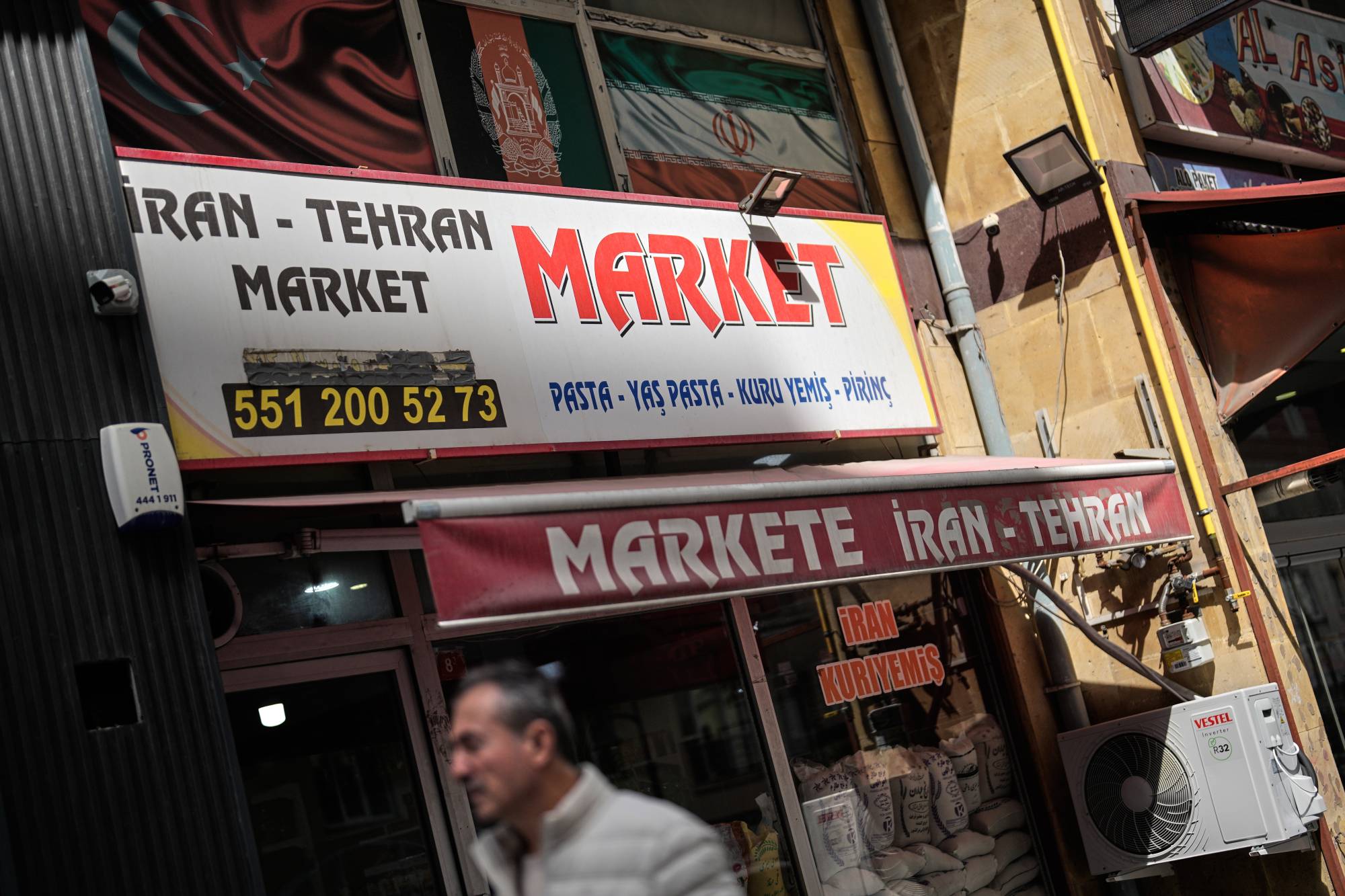
A man walks past an Iranian grocery shop in Istanbul on Tuesday, April 14, 2026. (AP Photo/Khalil Hamra)

Türkiye has not seen an influx of refugees, as most Iranians have sought safety within their country. Many who have crossed the land border were transiting to other countries where they have citizenship or residency.

Nearly 100,000 Iranians lived in Türkiye in 2025, according to the Turkish Statistical Institute. Around 89,000 have entered Türkiye since the start of the war, while around 72,000 have departed, according to the United Nations' refugee agency.

Some Iranians have used short-term visa-free stays to wait out the war, but there are few options for those who want to stay longer.

Sedat Albayrak, of the Istanbul Bar Association’s Refugee and Migrant Rights Center, said that getting international protection status can be difficult, and the system encourages Iranians to apply for short-term permits instead.

“There are people who have lived on them for over 10 years," The Associated Press quoted him as saying.

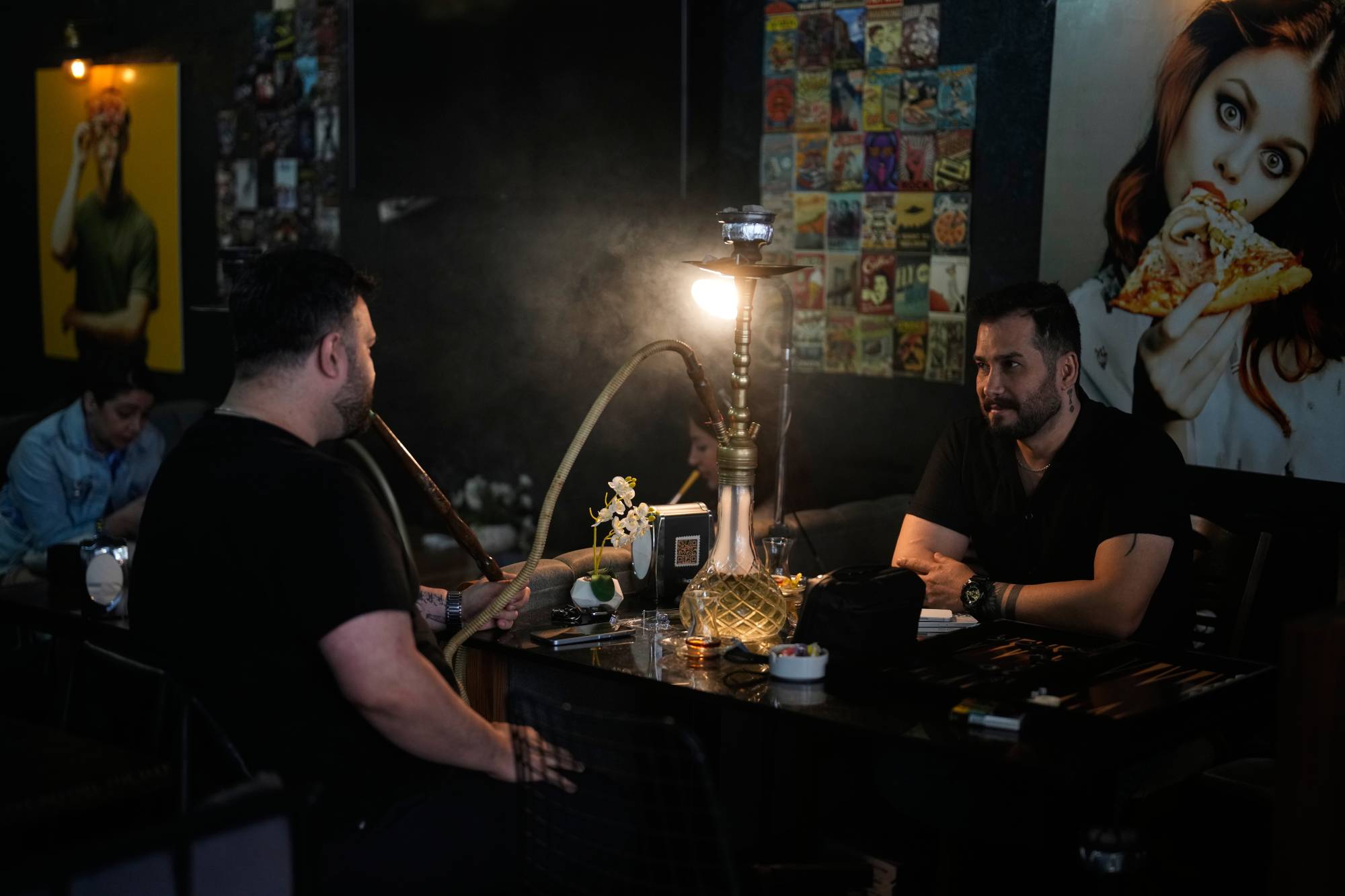
Nadr Rahim, right, sits with a friend at an Iranian coffee shop in Istanbul on Tuesday, April 14, 2026. (AP Photo/Khalil Hamra)

If the war continues, more may have to return Nadr Rahim came to Türkiye for his children’s education 11 years ago. Now, the war may force him to go home.

Because of the difficulty of getting a permit to start a business or work legally in Türkiye, he lived off the profits of his motorcycle salesroom in Iran. But there have been no sales since the war started, and international sanctions — and the internet outage — make it extremely difficult to transfer funds.

His family only has enough money to stay in Türkiye a few more months. His children grew up in Türkiye and don't read Farsi or speak it fluently. He worries about how they would adapt to living in Iran, but said “if the war continues, we will have no choice but to return.”

In the meantime, he spends most of his days scrolling on his phone, waiting for news from his parents in Tehran or discussing the war over waterpipes with Iranian friends.

A 42-year-old Iranian woman came to Türkiye eight months ago, hoping to make money to support her family. She and her daughter registered as university students to get study visas.

She attends classes in the morning to keep her legal status before rushing to service jobs, sometimes working until 3 a.m.

They share a room with six other people at a women's boarding house, she said, speaking on condition of anonymity out of fear for her security should she return to Iran.

“I truly love Iran. If necessary, I would even go and defend it in war,” she says. But she sees no future there, while in Türkiye, she’s barely scraping by and only able to send small amounts of money to her parents.

“I have a bad life in Türkiye, and my parents have a bad life in Iran,” she said. “I came to Türkiye with so much hope, to support my parents and build a future. But now I feel hopeless.”

A 33-year-old freelance architect from Tehran traveled to Türkiye during Iran's violent crackdown on mass protests in January. She had planned to return after the situation calmed down, but then the United States and Israel went to war with Iran at the end of February.

“I started to believe that it’s a very bad situation, worse than I expected,” she said, speaking on condition of anonymity for fear of persecution if she returns to Iran.

She has been unable to work for her usual clients back in Iran because of the internet blackout. With the end of her 90-day visa-free window approaching, she can't afford to apply for a longer stay in Türkiye.

Instead, she has decided to go to Malaysia, where she will get free accommodation in return for building shelters during a month of visa-free stay.

She has no plan for what comes next.


Strait of Hormuz Blockade Step by Step: What Do We Know?

A view of Iranian-flagged cargo ship M/V Touska as the US Navy Arleigh Burke-class Aegis guided missile destroyer USS Spruance conducts its interception in a location given as the north Arabian Sea, in this screen capture from a video released April 19, 2026. (CENTCOM/Handout via Reuters)
TT

Strait of Hormuz Blockade Step by Step: What Do We Know?

A view of Iranian-flagged cargo ship M/V Touska as the US Navy Arleigh Burke-class Aegis guided missile destroyer USS Spruance conducts its interception in a location given as the north Arabian Sea, in this screen capture from a video released April 19, 2026. (CENTCOM/Handout via Reuters)

Shipping traffic through the Strait of Hormuz remained mostly at a standstill on Monday, with just three vessels crossing the vital waterway, according to Kpler, a maritime data firm.

On Sunday, a US Navy destroyer attacked and seized an Iranian-flagged cargo ship that US President Donald Trump said had tried to evade the US blockade on ships traveling to and from Iranian ports.

In a separate incident, the United Kingdom Maritime Trade Operations center, which is administered by Britain’s Royal Navy, said that two vessels had been hit while trying to cross the Strait of Hormuz, according to a notice published on Saturday.

In one instance, gun ships operated by Iran’s Revolutionary Guards Corps fired at a tanker without radio warning, the British organization said. In the second incident, a container ship was hit by “an unknown projectile” that damaged some of the containers.

On Tuesday, the US military said it had seized an Iran-linked tanker in international waters, in what appears to be the latest move to enforce a blockade as the ceasefire deadline looms.

The US military said it had boarded the tanker Tifani “without incident.”

The ship, capable of carrying 2 million barrels of crude, last reported its position on Tuesday morning near Sri Lanka in the Indian Ocean, according to MarineTraffic tracking data. It was close to fully loaded and had signaled Singapore as its destination.

A two-week ceasefire between the US and Iran is set to expire early Wednesday.

Latest developments

The US Navy has turned back 27 ships trying to enter or exit Iranian ports since an American blockade outside the contested Strait of Hormuz began about a week ago, the military’s Central Command said on Monday.

On Sunday, a Navy destroyer disabled and seized the Touska, an Iranian cargo ship, in the Gulf of Oman after it tried to evade the blockade. It was the first time a vessel was reported to have tried to evade the US-imposed blockade on any ship entering or exiting Iranian ports since it took effect last week.

The guided-missile destroyer Spruance, one of more than a dozen Navy warships enforcing the US blockade, ordered the vessel’s crew to evacuate its engine room.

The Spruance then fired several rounds from its Mk-45 gun into the ship’s propulsion system as it steamed toward the port of Bandar Abbas in Iran, Central Command said in a statement that included a video of the firing.

American officials will determine what to do with the disabled vessel once the search is completed, a US military official said on Monday, speaking on the condition of anonymity to discuss operational matters, according to the New York Times. One option would be to tow the stricken ship to Oman, independent specialists said. An alternative would be to let the Touska steam to an Iranian port, if it can.

A spokesman for Iran’s military reiterated a threat on Monday to “take the necessary action against the US military” in response to the ship’s seizure, Iran’s state broadcaster reported.

How is the US imposing the blockade?

According to CENTCOM, more than 10,000 US personnel, including sailors, marines, and airmen, are participating in the operation, supported by over a dozen warships and dozens of aircraft. The effort spans key waterways surrounding Iran, including the Arabian Gulf and the Gulf of Oman.

The US blockade on Iranian ports does not have a defined geographic boundary, and the United States can interdict vessels almost anywhere in international waters until they arrive at their final port.

Analysts say modern technology allows blockade enforcement at great distances.

Can ships evade the blockade?

Maritime intelligence experts say that more ships in and around the Strait of Hormuz seem to be adopting “spoofing” tactics to avoid detection.

Under international maritime law, most large commercial vessels travel with a transponder that automatically transmits the ship’s name, location, route and other identifying information. That includes a nine-digit number with a country code, which serves as a digital fingerprint for a ship.

The tactics were used by Russian “shadow fleet” vessels evading sanctions related to the invasion of Ukraine in 2022.

When a ship is engaged in spoofing, its captain can type in a false origin or destination or can pretend to be piloting another ship altogether. Vessels can also temporarily turn off their transponders, seeming to disappear in one place and reappear in another.

The strait is “a contested information environment,” said Erik Bethel, a partner at Mare Liberum, a maritime technology venture capital fund.

Still, whatever ruses they employ, vessels going to and from Iran may get only so far. It is difficult to pass between the open ocean and a waterway as narrow as the Strait of Hormuz without being detected.

“My expectation is that the US Navy can sit out in the Gulf of Oman,” said Ami Daniel, the chief executive of Windward, a maritime intelligence data provider. “I don’t think there’s a way to breach the blockade.”

What are the US and Iranian strategies?

The US blockade sets up a significant test in the Iran war: Which side can endure more economic pain?

Instead of directing missiles and bombs, Trump is trying to choke off Iran’s oil exports, which make up just about all of the government’s revenue.

Some experts questioned whether the US blockade would work.

“Iran is already hurting, and they have shown that they are willing to take more than a couple of hits,” said Ahmet Kasim Han, a professor of international relations at TED University in Ankara, Türkiye.

Iran’s strategy appears to be using its leverage over global energy markets, where Tehran has discovered new powers that can cause pain in the US economy through spikes in the price of gasoline and other staples.

Why is the strait so important?

The Strait of Hormuz is a strategic waterway connecting the Gulf to the Gulf of Oman and the Indian Ocean. It is the only sea route for moving oil, natural gas and other cargo out of the Gulf. Iran’s coastline runs along the entire route.

At the strait’s narrowest and most vulnerable point — between Iran to the north and the Musandam Peninsula of Oman to the south — the navigable channel is about two miles wide each for inbound and outbound traffic, according to the International Energy Agency.

The legal status of the strait is complex. It lies within the territorial waters of Iran and Oman, but under international law it is treated as an international waterway where ships are generally guaranteed passage.

Iran has signed but not ratified that framework and has disputed the extent of those rights.

Before the war, about 20% of global oil and liquid natural gas passed through the strait. Most of the fossil fuels are bound for Asia, especially China, India, Japan and South Korea.

Other large vessels also use the strait, including car carriers and container ships.

Crucial industrial goods traveling through Hormuz include helium from Qatar, fertilizer from Oman and Saudi Arabia, and plastic feedstocks from Saudi Arabia and Emirati petrochemical plants.

How does Iran control the strait?

Iran’s military can threaten shipping traffic throughout the Strait of Hormuz, even though much of its navy has been destroyed by US and Israeli strikes.

The United States and Israel launched their war against Iran on the argument that if Iran one day got a nuclear weapon, it would have the ultimate deterrent against future attacks.

It turns out that Iran already has a deterrent: geography.

“The Iranians have thought a lot about how to utilize the geography to their benefit,” said Caitlin Talmadge, a professor at the Massachusetts Institute of Technology who studies Gulf security.

*The New York Times