


G20 Two Summits Proposal Will Contribute to Solving Problems, Addressing Urgent Files

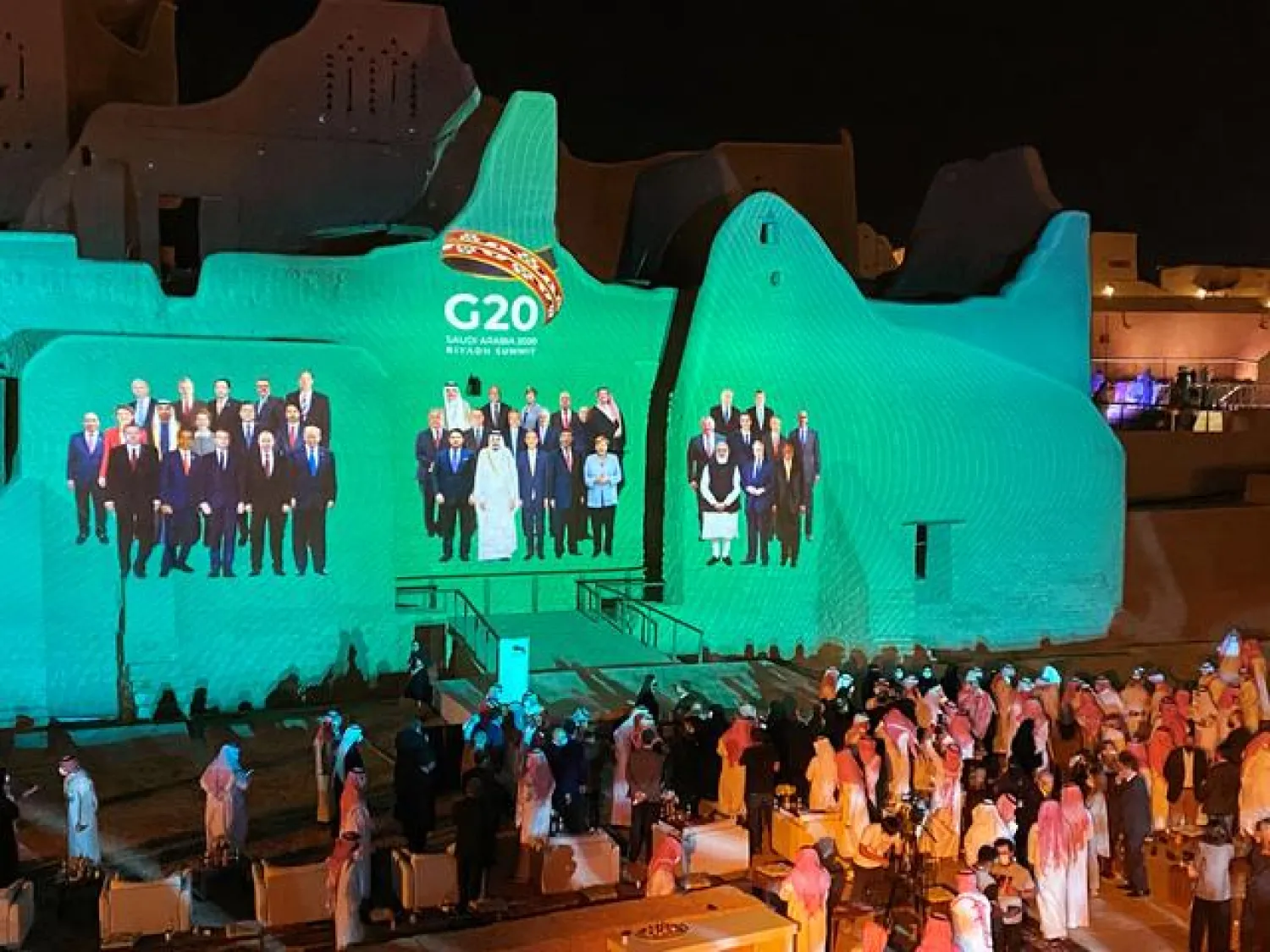
Family Photo for the annual G20 Summit World Leaders is projected onto Salwa Palace in At-Turaif, one of Saudi Arabia’s UNESCO World Heritage sites, in Diriyah, Saudi Arabia, November 20, 2020. REUTERS/Nael Shyoukhi
TT

G20 Two Summits Proposal Will Contribute to Solving Problems, Addressing Urgent Files

Family Photo for the annual G20 Summit World Leaders is projected onto Salwa Palace in At-Turaif, one of Saudi Arabia’s UNESCO World Heritage sites, in Diriyah, Saudi Arabia, November 20, 2020. REUTERS/Nael Shyoukhi

Political and economic experts have unanimously agreed on the importance of the proposal put forward by Saudi Crown Prince Mohammed bin Salman during his speech to the G20 leaders’ summit on Sunday.

Bin Salman has suggested that the G20 summit would be held twice a year, in order to accelerate decision-making and intensify follow-up of the outcome of the sub-committees’ meetings.

At the conclusion of the virtual summit, which was hosted by Riyadh, the Saudi crown prince proposed that the G20 group would convene in two summits every year – one virtually, mid-year, and the other in-person at the end of the year. Observers saw this proposal as important and necessary to reflect on the latest developments on the international scene and discuss the best mechanisms to address them.

During its presidency of the 2020 G20, Saudi Arabia has succeeded in bringing together the leaders of the group as well as international organizations amid the Coronavirus outbreak. The world has eagerly awaited its solutions to the crises that struck them as a result of the pandemic.

Dr. Fahd Al-Shulaimi, a strategic expert, told Asharq Al-Awsat that Prince Mohammad bin Saman’s proposal was very important in light of the many instabilities the world was going through.

“The meeting of the G20 leaders twice a year would strengthen effectiveness and flexibility in implementing strategies rather than waiting an entire year for a decision,” he remarked.

He added that the virtual summit would pave the way for bridging points of view and would give an indication of what would emerge from the year-end summit.

Meanwhile, Political Analyst Nayef Al-Ruqaa underlined the importance of the Saudi role in leading the G20 summit.

In remarks to Asharq Al-Awsat, he noted that the first proposal put forward by the Kingdom was working on the development of the poorest and least developed countries in the world. He added that maintaining international peace and security was among Saudi Arabia’s priorities even before the outbreak of the coronavirus pandemic.

Ruqaa pointed to other solutions presented by the Kingdom, namely postponing the payment of debts owed by the least developed or poorest countries, which benefited more than a billion people around the world, especially amid the severe economic and financial crises that overwhelmed the countries as a result of the pandemic.

In addition, the political analyst noted that Crown Prince Mohammed bin Salman presented an important practical proposal, represented in the holding of a remote virtual summit and another with the actual presence of the leaders. Ruqaa said it was a strong experience that could be used in the upcoming summits and a message that digital communication, e-learning, and digital economy would be the world’s choice in the coming years.



19 Migrants Found Dead by Italian Coastguard off Lampedusa

Hellenic coast guard performs SAR operation, following migrant's boat collision with coast guard off the Aegean island of Chios, near Mersinidi, Greece, February 4, 2026. REUTERS
TT

19 Migrants Found Dead by Italian Coastguard off Lampedusa

Hellenic coast guard performs SAR operation, following migrant's boat collision with coast guard off the Aegean island of Chios, near Mersinidi, Greece, February 4, 2026. REUTERS

The bodies of 19 migrants were recovered from a boat off the coast of Lampedusa on Wednesday by the Italian coastguard, the island's mayor told AFP.

Mayor Filippo Mannino said seven other migrants, including two children, were being treated for "hypothermia and intoxication from hydrocarbon fumes".

The coastguard rescue was staged some 135 kilometers (85 miles) off the Italian island, according to news agency ANSA.

The coastguard did not respond to AFP requests for information.

The rescue operation occurred in the early hours of Wednesday inside Libya's search-and-rescue zone, ANSA reported.

"All are believed to have died of hypothermia," wrote the agency, which cited strong winds, rain, and temperatures of 10C, in the area.

Lampedusa is a key landing point for migrants crossing the Mediterranean Sea from North Africa, with many dying trying the dangerous journey.

So far this year, 624 migrants have died or gone missing in the central Mediterranean, according to the UN's International Organization for Migration.

Lampedusa's last migrant disaster occurred in August last year, when 27 people died in two shipwrecks off the coast.

According to the interior ministry, 6,117 migrants have landed on Italy's shores so far this year.


Dollar Falls for Second Day as Middle East Ceasefire Expectations Rise

US dollar bills (Reuters)
TT

Dollar Falls for Second Day as Middle East Ceasefire Expectations Rise

US dollar bills (Reuters)

The dollar dropped for a second day on Wednesday as expectations of a ceasefire in the Middle East conflict grew after the US signalled that an end to the war could be near, even though markets remained on edge on fears of escalation.

The White House said US President Donald Trump would address the nation "to provide an important update on Iran" at 9 p.m. EDT on Wednesday (0100 GMT on Thursday).

Trump said on Tuesday the US could end its military campaign against Iran within two to three weeks, while Secretary of State Marco Rubio told Fox News Washington could see the "finish line" in the Iran war, according to Reuters.

Expectations that a ceasefire could be near have reversed some of the most popular trades since the war began in late February.

The yen recovered from this year's low of 160.46 per dollar, moving back through the psychologically important 160 level that had fanned concerns about intervention by Japanese authorities. The euro hit its highest level in a week.

The dollar index, which measures the currency against a basket of currencies including the yen and the euro, was last down 0.3% at 99.456, slipping to a one-week low after a 0.65% fall on Tuesday.

"Markets are increasingly buying into the notion of de-escalation in the Middle East overall," said Kirstine Kundby-Nielsen, FX analyst at Danske Bank.

"Markets are optimistic. We're seeing some relief with rates going lower, equities going higher and the price action in euro-dollar reflects that quite well."

The euro edged up 0.5% versus the dollar to $1.1603, after rising 0.8% on Tuesday.

The Japanese yen was up 0.1% at 158.46 per dollar. Sterling strengthened 0.7% to $1.3313.

At the same time, there were still signs of escalation in the conflict.
US Defense Secretary Pete Hegseth said the next few days in the war against Iran would be decisive and warned Tehran that the conflict would intensify if it did not make a deal.

The dollar should remain supported by the Fed's cautious stance on rate cuts, while the yen is being underpinned by rising expectations of a Bank of Japan hike in April, said Sho Suzuki, market analyst at Matsui Securities.

"We may see a tug-of-war between dollar strength and yen strength, with USD/JPY trading sideways in the upper 150s," he said.

The Australian dollar strengthened 0.7% to $0.6946. New Zealand's kiwi strengthened 0.4% to $0.5770.


Oil Slides as Middle East Uncertainty Keeps Markets on Edge

Concerns are growing in Europe about an economic recession as oil prices rise (Reuters)
TT

Oil Slides as Middle East Uncertainty Keeps Markets on Edge

Concerns are growing in Europe about an economic recession as oil prices rise (Reuters)

Oil reversed earlier gains on Wednesday as uncertainty over the situation in the Middle East unnerved markets and US President Donald Trump again suggested the US-Israeli war with Iran could be nearing an end.

The front-month Brent contract for June fell $1.06, or 1%, to $102.91 per barrel at 1106 GMT, having dropped to a session low of $98.35. US West Texas Intermediate crude futures for May slipped $1.44, or 1.4%, to $99.94 per barrel, after falling to $96.50 earlier.

Prices rose earlier on Wednesday but then uncertainty over the Middle East conflict prompted investors to lock in gains.

"Oil prices fell after US President Trump signalled a potential end to the war with Iran," ING said in a report.

Oil supply disruptions from the Middle East will increase in April and will hit Europe as the closure of the Strait of Hormuz hits exports further, International Energy Agency head Fatih Birol said on Wednesday.

Brent futures for June delivery settled down more than $3 on Tuesday following unconfirmed media reports that Iran's president was ready to end the war.

Trump told reporters on Tuesday that the US could end the military campaign within two to three weeks and that Iran does not have to make a deal to end the conflict, his clearest declaration yet that he wants to wind down the month-long war.

Still, analysts expect that energy flows through the Strait of Hormuz would be slow to return to levels before the conflict even if a ceasefire were announced.

"Even if the Strait reopens, clearing the vessel backlog would take time, with production, exports and LNG flows normalising only gradually rather than immediately," ING said.

According to a Wall Street Journal report, Trump has indicated he could end the war before reopening the Strait of Hormuz, the route through which 20% of global oil and liquefied natural gas trade flows.

"Even with diplomatic channels reportedly still active and intermittent comments from the US administration predicting a short end to the conflict, the combination of limited tangible diplomatic progress, continued maritime attacks and explicit threats against energy assets keeps supply risks skewed to the upside," LSEG analysts said in a note.

Illustrating the impact of the closure of the Strait of Hormuz, crude oil output from the Organization of the Petroleum Exporting Countries dropped by 7.5 million barrels per day in March compared with the previous month, as producers were forced to cut output because storage is full.

US crude oil output also fell, dropping by the most in two years in January after a severe winter storm knocked production offline, data from the Energy Information Administration showed on Tuesday.