


Ninety-Year-Old Woman First in Switzerland to Get COVID-19 Shot

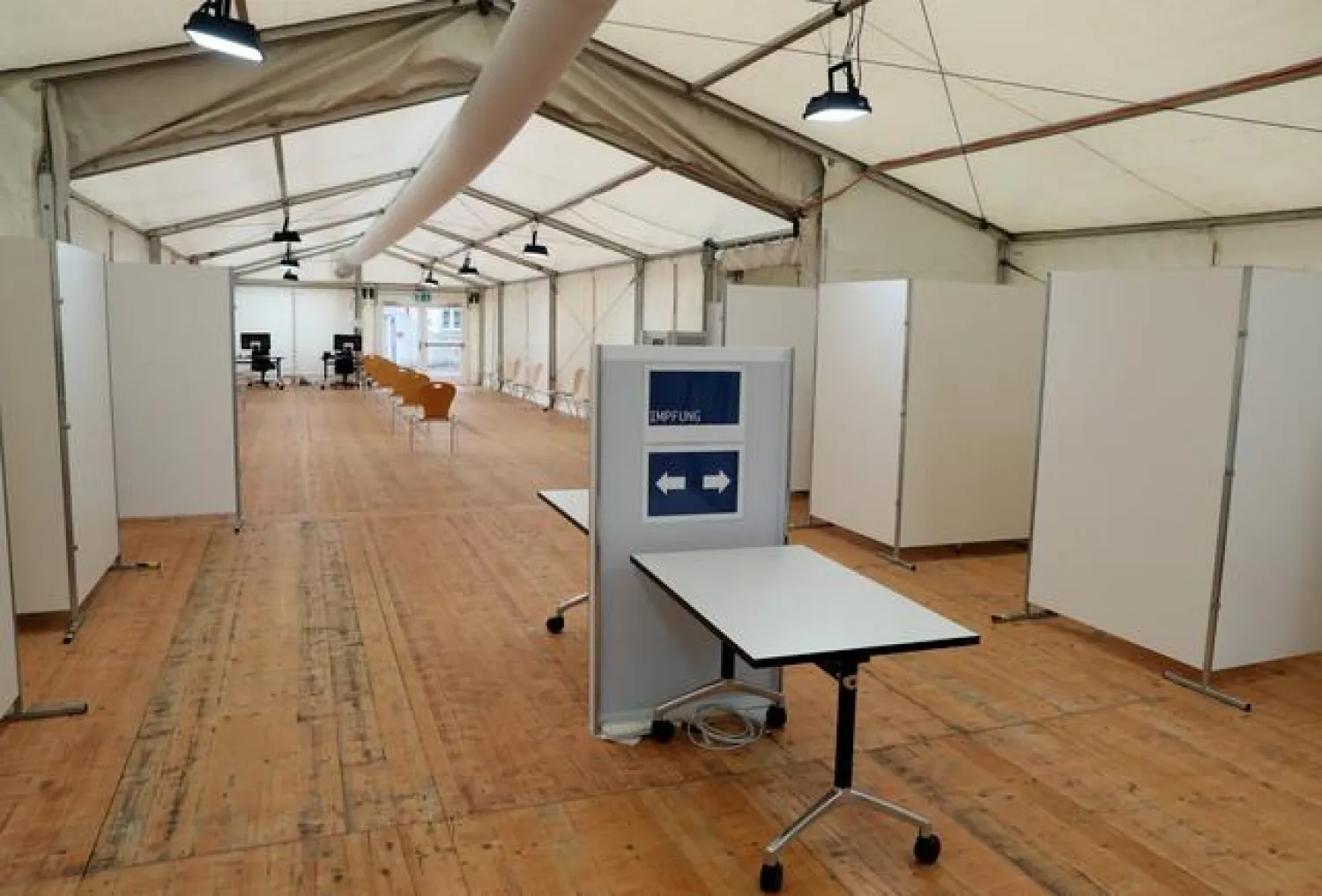
A general view shows the vaccination reference center at the Epidemiology, Biostatistics and Prevention Institute (EBPI), as the spread of the coronavirus disease (COVID-19) continues, in Zurich, Switzerland December 21, 2020. REUTERS/Arnd Wiegmann
TT

Ninety-Year-Old Woman First in Switzerland to Get COVID-19 Shot

A general view shows the vaccination reference center at the Epidemiology, Biostatistics and Prevention Institute (EBPI), as the spread of the coronavirus disease (COVID-19) continues, in Zurich, Switzerland December 21, 2020. REUTERS/Arnd Wiegmann

A 90-year-old woman in the canton of Lucerne on Wednesday became the first person in Switzerland to be vaccinated against the new coronavirus, as the Swiss military distributed a first installment of 107,000 COVID-19 shots around the country.

Lucerne and the rural canton of Appenzell Innerrhoden were first among Switzerland’s 26 cantons to begin inoculations after regulators approved the vaccine from Pfizer and German partner BioNTech on Saturday.

Initial vaccine doses will go to cantons to inoculate vulnerable people, including those aged over 75 and people with medical conditions.

“Residents of nursing and care homes will be first to get vaccines,” Lucerne said on Wednesday, adding it hopes to have the general population vaccinated by late 2021.

While COVID-19 vaccines have been approved in record time, production lags demand, with shots seen in short supply for months as a second infection wave disrupts normal life.

The woman in Lucerne who received the shot lives in a care home. Her name was not released.

Switzerland’s decentralized system of government has left it up to its cantons to develop individual plans to vaccinate the nation of 8.6 million people, though the military is helping with logistics.

Zurich, the largest by population, expects to start vaccinations on Jan. 4.

Britain began vaccinating citizens early this month, and the United States has also given emergency approval to shots from Pfizer/BioNTech and Moderna.

Switzerland, which has set aside 400 million Swiss francs ($450 million) to purchase vaccines, has a contract with Pfizer and BioNTech to eventually get 3 million doses, enough to give 1.5 million people two jabs three weeks apart with the booster seen helping boost efficacy above 90%.

The nation has ordered 15 million vaccine doses, in all, including from Moderna and AstraZeneca, whose vaccine is still under review.

($1 = 0.8895 Swiss francs)


Under Airstrikes, Iran Defiant on Eve of Trump's Ceasefire Deadline

A youngster walks past a religious complex that Iranian officials say was hit by an airstrike in Zanjan, Iran, Saturday, April 4, 2026. (AP Photo/Francisco Seco)
TT

Under Airstrikes, Iran Defiant on Eve of Trump's Ceasefire Deadline

A youngster walks past a religious complex that Iranian officials say was hit by an airstrike in Zanjan, Iran, Saturday, April 4, 2026. (AP Photo/Francisco Seco)

Iran and Israel traded attacks on Tuesday as Tehran refused to reopen the Strait of Hormuz and accept a ceasefire deal on the eve of a deadline set by US President Donald Trump to agree to his demands or get "taken out."

But in what could be a sign of progress, the Iranian ambassador to Pakistan said "positive and productive endeavors" by Islamabad to mediate an end to the war were "approaching a critical, sensitive stage", reported Reuters.

Iran has rejected a US proposal brokered by Pakistan for an immediate ceasefire and the lifting of its effective blockade of the strait, followed by talks on a broader peace settlement within 15 to 20 days, according to a source aware of the plan.

The Iranian response consisted of 10 clauses, including an end to conflicts in the region, a protocol for safe passage through the Strait of Hormuz, lifting of sanctions, and reconstruction, official IRNA news ‌agency reported.

On Monday, ‌Trump said "the entire country can be taken out in one night, and that night might be ‌tomorrow ⁠night." He vowed ⁠to destroy Iranian power plants and infrastructure if Tehran refused to agree before the deadline. Without a deal, Trump said "every bridge in Iran will be decimated" by midnight EDT (0400 GMT) on Wednesday and "every power plant in Iran will be out of business, burning, exploding, and never to be used again."

FIGHTING UNABATED

Early on Tuesday, the Israeli military said it had completed a wave of airstrikes targeting Iranian government infrastructure in Tehran and other areas. It was operating air defense systems to intercept missiles launched from Iran.

Israel also issued an advisory urging Iranians to avoid trains and stay away from railways until Tuesday evening. "Your presence on trains and near railway lines endangers your life," the military posted on its Persian-language account on X.

Saudi Arabia intercepted ballistic missiles ⁠towards its eastern region with debris falling near energy facilities, its defense ministry said without specifying who ‌launched the projectiles.

The kingdom has come under attack from hundreds of Iranian missiles and drones ‌since the US and Israel launched the war on Iran on February 28, most of which were intercepted, authorities have said.

Bahrain, Saudi Arabia and the ‌United Arab Emirates issued simultaneous public safety alerts on Tuesday.

With civilian infrastructure under attack across the region, Trump has brushed off questions that his vow to wipe out Iranian power plants would constitute war crimes, saying he was "not at all" concerned about the prospect.

"I hope I don't have to do it," he said.

Iran's envoy to the United Nations said on Monday Trump's threat to strike was "direct incitement to terrorism and provide clear evidence of intent to commit war crimes under international law." ‌Its top military command said Trump was "delusional."

Iran's deputy sports minister, Alireza Rahimi, has called on artists and athletes to form human chains at power plants across the country on Tuesday. "We will ⁠stand hand in hand to say: Attacking ⁠public infrastructure is a war crime."

CHOKEHOLD

Oil prices hovered around $110 per barrel as Trump's deadline loomed and little visible prospect of the reopening of the Strait of Hormuz, a key global oil transit chokepoint that has spurred inflation worries around the world.

Iran effectively closed Hormuz, a conduit for about a fifth of the world's oil and natural gas supply.

Brent crude futures rose 1% to $111.53 a barrel having risen over 50% since the war began, while US West Texas Intermediate crude futures climbed 0.8% to $113.31. Trump was on the verge of a political crisis as Iran proved a tougher adversary than he predicted at the start of the conflict, which he said was aimed at stopping the country from building nuclear weapons and developing missiles to deliver them.

With 13 US service members killed since the conflict began, he found himself on an even more perilous ground when a US F-15E fighter jet was downed on Friday and one of the two airmen was left stranded deep inside Iranian territory. A rescue mission by US commandos to extract the stranded weapons specialist officer to safety helped avert a disastrous escalation of a political crisis for Trump. Thousands of people have been killed across the Middle East in the war, including 3,546 in Iran, US-based rights group HRANA said, and nearly 1,500 in Lebanon where Israel has targeted the Iran-backed Hezbollah militia.


Taiwan Opposition Leader Heads to China in What She Calls a ‘Journey for Peace’

FILE PHOTO: Kuomintang (KMT) Chairperson Cheng Li-wun speaks to the media ahead of her trip to China, in Taipei, Taiwan March 30, 2026. REUTERS/Ann Wang/File Photo
TT

Taiwan Opposition Leader Heads to China in What She Calls a ‘Journey for Peace’

FILE PHOTO: Kuomintang (KMT) Chairperson Cheng Li-wun speaks to the media ahead of her trip to China, in Taipei, Taiwan March 30, 2026. REUTERS/Ann Wang/File Photo

Taiwan opposition leader Cheng Li-wun is heading to China on Tuesday at the invitation of President Xi Jinping, in what she calls a “journey for peace” as Beijing calls for the self-ruled island to come under its control.

The visit is the first by a Taiwanese opposition leader in a decade and comes ahead of a meeting in Beijing between Xi and US President Donald Trump scheduled to take place in May.

Before leaving Taipei, the chairwoman of the Kuomintang told reporters that Taiwan must spare no effort to prevent war and seize any opportunity to promote peace, The Associated Press said.

China claims the self-ruled island as its own territory and has not ruled out the use of force to take it.

“The purpose of this visit to mainland China is precisely to show the world that it is not just Taiwan that unilaterally hopes for peace,” Cheng said.

“I believe that through this journey for peace, everyone is even more eager to see the sincerity and determination of the CPC Central Committee to use peaceful dialogue and exchange to resolve all possible differences between the two sides,” she added, referring to the initials of the Communist Party of China.

A few dozen supporters and detractors of Cheng showed up at Taipei’s airport, chanting and holding signs.

The Trump administration in December announced a massive package of arms sales to Taiwan valued at more than $10 billion that includes medium-range missiles, howitzers and drones, angering Beijing.

Beijing prohibits all its diplomatic partners, including the US, from maintaining formal ties with Taipei. The US is the island’s strongest informal backer and arms provider, and the arms sale is expected to be discussed at the Xi-Trump summit.

In a call in February between Xi and Trump, the Chinese leader said that “Taiwan will never be allowed to separate from China,” according to a Chinese government statement about the conversation released at the time. “The US must handle the issue of arms sales to Taiwan with prudence,” it added.

Beijing also said that the “Taiwan question is the most important issue in China-US relations.”

China has been sending warplanes and naval vessels toward Taiwan on a near-daily basis, and its military recently staged two major military exercises around the island. The most recent exercise was in December, after the US announcement of the arms sales, and involved the deployment of air, naval and missile units for a joint live-fire drill.

The US State Department said such activities “increase tensions unnecessarily” and called on Beijing to cease military pressure against Taiwan.

China does not engage with Taiwanese President Lai Ching-te, describing him as a separatist.

Cheng will be in China at a time when the opposition-controlled parliament has stalled attempts by Taiwan’s government to pass a $40 billion special defense budget.


Japanese National Detained in Iran in January Released on Bail

Japanese government spokesman Minoru Kihara (Reuters)
TT

Japanese National Detained in Iran in January Released on Bail

Japanese government spokesman Minoru Kihara (Reuters)

A Japanese national detained in Iran has been released on bail, Japan's top government spokesperson said on Tuesday.

The individual was detained on January 20 and released on bail on Monday, and appears to have ‌no health issues, ‌Chief Cabinet Secretary Minoru ‌Kihara ⁠told a press ⁠briefing without providing further details such as identity or charges, according to Reuters.

In February, Radio Free Europe reported that public broadcaster NHK's Tehran bureau chief ⁠Shinnosuke Kawashima had been arrested ‌in ‌Iran and transferred to a local ‌prison.

At the time, NHK ‌said "there is nothing we can answer at this stage" and that staff safety was a top ‌priority.

Japan's government later confirmed a Japanese national had been ⁠detained ⁠in Iran and that it had been in contact with the person's family and Iranian authorities.

Iran has been under fire since the US and Israel began hostilities against the Middle Eastern country on February 28.
