


'You'll Never Walk Alone:' Singer Gerry Marsden Dies at 78

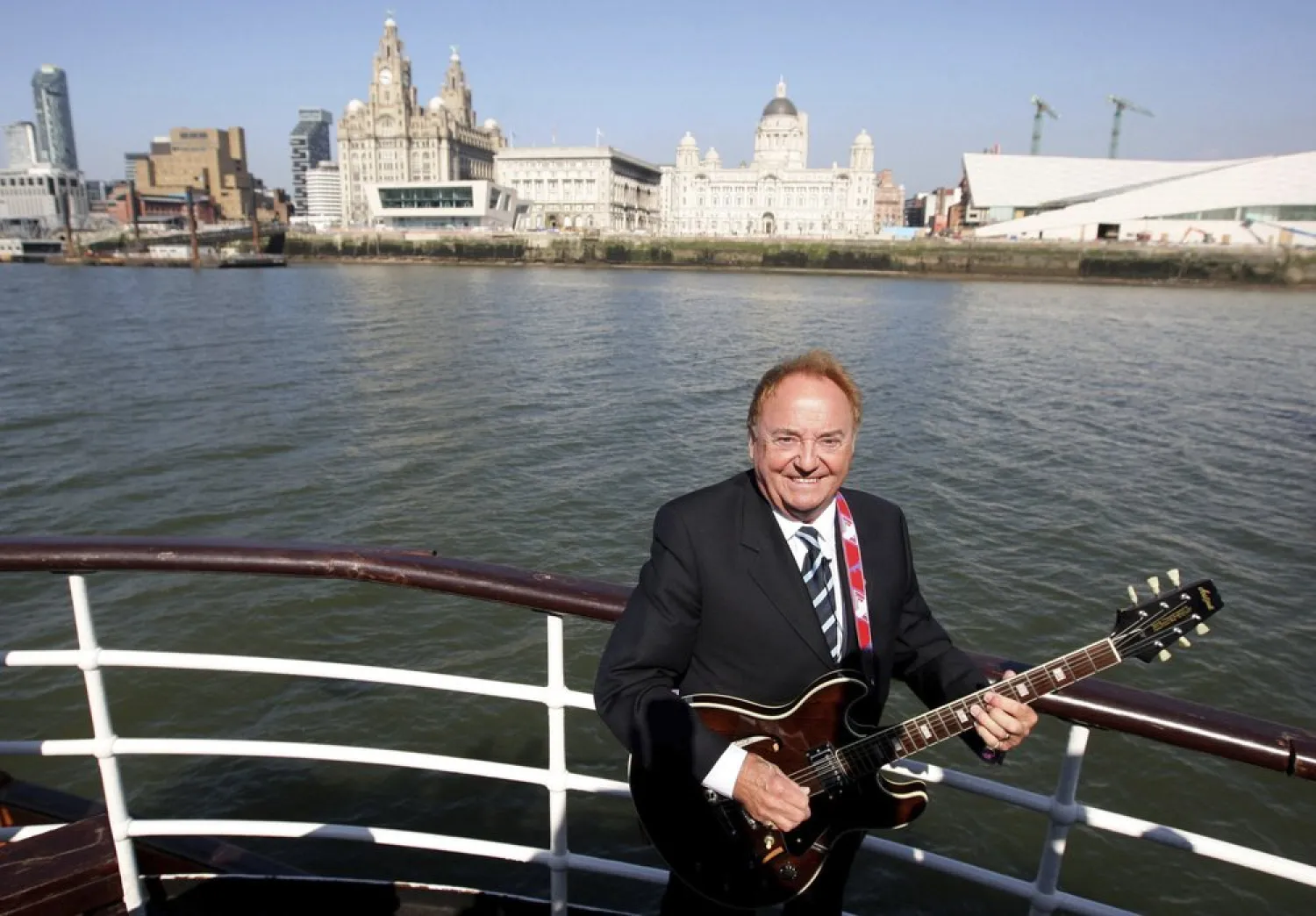
This April 20, 2009 file photo shows Gerry Marsden on board the Mersey ferry. (AP)
TT

'You'll Never Walk Alone:' Singer Gerry Marsden Dies at 78

This April 20, 2009 file photo shows Gerry Marsden on board the Mersey ferry. (AP)

Gerry Marsden, lead singer of the 1960s British group Gerry and the Pacemakers that had such hits as “Ferry Cross the Mersey” and the song that became the anthem of Liverpool Football Club, “You’ll Never Walk Alone,” has died. He was 78.

His family said that Marsden died Sunday “after a short illness in no way connected with COVID-19” and that his wife, daughters and grandchildren are “devastated.”

His friend Pete Price said on Instagram after speaking to Marsden’s family that the singer died after a short illness related to a heart infection.

“I’m sending all the love in the world to (his wife) Pauline and his family,” he said. “You’ll Never Walk Alone.”

Marsden was the lead singer of the band that found fame in the Merseybeat scene in the 1960s. Though another Liverpool band — The Beatles — reached superstardom, Gerry and the Pacemakers will always have a place in the city’s consciousness because of “You’ll Never Walk Alone.”

“I thought what a beautiful song. I’m going to tell my band we’re going to play that song,” Marsden told The Associated Press in 2018 when recalling the first time he heard the song at the cinema. “So I went back and told my buddies we’re doing a ballad called ‘You’ll Never Walk Alone.’”

Marsden is best known for his band’s rendition of the song from “Carousel,” which was a 1945 Rodgers and Hammerstein musical that became a feature film in 1956. The Pacemakers’ cover version was released in October 1963 and became the band’s third No. 1 hit on the British singles chart.

It was adopted by fans of the football club Liverpool and is sung with spine-tingling passion before each home game of the 19-time English champion — before coronavirus restrictions meant many matches being played in empty stadiums.

“I was saddened by Gerry Marsden’s passing. His voice will always lead the way at Anfield, in times of celebration or lament,” singer Elvis Costello said, referring to Liverpool’s stadium.

The song’s lyrics, showcasing unity and perseverance through adversity — including “When you walk through a storm, Hold your head up high, And don’t be afraid of the dark” — have been a rallying cry for the Liverpool faithful and the song’s title are on the Liverpool club crest.

The song has also been adopted by supporters of Scotland’s Celtic and Germany’s Borussia Dortmund.

Liverpool tweeted alongside a video of the fans in full voice that Marsden’s voice “accompanied our biggest nights” and that his “anthem bonded players, staff and fans around the world, helping create something truly special.”

The song was embraced during the outset of the coronavirus pandemic last spring when a cover of the song, which featured World War II veteran Tom Moore, reached number one. Moore had captivated the British public by walking 100 laps of his garden in England in the run-up to his 100th birthday in April to raise some 33 million pounds ($40 million) for the National Health Service.

The Cavern Club in Liverpool, the music venue which was the venue for many of The Beatles’ early gigs, described Marsden as a “legend” and a “very good friend.”

In 1962, Beatles manager Brian Epstein signed up the band and their first three releases reached No. 1 in 1963 — “How Do You Do It?” and “I Like It” as well as “You’ll Never Walk Alone.” Later hits included “Ferry Cross the Mersey,” and “Don’t Let the Sun Catch You Crying.” The group split in 1967 and Marsden pursued a solo career before reforming the bank a few years later.

Paul McCartney from The Beatles said Marsden was “a mate from our early days in Liverpool” and that his group were “our biggest rivals” on the local scene.

“His unforgettable performances of ‘You’ll Never Walk Alone’ and ‘Ferry Cross the Mersey’ remain in many people’s hearts as reminders of a joyful time in British music,” he said.

Marsden is survived by his wife Pauline, whom he married in 1965. The couple had two daughters.



Perry Bamonte, Keyboardist and Guitarist for The Cure, Dies at 65

Perry Bamonte of The Cure performs at North Island Credit Union Amphitheater on May 20, 2023 in Chula Vista, California. (Getty Images/AFP)
TT

Perry Bamonte, Keyboardist and Guitarist for The Cure, Dies at 65

Perry Bamonte of The Cure performs at North Island Credit Union Amphitheater on May 20, 2023 in Chula Vista, California. (Getty Images/AFP)

Perry Bamonte, keyboardist and guitarist in The Cure, has died at 65, the English indie rock band confirmed through their official website on Friday.

In a statement, the band wrote that Bamonte died "after a short illness at home" on Christmas Day.

"It is with enormous sadness that ‌we confirm ‌the death of our ‌great ⁠friend and ‌bandmate Perry Bamonte who passed away after a short illness at home over Christmas," the statement said, adding he was a "vital part of The Cure story."

The statement said Bamonte was ⁠a full-time member of The Cure since 1990, ‌playing guitar, six-string bass, ‍and keyboards, and ‍performed in more than 400 shows.

Bamonte, ‍born in London, England, in 1960, joined the band's road crew in 1984, working alongside his younger brother Daryl, who worked as tour manager for The Cure.

Bamonte first worked as ⁠an assistant to co-founder and lead vocalist, Robert Smith, before becoming a full member after keyboardist Roger O'Donnell left the band in 1990.

Bamonte's first album with The Cure was "Wish" in 1992. He continued to work with them on the next three albums.

He also had various acting ‌roles in movies: "Judge Dredd,About Time" and "The Crow."


First Bond Game in a Decade Hit by Two-month Delay

'007 First Light' depicts a younger Bond earning his license to kill. Ina FASSBENDER / AFP
TT

First Bond Game in a Decade Hit by Two-month Delay

'007 First Light' depicts a younger Bond earning his license to kill. Ina FASSBENDER / AFP

A Danish video game studio said it was delaying the release of the first James Bond video game in over a decade by two months to "refine the experience".

Fans will now have to wait until May 27 to play "007 First Light" featuring Ian Fleming's world-famous spy, after IO Interactive said on Tuesday it was postponing the launch to add some final touches.

"007 First Light is our most ambitious project to date, and the team has been fully focused on delivering an unforgettable James Bond experience," the Danish studio wrote on X.

Describing the game as "fully playable", IO Interactive said the two additional months would allow their team "to further polish and refine the experience", giving players "the strongest possible version at launch".

The game, which depicts a younger Bond earning his license to kill, is set to feature "globe-trotting, spycraft, gadgets, car chases, and more", IO Interactive added.

It has been more than a decade since a video game inspired by Bond was released. The initial release date was scheduled for March 27.


Movie Review: An Electric Timothee Chalamet Is the Consummate Striver in Propulsive ‘Marty Supreme’

 Timothee Chalamet attends the premiere of "Marty Supreme" at Regal Times Square on Tuesday, Dec. 16, 2025, in New York. (AP)
Timothee Chalamet attends the premiere of "Marty Supreme" at Regal Times Square on Tuesday, Dec. 16, 2025, in New York. (AP)
TT

Movie Review: An Electric Timothee Chalamet Is the Consummate Striver in Propulsive ‘Marty Supreme’

 Timothee Chalamet attends the premiere of "Marty Supreme" at Regal Times Square on Tuesday, Dec. 16, 2025, in New York. (AP)
Timothee Chalamet attends the premiere of "Marty Supreme" at Regal Times Square on Tuesday, Dec. 16, 2025, in New York. (AP)

“Everybody wants to rule the world,” goes the Tears for Fears song we hear at a key point in “Marty Supreme,” Josh Safdie’s nerve-busting adrenaline jolt of a movie starring a never-better Timothee Chalamet.

But here’s the thing: everybody may want to rule the world, but not everybody truly believes they CAN. This, one could argue, is what separates the true strivers from the rest of us.

And Marty — played by Chalamet in a delicious synergy of actor, role and whatever fairy dust makes a performance feel both preordained and magically fresh — is a striver. With every fiber of his restless, wiry body. They should add him to the dictionary definition.

Needless to say, Marty is a New Yorker.

Also needless to say, Chalamet is a New Yorker.

And so is Safdie, a writer-director Chalamet has called “the street poet of New York.” So, where else could this story be set?

It’s 1952, on Manhattan’s Lower East Side. Marty Mauser is a salesman in his uncle’s shoe store, escaping to the storeroom for a hot tryst with his (married) girlfriend. This witty opening sequence won’t be the only thing recalling “Uncut Gems,” co-directed by Safdie with his brother Benny before the two split for solo projects. That film, which feels much like the precursor to “Marty Supreme,” began as a trip through the shiny innards of a rare opal, only to wind up inside Adam Sandler’s colon, mid-colonoscopy.

Sandler’s Howard Ratner was a New York striver, too, but sadder, and more troubled. Marty is young, determined, brash — with an eye always to the future. He’s a great salesman: “I could sell shoes to an amputee,” he boasts, crassly. But what he’s plotting to unveil to the world has nothing to do with shoes. It’s about table tennis.

How likely is it that this Jewish kid from the Lower East Side can become the very face of a sport in America, soon to be “staring at you from the cover of a Wheaties box?”

To Marty, perfectly likely. Still, he knows nobody in the US cares about table tennis. He’s so determined to prove everyone wrong, starting at the British Open in London, that when there’s a snag obtaining cash for his trip, he brandishes a gun at a colleague to get it.

Shaking off that sorta-armed robbery thing, Marty arrives in London, where he fast-talks his way into a suite at the Ritz. Here, he spies fellow guest Kay Stone (Gwyneth Paltrow, in a wise, stylish return to the screen), a former movie star married to an insufferable tycoon (“Shark Tank” personality Kevin O’Leary, one of many nonactors here.)

Kay’s skeptical, but Marty finds a way to woo her. Really, all he has to say is: “Come watch me.” Once she sees him play, she’s sneaking into his room in a lace corselet.

This would be a good time to stop and consider Chalamet’s subtly transformed appearance. He is stick-thin — duh, he never stops moving. His mustache is skimpy. His skin is acne-scarred — just enough to erase any movie-star sheen. Most strikingly, his eyes, behind the round spectacles, are beady — and smaller. Definitely not those movie-star eyes.

But then, nearly all the faces in “Marty Supreme” are extraordinary. In a movie with more than 100 characters, we have known actors (Fran Drescher, Abel Ferrara); nonacting personalities (O’Leary, and an excellent Tyler Okonma (Tyler, The Creator) as Marty’s friend Wally); and exciting newcomers like Odessa A’Zion as Marty’s feisty girlfriend Rachel.

There are also a slew of nonactors in small parts, plus cameos from the likes of David Mamet and even high wire artist Philippe Petit. The dizzying array makes one curious how it all came together — is casting director Jennifer Venditti taking interns? Production notes tell us that for one hustling scene at a bowling alley, young men were recruited from a sports trading-card convention.

Elsewhere on the creative team, composer Daniel Lopatin succeeds in channeling both Marty’s beating heart and the ricochet of pingpong balls in his propulsive score. The script by Safdie and cowriter Ronald Bronstein, loosely based on real-life table tennis hustler Marty Reisman, beats with its own, never-stopping pulse. The same breakneck aesthetic applies to camera work by Darius Khondji.

Back now to London, where Marty makes the finals against Japanese player Koto Endo (Koto Kawaguchi, like his character a deaf table tennis champion). “I’ll be dropping a third atom bomb on them,” he brags — not his only questionable World War II quip. But Endo, with his unorthodox paddle and grip, prevails.

After a stint as a side act with the Harlem Globetrotters, including pingpong games with a seal — you’ll have to take our word for this, folks, we’re running low on space — Marty returns home, determined to make the imminent world championships in Tokyo.

But he's in trouble — remember he took cash at gunpoint? Worse, he has no money.

So Marty’s on the run. And he’ll do anything, however messy or dangerous, to get to Japan. Even if he has to totally debase himself (mark our words), or endanger friends — or abandon loyal and brave Rachel.

Is there something else for Marty, besides his obsessive goal? If so, he doesn’t know it yet. But the lyrics of another song used in the film are instructive here: “Everybody’s got to learn sometime.”

So can a single-minded striver ultimately learn something new about his own life?

We'll have to see. As Marty might say: “Come watch me.”