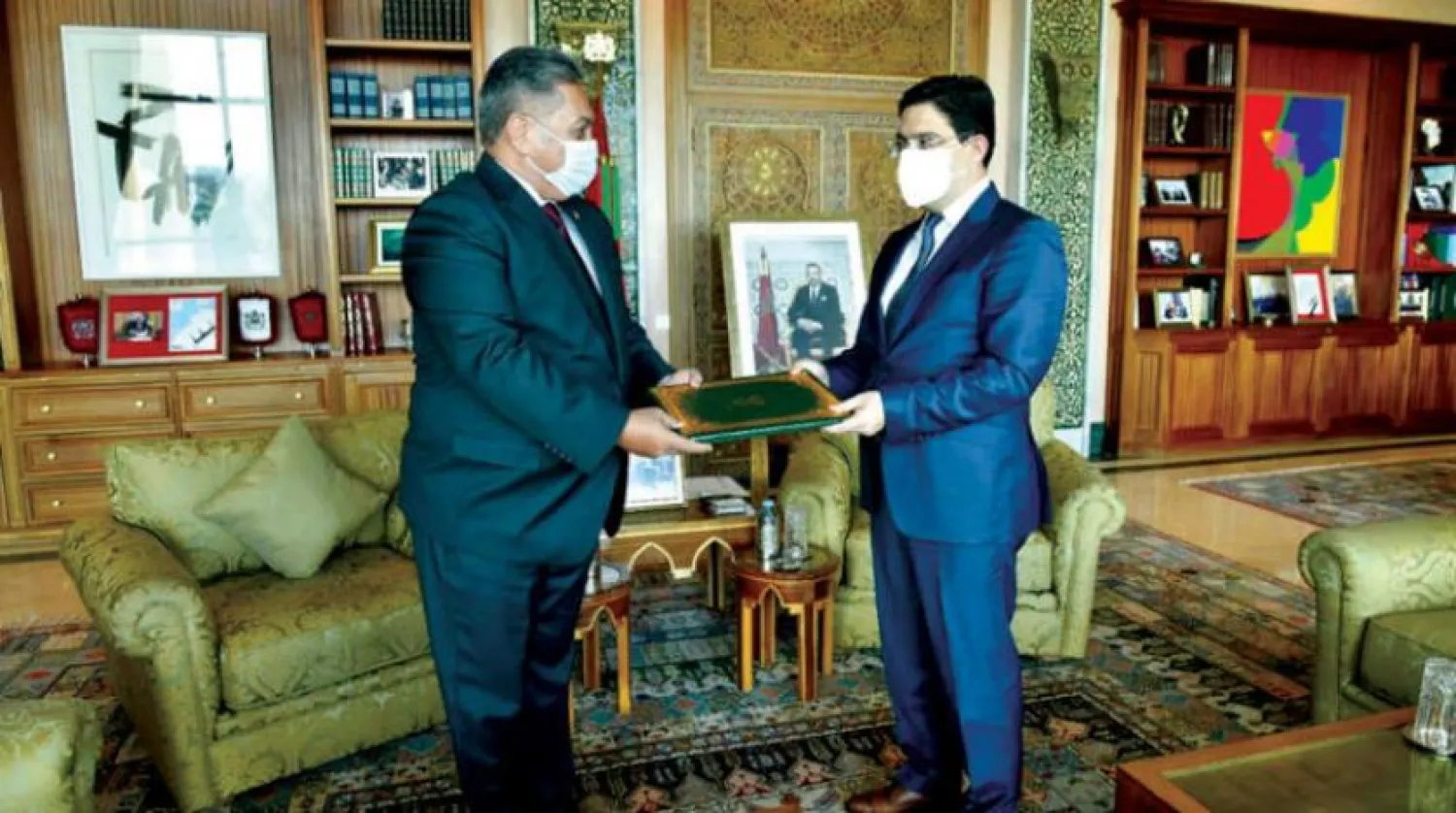
Moroccan-Gulf Talks on ‘Strategic Partnership’

Moroccan Foreign Minister Nasser Bourita (right)
TT

Moroccan-Gulf Talks on ‘Strategic Partnership’

Moroccan Foreign Minister Nasser Bourita (right)

Moroccan Foreign Minister Nasser Bourita had a virtual meeting with the Secretary-General of the Cooperation Council for the Arab States of the Gulf (GCC), Dr. Nayef Falah Mubarak Al-Hajraf, to discuss “strategic partnership”.

The meeting focused on ways to consolidate the existing strategic partnership between the Kingdom of Morocco and the GCC.

Several important milestones of this partnership have been achieved, since 2011, thanks to the leadership of King Mohammed VI, and his brothers, the leaders of the member states of the GCC.

The two parties agreed to extend their joint work plan until 2024.

In this context, Bourita expressed the will of the Kingdom to continue working with the General Secretariat and the Gulf States in order to further develop this partnership.

This would be attained through establishing a new stage of cooperation and through a participatory framework that strengthens political, economic, commercial, and human relations between the two parties.

It embodies the vision of King Mohammed VI, in the Royal Speech at the Morocco-Gulf Countries Summit in Riyadh held on April 20, 2016.

The Secretary-General of the Cooperation Council praised the efforts of the King, chairman of the Jerusalem Committee, in defending the special status of Jerusalem, protecting its Islamic character, preserving the sanctity of Al-Aqsa Mosque, and defending the historical identity of this city as a land for the coexistence of the divine religions.

During the meeting, the Secretary-General reaffirmed the firm position of the GCC States in favor of Morocco's sovereignty over its Sahara and its territorial integrity.

He considered that any solution to this regional conflict can only take place in the framework of the sovereignty of the Kingdom of Morocco.

Bourita further praised Morocco's relationship with the countries of the GCC.

The Moroccan FM underlined the support of the Kingdom of Morocco for the security and stability of the Gulf States and its rejection of any threat to its brother countries.

Talks also covered a number of Arab and regional issues, on which the two sides expressed their similar opinions.


Son of Hamas Chief Survives Israeli Strike, Hamas Says

Palestinians ride a motorcycle past destroyed buildings in Gaza City, Thursday, Nov. 26, 2026. (AP)
TT

Son of Hamas Chief Survives Israeli Strike, Hamas Says

Palestinians ride a motorcycle past destroyed buildings in Gaza City, Thursday, Nov. 26, 2026. (AP)

The son of Hamas chief Khalil al-Hayya survived an assassination attempt by the Israeli military on Friday, senior Hamas official Basem Naim said.

He told Reuters that Izzeldeen al-Hayya and his family had survived a dawn airstrike and Hamas sources said several people, including Hayya's daughter-in-law, had been wounded but there had been no deaths.

The Israeli military had ‌no immediate ‌comment.

Naim described Izzeldeen al-Hayya, ‌born ⁠in 1997, as ⁠the Hamas chief's last surviving son, with four others having been killed by Israeli forces.

The family of one of the late sons survived Friday's strike, Naim said.

Hamas said in a statement that the Israeli military had targeted ⁠a residential apartment, and linked ‌the attack to threats ‌Israeli Defense Minister Israel Katz has made against Hayya.

Hamas ‌accused Israel of seeking to undermine ‌a 2025 Gaza ceasefire agreement and said Israel bore full responsibility for the consequences of its continued attacks.

Izzeldeen is the twin brother of Hamam ‌Khalil al-Hayya, who was killed in a 2025 Israeli airstrike targeting Hamas leaders in ⁠Qatar, ⁠Naim said.

Named Hamas' overall leader in July, Hayya narrowly escaped assassination himself in the Qatar strike.

Hayya warned of possible retaliation on Thursday after Israeli attacks killed at least 10 people in Gaza.

Separately, three Palestinians were killed and two others injured on Friday in an Israeli strike on the city of Rafah, medical sources told Reuters. There was no immediate Israeli comment on the strike.


Salam Says a Proposal Is Underway to Have UN Peacekeepers Stay in Lebanon

 Lebanese Prime Minister Nawaf Salam speaks during an interview with The Associated Press in Beirut, Lebanon, Friday, Nov. 27, 2026. (AP)
Lebanese Prime Minister Nawaf Salam speaks during an interview with The Associated Press in Beirut, Lebanon, Friday, Nov. 27, 2026. (AP)
TT

Salam Says a Proposal Is Underway to Have UN Peacekeepers Stay in Lebanon

 Lebanese Prime Minister Nawaf Salam speaks during an interview with The Associated Press in Beirut, Lebanon, Friday, Nov. 27, 2026. (AP)
Lebanese Prime Minister Nawaf Salam speaks during an interview with The Associated Press in Beirut, Lebanon, Friday, Nov. 27, 2026. (AP)

Lebanon’s prime minister said Friday that a new proposal is in the works that could have the UN Security Council allow the peacekeeping force in southern Lebanon to continue working after its nearly 50-year mandate expires at the end of the year.

Prime Minister Nawaf Salam told The Associated Press that the plan would see the peacekeeping force known as UNIFIL continuing its work after Dec. 31 and as the Security Council debates what should replace it.

France is preparing to introduce a resolution, Salam said, which would allow UNIFIL to continue some of its functions — such as clearing mines, escorting humanitarian convoys, and monitoring violations — in southern Lebanon during a drawdown period after the peacekeepers' mandate ends.

US officials have indicated that Washington is “open to considering” such an arrangement, he said.

“This would not resolve the problem of so-called post-UNIFIL, but it will give us some extra time to agree on a new architecture in southern Lebanon,” Salam said in an exclusive interview with the AP at the government palace in Beirut.

No plan in place for what comes next

The UN Security Council voted last year to terminate UNIFIL’s mandate at the end of 2026, bowing to demands from the United States and its close ally Israel, which argued that the force had failed to stop Hezbollah's buildup in southern Lebanon.

UNIFIL officials say they were never charged with disarming Hezbollah and that the force helped to preserve calm in the border region for 17 years before Hamas’ 2023 attack on southern Israel ignited a regional war.

The 7,500 peacekeepers currently stationed in southern Lebanon are expected to gradually withdraw over about six months after their mandate expires. The force has a year to fully end its operations.

Much of southern Lebanon, meanwhile, is occupied by Israeli forces after a war broke out in March between Israel and the Lebanese group Hezbollah, linked to the wider Iran war. Hezbollah has refused to give up its weapons, and Israel says it will not withdraw before the group is disarmed.

France has not publicly commented on the proposal that Salam cited.

However, a Western diplomat with knowledge of the matter said one option under discussion is to slow down the withdrawal process and “maintain certain UNIFIL missions” to avoid a power vacuum. The diplomat spoke on condition of anonymity to discuss the matter.

Lebanese officials have called for an extension of UNIFIL's mandate or, failing that, for a new UN-mandated force to be formed.

US officials have expressed willingness for some sort of international force to remain, but not in its current form. They have suggested that it could be a civilian force or private defense contractor.

Salam said that “any force to be deployed will have to be endorsed by the Security Council."

“I was very clear about it," he said. Any presence of forces "in the south will have to be endorsed by the Security Council."

‘In flux’

Salam said that with the wider Middle East and especially his region "in flux,” it's hard to make definitive plans.

Efforts are still underway to form a new government in Israel following last month's elections, and it remains unclear whether the US-Iran war is heading toward a new escalation or a negotiated solution. Iran is Hezbollah's main backer.

While the Lebanese government has insisted that its negotiations with Israel are separate from any US-Iran deal, Salam acknowledged that “the relation between the US and Iran directly affects the situation in Lebanon.”

“Lebanon is not an isolated island in the Mediterranean,” he said. “We are very much influenced by developments in the region. The whole region is in turmoil.”

Lebanon and Israel reached an agreement in June under which Israeli forces are supposed to gradually withdraw from Lebanon and hand over control to the Lebanese army, while Hezbollah is to be disarmed.

But implementation has stalled, as have talks between the two countries.

Salam denied that the talks have collapsed but said the “formal negotiations were put on hold” because of the Israeli elections and uncertainty around the composition of the next Israeli government.

It is unclear how an Israeli government potentially headed by opposition politician Gadi Eisenkot instead of current Prime Minister Benjamin Netanyahu would differ in its approach to Lebanon, Salam said.

Salam's firm stand on Iran and Hezbollah

The Lebanese prime minister said that his government has open lines of communication with Hezbollah and Iran but will not “allow the future of the country to be contingent on Iran’s wishes.”

Hezbollah, which has suffered a series of major blows in two recent wars with Israel, seems to be “more and more dependent on Iran" and continues to receive military and financial assistance from Tehran, Salam said.

That's despite attempts to clamp down on the group's ability to move money and weapons into the country.

Since the ouster of Syria's Iran-allied former President Bashar Assad two years ago, the flow of arms from Iran to Lebanon via Syria has slowed but not stopped.

Lebanon remains in a difficult position. Hezbollah has threatened to fight any attempt to forcibly disarm it, and the Lebanese army has so far moved cautiously.

“Definitely we are not seeking confrontation with Hezbollah," Salam said. "But we will not succumb to the intimidation of Hezbollah.”


UN Peacekeepers Are Preparing to Leave Southern Lebanon with No Plan for What Comes Next

 This picture, taken from northern Israel, shows a United Nations Interim Force in Lebanon (UNIFIL) armored vehicle driving past destroyed buildings in southern Lebanon on November 24, 2026. (AFP)
This picture, taken from northern Israel, shows a United Nations Interim Force in Lebanon (UNIFIL) armored vehicle driving past destroyed buildings in southern Lebanon on November 24, 2026. (AFP)
TT

UN Peacekeepers Are Preparing to Leave Southern Lebanon with No Plan for What Comes Next

 This picture, taken from northern Israel, shows a United Nations Interim Force in Lebanon (UNIFIL) armored vehicle driving past destroyed buildings in southern Lebanon on November 24, 2026. (AFP)
This picture, taken from northern Israel, shows a United Nations Interim Force in Lebanon (UNIFIL) armored vehicle driving past destroyed buildings in southern Lebanon on November 24, 2026. (AFP)

Among the few buildings still standing in the Lebanese border town of Naqoura are an abandoned hotel occupied by Israeli soldiers, its walls draped with anti-drone netting, and the compound housing the headquarters of the UN peacekeeping force.

The roads passing through the once-idyllic seaside town, now largely reduced to rubble, are empty except for the occasional military patrol or convoy of peacekeepers escorting civilians or supplies.

The end of the nearly 50-year mandate of the UNIFIL peacekeeping force is looming in just over a month, and still there is no plan for what comes after it.

The peacekeepers' impending exit, in parallel with an ongoing occupation by Israeli forces and a debate over the disarmament of the Hezbollah group, leaves the future of southern Lebanon in limbo.

Lebanon wants the UN force to stay. But the UN Security Council voted last year to terminate UNIFIL’s mandate at the end of 2026, bowing to demands from the United States and its close ally Israel.

Israel says the mission was a failure, citing Hezbollah’s military buildup over the years. The peacekeepers say they helped preserve calm for 17 years before Hamas’ 2023 attack on southern Israel ignited a regional conflict.

“My mandate is not to disarm Hezbollah,” UNIFIL’s commander, Maj. Gen. Diodato Abagnara, told The Associated Press in an interview. “My mandate is to support the Lebanese Armed Forces, to create the best conditions for the Lebanese Armed Forces to take full control here in the south. It’s not to fight against Hezbollah.”

UNIFIL is set to begin a gradual drawdown of its 7,500 peacekeepers on Jan. 1. Whatever comes after that, he said, “It’s very important to avoid a security vacuum in the south.”

Lebanese civilians fear a future without UNIFIL

UNIFIL wasn’t able to stop Hezbollah from launching missiles or Israel from carrying out airstrikes in two recent wars. But many residents of southern Lebanon say they still feel safer with its presence.

Mohammed Aoun was late to start harvesting his olive groves this year in the village of Halta, just outside of the Israeli-occupied area. On the first day of harvest earlier this month, as a UNIFIL patrol stopped at the orchard, an Israeli drone was buzzing overhead. The thud of a distant airstrike echoed through the valley.

Aoun said he was hesitant to start picking, but he had already lost out on the previous two years’ harvests. He is apprehensive about the impending departure of UNIFIL forces.

“Of course, we feel more secure when we see patrols coming and going; it’s a sort of protection,” he said. “Their presence is important with regards to the security situation. We don’t know what will happen after they leave.”

A decades-long presence

The UN Interim Force in Lebanon was created in 1978 after Israel invaded southern Lebanon to fight Palestinian militants. Israel invaded again in 1982 and didn't withdraw until 2000. During that period, Hezbollah, backed by Iran, emerged as a guerrilla force.

After a monthlong war between Israel and Hezbollah in 2006, UNIFIL was tasked with monitoring violations of UN Security Council Resolution 1701, which ended the fighting. When a ceasefire ended another Israel-Hezbollah war in 2024, UNIFIL was part of the mechanism overseeing its implementation.

The Lebanese army was to take over security in southern Lebanon after the UN force's exit.

But then another war broke out between Israel and Hezbollah in March, linked to the wider Iran war. Israel now occupies large swaths of southern Lebanon, where its soldiers have emptied and demolished dozens of villages.

About 11,000 people remain in a handful of mostly Christian villages in the occupied area, Abagnara said. They depend on UNIFIL to escort the convoys that keep them connected with the rest of the country.

An agreement between Lebanon and Israel for Israeli forces to withdraw in exchange for the disarmament of Hezbollah has floundered, and negotiations between the two countries have stalled.

No clear solution

Lebanese President Joseph Aoun said in a statement Wednesday that “Israel continues to engage in hostile acts in the south” and his government and France — a Security Council member with close ties to Lebanon — both want an extension of UNIFIL's mandate. Any alternative force should continue to operate under the 1701 framework, with some possible amendments, he said.

On Friday, Lebanon’s Prime Minister Nawaf Salam told the AP that a proposal is in the works to let UNIFIL continue some of its functions during the drawdown period after its mandate ends, as the Security Council debates what should replace it. But it's not clear if Washington will accept the plan.

US officials have expressed willingness for some sort of international force to remain, but not in its current form. They have suggested that it could be a civilian force or private defense contractor.

Israel wants its military to coordinate directly with the Lebanese army to remove what remains of Hezbollah’s weapons.

Israel’s ambassador to the UN, Danny Danon, said earlier this month that Hezbollah had "exploited UNIFIL’s presence."

“We do not rely on any international force," he said. "We trust only our own soldiers.”

Lebanon opposes the idea of a civilian contractor and has rejected direct military coordination with Israel.

France is working on a Security Council resolution that would authorize a new international force, a UN diplomat said. A Western diplomat said there are also discussions of slowing down UNIFIL's withdrawal and maintaining certain missions to avoid a “power vacuum.”

They spoke on condition of anonymity because they were not authorized to comment publicly.

The question of Hezbollah's weapons remains

In January, the Lebanese army announced that it had finished removing Hezbollah weapons caches from the border area south of the Litani River.

Hezbollah did not actively oppose the effort but has refused to give up its weapons elsewhere in the country and threatened to fight any attempt to forcibly disarm it.

The Lebanese army has been cautious about any move that might provoke a civil conflict. A Lebanese security official, who spoke on condition of anonymity to discuss sensitive matters, said the army’s current policy is to stop weapons shipments from moving around the country — a change from the past, when Hezbollah freely transported arms — but not to raid the group’s storage sites.

Hezbollah supporters in the past accused UNIFIL of spying for Israel and sometimes attacked peacekeepers. Now the group says it would accept UNIFIL or another UN-mandated force, but not a private security contractor or a force seen as supporting Israel's occupation.