


Beat Poet, Publisher Lawrence Ferlinghetti Dies at 101

Author Lawrence Ferlinghetti recites a poem after he was awarded the Literarian Award for Outstanding Service to the American Literary Community at the National Book Awards in New York, on Nov. 16, 2005. (AP)
TT

Beat Poet, Publisher Lawrence Ferlinghetti Dies at 101

Author Lawrence Ferlinghetti recites a poem after he was awarded the Literarian Award for Outstanding Service to the American Literary Community at the National Book Awards in New York, on Nov. 16, 2005. (AP)

Lawrence Ferlinghetti, the poet, publisher, bookseller and activist who helped launch the Beat movement in the 1950s and embodied its curious and rebellious spirit well into the 21st century, has died at age 101.

Ferlinghetti, a San Francisco institution, died Monday at his home, his son Lorenzo Ferlinghetti said. A month shy of his 102nd birthday, Ferlinghetti died “in his own room,” holding the hands of his son and his son’s girlfriend, “as he took his last breath." The cause of death was lung disease. Ferlinghetti had received the first dose of the COVID vaccine last week, his son said Tuesday.

Few poets of the past 60 years were so well known, or so influential. His books sold more than 1 million copies worldwide, a fantasy for virtually any of his peers, and he ran one of the world’s most famous and distinctive bookstores, City Lights. Although he never considered himself one of the Beats, he was a patron and soul mate and, for many, a lasting symbol — preaching a nobler and more ecstatic American dream.

“Am I the consciousness of a generation or just some old fool sounding off and trying to escape the dominant materialist avaricious consciousness of America?” he asked in “Little Boy,” a stream of consciousness novel published around the time of his 100th birthday

He made history. Through the City Lights publishing arm, books by Jack Kerouac, William S. Burroughs and many others came out and the release of Allen Ginsberg’s landmark poem “Howl” led to a 1957 obscenity case that broke new ground for freedom of expression.

He also defied history. The Internet, superstore chains and high rents shut down numerous booksellers in the Bay Area and beyond, but City Lights remained a thriving political and cultural outlet, where one section was devoted to books enabling “revolutionary competence,” where employees could get the day off to attend an anti-war protest.

“Generally, people seem to get more conservative as they age, but in my case, I seem to have gotten more radical,” Ferlinghetti told Interview magazine in 2013. “Poetry must be capable of answering the challenge of apocalyptic times, even if this means sounding apocalyptic.”

The store even endured during the coronavirus outbreak, when it was forced to close and required $300,000 to stay in business. A GoFundMe campaign quickly raised $400,000.

Ferlinghetti, tall and bearded, with sharp blue eyes, could be soft-spoken, even introverted and reticent in unfamiliar situations. But he was the most public of poets and his work wasn’t intended for solitary contemplation. It was meant to be recited or chanted out loud, whether in coffee houses, bookstores or at campus gatherings.

His 1958 compilation, “A Coney Island of the Mind,” sold hundreds of thousands of copies in the US alone. Long an outsider from the poetry community, Ferlinghetti once joked that he had “committed the sin of too much clarity.” He called his style “wide open” and his work, influenced in part by E.E. Cummings, was often lyrical and childlike: “Peacocks walked/under the night trees/in the lost moon/light/when I went out/looking for love,” he wrote in “Coney Island.”

Ferlinghetti also was a playwright, novelist, translator and painter and had many admirers among musicians. In 1976, he recited “The Lord’s Prayer” at the Band’s farewell concert, immortalized in Martin Scorsese’s “The Last Waltz.”

He lived long and well despite a traumatic childhood. His father died five months before Lawrence was born in Yonkers, New York, in 1919, leaving behind a sense of loss that haunted him, yet provided much of the creative tension that drove his art. His mother, unable to cope, had a nervous breakdown two years after his father’s death. She eventually disappeared and died in a state hospital.

Ferlinghetti spent years moving among relatives, boarding homes and an orphanage before he was taken in by a wealthy New York family, the Bislands, for whom his mother had worked as a governess. He studied journalism at the University of North Carolina at Chapel Hill, received a master’s in literature from Columbia University, and a doctorate degree from the Sorbonne in Paris. His early influences included Ernest Hemingway, Thomas Wolfe and Ezra Pound.

Ferlinghetti hated war, because he was in one. In 1945, he was a Navy commander stationed in Japan and remembered visiting Nagasaki a few weeks after the US had dropped an atom bomb. The carnage, he would recall, made him an “instant pacifist.”

In the early 1950s, he settled in San Francisco and married Selden Kirby-Smith, whom he divorced in 1976. (They had two children). Ferlinghetti also became a member of the city’s rising literary movement, the so-called San Francisco Renaissance, and soon helped establish a gathering place. Peter D, Martin, a sociologist, had opened a paperback store in the city’s North Beach section and named it after a recent Charlie Chaplin film, “City Lights.” When Ferlinghetti saw the storefront, in 1953, he suggested he and Martin become partners. Each contributed $500.

Ferlinghetti later told The New York Times: “City Lights became about the only place around where you could go in, sit down, and read books without being pestered to buy something.”

The Beats, who had met in New York in the 1940s, now had a new base. One project was City Lights’ Pocket Poets series, which offered low-cost editions of verse, notably Ginsberg’s “Howl.”

Ferlinghetti published “Howl and Other Poems” in 1956, but customs officials seized copies of the book that were being shipped from London, and Ferlinghetti was arrested on obscenity charges. After a highly publicized court battle, a judge in 1957 ruled that “Howl” was not obscene, despite its sexual themes, citing the poem’s relevance as a criticism of modern society. A 2010 film about the case, “Howl,” starred James Franco as Ginsberg and Andrew Rogers as Ferlinghetti.

Ferlinghetti would also release Kerouac’s “Book of Dreams,” prison writings by Timothy Leary and Frank O’Hara’s “Lunch Poems.” Ferlinghetti risked prison for “Howl,” but rejected Burrough’s classic “Naked Lunch,” worrying that publication would lead to “sure premeditated legal lunacy.”

Ferlinghetti’s eyesight was poor in recent years, but he continued to write and to keep regular hours at City Lights. The establishment, meanwhile, warmed to him, even if the affection wasn’t always returned. He was named San Francisco’s first poet laureate, in 1998, and City Lights was granted landmark status three years later. He received an honorary prize from the National Book Critics Circle in 2000 and five years later was given a National Book Award medal for “his tireless work on behalf of poets and the entire literary community.”

In 2012, Ferlinghetti won the Janus Pannonius International Poetry Prize from the Hungarian PEN Club. When he learned the country’s right-wing government was a sponsor, he turned the award down.



Culture Ministry Continues Preparations in Historic Jeddah to Welcome Visitors during Ramadan 

Historic Jeddah has emerged as a leading cultural tourism destination during Ramadan. (SPA)
TT

Culture Ministry Continues Preparations in Historic Jeddah to Welcome Visitors during Ramadan 

Historic Jeddah has emerged as a leading cultural tourism destination during Ramadan. (SPA)

The Saudi Ministry of Culture is continuing its efforts to revitalize Historic Jeddah in preparation for welcoming visitors during the holy month of Ramadan, offering cultural programs, events, and heritage experiences that reflect the authenticity of the past.

The district has emerged as a leading cultural tourism destination at this time of year as part of the “The Heart of Ramadan” campaign launched by the Saudi Tourism Authority.

Visitors are provided the opportunity to explore the district’s attractions, including archaeological sites located within the geographical boundaries of the UNESCO World Heritage-listed area, which represent a central component of the Kingdom’s urban and cultural heritage.

The area also features museums that serve as gateways to understanding the city’s rich heritage and cultural development, in addition to traditional markets that narrate historical stories through locally made products and Ramadan specialties that reflect authentic traditions.

These initiatives are part of the ministry’s ongoing efforts to revitalize Historic Jeddah in line with the objectives of Saudi Vision 2030 and aiming to transform it into a vibrant hub for arts, culture, and the creative economy, while preserving its tangible and intangible heritage.


Thousands of Animals, Rare Specimens Stolen from Sudan Museum

Skulls of several mammals before the destruction (Asharq Al-Awsat)
TT

Thousands of Animals, Rare Specimens Stolen from Sudan Museum

Skulls of several mammals before the destruction (Asharq Al-Awsat)

“Everything is over.” With that short and painful phrase, a Sudanese government official summed up the loss of nearly a century and a half of history after war destroyed the headquarters of the Sudan Natural History Museum in central Khartoum, stripping the country of thousands of taxidermied and live endangered animals, as well as rare reference specimens.

In the first days after fighting erupted in April 2023, activists on social media called for food and water to be provided to save the live animals. When that proved impossible, cages were opened, and the animals fled, even though some of the reptiles were venomous snakes.

The museum, officially affiliated with the University of Khartoum, lies about one kilometer from the Sudanese army’s general command headquarters in central Khartoum.

Its close proximity led to severe damage from clashes and shelling between the Sudanese army and the Rapid Support Forces, which later took control of the surrounding area for more than a year.

Dr. Othman Ali Haj Al-Amin, Dean of the Faculty of Science at the University of Khartoum, said: “We lost thousands of taxidermied animals, birds, and reptiles that are more than 150 years old.”

“It is most likely that the live animals were stolen or looted and did not die,” he added. “We did not find remains or skeletons of those animals inside the museum.”

Al-Amin broke down in tears as he described to Asharq Al-Awsat the scale of devastation inflicted on one of the world’s oldest natural history museums.

“We lost about 2,000 taxidermied animal specimens, in addition to more than 600 endangered reference specimens that were on display, and nearly all geological records, including animal, plant, and rock fossils,” he said.

“The greatest loss was around 100 species representing all families of animals, birds, and reptiles that had been cared for and preserved for decades.”

Among them were fossil bird specimens collected between 1885 and 1945 that cannot be replaced, as well as a Kordofan giraffe, an endangered subspecies.

The war also claimed “the oldest crocodile, which had lived in the museum for many years and had been cared for since it was an egg,” along with numerous reptiles, including venomous snakes, scorpions, and a Nile monitor lizard.

A taxidermied lioness was recovered and transferred to the university’s veterinary faculty.

Asharq Al-Awsat learned that the International Committee of the Red Cross attempted in those early days to evacuate civilians, including university students who were trapped inside the museum for weeks, as well as to move live and taxidermied animals. The effort failed due to intense fighting in the heart of Khartoum.

According to the Sudanese official, the preserved specimens were collected in the mid-19th century by British army officers.

During World War II, they were transferred from the Sudan National Museum to the Natural History Museum next to the University of Khartoum, which has managed them since its establishment in 1929.

Al-Amin said the museum housed specimens illustrating biodiversity from across Sudan, including South Sudan before its secession, as well as samples gifted to Sudan by international museums.

The Sudan Natural History Museum included multiple sections, among them halls displaying rare bird species, another devoted to animal skulls preserved for decades, a section for medicinal and aromatic plants, geological rock samples collected from ancient eras and environments, and enclosures for live animals.

The dean said restoring the museum to its original state would require many years of work and significant funding. He voiced pessimism about recovering the rare animals, historical specimens, and old records lost during the war.

Many live animals were likely deliberately killed or died of hunger and thirst, he said, while taxidermied animals and rare rock and herb specimens — painstakingly collected, sorted, and classified over many years by researchers — were looted.

The Natural History Museum was a scientific and cultural institution dedicated to the study of biodiversity and natural specimens, and one of the oldest museums in Sudan.


Once a National Obsession, Traditional Korean Wrestling Fights for Survival 

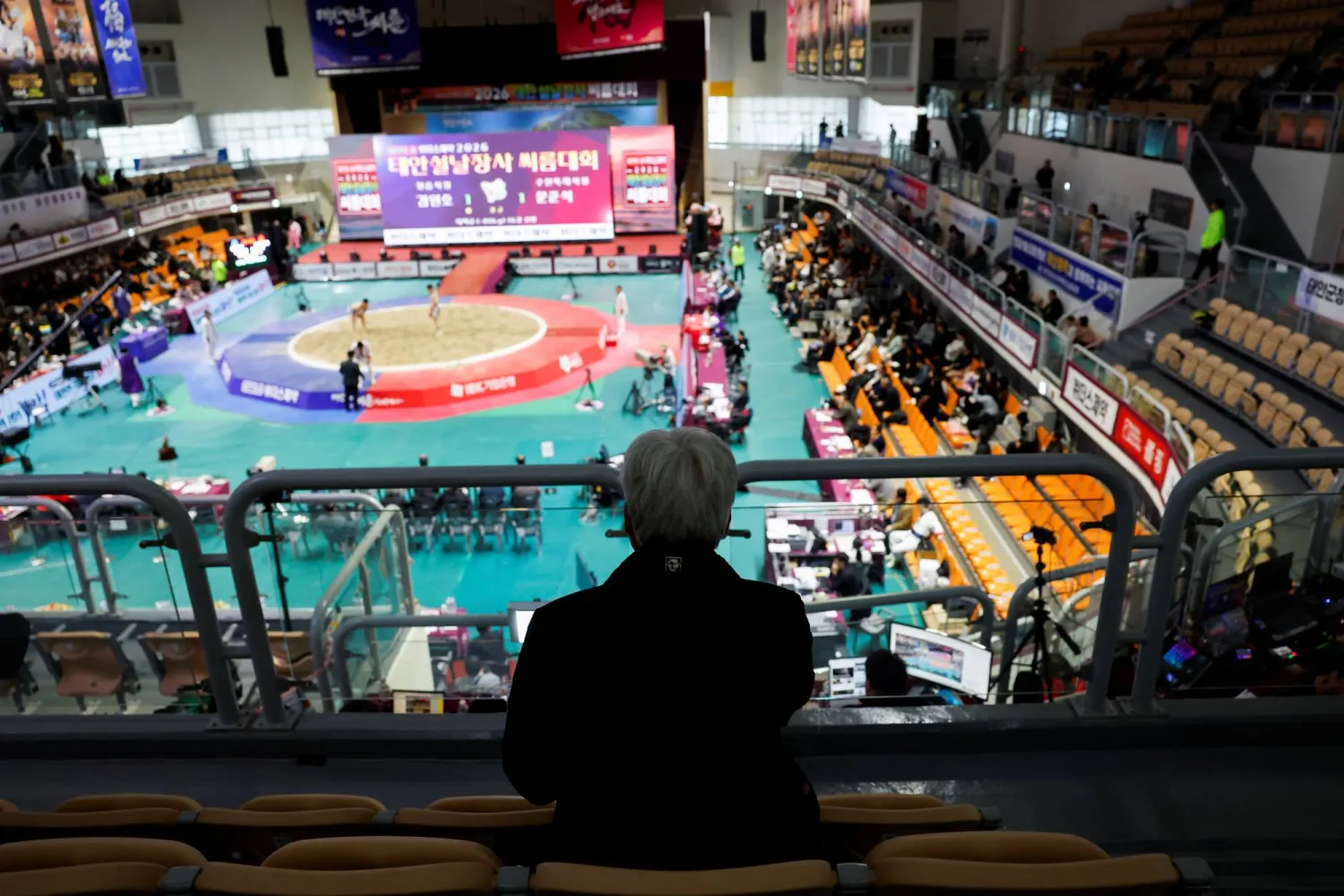
An elderly spectator watches a ssireum match during a Lunar New Year Ssireum championship at the Taean Complex Indoor Gymnasium in Taean, South Korea, February 14, 2026. (Reuters)
TT

Once a National Obsession, Traditional Korean Wrestling Fights for Survival 

An elderly spectator watches a ssireum match during a Lunar New Year Ssireum championship at the Taean Complex Indoor Gymnasium in Taean, South Korea, February 14, 2026. (Reuters)

As South Korea's global cultural influence expands in areas such as music, film and television, one form of entertainment struggling to attract attention even at home is Korea's traditional style of wrestling, known as ssireum.

Ssireum - pronounced like "see room" - had its heyday in the 1980s and early 1990s, when there were as many as eight professional teams and the top wrestlers became household names. Since then, it has been squeezed by tighter budgets and a public quick to move on to new trends.

Twenty-year-old Lee Eun-soo, who began training at the age ‌of nine, is ‌taking part in this year's Lunar New Year ‌tournament, ⁠the showcase event ⁠for the more than 1,500-year-old sport.

Lee lamented that at his former high school, the ssireum team currently has no members and there is talk of disbanding it.

"I once tried to imagine my life if I hadn’t done ssireum," Lee said. "I don’t think I could live without it."

A ssireum match involves two wrestlers facing off in an ⁠eight-meter (26.25 ft) sandpit ring, gripping each other by a ‌cloth belt called a "satba" and using ‌strength, balance, timing and stamina to force the opponent to the ground.

Ssireum ‌was inscribed on UNESCO's Representative List of the Intangible Cultural Heritage ‌of Humanity in 2018, but that international recognition has not translated into commercial success. Its relative obscurity contrasts with the high profile of Japan's sumo, another centuries-old form of wrestling.

Unlike sumo, which is supported by ‌a centralized professional ranking system and six major annual tournaments - or Olympic wrestling, with its global reach - ⁠ssireum remains ⁠largely domestic.

"Sport is something people won't come to watch if they don’t know the wrestlers or even the sport itself," said Lee Tae-hyun, a former ssireum wrestler and Professor of Martial Arts at Yong In University, who has promoted the sport overseas and believes it has commercial potential with the right backing.

Lee Hye-soo, 25, a spectator at the Lunar New Year tournament, said many Koreans are now unfamiliar with ssireum.

"My grandfather liked watching ssireum, so I watched it with him a lot when I was young," she said.

"I like it now too, but I think it would be even better if it became more famous."