
In Oil-Rich Iraq, a Few Women Buck Norms, Take Rig Site Jobs

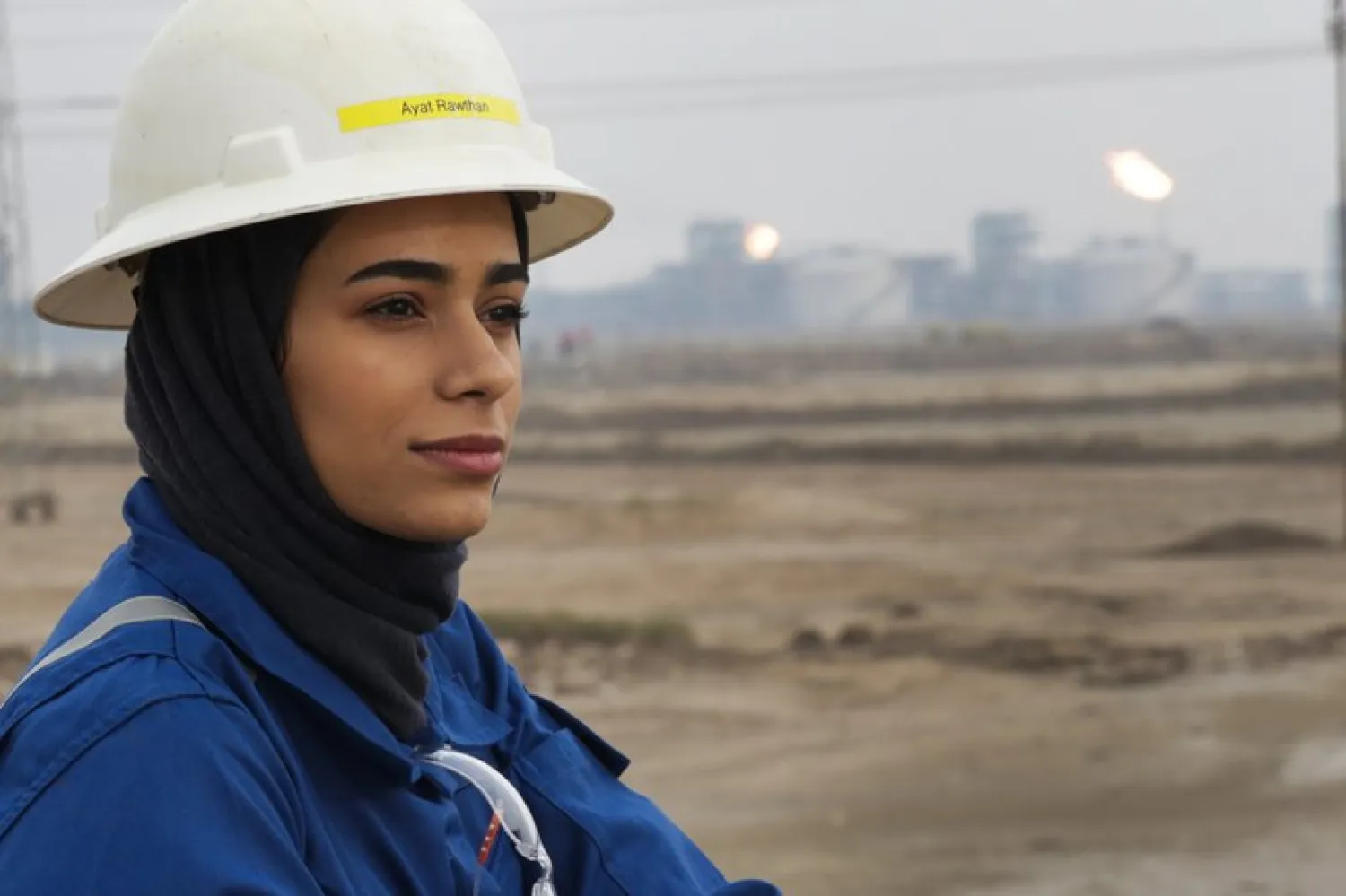
Ayat Rawthan, a petrochemical engineer, poses for a photo near an oil field outside Basra, Iraq, Tuesday, Feb. 5, 2021. (AP Photo/Nabil al-Jourani)
TT

In Oil-Rich Iraq, a Few Women Buck Norms, Take Rig Site Jobs

Ayat Rawthan, a petrochemical engineer, poses for a photo near an oil field outside Basra, Iraq, Tuesday, Feb. 5, 2021. (AP Photo/Nabil al-Jourani)

It’s nearly dawn and Zainab Amjad has been up all night working on an oil rig in southern Iraq. She lowers a sensor into the black depths of a well until sonar waves detect the presence of the crude that fuels her country’s economy.

Elsewhere in the oil-rich province of Basra, Ayat Rawthan is supervising the assembly of large drill pipes. These will bore into the Earth and send crucial data on rock formations to screens sitting a few meters (feet) away that she will decipher.

The women, both 24, are among just a handful who have eschewed the dreary office jobs typically handed to female petroleum engineers in Iraq. Instead, they chose to become trailblazers in the country’s oil industry, donning hard hats to take up the grueling work at rig sites.

They are part of a new generation of talented Iraqi women who are testing the limits imposed by their conservative communities. Their determination to find jobs in a historically male-dominated industry is a striking example of the way a burgeoning youth population finds itself increasingly at odds with deeply entrenched and conservative tribal traditions prevalent in Iraq’s southern oil heartland.

The hours Amjad and Rawthan spend in the oil fields are long and the weather unforgiving. Often they are asked what — as women — they are doing there, The Associated Press reported.

“They tell me the field environment only men can withstand,” said Amjad, who spends six weeks at a time living at the rig site. “If I gave up, I’d prove them right.”

Iraq’s fortunes, both economic and political, tend to ebb and flow with oil markets. Oil sales make up 90% of state revenues — and the vast majority of the crude comes from the south. A price crash brings about an economic crisis; a boom stuffs state coffers. A healthy economy brings a measure of stability, while instability has often undermined the strength of the oil sector. Decades of wars, civil unrest and invasion have stalled production.

Following low oil prices dragged down by the coronavirus pandemic and international disputes, Iraq is showing signs of recovery, with January exports reaching 2.868 million barrels per day at $53 per barrel, according to Oil Ministry statistics.

To most Iraqis, the industry can be summed up by those figures, but Amjad and Rawthan have a more granular view. Every well presents a set of challenges; some required more pressure to pump, others were laden with poisonous gas. “Every field feels like going to a new country,” said Amjad.

Given the industry’s outsized importance to the economy, petrochemical programs in the country’s engineering schools are reserved for students with the highest marks. Both women were in the top 5% of their graduating class at Basra University in 2018.

In school they became awestruck by drilling. To them it was a new world, with it’s own language: “spudding” was to start drilling operations, a “Christmas tree” was the very top of a wellhead, and “dope” just meant grease.

Every work day plunges them deep into the mysterious affairs below the Earth’s crust, where they use tools to look at formations of minerals and mud, until the precious oil is found. “Like throwing a rock into water and studying the ripples,” explained Rawthan.

To work in the field, Amjad, the daughter of two doctors, knew she had to land a job with an international oil company — and to do that, she would have to stand out. State-run enterprises were a dead end; there, she would be relegated to office work.

“In my free time, on my vacations, days off I was booking trainings, signing up for any program I could,” said Amjad.

When China’s CPECC came to look for new hires, she was the obvious choice. Later, when Texas-based Schlumberger sought wireline engineers she jumped at the chance. The job requires her to determine how much oil is recoverable from a given well. She passed one difficult exam after another to get to the final interview.

Asked if she was certain she could do the job, she said: “Hire me, watch.”

In two months she traded her green hard hat for a shiny white one, signifying her status as supervisor, no longer a trainee — a month quicker than is typical.

Rawthan, too, knew she would have to work extra hard to succeed. Once, when her team had to perform a rare “sidetrack” — drilling another bore next to the original — she stayed awake all night.

“I didn’t sleep for 24 hours, I wanted to understand the whole process, all the tools, from beginning to end,” she said.

Rawthan also now works for Schlumberger, where she collects data from wells used to determine the drilling path later on. She wants to master drilling, and the company is a global leader in the service.

Relatives, friends and even teachers were discouraging: What about the hard physical work? The scorching Basra heat? Living at the rig site for months at a time? And the desert scorpions that roam the reservoirs at night?

“Many times my professors and peers laughed, ‘Sure, we’ll see you out there,’ telling me I wouldn’t be able to make it,” said Rawthan. “But this only pushed me harder.”

Their parents were supportive, though. Rawthan’s mother is a civil engineer and her father, the captain of an oil tanker who often spent months at sea.

“They understand why this is my passion,” she said. She hopes to help establish a union to bring like-minded Iraqi female engineers together. For now, none exists.

The work is not without danger. Protests outside oil fields led by angry local tribes and the unemployed can disrupt work and sometimes escalate into violence toward oil workers. Confronted every day by flare stacks that point to Iraq’s obvious oil wealth, others decry state corruption, poor service delivery and joblessness.

But the women are willing to take on these hardships. Amjad barely has time to even consider them: It was 11 p.m., and she was needed back at work.

“Drilling never stops,” she said.


Assad Curses Ghouta, Mocks Syrian Troops in Leaked Videos

Bashar al-Assad was overthrown after 24 years in power. (EPA)
TT

Assad Curses Ghouta, Mocks Syrian Troops in Leaked Videos

Bashar al-Assad was overthrown after 24 years in power. (EPA)

As Syrians gear up to mark the one-year anniversary of the ouster of President Bashar al-Assad's regime on Monday, Al Arabiya television released videos of the toppled leader recorded a few years ago showing him cursing the region of al-Ghouta and mocking his own troops even amid the civil war.

The videos released on Saturday showed Assad as he was driving his car through Damascus with his late media advisor Luna al-Shibl. The videos are undated but suspected to have been recorded around 2018 after opposition fighters were forced out of Ghouta. They were filmed by a third person in the vehicle with Assad and Shibl.

In one video, Assad is heard cursing Ghouta, saying: “To hell with it.” Other shots showed him mocking his own soldiers when they would kiss the president’s hands in a show of loyalty.

At one point, Shibl asked Assad how he feels about seeing posters of himself on the streets of Syria, to which he replied that he feels “nothing” about them.

On the situation in war-torn Syria, Assad said he was “not only ashamed but disgusted.”

Assad at one point mocks even his family name, which translates to “lion” in Arabic, saying maybe he should change it to “some other animal.”

Assad and Shibl even mocked Lebanon's Hezbollah that had sent its fighters to Syria to prop up the regime.

Commenting on the leaks, Syrians dismissed them, while other said they were further evidence of his lack of loyalty to forces that had stood by him during the war.

Journalist Wael Youssef said he did not care about the leaks, saying Assad and Shibl were now part of the past.

He added that he was disturbed even hearing their voices. “Personally, I could never listen to Bashar when he was delivering an allegedly important speech. If it was really important, I would get a copy of it to read. Today they are now behind us, thank God.”

Assad's late media advisor Luna al-Shibl.

Radwan, a resident of Damascus’ Jobar neighborhood that was destroyed by regime forces during the war, described Assad as an “idiot, which is why we rose up against him”.

“When he would bomb us with planes, we would often wonder how he could possibly call himself Syrian because he has an unnatural animosity to Syria and its people,” he said. “The videos are evidence of this.”

Lawyer Nibal Hamdoun said she was not surprised by Assad’s comments in the leaks. “We had experienced his sentiments during 14 years of killing and destruction during the war,” she remarked.

“If he believes Syria is disgusting, then it is because of his corrupt rule and the corruption of his father (late President Hafez al-Assad),” she stressed, adding that he should be ashamed of himself.

Another Syrian, Badr Rahmeh said he was curious to learn how Assad feels in his Moscow exile as he watches Syria prepare to celebrate a year since his ouster.

“Will he watch as we trample posters of his image that he allegedly didn’t like to see on the streets where we were forced to hang them?” he wondered.

“I want to know how the supporters Shibl had called on to persevere during the war now feel as they watch these videos that mock their loyalty,” he went on to say.

Shibl had died in mysterious circumstance in 2024. The official story was that she died in a car accident, while skeptics say that the accident was deliberate and staged by the regime after she had fallen afoul of it.

She had worked for years as the director of the presidency media office before being promoted to Assad’s media advisor.


Abbas Calls on Hamas to Disarm, Israel to Withdraw from Gaza

Palestinian President Mahmoud Abbas. (dpa)
TT

Abbas Calls on Hamas to Disarm, Israel to Withdraw from Gaza

Palestinian President Mahmoud Abbas. (dpa)

Palestinian President Mahmoud Abbas said on Saturday that the second phase of US President Donald Trump’s ceasefire plan in Gaza demands Israel’s withdrawal from the enclave and for Hamas and other armed groups to turn over their weapons to his Palestinian Authority.

Speaking during a telephone call with German Chancellor Friedrich Merz, Abbas added that his priority now lies in implementing Trump’s plan to end the war, stop the bloodshed and ease the suffering of the Palestinian people in Gaza and prevent their displacement.

The implementation of the second phase will pave the way for the deployment of Palestinian police and the international stabilization force in Gaza and the launch of the reconstruction phase in an organized and effective manner, he explained.

Parallel steps must be carried out in the occupied West Bank to put an end to Israeli measures that are undermining the two-state solution, Abbas continued.

He demanded an end to Israeli settler violence against the Palestinian people, an end to settlement expansion and annexation policies, and an end to Israeli policies that are harming the Palestinian economy and government’s ability to meet its commitments to the people.

Abbas reiterated his condemnation of Hamas’ October 7, 2023 attack, saying the movement “must end its rule in Gaza and hand over its weapons.”

He renewed Palestine’s commitment to recognize Israel and the two-state solution, “so that an independent Palestinian state can coexist side by side by Israel in peace and security.”

Abbas and Merz held their call hours before the German leader arrived in Israel on an official visit.


Sudanese Paramilitary Drone Attack Kills 50, Including 33 Children in Kordofan

FILE - Sudanese soldiers from the Rapid Support Forces unit patrol during a rally for Dagalo, in Garawee town, north of Sudan, Saturday, June 15, 2019. (AP Photo)
TT

Sudanese Paramilitary Drone Attack Kills 50, Including 33 Children in Kordofan

FILE - Sudanese soldiers from the Rapid Support Forces unit patrol during a rally for Dagalo, in Garawee town, north of Sudan, Saturday, June 15, 2019. (AP Photo)

A drone attack by the Sudanese paramilitary forces hit a kindergarten in south-central Sudan, killing 50 people, including 33 children, a doctors’ group said.

Paramedics on the scene in the town of Kalogi in South Kordofan state were targeted in “a second unexpected attack," Sudan Doctors’ Network said in a statement late Friday.

Emergency Lawyers, a rights group tracking violence against civilians in Sudan reported in a statement Saturday the second strike on paramedics treating survivors in Kalogi and said “a third civilian site near the previous two” was also attacked, reported The Associated Press.

The group condemned the attack, blaming the paramilitary group, the Rapid Support Forces, or RSF, for the strikes, calling them “a flagrant violation of international humanitarian law, including the protection of civilians, especially children, and vital civilian infrastructure.”

The death toll is expected to be higher, but communication blackouts in the area have made it difficult to report casualties.

Thursday's attack is the latest in the fighting between the RSF, and the Sudanese military, who have been at war for over two years. It is now concentrating in the oil-rich Kordofan states.

“Killing children in their school is a horrific violation of children’s rights,” said UNICEF Representative for Sudan Sheldon Yett in a statement Friday.

“Children should never pay the price of conflict,” said Yett.

He said UNICEF urges all parties “to stop these attacks immediately and allow safe, unhindered access for humanitarian assistance to reach those in desperate need.”

Hundreds of civilians were killed throughout the Kordofan states in the last few weeks as intensified fighting shifted from Darfur after the RSF took over the besieged city of el-Fasher.

Sudanese military aerial strikes on Sunday killed at least 48 people, mostly civilians, in Kauda, South Kordofan.

UN Human Rights Chief Volker Türk warned that Kordofan could face new atrocities like those in el-Fasher.

Separately, the RSF condemned in a statement Friday a drone strike on the Chad-Sudan border, accusing the Sudanese military of being behind it and posted a video showing billowing black smoke. This couldn't be independently verified and it is unclear whether there were casualties in this strike. There was no immediate comment from the Sudanese military.

RSF’s violent takeover of el-Fasher was marked with executions of civilians, rapes and sexual assaults, and other atrocities. Thousands escaped and thousands more are feared killed or trapped in the city.

The RSF and the Sudanese military have been fighting for power over Sudan since 2023. More than 40,000 people were killed in the war, according to the World Health Organization, and 12 million displaced. However, aid groups say the true death toll could be way higher.