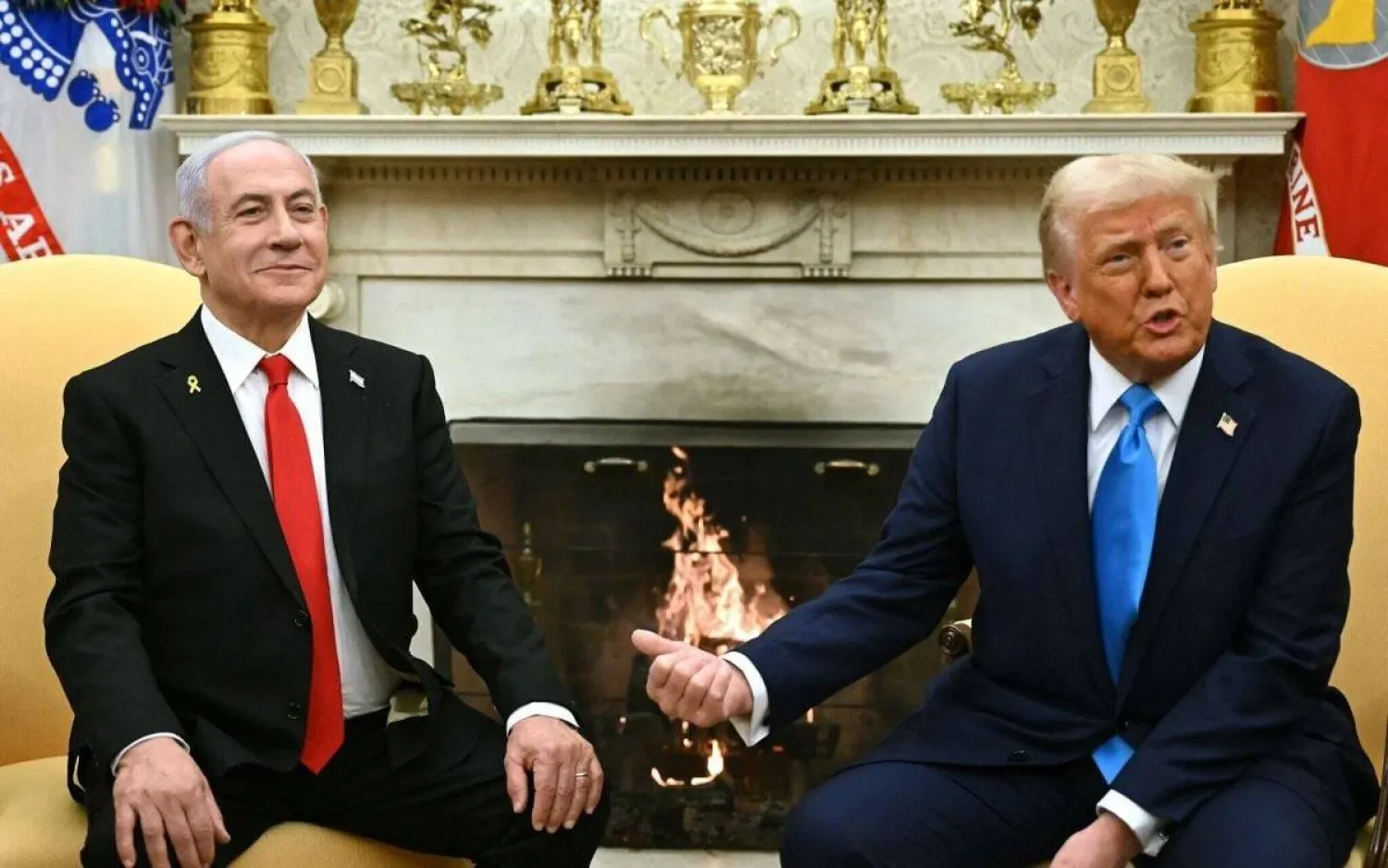
In the run-up to the February 28 attack on Iran, Prime Minister Benjamin Netanyahu of Israel was not only in the Situation Room with President Trump, he was leading the discussion, predicting that a joint US-Israeli strike could very well lead to the demise of the regime in Iran.
“Just a few weeks later, after those sanguine assurances proved inaccurate, the picture was starkly different. Israel was so thoroughly sidelined by the Trump administration, two Israeli defense officials said, that its leaders were cut almost entirely out of the loop on truce talks between the United States and Iran,” said a New York Times report on Saturday.
“Starved of information from their closest ally, the Israelis have been forced to pick up what they can about the back-and-forth between Washington and Tehran through their connections with leaders and diplomats in the region as well as their own surveillance from inside the Iranian regime,” said the two officials, who spoke on the condition of anonymity to discuss sensitive matters.
“The banishment from the cockpit to economy class has potentially significant consequences for Israel, and especially for the prime minister, who faces an uphill re-election battle this year.”
“Netanyahu has long sold himself to Israeli voters as a kind of Trump whisperer,” uniquely capable of enlisting and retaining the president’s support. In a televised speech early in the war, he portrayed himself as the president’s peer, assuring Israelis that he talked to Trump “almost every day,” exchanging ideas and advice, “and deciding together.”
“He had led Israel to war in February with grand visions of achieving a goal he has pursued for decades: stopping Iran’s push for nuclear weapons once and for all. As the war began with a stunning decapitation of much of the government in Tehran, it seemed as though an even more grandiose dream might come true: the toppling of the regime.”
“But many in Trump’s inner circle had always viewed the idea of regime change as absurd. And it wasn’t long before American and Israeli priorities began to diverge more, especially after Iran closed the Strait of Hormuz, sending oil prices soaring and pressuring Trump into agreeing to a ceasefire.”
Far from vanquished, Tehran has behaved as though it won the war, merely by surviving it. Israel, by contrast, has seen its biggest objectives for the war elude its grasp.
Netanyahu set three goals at the start of the war: toppling the regime, destroying Iran’s nuclear program and eliminating its missile program. None have been realized.
Instead of burying Iran’s nuclear ambitions, a recent American proposal called for a 20-year suspension of, or moratorium on, Iranian nuclear activity and that time frame may have gotten smaller in subsequent proposals. That raises the prospect that an eventual deal could resemble the Obama administration’s 2015 nuclear accord, which Netanyahu fought against at the time and Trump exited from three years later.
With the Trump administration excluding Israel from the negotiations, Iran’s arsenal of ballistic missiles may have been left off the table, as far as Israeli officials know. In that respect, any deal would fail to improve on the 2015 agreement, which Netanyahu assailed in part because it did not address Iran’s missiles.
It would also be a dismaying setback for the Israeli public, for whom life largely ground to a halt as the nation was bombarded by Iranian missiles in March and April.
There are other concerns for Israel about the possible contours of a US-Iran agreement, including a lifting of economic sanctions against Tehran. Doing so could amount to an economic lifeline, flooding Iran with billions of dollars that it could then use to rearm and to help its proxy forces, like Hezbollah, replenish their own arsenals with weapons to use against Israel.
While little is certain yet about the shape of an eventual deal — and any agreement could still be postponed by a renewal of fighting — what seems clear is that Israel’s partnership with the United States has come at a steep price. A country that for generations prided itself on “defending ourselves by ourselves,” and whose leaders exasperated a succession of American presidents with their hardheaded recalcitrance, is now making little secret of its need, and willingness, to submit to Trump’s demands.
As Defense Minister Israel Katz said on April 23, as Trump threatened to resume the war and bomb Iran back to the “Stone Age”: “We are only waiting for the green light from the US.”
“That admission was a humbling climbdown from the heady first days of the war, when the two countries achieved air supremacy and were so confident of success that they urged the Iranian people to topple the regime and secure their future,” said the NYT.
Within two weeks, it became clear that the war would not produce instant victory, as Trump had hoped. The White House, and some Israeli leaders, put aside their hopes for regime change, and Trump turned his attention toward ending the fighting.
“He had viewed Netanyahu as a war ally, but not as a close partner when it came to negotiating with the Iranians,” American officials familiar with his thinking said; in fact, he considered Netanyahu someone “who needed to be restrained when it comes to resolving conflicts.”
Israel soon found itself demoted from “equal partner” to something more akin to a “subcontractor” to the US military.
Israel would often clear plans with the United States, only to have the Trump administration throw it under the bus after those plans were executed, such as when Israel struck the South Pars natural gas field and oil facilities along the Gulf in southern Iran.
Trump even pressured Israel to bring a premature halt to its campaign against Hezbollah in Lebanon within days after the ceasefire on April 8, forcing Israel to accept restraints on its fighting with a hostile adversary right on its border.
“The sidelining is particularly hard to take for some Israeli officials, who, speaking on condition of anonymity, noted that the country willingly shouldered some of the war’s more controversial assignments.”
For Netanyahu, it has meant repeatedly recalibrating his rhetoric, and even adjusting his description of Israel’s war objectives, in response to Trump’s frequent vacillations.
After initially telling his citizens that Israel’s goals were to “remove” the existential threats of an Iranian nuclear weapon and of its ballistic missile arsenal, by March 12 Netanyahu was articulating a new idea. This one downplayed the fact that those threats had not been removed, and instead exalted Israel’s close partnership with the United States.
“Threats come and threats go, but when we become a regional power, and in certain fields a global power, we have the strength to push dangers away from us and secure our future,” he said. What gave Israel such newfound strength in the eyes of its adversaries, Netanyahu asserted, was his alliance with Trump — “an alliance like no other.”
*David M. Halbfinger and Ronen Bergman for The New York Times