

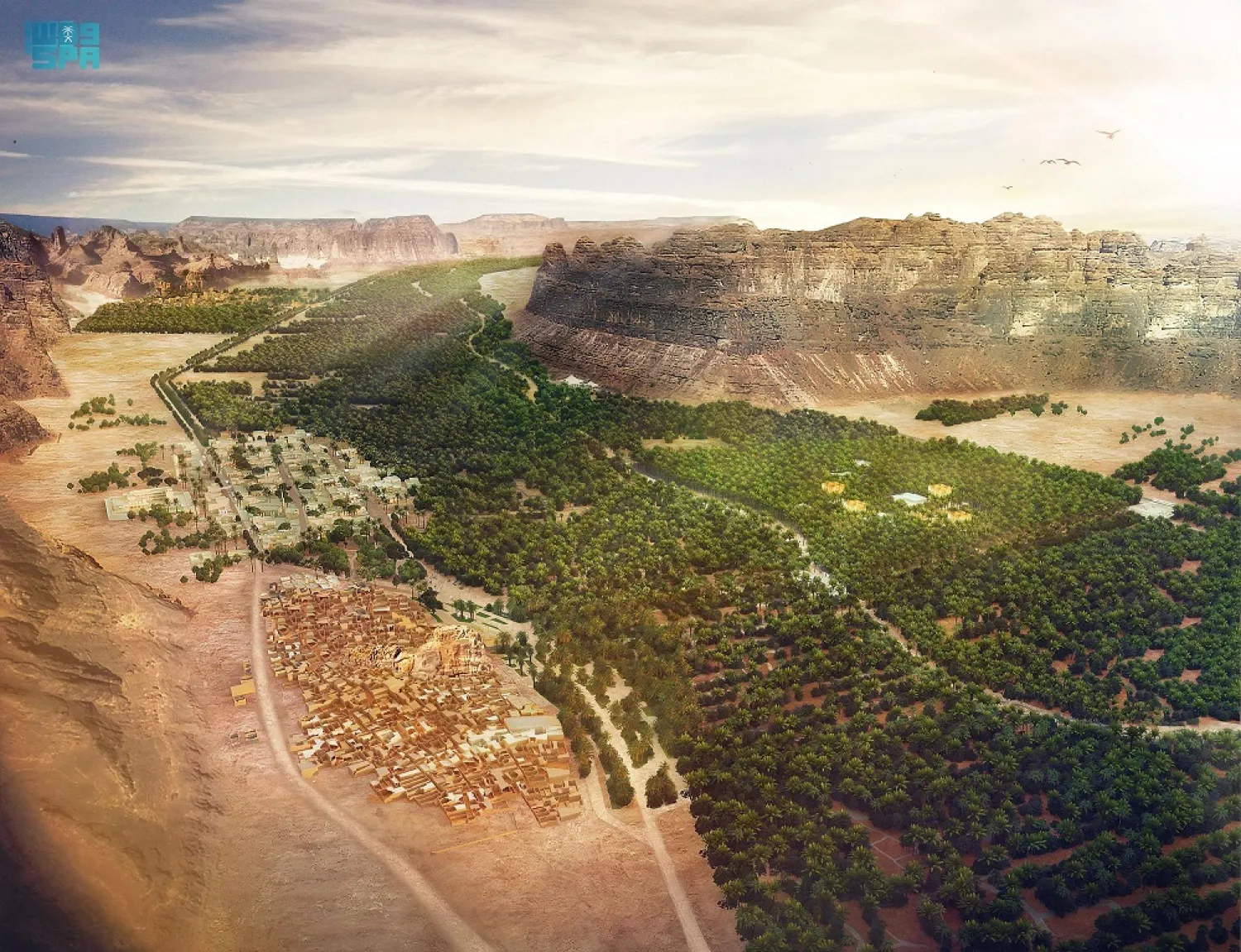

Saudi Crown Prince Launches ‘The Journey Through Time’ Masterplan for AlUla

“The Journey Through Time” represents a key milestone in the transformation of AlUla into a global destination for heritage. (SPA)
TT

Saudi Crown Prince Launches ‘The Journey Through Time’ Masterplan for AlUla

“The Journey Through Time” represents a key milestone in the transformation of AlUla into a global destination for heritage. (SPA)

Saudi Crown Prince Mohammed bin Salman, Chairman of the Royal Commission for AlUla, launched on Wednesday a visionary masterplan that sets to responsibly and sustainably develop the core historical area of AlUla, a unique cultural landscape located in northwestern Arabia.

“The Journey Through Time” represents a key milestone in the transformation of AlUla into a global destination for heritage, culture and nature, and contributes to the advancement of Saudi Arabia’s Vision 2030.

Under the leadership of the Crown Prince and the guidance of Prince Badr, the Saudi Minister of Culture, and the Governor of the Royal Commission for AlUla (RCU), the plan will be implemented in three phases until 2035, with the first phase set to be completed by 2023.

The masterplan represents the first phase of a wider development strategy for AlUla, which is being overseen by the RCU. Upon completion in 2035, the Commission aims to create 38,000 new jobs amid a population grown to 130,000, with AlUla contributing SAR 120 billion to the Kingdom’s GDP.

The masterplan draws on the deep-rooted essence of what AlUla already is – an oasis of unique culture, heritage, nature, and community – promoting the inclusion of the local community in AlUla’s development process to inform the future and open new chapters in AlUla’s unfolding history.

As part of the masterplan, five districts spanning the 20km heart of AlUla will serve as waypoints on the “Journey Through Time”, representing a Living Museum.

The five key districts envisioned in the masterplan include the AlUla Old Town, Dadan, Jabal Ikmah, Nabataean Horizon and Hegra Historical City.

Each of these districts is a cultural landmark in its own right and reflective of the topography and nature that is unique to each location. The highly differentiated experiences and cultural assets are designed to be visitor-centric, rewarding more immersive discovery of the region’s rich culture and history.

Fifteen new cultural assets including museums, galleries and cultural centers are planned as part of the masterplan, serving as landmarks across each district. Besides, 5,000 room keys will also be added, with each district offering its tailored blend of living and hospitality options, ranging from hotels and eco-tourism resorts to exclusive lodges and canyon farms carved into the sandstone rocks.

The Kingdoms Institute, one of the plan’s flagship components, will be a global hub for archaeological knowledge and research dedicated to the cultures and civilizations that have inhabited this area for more than 7,000 years. This includes the ancient kingdoms of Dadan and Lihyan and the magnificent Nabataeans, who built the city of Hegra, a UNESCO World Heritage Site.

The masterplan offers several sustainable mobility solutions to help visitors traverse each of the districts, to minimize road congestion and noise levels. A scenic roadway as well as bicycle, equestrian, and pedestrian trails will promote a smooth and experiential approach to mobility, championing low-carbon journeys.

Reflecting AlUla’s standing as a historic crossroads and the cultural center of northwestern Arabia, the historical tramway will ensure that visitors enjoy a memorable and historically stimulating experience, connecting from AlUla’s International Airport to the five districts.

The masterplan also serves as an investment in AlUla’s citizens and their future, emphasizing RCU’s commitment to community inclusivity. Fully embedded within the plan, new community-driven services, amenities as well as cultural and educational facilities will together promote the development of the local tourism, cultural and agricultural economies for AlUla, helping to nurture a thriving and vibrant society in a great place to live, work and explore. Also, the masterplan will contribute to the revitalization and rehabilitation of the cultural oasis, and the sustainable development of its agricultural community, as a commitment to developing the agricultural sector in AlUla.

Reinforcing Saudi Arabia’s renewed commitment to the preservation and protection of world heritage, knowledge and research, the masterplan is backed by extensive scientific studies on AlUla’s human patterns, environmental and geological evolution, led by a team of international and Saudi experts over three years. It seeks to achieve the concept of coexistence with nature and to celebrate the cultural and historical heritage of AlUla.

As a direct result, the revitalization of AlUla's cultural oasis and the sustainable development of its community is an integral part of the plan, in response to the challenges of sustainably and responsibly developing in a fragile desert environment. At the heart of this are several robust resiliency policies, including circularity commitments, as well as flood and improved water management and sustainable agricultural production.

Together, the two flagship projects of the masterplan – the Kingdoms Institute and the Cultural Oasis – reflect Saudi Arabia’s commitment to offering the world a viable model for protecting, preserving and contributing to the world’s cultural and natural legacy.

Solid policies have been adopted regarding development in heritage and environmentally sensitive areas, development of AlUla community, sustainable agricultural production, improvement of water management, in addition to promoting the principles of circular economy in the masterplan.

Contributing to the Saudi Green Initiative, the regeneration of AlUla is underpinned by a strategy to rehabilitate the land and reverse the course of desertification in the area. Enabling a major expansion of AlUla’s green and open spaces up to 10 million square meters, 80 percent of AlUla province is also being designated as nature reserves with key flora and fauna reintroduced, as well as the conservation of wild animals.

This will be achieved through income generated by welcoming two million visitors annually, offering over 9,000 hotel keys in total across the six areas, and further promoting agriculture, arts and culture, and tourism as key economic drivers for AlUla. Unique opportunities brought on by the development of the masterplan will further encourage and accelerate business and investment from partners who share RCU’s values of sustainability, responsible development and community inclusivity.



Lebanese Cabinet Approves Draft Law on Financial Crisis Losses

A photograph released by the Lebanese Government Press Office on December 26, 2025, show Prime Minister Nawaf Salam speaking during a press conference after a cabinet session in Beirut on December 26, 2025. (Photo by Handout / Lebanese Government Press Office / AFP)
TT

Lebanese Cabinet Approves Draft Law on Financial Crisis Losses

A photograph released by the Lebanese Government Press Office on December 26, 2025, show Prime Minister Nawaf Salam speaking during a press conference after a cabinet session in Beirut on December 26, 2025. (Photo by Handout / Lebanese Government Press Office / AFP)

Lebanon's government on Friday approved a draft law to distribute financial losses from the 2019 economic crisis that deprived many Lebanese of their deposits despite strong opposition to the legislation from political parties, depositors and banking officials.

The draft law will be submitted to the country's divided parliament for approval before it can become effective.

The legislation, known as the "financial gap" law, is part of a series of reform measures required by the International Monetary Fund (IMF) in order to access funding from the lender.

The cabinet passed the draft bill with 13 ministers in favor and nine against. It stipulates that each of the state, the central bank, commercial banks and depositors will share the losses accrued as a result of the financial crisis.

Prime Minister Nawaf Salam defended the bill, saying it "is not ideal... and may not meet everyone's aspirations" but is "a realistic and fair step on the path to restoring rights, stopping the collapse... and healing the banking sector.”

According to government estimates, the losses resulting from the financial crisis amounted to about $70 billion, a figure that is expected to have increased over the six years that the crisis was left unaddressed.

Depositors who have less than $100,000 in the banks, and who constitute 85 percent of total accounts, will be able to recover them in full over a period of four years, Salam said.

Larger depositors will be able to obtain $100,000 while the remaining part of their funds will be compensated through tradable bonds, which will be backed by the assets of the central bank.

The central bank's portfolio includes approximately $50 billion, according to Salam.

The premier told journalists that the bill includes "accountability and oversight for the first time.”

"Everyone who transferred their money before the financial collapse in 2019 by exploiting their position or influence... and everyone who benefited from excessive profits or bonuses will be held accountable and required to pay compensation of up to 30 percent of these amounts," he said.

Responding to objections from banking officials, who claim components of the bill place a major burden on the banks, Salam said the law "also aims to revive the banking sector by assessing bank assets and recapitalizing them.”

The IMF, which closely monitored the drafting of the bill, previously insisted on the need to "restore the viability of the banking sector consistent with international standards" and protect small depositors.

Parliament passed a banking secrecy reform law in April, followed by a banking sector restructuring law in June, one of several key pieces of legislation aimed at reforming the financial system.

However, observers believe it is unlikely that parliament will pass the current bill before the next legislative elections in May.

Financial reforms in Lebanon have been repeatedly derailed by political and private interests over the last six years, but Salam and Lebanese President Joseph Aoun have pledged to prioritize them.


Türkiye Says Russia Gave It $9 Billion in New Financing for Akkuyu Nuclear Plant

Türkiye’s Energy Minister Alparslan Bayraktar talks during a meeting in Ankara, Türkiye, September 14, 2023. (Reuters)
TT

Türkiye Says Russia Gave It $9 Billion in New Financing for Akkuyu Nuclear Plant

Türkiye’s Energy Minister Alparslan Bayraktar talks during a meeting in Ankara, Türkiye, September 14, 2023. (Reuters)

Türkiye's energy minister said Russia had provided new financing worth $9 billion for the Akkuyu nuclear power plant being built by ​Moscow's state nuclear energy company Rosatom, adding Ankara expected the power plant to be operational in 2026.

Rosatom is building Türkiye's first nuclear power station at Akkuyu in the Mediterranean province of Mersin per a 2010 accord worth $20 billion. The plant was expected ‌to be operational ‌this year, but has been ‌delayed.

"This (financing) ⁠will ​most ‌likely be used in 2026-2027. There will be at least $4-5 billion from there for 2026 in terms of foreign financing," Alparslan Bayraktar told some local reporters at a briefing in Istanbul, according to a readout from his ministry.

He said ⁠Türkiye was in talks with South Korea, China, Russia, and ‌the United States on ‍nuclear projects in ‍the Sinop province and Thrace region, and added ‍Ankara wanted to receive "the most competitive offer".

Bayraktar said Türkiye wanted to generate nuclear power at home and aimed to provide clear figures on targets.


China Bets on Advanced Technologies to Revive Tepid Industrial Sector

A humanoid robot Tiangong by Beijing Innovation Center of Humanoid Robotics Co, moves an orange as a demonstration at its company, during an organized media tour to Beijing Robotics Industrial Park, in Beijing Economic-Technological Development Area, also known as Beijing E-Town, China May 16, 2025. (Reuters)
TT

China Bets on Advanced Technologies to Revive Tepid Industrial Sector

A humanoid robot Tiangong by Beijing Innovation Center of Humanoid Robotics Co, moves an orange as a demonstration at its company, during an organized media tour to Beijing Robotics Industrial Park, in Beijing Economic-Technological Development Area, also known as Beijing E-Town, China May 16, 2025. (Reuters)

China pledged on Friday to double down on upgrading its manufacturing base and ​promised capital to fund efforts targeting technological breakthroughs, after its industrial sector delivered an underwhelming performance this year.

China's industry ministry expects output of large industrial companies to have increased 5.9% in 2025 compared with 2024, state broadcaster CCTV said on Friday, almost unchanged from the 5.8% pace in 2024.

It would also be less than the ‌6% pace ‌of the first 11 months of ‌2025, ⁠based ​on ‌data released by the National Bureau of Statistics, as a weak Chinese economy suppressed domestic demand.

Industrial output, which covers industrial firms with annual revenue of at least 20 million yuan ($2.85 million), recorded growth of 4.8% in November, the weakest monthly year-on-year rise since August 2024.

Chinese policymakers have been looking ⁠to create new growth drivers in the economy by focusing on advancing ‌its industrial sector.

China has also vowed stronger ‍efforts to achieve technological self-reliance ‍amid intensifying rivalry with the United States over dominance ‍in advanced technology.

At the annual two-day national industrial work conference in Beijing that ended on Friday, officials pledged to deliver major breakthroughs in building a "modern industrial system" anchored by advanced manufacturing.

The ​focus will be on sectors such as integrated circuits, low-altitude economy, aerospace and biomedicine, an industry ministry ⁠statement showed.

The statement comes after China launched on Friday a national venture capital fund aimed at guiding billions of dollars of capital into "key hard technologies" such as quantum technology and brain-computer interfaces.

On artificial intelligence, the industry ministry said it will expand efforts to help small and medium-sized enterprises adopt the technology, while fostering new intelligent agents and AI-native companies in key industries.

Officials also vowed to "firmly curb" deflationary price wars, dubbed "involution", referring to excessive and low-return competition among ‌firms that erodes profits.