

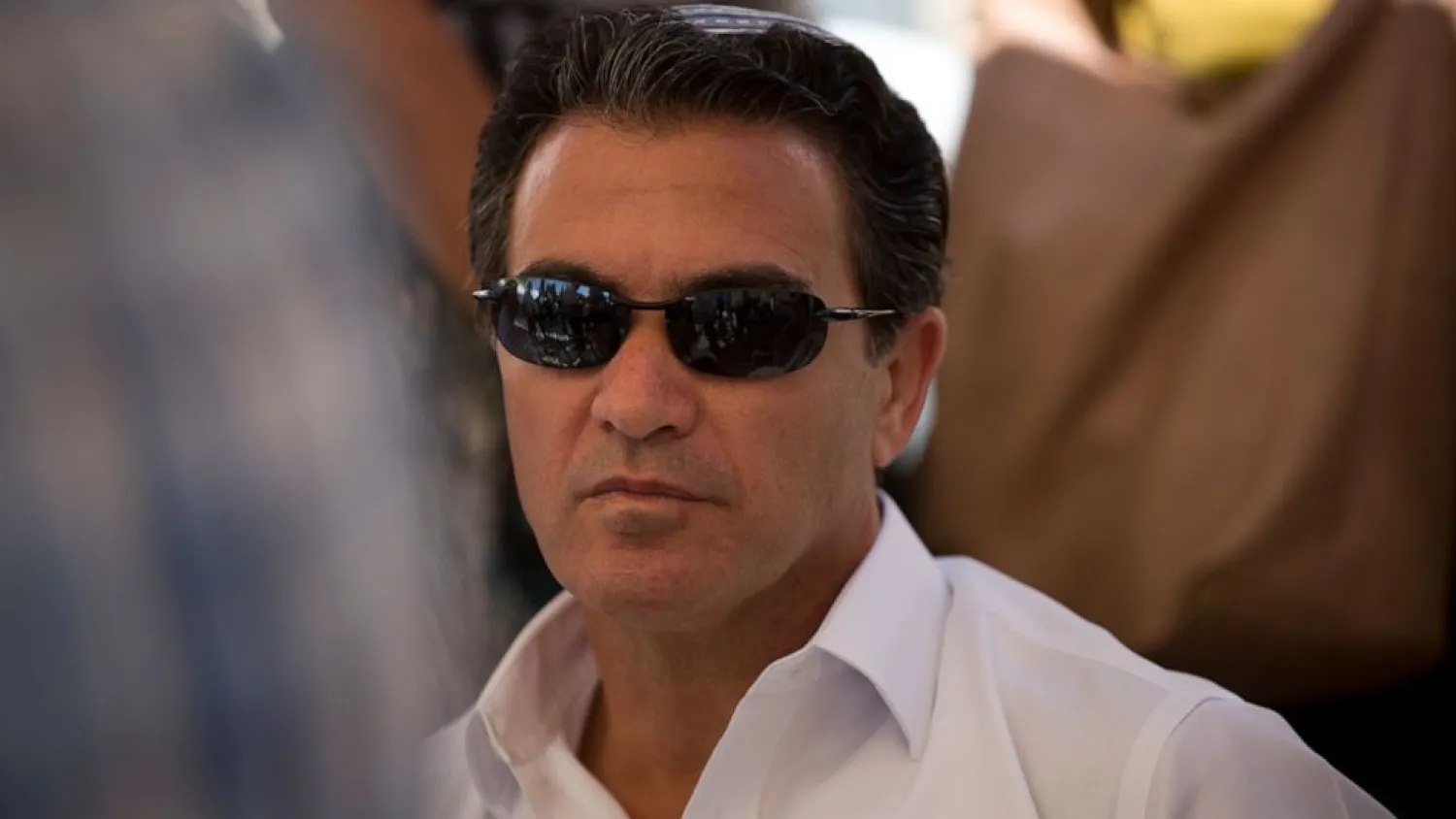

Ex-Mossad Chief Signals Israel Behind Recent Iran Nuclear Attacks

FILE - In this July 3, 2016, file photo, Yossi Cohen, then the director of Israel's Mossad intelligence agency, attends the funeral in Jerusalem of a rabbi killed by Palestinian gunmen. (AP Photo/Oded Balilty, File)
TT

Ex-Mossad Chief Signals Israel Behind Recent Iran Nuclear Attacks

FILE - In this July 3, 2016, file photo, Yossi Cohen, then the director of Israel's Mossad intelligence agency, attends the funeral in Jerusalem of a rabbi killed by Palestinian gunmen. (AP Photo/Oded Balilty, File)

The outgoing chief of Israel's Mossad intelligence service has offered the closest acknowledgment yet his country was behind recent attacks targeting Iran's nuclear program and a military scientist, The Associated Press reported.

The comments by Yossi Cohen, speaking to Israel's Channel 12 investigative program “Uvda” in a segment aired Thursday night, offered an extraordinary debriefing by the head of the typically secretive agency in what appears to be the final days of Prime Minister Benjamin Netanyahu's rule.

It also gave a clear warning to other scientists in Iran's nuclear program that they too could become targets for assassination even as diplomats in Vienna try to negotiate terms to try to salvage its atomic accord with world powers.

“If the scientist is willing to change career and will not hurt us anymore, than yes, sometimes we offer them" a way out, Cohen said.

Among the major attacks to target Iran, none have struck deeper than two explosions over the last year at its Natanz nuclear facility. There, centrifuges enrich uranium from an underground hall designed to protect them from airstrikes.

In July 2020, a mysterious explosion tore apart Natanz's advanced centrifuge assembly, which Iran later blamed on Israel. Then in April of this year, another blast tore apart one of its underground enrichment halls.

Discussing Natanz, the interviewer asked Cohen where he'd take them if they could travel there, he said “to the cellar" where “the centrifuges used to spin.”

“It doesn't look like it used to look,” he added.

Cohen did not directly claim the attacks, but his specificity offered the closest acknowledgement yet of an Israeli hand in the attacks. The interviewer, journalist Ilan Dayan, also seemingly offered a detailed description in a voiceover of how Israel snuck the explosives into Natanz's underground halls.

“The man who was responsible for these explosions, it becomes clear, made sure to supply to the Iranians the marble foundation on which the centrifuges are placed,” Dayan said. "As they install this foundation within the Natanz facility, they have no idea that it already includes an enormous amount of explosives.”

They also discussed the November killing of Mohsen Fakhrizadeh, an Iranian scientist who began Tehran's military nuclear program decades ago. US intelligence agencies and the International Atomic Energy Agency believe Iran abandoned that organized effort at seeking a nuclear weapon in 2003. Iran long has maintained its program is peaceful.

While Cohen on camera doesn't claim the killing, Dayan in the segment described Cohen as having "personally signed off on the entire campaign.” Dayan also described how a remotely operated machine gun fixed to a pickup truck killed Fakhrizadeh and later self-destructed.

Cohen described an Israeli effort to dissuade Iranian scientists from taking part in the program, which had seen some abandon their work after being warned, even indirectly, by Israel. Asked by the interviewer if the scientists understood the implications if they didn't stop, Cohen said: “They see their friends.”

They also talked about Israel's operation seizing archival documents from Iran's military nuclear program. Dayan said 20 agents, none Israelis, seized material from 32 safes, then scanned and transmitted a large portion of the documents. Cohen confirmed that the Mossad received most of the material before it was physically taken out of Iran.

Cohen defended Prime Minister Benjamin Netanyahu's decision to go public with the results of the operation, going against a long-standing practice of secrecy involving Mossad activities.

“It was important to us that the world will see this, but this thing should also resonate with the Iranian leadership, to tell them, ‘Dear friends: One, you have been infiltrated. Two, we see you.. Three, the era of ... lies is over,'” Cohen said.

Media in Israel operate under a decades-old policy that requires journalists to clear stories involving security matters through military censors. That Cohen's remarks apparently cleared the censors suggests Israel wanted to issue a new warning to Iran amid the Vienna nuclear negotiations.

Iran has repeatedly complained about Israel's attacks, with Iran's ambassador to the IAEA Kazem Gharibabadi warning as recently as Thursday that the incidents “not only will be responded to decisively, but also certainly leave no option for Iran but to reconsider its transparency measures and cooperation policy.”

Iran's mission to the United Nations did not immediately respond to a request for comment over the comments by Cohen, who was replaced by former operative David Barnea. Cohen in the interview acknowledged he might one day seek the prime minister's office himself.



Somalia’s Al-Shabaab Vows to Fight Any Israeli Use of Somaliland

Residents wave Somaliland flags as they gather to celebrate Israel's announcement recognizing Somaliland's statehood in downtown Hargeisa, on December 26, 2025. (AFP)
TT

Somalia’s Al-Shabaab Vows to Fight Any Israeli Use of Somaliland

Residents wave Somaliland flags as they gather to celebrate Israel's announcement recognizing Somaliland's statehood in downtown Hargeisa, on December 26, 2025. (AFP)

Somalia's Al-Qaeda-linked militant group Al-Shabaab vowed Saturday to fight any attempt by Israel "to claim or use parts of Somaliland" following its recognition of the breakaway territory.

"We will not accept it, and we will fight against it," Al-Shabaab said in a statement.

Its spokesman Ali Dheere said in the statement that Israel's recognition of Somaliland as a sovereign state showed it "has decided to expand into parts of the Somali territories" to support "the apostate administration in the northwest regions".

Israel said Friday it was officially recognizing Somaliland, a first for the self-proclaimed republic that in 1991 declared it had unilaterally seceded from Somalia.

Mogadishu immediately denounced a "deliberate attack" on its sovereignty, while Egypt, Türkiye, the six-nation Gulf Cooperation Council and the Saudi-based Organization of Islamic Cooperation all condemned Israel's move.

Regional analysts believe that a rapprochement with Somaliland could allow Israel to secure better access to the Red Sea.

In addition, press reports a few months ago said Somaliland was among a handful of African territories willing to host Palestinians expelled by Israel, but neither the Somaliland authorities nor the Israeli government has ever commented on those reports.

"It is humiliation of the highest level today, to see some Somali people celebrating a recognition by the Israeli Prime Minister (Benjamin) Netanyahu" when "Israel is the biggest enemy of the Islamic society".

The territory of Somaliland is roughly a third the size of France and corresponds more or less to the former British Somaliland protectorate.

It has its own money, army and police and enjoys relative stability compared to its neighbors.

But, until now, Somaliland had not been publicly recognized by any country, which has kept it politically and economically isolated despite its location on one of the world's busiest trade routes connecting the Indian Ocean to the Suez Canal.

Somalia has been battling Al-Shabaab for nearly 20 years and while security has significantly improved in Mogadishu, the war still rages 60 kilometers from the capital.


China Welcomes Cambodia-Thailand Ceasefire, Plans Talks

A handout photo made available by the Defense Ministry of Thailand shows Cambodian Defense Minister Tea Seiha (L) and Thai Defense Minister Natthaphon Narkphanit exchanging ceasefire agreement documents during a General Border Committee Meeting in Ban Pak Kard, Chanthaburi Province, Thailand, 27 December 2025. (EPA/Defense Ministry of Thailand/Handout)
TT

China Welcomes Cambodia-Thailand Ceasefire, Plans Talks

A handout photo made available by the Defense Ministry of Thailand shows Cambodian Defense Minister Tea Seiha (L) and Thai Defense Minister Natthaphon Narkphanit exchanging ceasefire agreement documents during a General Border Committee Meeting in Ban Pak Kard, Chanthaburi Province, Thailand, 27 December 2025. (EPA/Defense Ministry of Thailand/Handout)

China on Saturday welcomed a joint ceasefire statement signed by Cambodia and Thailand and said its foreign minister would meet his counterparts from both countries in China, according to a notice posted on the foreign ministry's website late in the day.

Cambodia and Thailand agreed ‌on Saturday to ‌a second ceasefire ‌in ⁠recent months, ‌ending weeks of intense border clashes described as the worst fighting in years between the two Southeast Asian neighbors.

China's foreign ministry said the agreement showed that dialogue and consultation ⁠were practical and effective ways to resolve ‌complex disputes.

Foreign Minister Wang ‍Yi will meet ‍Cambodian counterpart Prak Sokhonn and ‍Thailand's Sihasak Phuangketkeow in southwestern Yunnan province on December 28–29, the ministry said, adding that military representatives from all three countries would also attend.

China said it was willing to continue ⁠providing a platform and facilitating more substantive and detailed communication between Cambodia and Thailand.

"China will play a constructive role in its own way to help Cambodia and Thailand consolidate the ceasefire, resume exchanges, rebuild political mutual trust, achieve a turnaround in relations and maintain regional ‌peace," the ministry said.


Netanyahu to Meet Trump in US on Monday for Talks on Iran, Gaza, Hezbollah, Syria

 Israeli Prime Minister Benjamin Netanyahu speaks during a joint press conference with Greek Prime Minister Kyriakos Mitsotakis and Cypriot President Nikos Christodoulides (not pictured) after a trilateral meeting in Jerusalem on December 22, 2025. (AFP)
Israeli Prime Minister Benjamin Netanyahu speaks during a joint press conference with Greek Prime Minister Kyriakos Mitsotakis and Cypriot President Nikos Christodoulides (not pictured) after a trilateral meeting in Jerusalem on December 22, 2025. (AFP)
TT

Netanyahu to Meet Trump in US on Monday for Talks on Iran, Gaza, Hezbollah, Syria

 Israeli Prime Minister Benjamin Netanyahu speaks during a joint press conference with Greek Prime Minister Kyriakos Mitsotakis and Cypriot President Nikos Christodoulides (not pictured) after a trilateral meeting in Jerusalem on December 22, 2025. (AFP)
Israeli Prime Minister Benjamin Netanyahu speaks during a joint press conference with Greek Prime Minister Kyriakos Mitsotakis and Cypriot President Nikos Christodoulides (not pictured) after a trilateral meeting in Jerusalem on December 22, 2025. (AFP)

Israeli Prime Minister Benjamin Netanyahu is due to meet US President Donald Trump in Florida on Monday, an Israeli official told AFP, in what is seen as a crucial visit for the next steps of the fragile Gaza truce plan.

It will be Netanyahu's fifth visit to see key ally Trump in the United States this year.

His trip comes as the Trump administration and regional mediators push to proceed to the second stage of the ceasefire between Israel and Hamas in the Gaza Strip.

An Israeli official on Saturday said Netanyahu would leave for the US on December 28 and meet with Trump a day later in Florida, without providing a specific location.

Trump told reporters in mid-December that Netanyahu would probably visit him in Florida during the Christmas holidays.

"He would like to see me. We haven't set it up formally, but he'd like to see me," Trump said before leaving for his Mar-a-Lago resort.

Israel's Yedioth Ahronoth newspaper reported on Wednesday that a wide range of regional issues was expected to be discussed, including Iran, talks on an Israel-Syria security agreement, the ceasefire with Hezbollah in Lebanon and the next stages of the Gaza deal.

- 'Going nowhere' -

Concerning Gaza, the timing of the meeting is "very significant", said Gershon Baskin, the co-head of peacebuilding commission the Alliance for Two States, who has taken part in back-channel negotiations with Hamas.

"Phase one is basically over, there's one remaining Israeli deceased hostage which they (Hamas) are having difficulty finding," he told AFP.

"Phase two has to begin, it's even late and I think the Americans realize that it's late because Hamas has had too much time to re-establish its presence and this is certainly not a situation that the Americans want to leave in place," he added.

Progress in moving to the second phase of October's Gaza ceasefire agreement, which was brokered by Washington and its regional allies, has so far been slow.

Both sides allege frequent ceasefire violations and mediators fear that Israel and Hamas alike are stalling.

Under the next stages, Israel is supposed to withdraw from its positions in Gaza, an interim authority is to govern the Palestinian territory instead of Hamas, and an international stabilization force (ISF) is to be deployed.

It also includes a provision for Palestinian movement Hamas to lay down its weapons -- a major sticking point.

On Friday, US news outlet Axios reported that the meeting between Trump and Netanyahu was key to advancing to the next steps of the deal.

Citing White House officials, Axios said that the Trump administration wanted to announce the Palestinian technocratic government for Gaza and the ISF as soon as possible.

It reported that senior Trump officials were growing exasperated "as Netanyahu has taken steps to undermine the fragile ceasefire and stall the peace process".

"There are more and more signs that the American administration is getting frustrated with Netanyahu," said Yossi Mekelberg, a Middle East expert at London-based think-tank Chatham House.

"The question is what it's going to do about it," he added, "because phase two is right now going nowhere."

- Iran tops agenda -

While the Trump administration is keen for progress on Gaza, analysts said the prospect of Iran rebuilding its nuclear program and ballistic missile capabilities was likely to top the agenda for Netanyahu.

"All the news that we've heard in the Israeli media over the last two weeks about Iran building up its missiles and being a threat to Israel is all part of a planned strategy of deflecting attention from Gaza to the issue that Netanyahu loves to talk about which is Iran," said Baskin.

In June, Israel launched strikes on Iranian military and nuclear sites as well as residential areas.

Iran responded with drone and missile strikes on Israel, and later on in the 12-day war, the United States joined Israel in targeting Iranian nuclear facilities.

Mekelberg shared the view that Netanyahu could be attempting to shift attention from Gaza onto Iran.

With Israel entering an election year, Mekelberg said with regards to the Trump meeting, Netanyahu would be "taking a defensive approach, to minimize what can be difficult for him coming back home".

"Everything is connected to staying in power," he said of the long-time Israeli premier.