


Lebanon Workers Stage ​General Strike over Escalating Crises

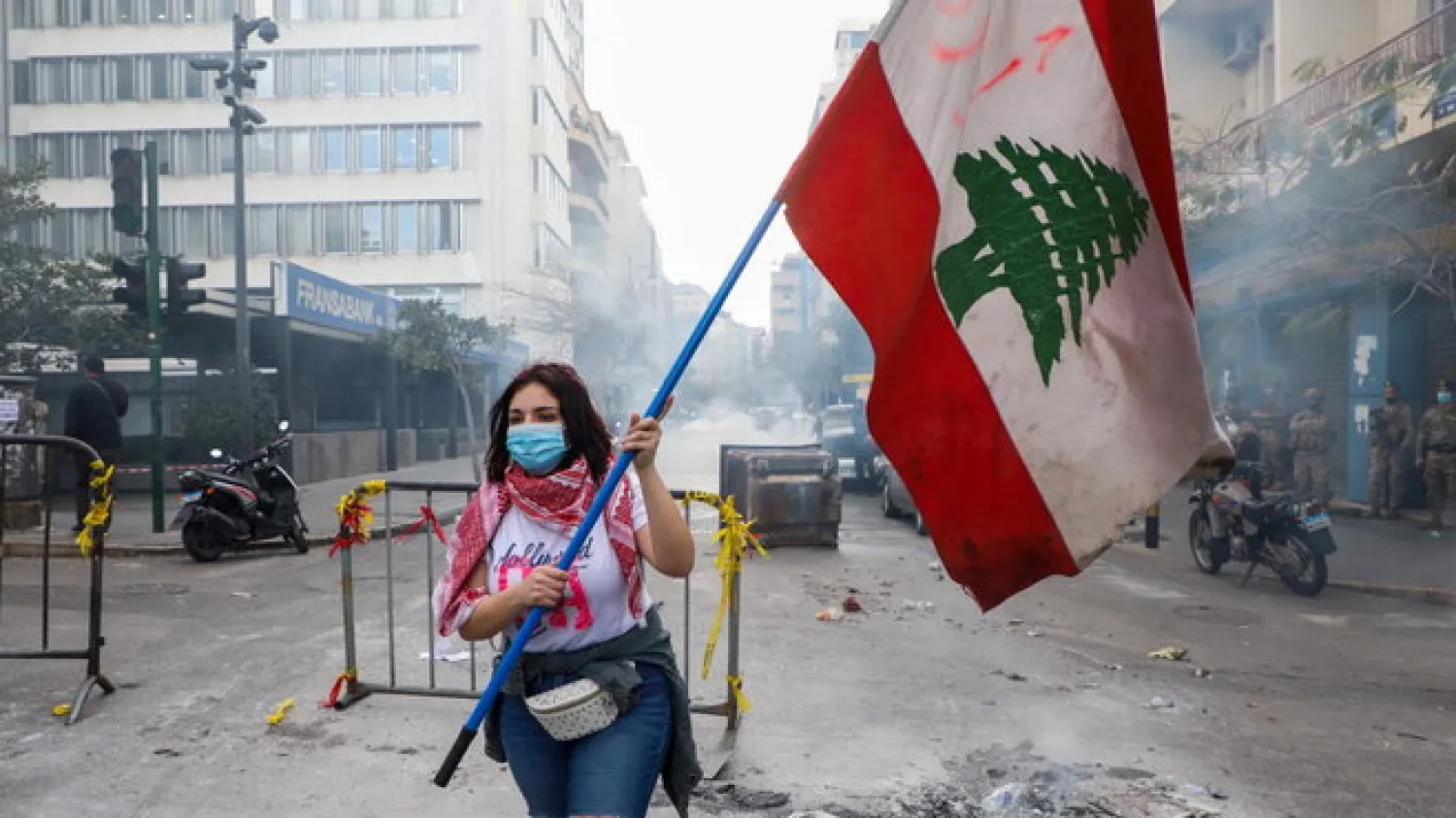
A demonstrator carries a national flag during a protest against mounting economic hardships, near the Central Bank building, in Beirut. (Reuters)
TT

Lebanon Workers Stage ​General Strike over Escalating Crises

A demonstrator carries a national flag during a protest against mounting economic hardships, near the Central Bank building, in Beirut. (Reuters)

Shops, government offices, businesses and banks shuttered their doors in Lebanon on Thursday, as part of a general strike to protest deteriorating economic conditions and press for a government to deal with worsening crises.

The strike, which was accompanied by several roadblocks set up around Beirut and other cities, was ironically supported by the very political parties blamed for the deadlock over forming a government. This drew criticism from many activists and commentators, who questioned why those who were driving the economic and financial meltdown were themselves on strike.

Lebanon has been without a fully functioning government since August. Prime Minister designate Saad Hariri, named to the post in October, has failed to gain support from the presidency over his Cabinet picks — and the two sides have locked horns over who gets more say in shaping a government. The World Bank has described Lebanon' financial and economic crises as among the worst in the world in 150 years.

The crisis, festering since 2019, has reached new heights in recent weeks. Fuel has been in short supply, power outages have increased, and medicine — mostly imported — has been missing. Hospitals have closed their labs to outpatients and prices have soared as the local currency, pegged to the dollar for 30 years, is in free fall. On the black market, it sells at nearly 10 times its official rate.

Protesters have blocked Beirut's airport highway with trash bins, setting them on fire, and causing large clouds of black smoke to hang over the motorway. Banks and government offices were shut and several shops in central Beirut were also closed, The Associated Press reported.

Critics ridiculed the ruling elite's attempt to rally behind the strike. A hashtag on Twitter called “the regime revolts” was trending on Thursday. Memes were posted using pictures from popular anti-government protests in 2019, replacing faces of protesters arrested or dragged by security forces with those of images of prominent politicians.

Amid the crisis, politicians appeared in no rush to form a government that would have to take major, unpopular reform and austerity decisions.

On Wednesday, a public war of words broke out between President Michel Aoun and powerful parliament speaker Nabih Berri, who has offered to mediate the deadlock.

Berri questioned the role of the president in delaying the Cabinet formation — suggesting that he and his Christian party, led by his son-in-law, were seeking enough seats in the government to block decisions. Aoun responded by denying the charges and accusing Berri of siding with the prime minister designate.

“The system is going on strike against itself while its pillars are fighting among themselves over powers that no longer exist to prove to us who can contribute to our bankruptcy more than the other,” tweeted Samy Gemayel, head of the Kataeb party.

He resigned from parliament last year over corruption and a massive explosion in Beirut. The three leaders “are not living on the same planet as us,” he added.



Sudan’s Security and Defense Council Orders Curbs on Armed Movement Inside Cities

Al-Burhan chairs a meeting of Sudan’s Security and Defense Council on Tuesday (Transitional Sovereignty Council)
 
Al-Burhan chairs a meeting of Sudan’s Security and Defense Council on Tuesday (Transitional Sovereignty Council)  
TT

Sudan’s Security and Defense Council Orders Curbs on Armed Movement Inside Cities

Al-Burhan chairs a meeting of Sudan’s Security and Defense Council on Tuesday (Transitional Sovereignty Council)
 
Al-Burhan chairs a meeting of Sudan’s Security and Defense Council on Tuesday (Transitional Sovereignty Council)  

Sudan’s highest military and security authority has called for tighter controls on the movement of armed personnel, combat vehicles, and security cells inside cities and marketplaces, following reports and videos alleging incidents of “disorder” attributed to armed forces and army-aligned groups in areas recently recaptured by the military or currently under its control.

Following the Security and Defense Council’s regular meeting on Tuesday evening, Sudanese Defense Minister Lt. Gen. Hassan Daoud Kabroun said that the council had instructed the relevant authorities to regulate the movement of armed individuals and vehicles inside cities and markets, and to establish rules governing the work of “security cells” in local districts, with a focus on investigations involving those authorities describe as collaborators with the Rapid Support Forces (RSF).

The term “security cells” refers to groups or units operating in support of military and security agencies. They are typically engaged in surveillance, monitoring, inspections, and intelligence-gathering activities in neighborhoods, markets, and conflict zones.

Authorities say their role is focused on “tracking down collaborators with the RSF, dismantling sabotage cells, and protecting areas retaken by the army.” Critics of the Transitional Sovereignty Council, however, describe them in social media commentary as an extension of Islamist organizations tied to the former regime, alleging that they seek to eliminate political opponents.

The Security and Defense Council is one of Sudan’s most prominent military and sovereign decision-making bodies. It includes executive, military, and security leaders, among them the ministers of defense, interior, foreign affairs, and finance, as well as army commanders and heads of security agencies. The council is chaired by Sovereignty Council President and Armed Forces Commander-in-Chief Gen. Abdel Fattah al-Burhan.

According to media affiliated with it, the council met Tuesday under al-Burhan’s chairmanship, with all members in attendance, to review the country’s security and military situation.

The council’s role in managing security and military affairs has expanded since the outbreak of war between the army and the RSF on April 15, 2023, amid the widening conflict and mounting concerns over security violations in war-affected areas.

On the military front, Kabroun said the armed forces and allied troops had achieved “major victories” in recent weeks on several battlefronts, particularly in South Kordofan, Blue Nile, and Darfur.

He added that the council stressed the importance of adherence to the law, respect for human rights and Sudan’s sovereignty, as well as the need to provide essential services to citizens returning to their areas, especially electricity and water.

Citizens’ Complaints

Residents in some army-controlled areas - particularly the capital, Khartoum, parts of Al Jazirah State, and other states retaken by the military in recent months - have complained of what they describe as growing “security abuses.”

The allegations include looting, arrests, and other violations attributed to armed groups or individuals wearing military uniforms, in addition to the widespread presence of weapons and combat vehicles in neighborhoods and markets.

Videos and local testimonies concerning these incidents have circulated widely on social media platforms, while authorities say they are working to regulate armed movements and pursue those responsible.

Independent verification of all the accounts has not been possible because of the ongoing war and the complexity of the security situation.


Iraq: Al-Sadr Warns Against Being Branded a ‘Traitor’ after Backing Government

A photo from a meeting of the Coordination Framework forces in Baghdad (Iraqi News Agency).
TT

Iraq: Al-Sadr Warns Against Being Branded a ‘Traitor’ after Backing Government

A photo from a meeting of the Coordination Framework forces in Baghdad (Iraqi News Agency).

Sadrist Movement leader Muqtada al-Sadr is facing mounting criticism over reports that he supports Iraq’s new prime minister, Ali al-Zaidi, as major political factions reassess their alliances after failing to secure key cabinet posts in the new government.

Among the dissatisfied parties are Nouri al-Maliki’s State of Law Coalition and Masoud Barzani’s Kurdistan Democratic Party (KDP), both of which saw their influence weakened by the passage of al-Zaidi’s cabinet. The developments have revived debate over the collapse of the Tripartite Alliance formed in 2021 by the Sadrist Movement, the KDP, and the Sunni-led Taqaddum coalition.

Al-Sadr’s phone call with al-Zaidi earlier this week further complicated the political landscape, reportedly unsettling factions within the Coordination Framework, the umbrella coalition of Iran-aligned Shiite groups, as well as Kurdish parties angered by the parliamentary confidence vote.

Shakhawan Abdullah, head of the KDP bloc in parliament, said candidates from both the KDP and the State of Law Coalition had filed appeals with Iraq’s Federal Supreme Court challenging the legitimacy of the session that approved al-Zaidi’s government.

According to Abdullah, the appeals focus on voting procedures and the rejection of certain nominees. He claimed there are “documents and recordings” proving procedural violations during the parliamentary vote on ministerial portfolios.

Legal experts say candidates who failed to win parliamentary approval cannot be renominated under parliament’s internal rules, which require political blocs to submit alternative names for vacant ministries.

Despite the political turmoil, al-Zaidi has sought to project an image of decisiveness. During his first cabinet meeting, he issued rapid directives aimed at addressing administrative problems, reducing bureaucracy, and accelerating government procedures.

The clearest shift, however, came in his tougher stance toward armed factions. Al-Zaidi strongly condemned attacks targeting neighboring countries, including Saudi Arabia and the United Arab Emirates, even though the factions denied responsibility.

On May 17, 2026, al-Sadr called al-Zaidi to congratulate him on forming the government and urged him to improve public services and combat corruption.

Observers believe al-Sadr’s support could provide al-Zaidi with political cover if he chooses to confront the influence of armed groups, especially amid widening divisions within the Coordination Framework.

At the same time, support voiced by US President Donald Trump for al-Zaidi has placed both the prime minister and al-Sadr in indirect confrontation with factions that identify themselves as the “Resistance” and accuse their rivals of being too close to Washington.

Al-Sadr responded sharply to the criticism, accusing some opponents of “selling their consciences” and attempting to distort his political positions through media campaigns and personal attacks.

He said he was dealing with critics “patiently,” but warned against accusations of “treason” or collaboration with foreign powers, threatening legal action against those promoting such claims.


Lebanon: Truce Gradually Draws South Beirut Residents Back Home

A branch of Al-Qard Al-Hassan in Beirut’s southern suburbs after it was hit by an Israeli strike during the 2024 war (File photo, Asharq Al-Awsat)
TT

Lebanon: Truce Gradually Draws South Beirut Residents Back Home

A branch of Al-Qard Al-Hassan in Beirut’s southern suburbs after it was hit by an Israeli strike during the 2024 war (File photo, Asharq Al-Awsat)

Residents are gradually returning to Beirut’s southern suburbs after a ceasefire agreement was extended for six weeks, three months after they were displaced from the area, and after the suburbs were largely spared Israeli bombardment during the truce.

Residents say they have no choice but to return after experiencing the hardship of displacement and a sense of joblessness.

The return to the southern suburbs began early this week, although residents told Asharq Al-Awsat that complete reassurance remains absent. They said returning to livelihoods and homes had become necessary, driven by the need to restore the rhythm of daily life.

Livelihoods reopen doors

In an area where a large part of the population depends on self-employment and small shops, restoring livelihoods has become essential to restarting life itself.

Ali Zeineddine, a father of two and the owner of a clothing shop in Beirut’s southern suburbs, said, “People are returning because they have work, a business, or a source of income. Today, the return is tied more to earning a living than to feeling reassured.”

He said owning the shop helped him reopen at a time when many others faced difficulty returning because of rent burdens and losses. But reopening did not mean life had fully returned to what it was before.

“There is movement, but it is timid. There is buying and selling on a limited scale, but it helps cover part of the family’s expenses,” he said.

He added that the pattern of life itself had changed after the war.

“Before the war, we used to work until late at night. Today, I open in the morning and close earlier, before sunset, because people’s movement has changed. Many come down during the day and then leave in the evening, so the night is no longer what it used to be.”

He said the overall scene still reflects a gradual return rather than full stability. “People are trying to restore their lives with what is available, but no one is acting as if everything has returned to normal.”

A long wait

Wissam Shehab, the owner of a vegetable shop and a father supporting a family of five, had not initially planned to return quickly, but found himself facing a different reality as time passed.

“We returned because my source of income is here. My shop is in the southern suburbs, and it is how I live and support my family. At first, we thought the displacement phase would be short and that it only needed some time. But when the period began to drag on, it was no longer possible to keep life suspended,” he said.

He added that keeping the family in an open-ended state of waiting would make matters more complicated, both economically and psychologically. That is why he decided to return and settle in his home again.

But the return did not lead him to rule out other possibilities. “We kept our place of displacement in Mount Lebanon as it is, in case of any new developments. It is true that we returned and settled in the southern suburbs, but no one feels that conditions have become fully settled,” he said.

Shehab said the feeling of insecurity was no longer tied to one particular area. “The southern suburbs today appear relatively spared, but insecurity has become a general condition people feel wherever they are.”

Return does not end displacement

By contrast, Umm Hassan Harqous and her family have not yet decided to return fully. The family still moves between the southern suburbs and Bchamoun, where they are currently displaced.

She said she goes down to the suburbs during the day and leaves before sunset, because, for her, returning does not simply mean opening the house door for a few hours.

She explained that the reasons for delaying the return are not only security concerns but also the loss of the source of income on which the family had depended. The grocery shop that had provided its main income became a means of survival during the war, after the family relied on the food items inside it during the displacement period.

“We lived on what was in the shop, and we gradually consumed its contents during the war so we could continue,” she said.

“How can a person return and settle if their very source of livelihood has stopped? Return is not just about a home. People need work and a life they can sustain,” she added.

She said members of her family had also suffered professional and livelihood losses, making the decision to return fully more difficult.

Institutions wait, individuals return

Sawsan Ammar, a teacher at a school in Beirut’s southern suburbs, said schools located deep inside the suburbs, including the one where she works, have not yet reopened due to concerns about the safety of students and teaching staff.

“There is no need to take risks while instability continues,” she said.

She noted that educational institutions differ by nature from individual businesses. “It is not about one person making a decision for themselves, but about hundreds of students and employees.”

Home is less harsh than displacement

On the other side, Hassan Maatouk sums up another aspect of the scene. The man, who had been living with his family in a school designated for displaced people, decided to return home despite realizing that fears remain.

“Returning home, even with a relative risk, remains better than staying in a state of continuous displacement,” he said.

He added that the long period of displacement had left a deep psychological impact. “When a person lives for a long time outside their home, they feel as if they are living a temporary life, as if they are a guest in a place that is not theirs.”

“No one can say they returned because they are no longer afraid, but people grow tired of the life of waiting itself,” he said.