


Migrant Family’s Presence on Greek Island Hints at Pushbacks

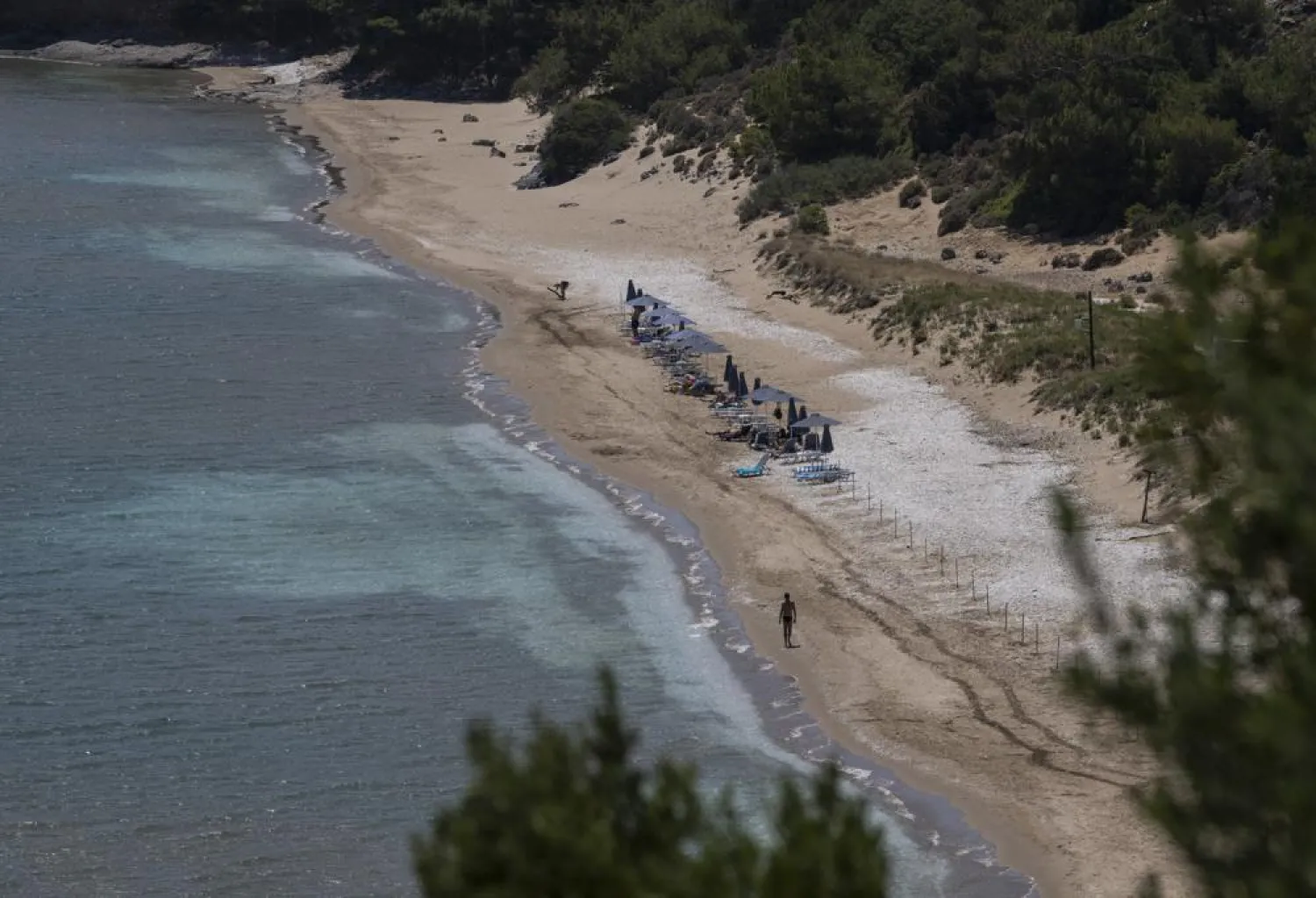
A man walks at the beach of Marathokampos, on the island of Samos, North Aegean, Greece, Wednesday June 9, 2021. (AP)
TT

Migrant Family’s Presence on Greek Island Hints at Pushbacks

A man walks at the beach of Marathokampos, on the island of Samos, North Aegean, Greece, Wednesday June 9, 2021. (AP)

Around dawn one recent spring day, an inflatable dinghy carrying nearly three dozen people reached the Greek island of Samos from the nearby Turkish coast. Within 24 hours, refugee rights groups say, the same group was seen drifting in a life raft back to Turkey.

But of the 32 people determined to have initially made it to Samos, only 28 were in the raft the Turkish coast guard reported retrieving at sea.

Four days later, the missing four — a Palestinian woman and her three children — appeared in Samos’ main town of Vathy, apparently having eluded Greek authorities. She applied for asylum and last week was informed their application had been accepted.

“I consider that the arrival of this woman, if we’re not speaking of a miracle, of a virgin birth, of her falling from the sky, we’re speaking of clear proof of a pushback,” said Dimitris Choulis, the lawyer who helped 31-year-old Huda Zaga apply for asylum, along with her 12-year-old daughter and sons, aged 11 and 5.

Accusations from rights groups and migrants that Greece has been carrying out pushbacks — the illegal summary deportation of migrants without allowing them to apply for asylum — are nothing new, on land or at sea. But it is rare for such cases to involve anyone managing to stay behind.

Greece vehemently denies the claims, but says it has an obligation to protect its borders, which are also the European Union’s external borders. It points to March 2020, when Turkey opened its borders into the EU and actively encouraged migrants to cross into Greece.

Zaga says she arrived on Samos on April 21 in a dinghy crammed with people. After making landfall, the group scrambled up a wooded hill, splitting up to avoid detection by authorities.

“We were terrified of being caught and being sent back to Turkey, especially after we crossed into the territorial waters of Greece,” Zaga told The Associated Press.

Before long, social media posts appeared. A local journalist posted about the migrants’ arrival. Other residents said they had seen them, or given them food or water.

But as the day progressed, the story changed. The journalist contacted authorities, and posted she was told the migrants were not new arrivals but residents of a refugee camp on the outskirts of Vathy making a day trip — a roughly 50-kilometer (31-mile) hike over mountains.

Several residents told the AP they were told by authorities and others not to speak of what they had seen. They spoke on condition of anonymity, saying they didn’t want problems.

The next day, a piece of the dinghy the migrants arrived in still lay on the beach of Marathokampos Bay. The rights group Aegean Boat Report, which monitors arrivals on Greek islands, posted photos of the new arrivals. Some showed Zaga and her children with others on a wooded hillside, the Marathokampos coastline in the background.

Asked about the case, Greece’s Shipping Ministry, under whose jurisdiction the coast guard falls, said it had no record of an April 21 arrival on Samos. Authorities did not provide any explanation for the appearance of the woman and her children.

Zaga said she was aware of the pushback risk, having experienced it before. She tried to enter Greece three times earlier from the land border but was caught twice inside Turkey and once after entering Greece. This time, she was determined to succeed.

“We managed the impossible, to make sure that what happened to them won’t happen to us,” she said of those returned to Turkey.

Zaga said she broke away from the others, staying behind with her children, and got in touch with people who had helped arrange her journey to Samos. She would not provide specifics about how she managed to evade detection, or who helped her contact the lawyer. But on April 26, she arrived at Choulis’ office asking for assistance.

Choulis said he immediately realized they were the people missing from the reported Marathokampos landing. He informed Greek judicial authorities, police and the coast guard that he was accompanying the family to the refugee camp for registration.

As he waited outside during Zaga’s registration interview he was told repeatedly to leave, Choulis said.

“There was a strange climate of suspicion,” he said, and an intense fear that Zaga and her children might still be sent back to Turkey. But at this point, representatives of the UN refugee agency had been informed and were present.

UNHCR Representative in Greece Mireille Girard said the organization received a telephone message on April 21 about migrants arriving on Samos and sought confirmation from authorities, but got no response. A few days later, the agency was informed a family believed to have been with the group had remained on Samos and was applying for asylum.

“These elements are concerning. They are indications of a pushback from Samos island on 21 April and need to be formally investigated,” Girard said.

In the meantime, Zaga’s family has received asylum. She says she fled her home in the Nablus region of the West Bank for several reasons, but mainly to escape an abusive husband who assaulted her eldest son. She hopes to eventually reach Belgium, where her sister lives.

“I want to see my children happy, to see them going to school, eating healthy food, sleeping well and to live normally just like other children. To have safety and security, to have a school and home,” she said.

For Choulis, Zaga’s successful asylum application underscores the perils of pushbacks, which have, at times, allegedly been carried out by masked men without visible badges on their uniforms, to hide their identities.

“The fact that her asylum application was accepted shows just how dangerous it is for masked men of the coast guard or the police to judge who has the right to asylum and who doesn’t,” the lawyer said.

“We cannot leave the fate of something as important as the right to asylum to be determined in the middle of the sea or on the shores.”



Thousands of Somalis Protest Israeli Recognition of Somaliland

This picture taken on November 7, 2024 shows a general view of the city of Hargeisa, capital and largest city of the self-proclaimed Republic of Somaliland. (Photo by LUIS TATO / AFP)
TT

Thousands of Somalis Protest Israeli Recognition of Somaliland

This picture taken on November 7, 2024 shows a general view of the city of Hargeisa, capital and largest city of the self-proclaimed Republic of Somaliland. (Photo by LUIS TATO / AFP)

Large protests broke out in several towns and cities across Somalia on Tuesday in opposition to Israel's recognition of the breakaway region of Somaliland.

Israel announced on Friday that it viewed Somaliland -- which declared independence in 1991 but has never been recognized by any other country -- as an "independent and sovereign state".

Somali President Hassan Sheikh Mohamud has condemned the move as a threat to stability in the Horn of Africa. He travelled Tuesday to Türkiye, a close ally, to discuss the situation, AFP reported.

Thousands of protesters marched through the streets of Somali capital Mogadishu and gathered at a stadium, waving placards with anti-Israeli slogans alongside Somali and Palestinian flags.

"We will never allow anyone to violate our sovereignty," one attendee, Adan Muhidin, told AFP, adding that Israel's move was "a blatant violation of international law".

Demonstrations also took place in Lascanod in the northeast, Guriceel in central Somalia, and Baidoa in the southwest.

"There is nothing we have in common with Israel. We say to the people of Somaliland, don't bring them close to you," said Sheikh Ahmed Moalim, a local religious leader, in Guriceel.

Somaliland has long been a haven of stability and democracy in the conflict-scarred country, with its own money, passport and army.

It also has a strategic position on the Gulf of Aden that makes it an attractive trade and military partner for regional and international allies.

But Israel's decision to recognize its statehood has brought rebukes from across the Muslim and African world, with many fearing it will stoke conflict and division.

There have been celebrations in Somaliland's capital Hargeisa, with the rare sight of Israeli flags being waved in a Muslim-majority nation.


Iranian Students Protest in Tehran and Isfahan, Says Local Media

Shopkeepers and traders walk over a bridge during a protest against the economic conditions and Iran's embattled currency in Tehran on December 29, 2025. (Handout / Fars News Agency / AFP)
TT

Iranian Students Protest in Tehran and Isfahan, Says Local Media

Shopkeepers and traders walk over a bridge during a protest against the economic conditions and Iran's embattled currency in Tehran on December 29, 2025. (Handout / Fars News Agency / AFP)

Student protests erupted on Tuesday at universities in the capital Tehran and the central city of Isfahan, decrying declining living standards following demonstrations by shopkeepers, local media reported.

"Demonstrations took place in Tehran at the universities of Beheshti, Khajeh Nasir, Sharif, Amir Kabir, Science and Culture, and Science and Technology, as well as the Isfahan University of Technology," reported Ilna, a news agency affiliated with the labor movement.


Iran Designates Royal Canadian Navy a Terrorist Organization

Iranians drive past a huge banner of former Iranian Revolutionary Guard Corps (IRGC) Quds Force commander Qassem Soleimani ahead of the sixth anniversary of his assassination at Valiasr Square in Tehran, Iran, 30 December 2025. (EPA)
TT

Iran Designates Royal Canadian Navy a Terrorist Organization

Iranians drive past a huge banner of former Iranian Revolutionary Guard Corps (IRGC) Quds Force commander Qassem Soleimani ahead of the sixth anniversary of his assassination at Valiasr Square in Tehran, Iran, 30 December 2025. (EPA)

The Iranian foreign ministry designated the Royal Canadian Navy a terrorist organization on Tuesday in what it said was retaliation for Canada's 2024 blacklisting of Iran's Revolutionary Guards.

In a statement, the ministry said that the move was in reaction to Ottawa declaring the Guards, the ideological arm of Iran's military, a terror group "contrary to the fundamental principles of international law".

Iran "within the framework of reciprocity, identifies and declares the Royal Canadian Navy as a terrorist organization," the statement added, without specifying what ramifications if any the force will face.

On June 19, 2024, Canada declared the IRGC a terror group. This bars its members from entering the country and Canadians from having any dealings with individual members or the group.

Additionally, any assets the Guards or its members hold in Canada could also be seized.
Canada accused the Guards of "having consistently displayed disregard for human rights both inside and outside of Iran, as well as a willingness to destabilize the international rules-based order."

One of the reasons behind Ottawa's decision to designate the force as a terror group was the Flight PS752 incident.

The flight was show down shortly after takeoff from Tehran in January 2020, killing all 176 passengers and crew, including 85 Canadian citizens and permanent residents.

The IRGC admitted its forces downed the jet, but claimed their controllers had mistaken it for a hostile target.

Ottawa broke off diplomatic ties with Tehran in 2012, calling Iran "the most significant threat to global peace".

Iran's archenemy, the United States, listed the Guards as a foreign terrorist organization in April 2019 while Australia did the same last month, accusing the force of being behind attacks on Australian soil.