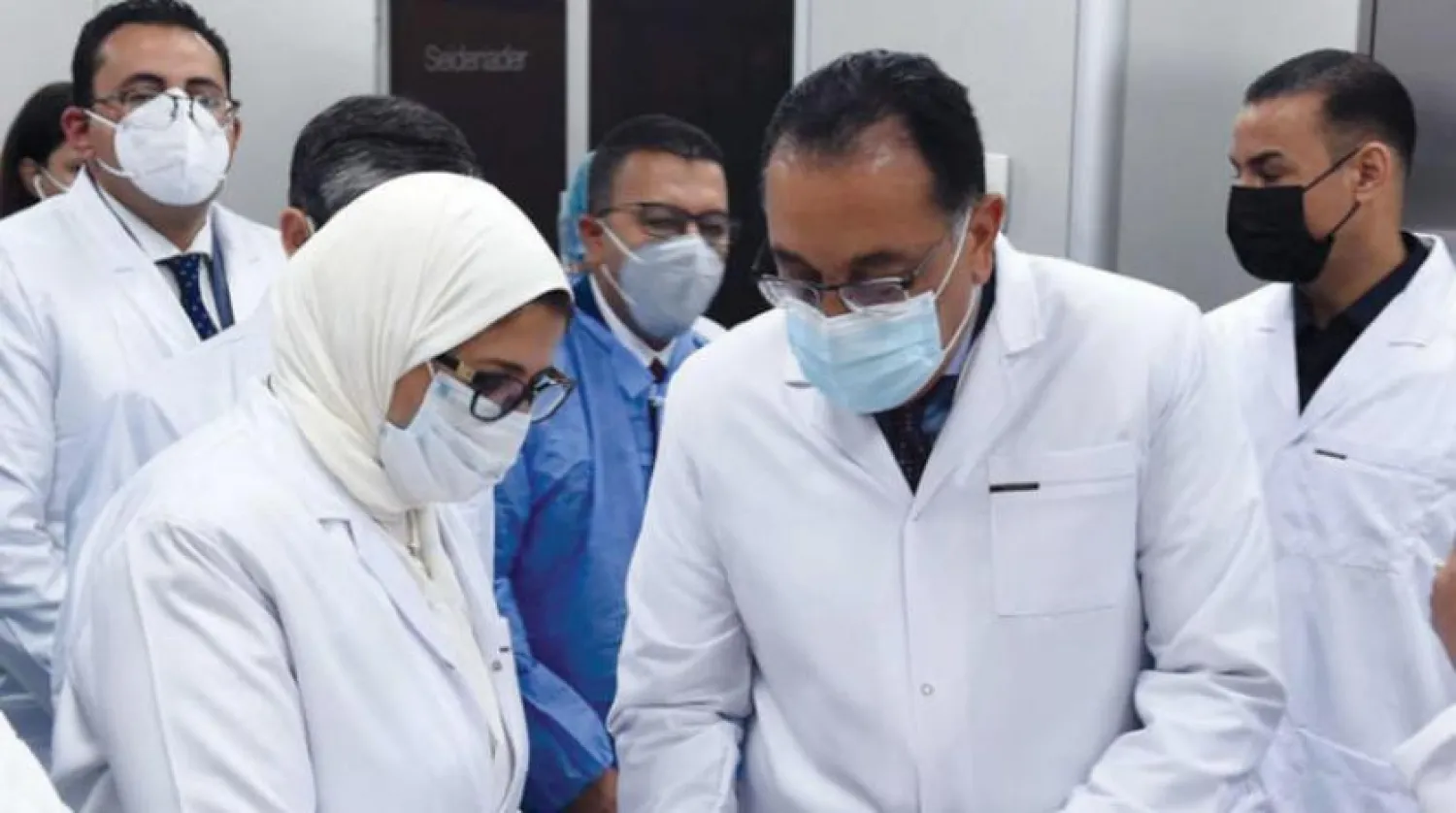
Egypt Manufactures First 1 Million Doses of COVID-19 Vaccine

 Egypt’s Prime Minster Mostafa Madbouly attends the production of the first one million doses of the locally manufactured COVID-19 vaccine (Egyptian Government)
Egypt’s Prime Minster Mostafa Madbouly attends the production of the first one million doses of the locally manufactured COVID-19 vaccine (Egyptian Government)
TT

Egypt Manufactures First 1 Million Doses of COVID-19 Vaccine

 Egypt’s Prime Minster Mostafa Madbouly attends the production of the first one million doses of the locally manufactured COVID-19 vaccine (Egyptian Government)
Egypt’s Prime Minster Mostafa Madbouly attends the production of the first one million doses of the locally manufactured COVID-19 vaccine (Egyptian Government)

Egypt produced one million doses of the locally manufactured COVID-19 vaccine, while the government confirmed it aims at vaccinating 40 percent of the population by the end of 2021.

Egypt’s Prime Minster Mostafa Madbouly said Monday that one million Sinovac doses have been produced so far, pointing out that the current capacity of the factory reached 300,000 doses per shift.

He said the challenge the government faces is receiving the raw materials necessary for producing the vaccine, but Egypt discussed with the Chinese side, doubling the amount of the raw materials to be delivered to it.

Madbouli said an agreement was reached with the company's head office to supply Egypt with the materials needed for manufacturing 80 million doses enough for vaccinating 40 million citizens.

“Under the directives of President Abdel Fattah El Sisi, the government seeks to produce the largest number of COVID-19 vaccines in order to protect its citizens,” the PM said.

It seems the pandemic would not come to an end any time soon, the PM said during a joint press conference with Health Minister Hala Zayed.

The minister confirmed that Egypt is considered one of the first countries in the world to start producing the COVID-19 vaccine.

“This step allows Egypt to become a pioneer in the production of vaccines and later to start exporting them to Africa and other regional states, after achieving self-sufficiency,” she said.

The daily COVID-19 infection rate in the country has continued to decline.

Egypt said on Monday it recorded 179 new coronavirus cases in the last 24 hours, upping the total number of confirmed cases since the outbreak in the country began to 282,082.

Ministry spokesman Khaled Megahed said 22 patients died from the virus, raising the death toll to 16,264.

On Sunday, Cabinet spokesman Nader Saad, said Egypt aims at vaccinating 40 percent of the population by the end of 2021, and that it will begin using the locally manufactured vaccines starting August.


In ‘Solidarity’ Visit to Beirut, French FM Vows to Pursue Lebanon Truce Efforts

French Foreign Minister Jean-Noël Barrot during his visit to Prime Minister Nawaf Salam (AP)
TT

In ‘Solidarity’ Visit to Beirut, French FM Vows to Pursue Lebanon Truce Efforts

French Foreign Minister Jean-Noël Barrot during his visit to Prime Minister Nawaf Salam (AP)

French Foreign Minister Jean-Noël Barrot on Friday expressed solidarity with Lebanon and pledged to press ahead with diplomatic efforts to halt escalating violence between Israel and Hezbollah.

Barrot’s visit came as Lebanon faces mounting security and humanitarian problems resulting from ongoing hostilities.

Lebanese officials said the French minister stressed Paris’s determination to find “common ground” to launch serious negotiations, reaffirming full support for an initiative by President Joseph Aoun to open direct talks with Israel.

France “will continue its efforts despite the difficulties,” Barrot told Lebanese leaders, according to official sources.

He added that he had spoken ahead of his trip with his US counterpart as well as Israel’s Ron Dermer, who has been tasked with representing his government in any negotiations with Lebanon.

Barrot also underscored the “vital role” of UN peacekeepers in southern Lebanon, stressing that France intends to maintain its presence even after the current mandate of the United Nations Interim Force in Lebanon (UNIFIL) expires at the end of the year.

In a statement, Lebanon’s presidency said Barrot briefed Aoun on ongoing diplomatic contacts aimed at halting Israeli strikes.

The French minister voiced readiness to work towards ending the escalation through proposals under discussion with relevant parties, describing Aoun’s initiative as “courageous” and backed by the international community.

He also highlighted the central role of the Lebanese army in any future settlement, including in the event of a UNIFIL withdrawal, and discussed coordination with neighboring Syria following a recent call involving Aoun, French President Emmanuel Macron and Syrian leader Ahmad al-Sharaa.

Aoun, for his part, reiterated the urgent need for a ceasefire and guarantees to ensure its durability, warning that continued escalation was blocking the launch of negotiations.

He said a halt to hostilities was essential to create the conditions for talks, pointing to widespread destruction in southern Lebanon, hundreds of casualties and more than one million displaced.

“Once the fire stops, negotiations can take place anywhere,” Aoun said, according to the statement, stressing that de-escalation remains the priority.

He also reaffirmed Lebanon’s desire for international forces to remain in the south to oversee any future agreement, or for European contingents to continue peacekeeping duties under any framework.

On the domestic front, Aoun said the government remains committed to enforcing the state’s monopoly on arms, including plans to disarm Hezbollah, though implementation has been hindered by the ongoing conflict.

He added that key infrastructure — including Beirut’s airport, seaport and border crossings — remains under state control, with the army conducting patrols nationwide to curb armed activity. Decisions on war and peace, he stressed, rest solely with the state.

Lebanese divisions, US role

Barrot also met Parliament Speaker Nabih Berri, who reiterated his refusal to name a Shiite representative to a negotiating delegation before “an end to Israeli aggression and the return of displaced persons.”

Prime Minister Nawaf Salam, for his part, told CNN Lebanon was ready to “immediately” enter direct negotiations with Israel.

“This war was imposed on us,” Salam said, noting that around 20 percent of the population has been displaced.

He described the United States as a strategic partner and said Donald Trump was “the most capable of playing a decisive role in ending the war.”

EU warns of ‘catastrophic’ situation

The European Union meanwhile voiced “grave concern” over the Israeli offensive in Lebanon, warning of severe humanitarian consequences and the risk of a prolonged conflict.

In a statement, the EU called on Israel to halt its operations, saying the humanitarian situation in Lebanon was already “catastrophic.”

It also criticized Hezbollah for drawing Lebanon into the conflict, refusing to disarm and continuing attacks on Israel.

Attacks on civilians, infrastructure, healthcare workers and UN peacekeepers are “unjustifiable and unacceptable and must stop immediately,” the statement said.


Talks in Baghdad Aim to Halt Attacks on US Embassy

The US Embassy compound in Iraq inside the Green Zone in Baghdad (AFP) 
TT

Talks in Baghdad Aim to Halt Attacks on US Embassy

The US Embassy compound in Iraq inside the Green Zone in Baghdad (AFP) 

A series of meetings held over the past two days inside Baghdad’s fortified Green Zone have produced a preliminary framework aimed at halting attacks on the US Embassy, according to an informed Iraqi source.

Speaking to Asharq Al-Awsat, the source said the discussions brought together representatives of armed factions and a senior Iraqi political figure, resulting in a proposed agreement that has been conveyed to the United States. The proposal includes conditions set by Kataib Hezbollah.

The meetings were intended to “test the positions of both sides” as a step toward broader implementation if the arrangement proves successful in Baghdad, the source added. However, the outcome will depend on the nature of the US response.

Abu Mujahid al-Assaf, a newly appointed security official for Kataib Hezbollah, announced a five-day suspension of attacks on the US Embassy, conditional on several demands. These include an end to Israeli strikes and displacement in Beirut’s southern suburbs.

Additional conditions call for a US commitment not to target residential areas in Baghdad and other provinces, as well as the withdrawal of CIA personnel from the vicinity of the embassy.

The group warned that failure to meet these conditions would prompt a “direct and concentrated” response, with an escalation in attacks after the deadline. It also urged Iraqi authorities to protect diplomatic missions and economic entities of countries not involved in the conflict, excluding what it described as Israeli entities and US occupation forces.

The United States announced it is carrying out strikes against Iran-backed armed groups in Iraq. General Dan Caine, Chairman of the Joint Chiefs of Staff, stated during a Pentagon briefing that US AH-64 Apache helicopters are being used in these operations.

Western sources told Asharq Al-Awsat that Washington is not engaged with such proposals and is likely to continue its current approach of responding to attacks targeting diplomatic facilities and US interests in Iraq.

Recent strikes, believed to have been conducted by the United States, targeted locations used by militia leaders for meetings. Kataib Hezbollah acknowledged in statements that several of its security leaders were killed in those attacks.

Meanwhile, French President Emmanuel Macron on Thursday urged Iraqi authorities to prevent attacks on diplomatic missions amid rising regional tensions.

Speaking on the sidelines of a European summit in Brussels, Macron said France has been present in Iraq since 2015 to combat ISIS and support the country’s sovereignty. He confirmed recent contacts with Iraqi Prime Minister Mohammed Shia al-Sudani and Kurdistan Region President Nechirvan Barzani, reaffirming France’s support for Iraq’s territorial integrity.

Macron called on Iraq to act decisively against groups targeting French nationals and facilities, warning that such actions undermine the country’s security and stability.

Baghdad Security Measures

Iraq’s Interior Ministry denied reports circulating on social media claiming that US forces had raided a unit of the Rapid Response Division at Baghdad International Airport.

Spokesperson Colonel Abbas al-Bahadli described the reports as “entirely false” and urged reliance on official sources, warning against the spread of misinformation.

Baghdad Operations Command confirmed that extensive security measures have been implemented across the capital. Lieutenant General Walid al-Tamimi said efforts include securing areas that could be used to launch indirect fire, assuring diplomatic missions that “the situation in Baghdad is stable and secure.”


Israel Says it Struck Syrian Military Post after Attacks on Druze

Demonstrators carry a Syrian flag during a rally commemorating the15th anniversary of the Syrian uprising against the Bashar Assad regime in Daraa, southern Syria, Wednesday, March 18, 2026. (AP Photo/Omar Sanadiki)
TT

Israel Says it Struck Syrian Military Post after Attacks on Druze

Demonstrators carry a Syrian flag during a rally commemorating the15th anniversary of the Syrian uprising against the Bashar Assad regime in Daraa, southern Syria, Wednesday, March 18, 2026. (AP Photo/Omar Sanadiki)

Israel’s military said Friday it struck sites in Syria in response to attacks against the Druze.

The army said it struck infrastructure belonging to Syria in response to attacks on the Druze population in Sweida in southern Syria.

The Israeli military said it targeted a ⁠command center and weapons in military compounds, and said it will not tolerate harm toward the Druze population, adding ⁠it ⁠will continue to operate to defend them and monitor developments in the region.