Lebanon: Govt Raises Bread Price for Seventh Time in One Year

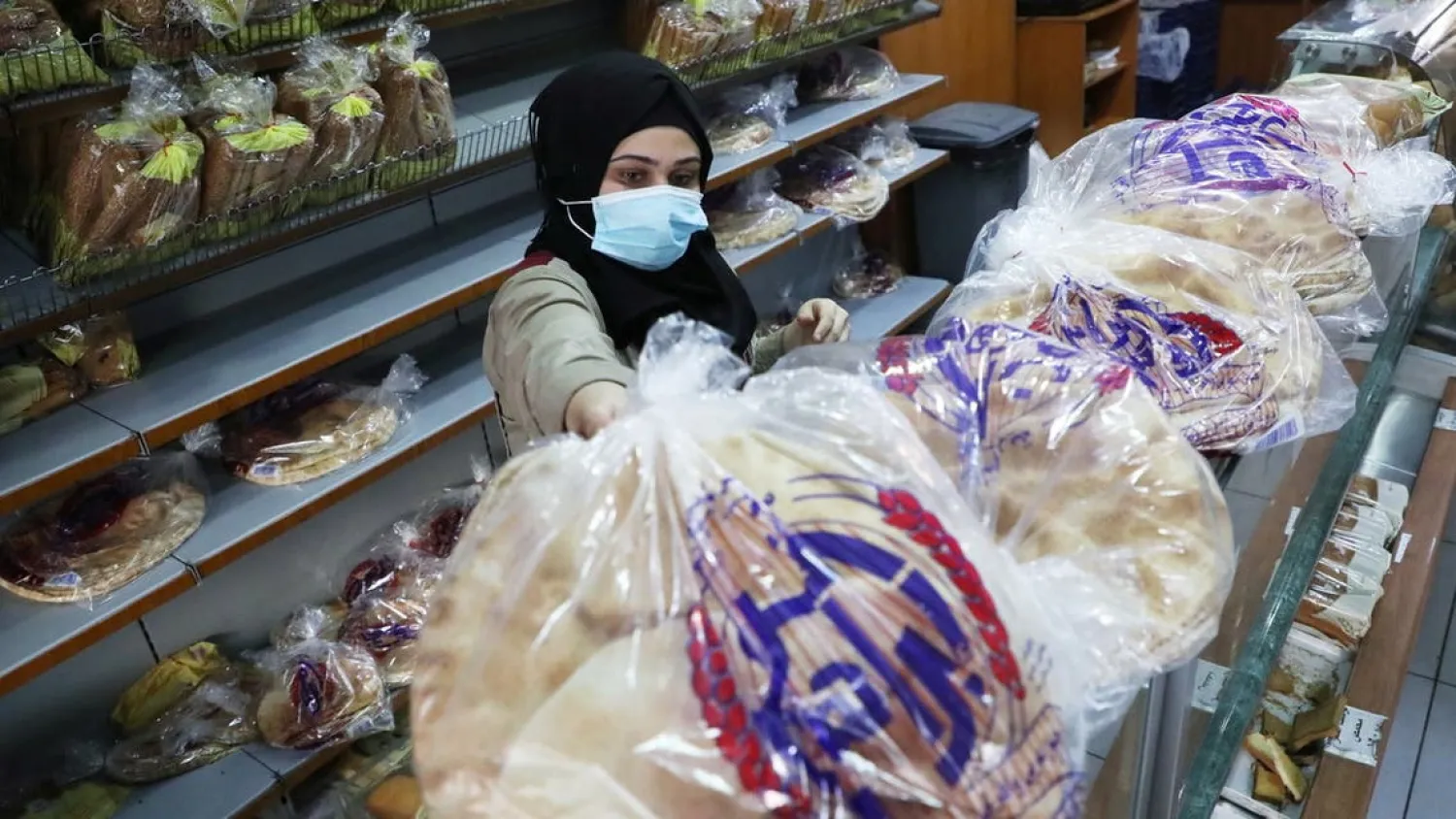
A vendor wearing a face mask arranges bread for sale inside a bakery in Beirut, Lebanon December 7, 2020. (Reuters)
TT

Lebanon: Govt Raises Bread Price for Seventh Time in One Year

A vendor wearing a face mask arranges bread for sale inside a bakery in Beirut, Lebanon December 7, 2020. (Reuters)

For the seventh time in a year, Lebanon’s economy ministry announced on Saturday new prices for bread, slowly removing subsidies as the country sinks deeper into a dire economic and political crisis.

The ministry said raising the price was necessary as the national currency continues to slide against the dollar, making imports of basic supplies including fuel and wheat more expensive. The currency, pegged to the dollar for nearly 30 years at 1,500 to the dollar, has lost over 90 percent of its value. It is now trading at nearly 20,000 Lebanese pounds to the dollar, according to The Associated Press.

This is the second price hike this month. The ministry raised the price of a bag of flatbread, a staple in Lebanon, by 6 percent — making it now sell at 4,000 Lebanese Pounds (or $2.7 at the official rate). The decision also included a new reduction in the size of the bag of bread — this time by 5 percent.

Lebanon is in the throes of an economic crisis that is bringing regular life to a near halt. Businesses are shutting down, pharmacies have gone on strikes because they can’t secure imported medicines. Fuel shortages have forced hospitals and the country’s only airport to ration their use, shutting down air conditioning and lights in some parts.

A marathon for vaccination against COVID-19 scheduled for Saturday and Sunday was postponed because many of the centers that planned to take part had no fuel to operate their generators or internet.

The World Bank has called Lebanon’s crisis one of the worst the world has seen in the past 150 years.

The crisis is made worse by a stifling political deadlock among rival groups who are failing to agree on a new government line-up.

The current government had resigned last year following the massive August blast in Beirut’s port. The government has since operated in a caretaker capacity — which doesn’t allow it to continue talks with the International Monetary Fund for a bailout.

As the crisis deepens, tempers are fraying. Protesters set up road blocks at major intersections in the capital Beirut to object to the political class’s continued bickering and worsening conditions. At long queues in gas stations, some motorists fired their guns in the air in anger.


Oil Edges Lower after Trump Signals Dialogue with Iran over Nuclear Program

A view shows a pressure gauge near oil pump jacks outside Almetyevsk, in the Republic of Tatarstan, Russia July 14, 2025. REUTERS/Stringer
TT

Oil Edges Lower after Trump Signals Dialogue with Iran over Nuclear Program

A view shows a pressure gauge near oil pump jacks outside Almetyevsk, in the Republic of Tatarstan, Russia July 14, 2025. REUTERS/Stringer

Oil prices slipped on Friday on signs that the US may engage in dialogue with Iran over its nuclear program, reducing concern over potential supply disruptions from a US attack.

Brent crude futures were down 21 cents, or 0.3%, at $70.50 a barrel by 1219 GMT. The March contract expires later on Friday. The more active April contract lost 45 cents, or 0.65%, to $69.14.

US West Texas Intermediate crude fell 38 cents, or 0.6%, to $65.04 a barrel, Reuters reported.

"President Trump’s willingness to give diplomacy a chance regarding Iran seemingly makes a US military intervention less likely than yesterday," said PVM Oil Associate analyst Tamas Varga.

Middle East tensions and oil prices had increased this week as the US strengthened its military presence in the region. US President Donald Trump urged Iran on Wednesday to make a deal on nuclear weapons or face an attack but on Thursday said he was planning to speak to the country's leaders.

Despite Friday's declines, benchmark prices remained on track for large monthly gains. Brent crude was set for its biggest monthly jump since January 2022 and WTI was poised for its largest monthly gain since July 2023.

Price pressure also came from a rise in the dollar after it hit a four-year low earlier in the week. Friday's dollar strength followed Trump's announcement that he would pick former Federal Reserve Governor Kevin Warsh to head the US central bank when Jerome Powell's leadership term ends in May.

A stronger dollar can limit demand from oil buyers paying in other currencies.

"Rising US crude oil output after shutdowns and Kazakhstan nearing the resumption of production at the Tengiz oilfield also contribute to the change in sentiment, and given the week’s bullish performance, it is reasonable to expect some profit-taking ahead of the weekend," Varga added.

Meanwhile, peak maintenance periods for Russian primary oil refining this year are expected this month and in September, based on Reuters calculations using estimates from industry sources.

A Reuters poll of 32 analysts found that most expect prices to hold near $60 a barrel this year as the prospect of oversupply offsets potential disruption from geopolitical tensions.


Syrians Decry Soaring Electricity Prices

Syria's electricity infrastructure was hammered by years of civil war © LOUAI BESHARA / AFP
TT

Syrians Decry Soaring Electricity Prices

Syria's electricity infrastructure was hammered by years of civil war © LOUAI BESHARA / AFP

When Hani Massalkhi went to pay his electricity bill in Damascus this week, he discovered that, under the new tariffs, the amount due was higher than his monthly income.

Massalkhi, a retired agricultural engineer who lives on a $70-a-month pension, left without paying.

"My bill used to vary between 15,000 and 20,000 pounds (less than $2). Now, it has surpassed 800,000 pounds", or $72, he told AFP.

In October, Syria's energy ministry hiked prices by up to 6,000 percent, sending shockwaves through a population already reeling from more than 13 years of war.

"Where are we supposed to get this money from?" Massalkhi wondered.

"People are emerging from a crisis, exhausted...they can't even put food on the table."

Authorities said the increase comes "within the framework of a project to reform the electricity sector, achieve sustainability, and improve service".

But, with most of Syria's population living below the poverty line and the minimum wage at around $75, many have found themselves unable to pay the new tariffs.

An official at the energy ministry did not respond to an AFP request for comment on the new prices.

- 'Electricity is a right' -

Since the ousting of longtime ruler Bashar al-Assad in 2024, the new Syrian authorities have repeatedly vowed to increase electricity production in a country where power cuts can last up to 20 hours a day.

Over the past year, they have signed contracts and memoranda of understanding to import gas from Turkey and Qatar to increase production.

They also hope to attract funding and investments to rehabilitate Syria's dilapidated infrastructure.

The World Bank estimates that post-war reconstruction will cost more than $216 billion.

However, citizens have yet to feel noticeable changes in their living conditions.

Damascus residents now receive up to six hours of state-provided electricity daily, but those outside the capital remain mostly in the dark.

Mohamad Ahmad, an economist and energy specialist at the Syria-focused consultancy Karam Shaar Advisory, told AFP that the price increase "primarily aims to prevent the financial collapse of the electricity sector".

"The core problem is not the tariff increase itself, but rather the erosion of wage purchasing power, particularly given that some employees earn less than $100 per month," he added.

On Thursday, a handful of people gathered outside the energy ministry in Damascus to protest the new tariffs, something unimaginable under the former government.

They held placards that read "we won't pay", condemning the widening gap between incomes and bills.

Protester Mohammed Daher, a retired public employee, told AFP that he now receives only two hours of electricity a day in the Tadamon suburb of Damascus.

He said that although he carefully rations his power use at home, he was "shocked to find out that my bill has surpassed 350,000 pounds ($31)," when it used to be less than $2.

"Where am I supposed to get that money from?" he added, saying his income was just $62 a month.

Feminist activist Sawsan Zakzak, 65, said she had been limiting her electricity consumption because she and her husband live on low pensions.

"We do not use air conditioning, and this year we did not use the boiler," she said as she held a placard that read "electricity service is a right".

"We also only watch television for a short period of time, fearing high tariffs."


Gold Tumbles Below $5,000, Dragging other Metals Lower

Gold and silver ingots at the Austrian "Ogussa" factory in Vienna (Reuters)
TT

Gold Tumbles Below $5,000, Dragging other Metals Lower

Gold and silver ingots at the Austrian "Ogussa" factory in Vienna (Reuters)

Gold prices tumbled by more than 7% to break below the $5,000 mark on Friday as the dollar strengthened on the imminent appointment of a new US Federal Reserve Chair, though the safe-haven metal remained set for its biggest monthly gain since 1999 after chalking up multiple record peaks.

Other precious metals also dropped sharply as profit-taking kicked in, said Reuters.

Spot gold lost 7.5% to $4,992.05 an ounce by 0947 GMT. US gold futures for February delivery fell 6.4% to $4,985.

Gold scaled ‌a record peak ‌of $5,594.82 on Thursday and is still on ‌track ⁠for a more ‌than 15% gain this month, heading for a sixth straight monthly gain and largest since 1999.

"I still believe several gold-supportive drivers remain in place, but after the strong rally in recent weeks a consolidation is healthy," said UBS analyst Giovanni Staunovo, adding that the likely nomination of a new Fed chair is applying immediate pressure on prices. US President Donald Trump said on Thursday ⁠that he will reveal his pick for the next Fed chair on Friday, with former ‌Fed Governor Kevin Warsh seen as a frontrunner. ‍Warsh has pushed for a smaller ‍Fed balance sheet, contrasting with Trump's inclination towards looser monetary policy.

The US ‍dollar rose on Friday, clawing back some of this week's slide to a four-year low. A stronger US currency makes dollar-priced gold more expensive for overseas buyers. Physical gold premiums in India rose to their highest in more than a decade on strong investment demand ahead of a likely duty increase. Premiums in China jumped after a pickup in investment and ⁠jewelry demand.

"We see gold dipping far lower than today but see a recovery and an average of $5,375 for 2026, reaching a peak of $6,400 during the fourth quarter," said independent analyst Ross Norman.

Among other precious metals, spot silver was down 14.1% at $99.77 an ounce after hitting a record $121.64 on Thursday. The metal has surged 42% this month, on track for its best monthly performance.

"Although a significant part of the move in the rise in silver has been based upon sound fundamentals, there was clearly a speculative excess within the market and I think that's getting blown off," Norman added.

Spot platinum lost ‌15.7% to $2,216.55 an ounce after hitting a record high of $2,918.80 on Monday. Palladium, meanwhile, plunged 13.4% to $1,737.50.