


US, Iraq Agree on Basic Troop Withdrawal End 2021

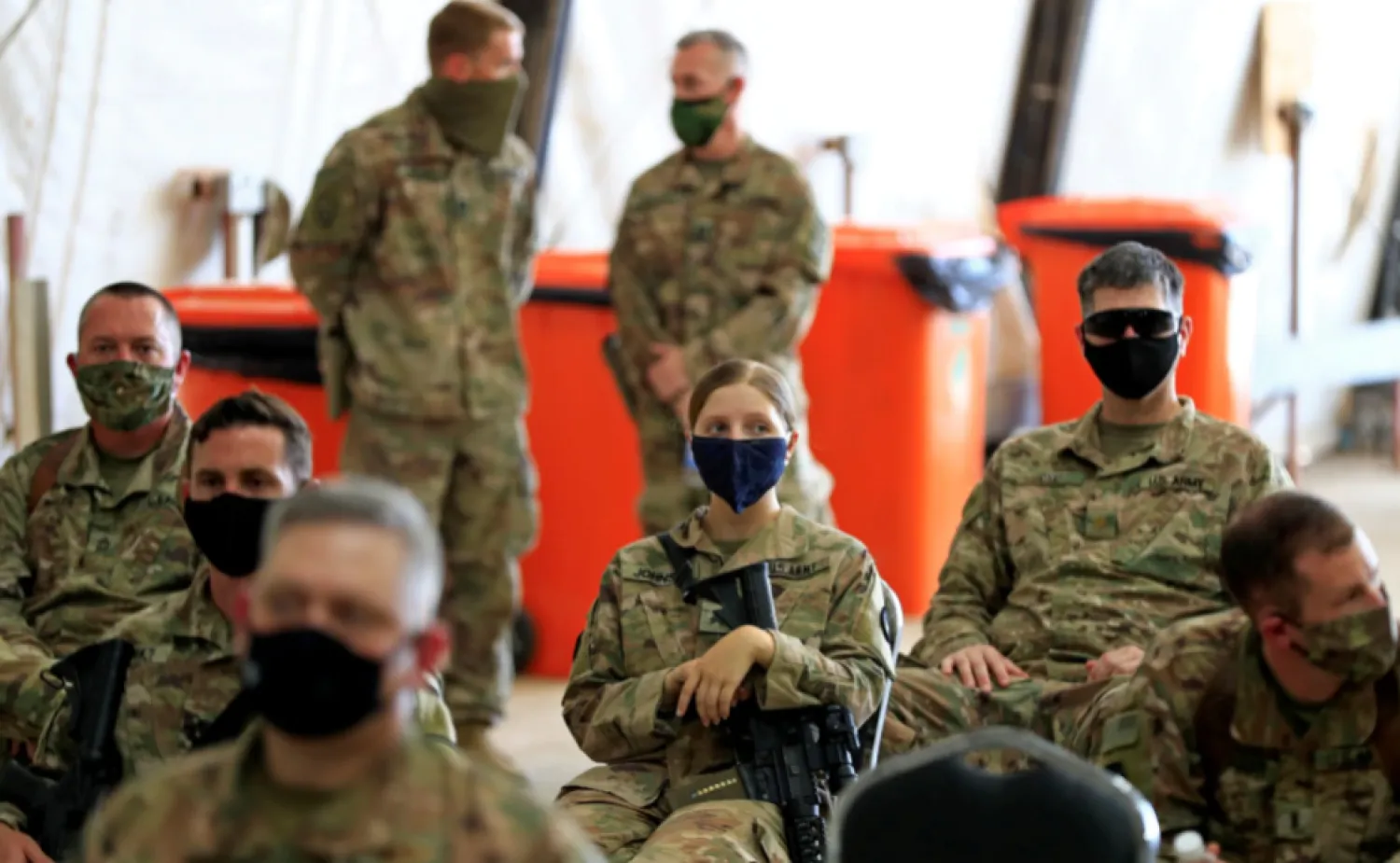
 US soldiers wearing protective masks are seen during a handover ceremony of Taji military base from US-led coalition troops to Iraqi security forces, in the base north of Baghdad, Iraq August 23, 2020. REUTERS/Thaier Al-Sudani/File Photo
US soldiers wearing protective masks are seen during a handover ceremony of Taji military base from US-led coalition troops to Iraqi security forces, in the base north of Baghdad, Iraq August 23, 2020. REUTERS/Thaier Al-Sudani/File Photo
TT

US, Iraq Agree on Basic Troop Withdrawal End 2021

 US soldiers wearing protective masks are seen during a handover ceremony of Taji military base from US-led coalition troops to Iraqi security forces, in the base north of Baghdad, Iraq August 23, 2020. REUTERS/Thaier Al-Sudani/File Photo
US soldiers wearing protective masks are seen during a handover ceremony of Taji military base from US-led coalition troops to Iraqi security forces, in the base north of Baghdad, Iraq August 23, 2020. REUTERS/Thaier Al-Sudani/File Photo

With the launching of the strategic dialogue between the United States and Iraq in Washington, US officials hinted at the possibility of agreeing to the Iraqi “wishes” and the issuance of a statement following US President Joe Biden’s meeting with Iraqi Prime Minister Mustafa Al-Kadhimi on Monday, announcing in principle that the US forces would leave Iraq by the end of this year.

Iraqi Foreign Minister Fouad Hussein had pointed to a new approach sought by Baghdad. He said that Iraq “does not need fighters, but rather intelligence cooperation, military training and air cover.” These demands are at the core of the role that the US forces are still assuming in Iraq.

The US State Department spokesman, Ned Price, was clear in responding to these expectations, saying that he would not anticipate the dialogue and its outcome, but he believed that the joint collective efforts to ensure the defeat of ISIS would be at the top of the agenda.

“Iraq is our partner and our forces are there. At the request of the government, we are working in coordination with them against common challenges,” he stated.

American and Iraqi officials were quoted as saying that the aim of the statement was to enable Al-Kadhimi to relieve the political pressure exerted by the Iraqi hardline factions loyal to Iran, who want the withdrawal of all US forces from the country.

A US official said that Washington was planning to redefine the role of some forces in Iraq, rather than reducing the US presence, according an article published by The Wall Street Journal.

In a statement, Pentagon spokesman John Kirby said that the first round of the strategic dialogue discussed bilateral security relations between the United States and Iraq, the long-term security collaboration and areas of cooperation outside the scope of counter-terrorism.

Kirby also stressed the renewal of the two countries’ joint commitment to eliminating ISIS, and the need to enable the US-led coalition to safely support the Iraqi security forces.

The Iraqi Joint Operations Command also said that it had held a meeting with its US counterpart, during which talks focused on the future of the strategic security relationship.

According to US experts, the changes demanded by the Iraqis in the current dialogue session would not have an impact on the daily tasks of the US forces, which are already carrying out the duties demanded by the Iraqi foreign minister.

The US forces practically do not carry out any combat missions, outside the scope of coordination with the Iraqi forces in their campaigns against terrorism. But they engage in combat operations only when exposed to attacks, as is happening now, and this is a legitimate right, according to US officials.

Pending the release of the statement, which is supposed to explain the modification in the role of US forces, US and Iraqi officials did not provide details on how the withdrawal of combat forces would take place and how the statement could be interpreted to allow for essential missions.



Iraq Closes Three Iran Crossings, Pursues Those Behind Attacks on Saudi Arabia

Travelers at the Shalamsheh border crossing between Iraq and Iran after Iraqi authorities ordered its closure as a precautionary measure following the latest drone attacks on Saudi Arabia on September 12, 2026 (Reuters)
TT

Iraq Closes Three Iran Crossings, Pursues Those Behind Attacks on Saudi Arabia

Travelers at the Shalamsheh border crossing between Iraq and Iran after Iraqi authorities ordered its closure as a precautionary measure following the latest drone attacks on Saudi Arabia on September 12, 2026 (Reuters)

Iraq closed three border crossings with Iran on Saturday, officials told AFP, after a drone attack on a Saudi Arabian pipeline that both Riyadh and Baghdad said was launched from Iraq.

An Iraqi security source and a government official told AFP that authorities ordered the closing of three border crossings with Iran.

The security source said the decision was "part of an intelligence effort to track down the perpetrators and prevent their escape... and to hinder the smuggling of drones through these crossings".

Both sources, who spoke on condition of anonymity because they were not allowed to speak to the media, could not specify when the crossings would reopen.

The closed crossings are Shalamsheh in Basra province, al-Shib in Missan and al-Mandali in the central province of Diyala.

Other border crossings with Iran are still open.

A security official said that "security forces found drone launchers near the Iraq-Iran border in the al-Tib" region, a remote part of Missan, close to the al-Shib crossing. A second security source gave the same account.

Military spokesperson Sabah al-Numan said the prime minister had approved "Iran's request to conduct a joint investigation into finding drone launch platforms near the Iraq-Iran border".

The government's security media cell said earlier that authorities "have started administrative and security reorganization operations at several border crossings".

It added that they had stepped up "intelligence activities" to determine "the breaches and violations that took place at these crossings".

It later announced that passengers stranded for hours at two crossings were permitted to pass.


Al-Halbousi Condemns Attacks on Saudi Arabia

Iraqi Speaker of parliament Mohammed al-Halbousi speaks with the news media as he departs the Department of State after meeting with Secretary of State Mike Pompeo, in Washington, on March 28, 2019. (AP)
TT

Al-Halbousi Condemns Attacks on Saudi Arabia

Iraqi Speaker of parliament Mohammed al-Halbousi speaks with the news media as he departs the Department of State after meeting with Secretary of State Mike Pompeo, in Washington, on March 28, 2019. (AP)

Speaker of the Iraqi Council of Representatives Haibat Al-Halbousi strongly condemned the attacks targeting the Kingdom of Saudi Arabia that originated from within Iraqi territory.

In a statement issued on Saturday, Al-Halbousi rejected the use of Iraq's territory or airspace to threaten Saudi Arabia's security or that of any neighboring state, describing such actions as unacceptable violations that contradict Iraq's national interests, stated foreign policy, and regional relations.

Al-Halbousi emphasized the critical need to restrict weapons exclusively to the state and its constitutional institutions under the authority of the commander-in-chief of the Armed Forces.

He stressed that enforcing state control over arms is vital to reinforcing national sovereignty, preserving domestic stability, and preventing Iraq from being drawn into wider regional conflicts.


Lebanese Army Detains Bashar Assad’s Relative on Weapons and Drugs Charges

Ousted Syrian President Bashar Assad - File Photo
TT

Lebanese Army Detains Bashar Assad’s Relative on Weapons and Drugs Charges

Ousted Syrian President Bashar Assad - File Photo

Lebanese authorities have detained a relative of ousted Syrian President Bashar Assad along with the son of a notorious drug dealer in northeast Lebanon on charges of carrying weapons and drugs, officials and the Lebanese army said Saturday.

Suleiman Assad and Ali Zeiter, son of Noah Zeiter, the suspected drug trafficker arrested last year, were detained Friday near the northeastern city of Baalbek, said the two judicial officials, who spoke on condition of anonymity because they were not authorized to speak to the media. Suleiman Assad is the son of Hilal Assad, a cousin of the ousted president, The AP news reported.

A number of Syrian officials and relatives of Assad have fled from Syria to other countries including Lebanon, after the five-decade Assad family rule came to an end in December 2024, when the opposition seized power. Bashar Assad and his younger brother, Maher, have been living in Russia.

The Lebanese army said in a statement that it detained three people, including a Syrian citizen who did not have documents proving that he is staying legally in Lebanon.

The army said they had weapons with them along with hashish, a drug that is processed from cannabis that are widely planted in northeast Lebanon. The army did not release the names but the initials of their first and family names matched those of Assad and Zeiter. The army said they were questioned under the supervision of judicial officials.

The arrest of Suleiman Assad comes weeks after Lebanon handed over to Syrian authorities a retired major general who commanded a division in Bashar Assad’s army.