

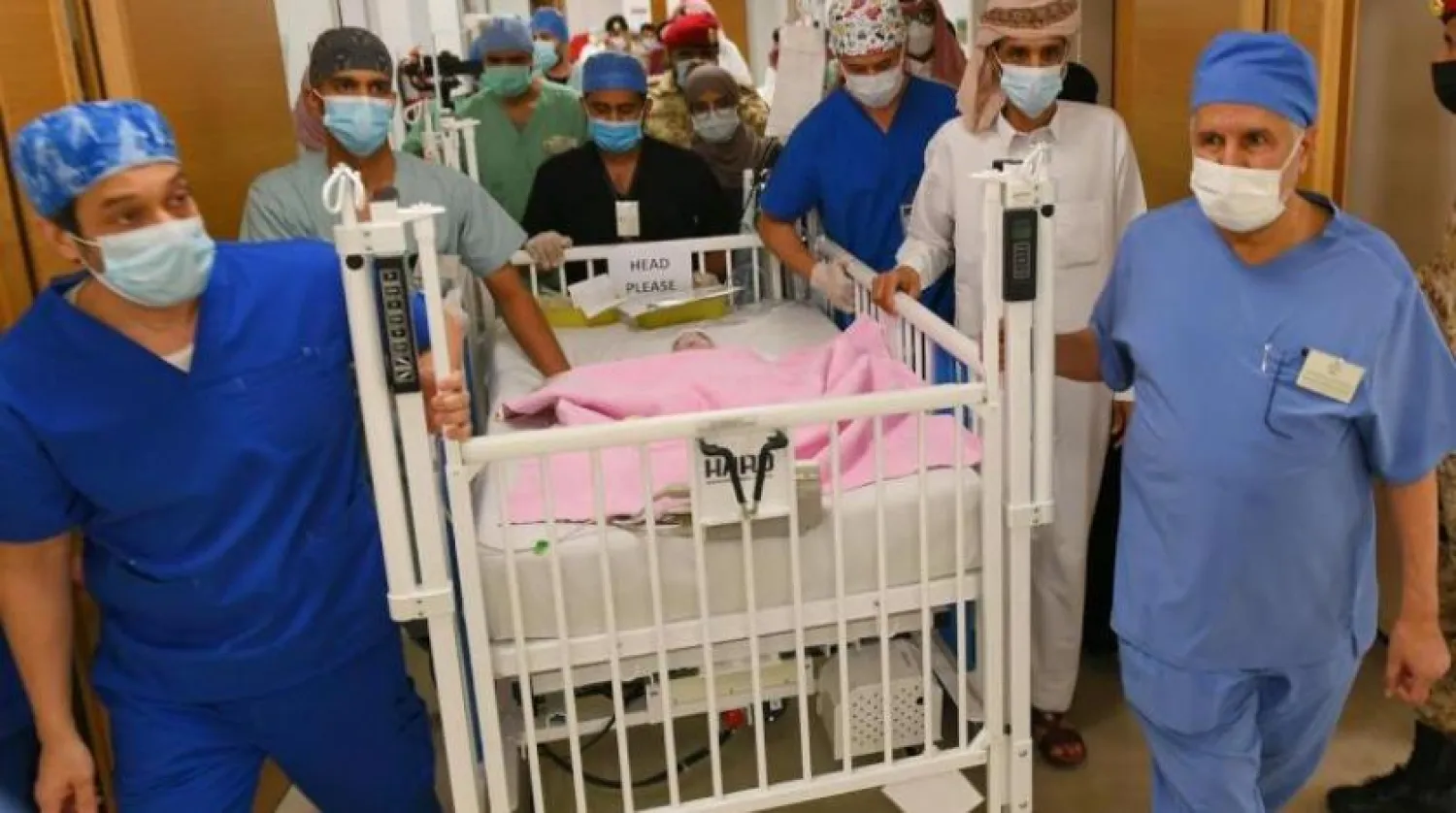

Dr. Al-Rabiah Announces Success of Parasitic Twins Separation Surgery

The team was able to finish the operation 45 minutes ahead of schedule. (King Salman Humanitarian Aid and Relief Center)
TT

Dr. Al-Rabiah Announces Success of Parasitic Twins Separation Surgery

The team was able to finish the operation 45 minutes ahead of schedule. (King Salman Humanitarian Aid and Relief Center)

Adviser at the Royal Court, General Supervisor of the King Salman Humanitarian Aid and Relief Center and head of the medical and surgical team in charge of the conjoined twin separation surgery, Dr. Abdullah bin Abdulaziz Al-Rabiah, announced on Friday the successful separation of the Yemeni parasitic twin Aisha Ahmed Saeed Muhaimud from the Al-Mahra Governorate.

The operation was performed on Friday in implementation of the directives of Custodian of the Two Holy Mosques, King Salman bin Abdulaziz, at the National Guard’s King Abdullah Specialist Children’s Hospital in Riyadh's King Abdulaziz Medical City.

Dr. Al-Rabiah expressed his happiness with this achievement and the success of the surgery in record time, revealing that the team was able to finish the operation 45 minutes ahead of schedule. He added that the operation lasted seven hours and 45 minutes, and included eight stages. Twenty-five doctors and specialists took part, as well as technicians and nurses.

Dr. Al-Rabiah said the operation began with the anesthesia stage, which saw the team led by Dr. Nizar Al-Zughaibi administer medications to the patient and follow it with the insertion of respiratory, venous and arterial tubes to ensure an accurate awareness of all parameters. This was followed by the second stage in which the urology team, led by Dr. Fayez Al-Madhhan, performed diagnostic endoscopy of the urinary and reproductive system. The third stage consisted in the sterilization and preparation of the sites to be operated on.

The fourth stage began with the plastic surgery team led, by Dr. Obaid Al-Mishal, opening the skin and membranes and separating them from the parasitic limbs in order to use them in covering the void left by the surgery, added Dr. Al-Rabiah.

The fifth stage, led by Dr. Ayman Jawadi's pediatric orthopedic team, consisted of separating the pelvis and parasitic limbs and modifying the pelvis, he continued.

The sixth stage saw the return of the pediatric urology team which separated and restored the shared parts of the lower urinary and reproductive system. This was followed by the seventh stage in which the intestines were explored for an opening, and the temporary removal of the colon by the pediatric surgery team, led by Dr. Muhammad Al-Namshan.

Dr. Al-Rabiah noted the participation of most surgical teams in the eighth and last stage, which consisted of reconstruction and the closing of any gaps resulting from the separation procedure. Eventually, all wounds were covered, and Aisha was transferred to the Pediatric Intensive Care Unit.

Dr. Al-Rabiah asked God to grant Aisha continued health and wellness, and added that the medical team was able to wake her up after the surgery and remove the artificial respirators. This enabled her to interact with the medical team and smile in gratitude to the Kingdom's generous leadership and people.

According to Dr. Al-Rabiah, this surgery constitutes the 50th national achievement of the Saudi Siamese Twins Separation Program, which has handled 117 cases from 22 countries in the past three decades.

He highlighted the tremendous support offered to this program by the Custodian of the Two Holy Mosques, King Salman bin Abdulaziz, and the constant endorsement of Crown Prince Mohammed bin Salman, Deputy Prime Minister and Minister of Defense. This support confirms Saudi Arabia's great advancement in health and scientific research in line with Vision 2030.

Dr. Al-Rabiah expressed his appreciation and gratitude to King Salman and Crown Prince Mohammed for their support and for the Kingdom's great humanitarian outreach. He also praised the efforts and experience of the members of the medical and surgical team behind this achievement.



How Saudi Arabia Protects Whistleblowers, Witnesses, Experts and Victims

The Witnesses, Experts, and Victims Protection Program takes the necessary measures to keep their data confidential. (SPA)
TT

How Saudi Arabia Protects Whistleblowers, Witnesses, Experts and Victims

The Witnesses, Experts, and Victims Protection Program takes the necessary measures to keep their data confidential. (SPA)

Saudi Arabia has launched a program to protect whistleblowers, witnesses, experts and victims, with the aim of ensuring their security and safety.

The forms of protection include monitoring their means of communication through the security department, after obtaining their written consent.

The program, established under Article 4 of the Law on the Protection of Whistleblowers, Witnesses, Experts and Victims, is linked to the Public Prosecutor.

Its administration is made up of a president, a deputy and two members of the Public Prosecution, as well as representatives from the Interior Ministry, the Presidency of State Security and the Oversight and Anti-Corruption Authority.

The regulations, published by the official Umm al-Qura newspaper, require courts to hear witness testimony and question experts away from the defendant and their lawyer in certain cases.

These include cases where the defendant’s criminal record shows they have previously harmed witnesses or experts, where they may pose a danger to others, or where the testimony or expert evidence is linked to a crime covered by the law and connected to an organized criminal group whose members have not all been arrested.

In such cases, the regulations also require courts to conceal the names of witnesses in judicial rulings.

According to the regulations, which came into force on Friday, the program’s administration will receive protection requests and refer them to the competent authorities to complete the requirements needed for review.

It will also submit recommendations to the Public Prosecutor on incomplete requests in cases where there are grounds to believe the person may face imminent danger.

The administration will study recommendations for protection from the competent authorities, determine the type of protection in detail when needed, and ensure it matches the risks, circumstances and facts of each case. It will then decide whether to approve or reject protection, continue it or amend its type.

Under the law, the administration will also submit recommendations to the Public Prosecutor on legal assistance requests from competent foreign authorities concerning protection.

It will support courts in implementing any measures they deem necessary and coordinate with relevant authorities to manage the affairs of the protected person and provide protection, including through electronic means.

It will notify the protected person if a decision is made to disclose their identity, take measures to protect them from physical harm, and ensure their health, safety and social adjustment throughout the protection period, while taking into account their rights and freedoms.

The administration must also preserve the confidentiality of the protected person’s data, determine their obligations and prepare a classification of the risks they may face.

The program’s duties include following up on the implementation of protection with the competent authorities, periodically reassessing the danger faced by the protected person and making any necessary adjustments.

It will also create a special register for protected persons and take measures to remedy any employment-related action referred to in the law.

The administration may interview the applicant or protected person when necessary, take legal action to recover from those responsible the costs borne by the state for their treatment, issue a decision ending protection under the law, and notify the protected person and relevant authorities.

The regulations allow protection requests to be submitted by the whistleblower, witness, expert or victim, or by a guardian, custodian, agent or lawyer acting on behalf of any of them.

Requests may be submitted to oversight bodies, law enforcement, evidence-gathering or investigation authorities, or the court, depending on the case.

The recommendation must include all necessary data and information, the measures taken, the factors affecting the case under the law, and the proposed type and duration of protection.

The authority that receives the request must submit its recommendation to approve or reject it to the program within five days.

Applicants may also submit requests directly to the administration. If the request meets the requirements set out in the regulations, the administration must refer it to the competent authority to review the recommendation.

Other factors the program’s administration must consider when reviewing a protection request include the public interest linked to criminal proceedings, the importance of the information and evidence provided by the person seeking protection, and that person’s health, social and financial condition.

The administration must also consider whether the danger or threat extends to the person’s spouse, relatives or others closely connected to them, as well as information from previous requests and the resources available to the security department.

When the administration approves a protection request under the law, the regulations require it to sign a protection document with the protected person. The document sets out the rights and obligations of both parties, as well as the relevant terms and conditions.

The security department is responsible for providing what is needed to implement protection or security escort for protected persons and for taking measures to ensure their safety, in line with the procedures, mechanisms and duration set by the program.

It must prepare periodic reports on protected persons, their compliance with the protection document, the risks they have faced, and continuing assessments of the risks they may face. It must also recommend whether protection should continue, be amended or be ended.

The program’s administration may apply any other form of protection it deems appropriate, based on the nature of the risk and harm, the seriousness of the criminal conduct and the circumstances of the person requiring protection.

These measures include monitoring the protected person’s means of communication through the security department after obtaining their written consent.

They also include transferring them, if they are detained, imprisoned or placed in custody, from their place of detention, imprisonment or custody to another location in coordination with the competent authorities.

The measures may also include issuing them a temporary protection identity document, within the narrowest limits and only in cases of urgent need.

The identity document may be used only for protection purposes and under controls agreed with the Interior Ministry to prevent its misuse. Any use for another purpose is invalid.

Other measures include placing protective technical devices in the protected person’s home or means of transport and assigning them an alternative residential address through the program’s administration.

Under the regulations, when the program’s administration ends protection for a protected person, it may continue protection for people who remain exposed to danger or harm because of their close connection to that person whenever there are grounds requiring continued protection.

The administration may issue a warning to the protected person if they fail to comply with protection instructions communicated to them, and may cancel the warning if they provide valid reasons. It must also verify whether they deliberately provided false information.

Any authority with which the protected person refuses to cooperate must immediately inform the program. Before ending protection, the program may request recommendations from the authority that sought protection, the security department and the competent authorities.

The person concerned must be notified of the decision through a legally recognized method. Protection does not end until the decision becomes final.


Saudi Crown Prince, Lebanese President Discuss Latest Developments

Prince Mohammed bin Salman, Saudi Crown Prince and Prime Minister, and Lebanese President Joseph Aoun. (Saudi Ministry of Foreign Affairs)
TT

Saudi Crown Prince, Lebanese President Discuss Latest Developments

Prince Mohammed bin Salman, Saudi Crown Prince and Prime Minister, and Lebanese President Joseph Aoun. (Saudi Ministry of Foreign Affairs)

Prince Mohammed bin Salman, Saudi Crown Prince and Prime Minister, held telephone talks on Friday with Lebanese President Joseph Aoun on the latest developments in Lebanon and the region.

The leaders discussed efforts to consolidate security and stability.

Aoun expressed Lebanon’s appreciation for Saudi Arabia’s stances towards Lebanon and its support to achieve stability and peace in the region.


Saudi Arabia, Russia Sign MoU for Environmental Protection

The Saudi flag. Asharq Al-Awsat
TT

Saudi Arabia, Russia Sign MoU for Environmental Protection

The Saudi flag. Asharq Al-Awsat

The Saudi Ministry of Environment, Water and Agriculture signed a memorandum of understanding with the Russian Ministry of Natural Resources and Environment to cooperate in environmental protection, aiming to strengthen the bilateral partnership and develop collaboration on environmental issues of mutual interest.

Signed by Saudi Vice Minister of Environment, Water and Agriculture Mansour Al Mushaiti during his visit to Russia and Russian Minister of Natural Resources and Environment Alexander Kozlov, the memorandum will contribute to strengthening joint efforts to preserve natural resources and achieve environmental sustainability in accordance with the legislation of both nations.

Key areas of cooperation include developing vegetation cover, mitigating land degradation, sustainable forest management, and developing management systems for protected and natural areas.

Additionally, the partnership will focus on enhancing environmental monitoring and waste management, supporting scientific research to protect and rehabilitate rare and endangered species, combating the illegal trade of endangered flora and fauna, and protecting migratory bird routes and stopover areas.

The agreement also targets the conservation of ecosystems and biodiversity alongside the exchange of technical expertise and successful environmental initiatives.

This cooperation will be implemented through the exchange of information, expert visits, and the organization of joint conferences, seminars, and training courses, supervised by a newly formed joint working group to follow up on future environmental opportunities.