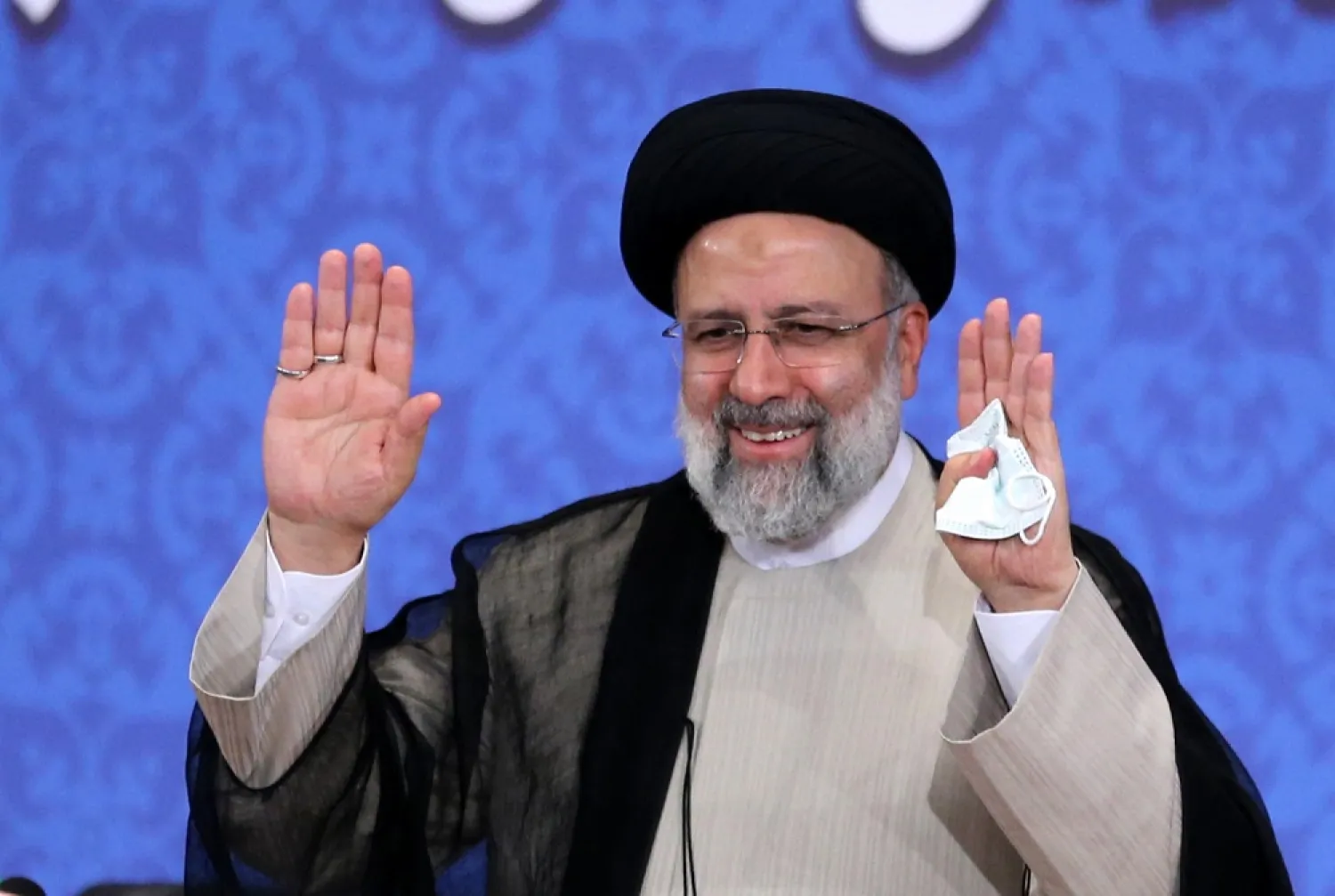
Rights Record under Scrutiny as Iran’s Raisi to Be Sworn in as President

Ebrahim Raisi will be sworn in on Tuesday. (Getty Images)
TT

Rights Record under Scrutiny as Iran’s Raisi to Be Sworn in as President

Ebrahim Raisi will be sworn in on Tuesday. (Getty Images)

Ultraconservative Ebrahim Raisi will be inaugurated on Tuesday as the new president of Iran, a country mired in deep economic crisis and hit by crippling US sanctions.

He replaces moderate president Hassan Rouhani, whose achievement was the 2015 nuclear deal between Iran and six world powers.

Raisi, 60, will have to tackle the nuclear talks aimed at reviving the deal from which the US unilaterally withdrew.

Two days after Tuesday’s inauguration by supreme leader Ali Khamenei, Raisi will take the oath before parliament.

He won June’s election when more than half the voters stayed away after many political heavyweights were barred from standing.

A former judiciary chief, Raisi has been criticized by the West for his human rights record.

Iran’s economic problems, exacerbated by the American sanctions, will be the new president’s greatest challenge, according to Clement Therme, a researcher at the European University Institute in Italy.

“His main objective will be to improve the economic situation by reinforcing the country’s economic relations with neighboring countries,” Therme told AFP.

“The goal would be to build a business model that would protect Iran’s economic growth from American policies and decisions.”

Therme believes Raisi’s main priority will be to “remove US sanctions” so Iran can bolster trade with its neighbors and non-Western countries such as China and Russia.

The 2015 deal saw Iran accept curbs on its nuclear capabilities in return for an easing of sanctions.

But former US president Donald Trump unilaterally withdrew from the accord three years later and ramped up sanctions again, prompting Tehran to pull back from most of its nuclear commitments.

Trump’s successor Joe Biden has signaled his readiness to return to the deal and engaged in indirect negotiations with Iran alongside formal talks with the agreement’s remaining parties -- Britain, China, France, Germany and Russia.

Economic malaise
The US sanctions choked Iran, including by seeking to stop its oil exports, and the economy contracted by more than six percent in both 2018 and 2019.

This was a blow to Rouhani who had hoped to liberalize the economy and develop the private sector.

In the winter of 2017-2018, and again in 2019, street protests sparked by economic woes rocked the country.

And in July this year, demonstrators in the oil-rich Khuzestan province, which has been hit by drought, took to the streets to vent their anger.

The economic malaise has been exacerbated by the coronavirus pandemic, which has left many Iranians struggling to get by.

Iranian reformist economist Saeed Laylaz said that the outgoing president was an “idealist” in his approach to the West.

“Rouhani believed he would be able to solve all the country’s problems quickly,” said Laylaz, who has acted as an adviser to Iranian presidents.

Laylaz believes that Raisi will choose a different path.

After his election, Raisi made clear that his key foreign policy would be to improve ties with regional countries.

In mid-July, Rouhani said he hoped his successor can clinch a deal to lift US sanctions and conclude nuclear talks.

But Khamenei, who will preside over Raisi’s inauguration on Tuesday and whose word is final in policy matters, has warned against trusting the West.

Nuclear talks
Raisi himself has already said he will not negotiate with the other parties to the nuclear deal, and indirectly with the US, just for the sake of negotiations.

His government will support talks that “guarantee national interests”, he has said.

Six rounds of nuclear talks between Iran and world powers were held in Vienna between April and June. The last round concluded on June 20, and no date has been set for another.

Officials in Tehran said there would be no new talks until Raisi assumed office.

According to Therme, the new administration in Tehran, where the ultra-conservative camp deeply distrusts the United States, has no wish to press things.

There is a will in Tehran “to show the American side there is no urgency for a quick compromise”, he said.

The new government also wants to show “it can clinch a better deal than the previous one”, Therme added.

According to Laylaz, the future of the nuclear deal will be one of the factors that will affect the fate of the economy.

“If Iran declares its intention not to pursue the negotiations, the sanctions will remain,” he said.

But he also expects Washington and Tehran to reach a compromise. “Iran and the United States cannot continue with the status quo,” Laylaz said.


Russia Says French Troops in Ukraine a ‘Direct Participation’ in War

Russian Foreign Minister Sergei Lavrov attends a joint press conference with the Secretary General of the Collective Security Treaty Organization (CSTO) Taalatbek Masadykov following the Joint Meeting of the CSTO Council of Foreign Ministers, Council of Ministers of Defense and Committee of Secretaries of Security Councils during the International Collective Security Forum in Moscow, Russia 10 November 2026. (EPA)
TT

Russia Says French Troops in Ukraine a ‘Direct Participation’ in War

Russian Foreign Minister Sergei Lavrov attends a joint press conference with the Secretary General of the Collective Security Treaty Organization (CSTO) Taalatbek Masadykov following the Joint Meeting of the CSTO Council of Foreign Ministers, Council of Ministers of Defense and Committee of Secretaries of Security Councils during the International Collective Security Forum in Moscow, Russia 10 November 2026. (EPA)

Russia said Tuesday it was aware of French troops having been sent to Ukraine, calling it "direct participation" in the war and saying a message had been issued to Paris.

"Not only French ones, we know this. We have conveyed our concern... this is no longer support for Ukraine, but direct participation in the war," Foreign Minister Sergei Lavrov told reporters.

His remarks come a day after a source told AFP and other media that French soldiers had been operating in Ukraine for several months to train Ukrainian personnel and help maintain equipment.

France on Tuesday rejected Lavrov's claim that the deployment amounted to "direct participation" in the Ukraine war as "absurd".

There is a "very limited" deployment of French troops in Ukraine for training and equipment maintenance, deputy defense minister Alice Rufo told parliament.

"There is the absence of any intention to fight, contrary to what the Russian foreign minister said this morning, which is absurd."

A source told AFP earlier the mission of a small contingent of French troops excludes any combat role.

They spoke on condition of anonymity after Radio France Internationale (RFI) first revealed the presence of French troops in the war-torn country earlier Monday.

"The rotation of French trainers supporting Ukraine in France, Poland, or occasionally in Ukraine is a reality," the source told AFP.

"But this is not a military operation. There is absolutely no intention of engaging in coercive actions."


US Attacks Iran’s Qeshm Island in Strait of Hormuz

An aerial view of the Iranian shores and the island of Qeshm in the Strait of Hormuz, December 10, 2023. (Reuters)
TT

US Attacks Iran’s Qeshm Island in Strait of Hormuz

An aerial view of the Iranian shores and the island of Qeshm in the Strait of Hormuz, December 10, 2023. (Reuters)

The United States on Tuesday carried out several attacks on Iran's southern Island of Qeshm, located in the Strait of Hormuz, a local Iranian official said.

"The American attack on locations on Qeshm island caused no damage to residential, commercial, or infrastructural areas," said Ahmad Nafisi, deputy provincial governor of the southern province of Hormozgan, quoted by the official IRNA news agency.

"The situation on Qeshm island is under control, and all relief, service, and executive agencies are on full alert," he added.

"The sounds of five to six explosions were heard on Qeshm on Tuesday evening," IRNA said.

Earlier in the day Iran's Revolutionary Guards said they had launched a drone attack targeting a radar system in Bahrain operated by the United States.

Since the outbreak of the Middle East war in late February, Tehran has attempted to restrict traffic through the strategic waterway, insisting vessels use only routes authorized by the country.

It has regularly targeted ships that transit without its authorization.

The United States has in response imposed a naval blockade on Iranian ports and helped tankers travel the strait, which normally carries about one-fifth of global oil supplies.

In recent weeks, Tehran has made multiple announcements saying ships have caught fire in the strait, often claiming they struck mines.

On Tuesday, the Iranian armed forces said three oil tankers struck naval mines while attempting to transit Hormuz.

The US military recently said it had cleared all mines from the main routes through the waterway.

US Central Command, which oversees US military operations in the region, said last month that it had helped Gulf countries export 1.5 billion barrels of oil via Hormuz since the summer.


4 Detained in North Macedonia for Alleged Iran-Backed Assassination Plot in Greece

Domestic security agency director Bojan Hristovski speaks to media after announcing the detention of four people implicated in an alleged Iran-backed assassination plot in neighboring Greece, in Skopje, North Macedonia, Tuesday, Nov. 17, 2026. (AP)
TT

4 Detained in North Macedonia for Alleged Iran-Backed Assassination Plot in Greece

Domestic security agency director Bojan Hristovski speaks to media after announcing the detention of four people implicated in an alleged Iran-backed assassination plot in neighboring Greece, in Skopje, North Macedonia, Tuesday, Nov. 17, 2026. (AP)

Authorities in North Macedonia have detained four people for questioning over an alleged Iran-linked assassination plot in neighboring Greece, officials said Tuesday.

Bojan Hristovski, director of North Macedonia's domestic security agency, said Tuesday that the suspects are all Macedonian citizens, adding that a fifth person had also been questioned and a sixth remained wanted by the authorities.

Hristovski named one of the Iranian recruiters as Naji Sharifi Zindashti, who is wanted in the United States for allegedly operating a criminal network that targets Iranian dissidents and activists abroad.

He did not give details of the alleged target in Greece, and Greek authorities did not immediately comment on the announcement.

“This concerns the dismantling of an Iranian proxy network involved in planning a terrorist attack,” Hristovski said.

“The network operating in Macedonia consisted of individuals embedded in criminal organizations within the country,” he said. “Acting on direct instructions from an Iranian national, they undertook preparatory and logistical activities for a terrorist act — an assassination targeting a previously identified individual located in Greece.”

Iran's mission to the United Nations did not immediately respond to a request for comment.