


Houthis Incur Losses South of Marib, Yemeni Govt Accuses Insurgency of Leaning on Iran

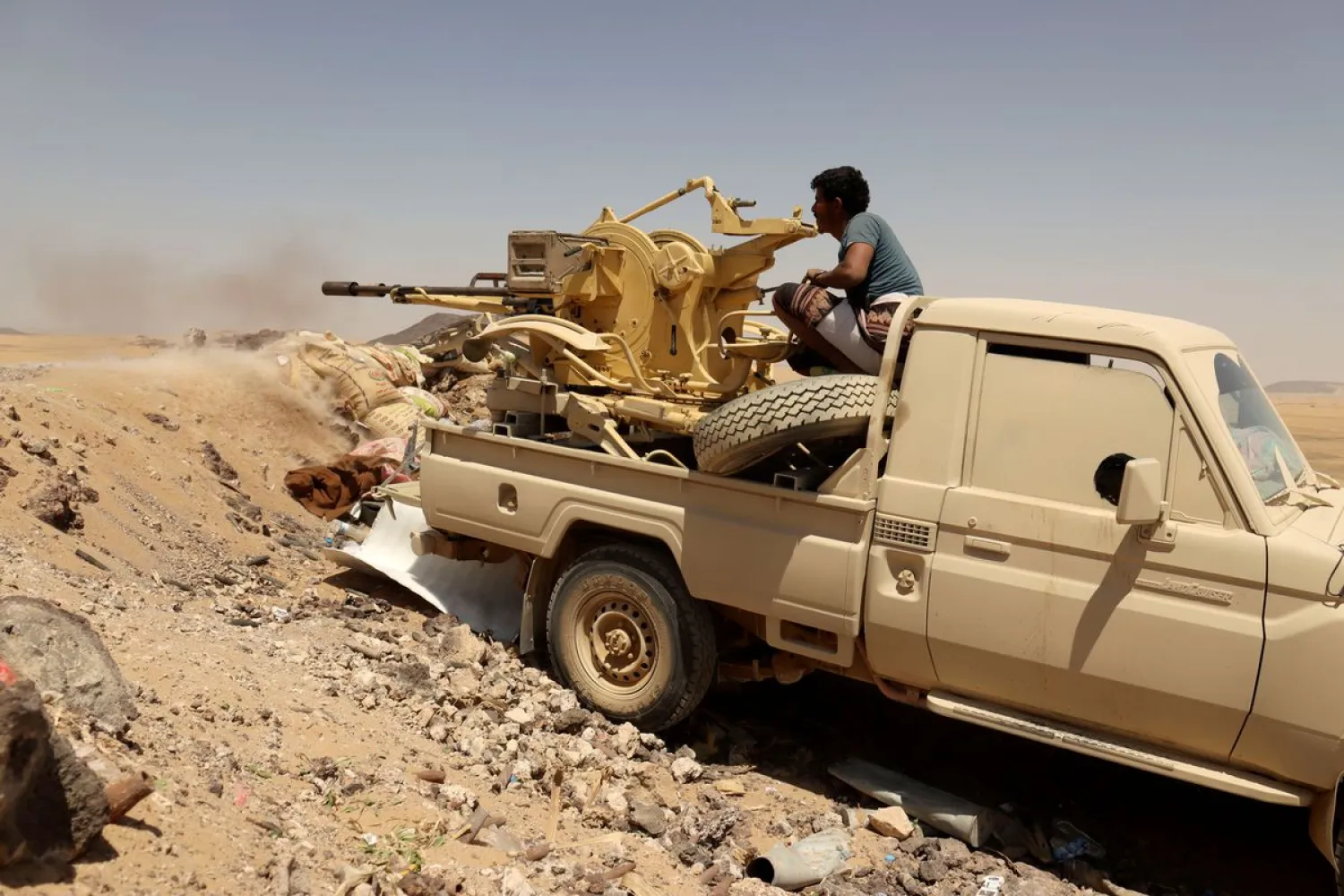
A Yemeni government fighter fires a vehicle-mounted weapon at a frontline position during fighting against Houthi militants in Marib, Yemen, March 28, 2021. Picture taken March 28, 2021. REUTERS/Ali Owidha/File Photo
TT

Houthis Incur Losses South of Marib, Yemeni Govt Accuses Insurgency of Leaning on Iran

A Yemeni government fighter fires a vehicle-mounted weapon at a frontline position during fighting against Houthi militants in Marib, Yemen, March 28, 2021. Picture taken March 28, 2021. REUTERS/Ali Owidha/File Photo

While continuing to mount attacks against Yemen’s northeastern governorate of Marib, Houthis reaffirmed allegiance to Tehran by sending a delegation to the Iranian capital to attend the swearing-in ceremony of the new President of Iran, Ebrahim Raeisi.

For the Yemeni internationally recognized government, a Houthi delegation participating at the Iranian event exposes how deeply aligned the insurgency group is with Tehran’s regional projects and ambitions.

Photos taken at the ceremony show Abdulsalam Fleitah, the de facto Houthi foreign minister, bowing down to salute the Iranian Revolutionary Guard Quds Force Commander Esmail Qaani.

Not only did the government decry Houthi behavior, but even insurgency loyalists criticized Fleitah for appearing next to Raeisi without the Yemeni flag in the background.

They also slammed the head of Houthi foreign affairs for sporting a luxurious watch to the event when millions of Yemenis are suffering back home.

Moammar Al-Eryani, Yemen’s minister for information, culture, and tourism, said that Iran hosting delegations from regional proxies and affiliated terrorist militias is an indicator that the cleric-led country will maintain hardline policies, especially at a time when it has stepped up its terror targeting of international navigation in Arab Gulf waters.

Eryani said that the ceremony also reflected the regional and international isolation Tehran suffers today.

“Instead of the new Iranian president sending positive messages on the sidelines of his inauguration ceremony… Tehran officially announces its sponsorship of terrorist militias, and its responsibility for crises and wars in the region, and terrorism that threatens the interests of the entire world,” said Eryani in an official statement.

As for battlefield developments, Yemeni army media reported that Arab Coalition fighter jets raided multiple Houthi positions in Marib’s southern Rahabah district, killing and injuring dozens of militiamen.

Other Arab Coalition airstrikes destroyed several pick-up vehicles carrying insurgency combatants across Rahabah.


Lebanon's Berri to Asharq Al-Awsat: We Are in Constant Contact with Aoun, Salam Despite Difference in Ideas

01 October 2020, Lebanon, Beirut: Speaker of the Lebanese parliament Nabih Berri speaks during a press conference in Beirut. (Lebanese Parliament/dpa)
TT

Lebanon's Berri to Asharq Al-Awsat: We Are in Constant Contact with Aoun, Salam Despite Difference in Ideas

01 October 2020, Lebanon, Beirut: Speaker of the Lebanese parliament Nabih Berri speaks during a press conference in Beirut. (Lebanese Parliament/dpa)

Lebanese parliament Speaker Nabih Berri stressed on Sunday that he was in “constant” contact with President Joseph Aoun and Prime Minister Nawaf Salam “despite differences in ideas.”

In remarks to Asharq Al-Awsat, he said: “I don't think we have a problem as long as we are united in demanding that Israel first withdraw from the South and then that the army be deployed there and that the people are allowed to return to their homes.”

The demands also include the release of detainees held by Israel and coming up with a plan, with Arab and international backing, to rebuild what Israel destroyed during the war, he added.

Berri made his remarks on the eve of the launch of the fifth round of US-sponsored Lebanese-Israeli military and political negotiations.

The speaker expressed his “satisfaction” with the efforts that have led to a ceasefire in the fighting between Israel and Hezbollah. Berri is a close ally to the Iran-backed group.

He hoped the ceasefire will last, saying that that hinges on Israel respecting it, which will in turn lead Hezbollah to respect it as well “because it is unjust to negotiate under fire.”

Berri revealed that Israel had requested the ceasefire through the “mechanism” committee that is responsible for overseeing the implementation of the 2024 truce between Israel and Hezbollah.

He noted that Israel came under American pressure to agree to a ceasefire following “two bloody days in the South that claimed dozens of civilian lives.”

He stressed that Hezbollah is “committed to the ceasefire,” accusing Israel of violating it.

“We hope that the ceasefire, with US pressure, will stand. We welcome any effort to pressure Israel to cease its hostile war against Lebanon,” he continued.

Moreover, the speaker expressed his rejection of “pilot zones” in the South, saying that reaching an agreement over their geographic borders could take years.

Israel and Lebanon agreed to move quickly towards establishing “pilot zones” in which the Lebanese Armed Forces would exercise exclusive control “to the exclusion of all non-state actors”.

Berri said that Lebanon “has not interest in wasting time that would allow Israel to continue its hostile activities. The solution lies in adopting a timetable for its withdrawal from the entire South in exchange for the deployment of the Lebanese army.”

“This remains the shortest path towards the South’s liberation from occupation instead of remaining bogged down by talks over the ‘pilot zones’,” he added.


Syria President Denies Wanting to Intervene in Lebanon After Trump Remarks

Syrian President Ahmed al-Sharaa. (AFP file)
TT

Syria President Denies Wanting to Intervene in Lebanon After Trump Remarks

Syrian President Ahmed al-Sharaa. (AFP file)

Syrian President Ahmed al-Sharaa denied on Sunday that his country sought to intervene militarily in Lebanon where Israel and Hezbollah are at war, after US President Donald Trump repeatedly suggested Damascus could get involved.

"We are looking for economic channels between Lebanon and Syria, not military ones," Sharaa said in an interview broadcast on television channel Al Mashhad.

On Sunday, Trump told Fox News he was "disappointed Israel can't put Hezbollah away", adding in reference to the fight against the militant group: "I'm close to giving it over to Syria."

Hezbollah drew Lebanon into the Middle East war on March 2 with rocket fire at Israel to avenge the killing of its backer Iran's supreme leader in US-Israeli strikes days earlier.

Israel responded with airstrikes and a ground invasion.

An Iran-US deal signed this week on ending the regional conflict includes Lebanon, where fighting has paused since Saturday evening.

At the G7 summit in France this week, Trump also said "if Israel can't do the job (against Hezbollah) without killing everyone else, then he (Sharaa) will do the job. Syria will do the job."

- Syria 'greatly concerned' -

Sharaa said in Sunday's interview that "we proposed with the United States that the war must stop," adding that "there must be various solutions, including economic, political and social, and the re-establishment of relations and the vital economic lifeline between Syria and Lebanon."

"And alongside this, some security measures that respond firstly to Syrian and Lebanese concerns, and also Israeli concerns," he added.

Hezbollah fought alongside longtime Syrian ruler Bashar al-Assad in his country's civil war, making Sharaa and the new authorities who toppled the former leader in 2024 deeply hostile to the group.

Syria had dominated its neighbor for decades following its military intervention in Lebanon's 1975-1990 civil war, withdrawing only in 2005, making any new military involvement a fraught proposition.

Syria offers "many tools for having a positive impact within Lebanon, but this also depends primarily on Lebanon's agreement", Sharaa said.

"Syria is greatly concerned with Lebanon's domestic situation because Lebanon's security and stability are part of Syria's security and stability," he added.

Responding to a question about whether he would sit at the table with Hezbollah, Sharaa said that "if this serves Lebanon's interests and safeguards Syria's interests, why not?"

Earlier this month, Trump also told US broadcaster NBC that "I'd like to see a more surgical attack on Hezbollah... And we can help them with that, or we can recommend Syria," he said, adding that Sharaa "would love to help".


Syria’s Foreign Ministry Appoints Jihad Makdissi as US Adviser

Jihad Makdissi. (File photo)
TT

Syria’s Foreign Ministry Appoints Jihad Makdissi as US Adviser

Jihad Makdissi. (File photo)

Syria's foreign ministry announced on Sunday it had appointed a former spokesman under now ousted ruler Bashar al-Assad as an adviser, returning him to the diplomatic corps years after he joined the opposition.

A ministry list of "new appointments" included Jihad Makdissi as "adviser for American affairs".

Makdissi, who lives in the United States, said on X that with "pride and gratitude, I return today to the ranks of the new Syrian diplomacy".

He was once one of the most recognizable faces of Assad's authorities during the early days of the country's civil war, which erupted in March 2011 and ended after the new authorities toppled the longtime leader in December 2024.

A native of Damascus, Makdissi took up the post of foreign ministry spokesman soon after the uprising erupted and became known for his active Twitter account.

The longtime Assad loyalist then disappeared from public view in December 2012, breaking his silence several months later by saying he had "left Syria because the polarization in the country has reached a deadly and destructive stage.

"I wish I could have stayed... but there is no longer room for moderation in this chaos," he had added.

In exile, he became a prominent figure in an opposition grouping known as the Cairo group, and participated in UN-sponsored talks in Geneva.

He presented himself as an independent and moderate voice, urging political transition through dialogue rather than militarization and foreign military intervention, before gradually distancing himself from the political scene.

After Assad's fall, he undertook several visits to Syria, meeting officials in the new administration.

His appointment comes as Syria's authorities are rebooting and rebuilding international relations after nearly 14 years of civil war and diplomatic isolation, with the United States having emerged as a prominent supporter.
