

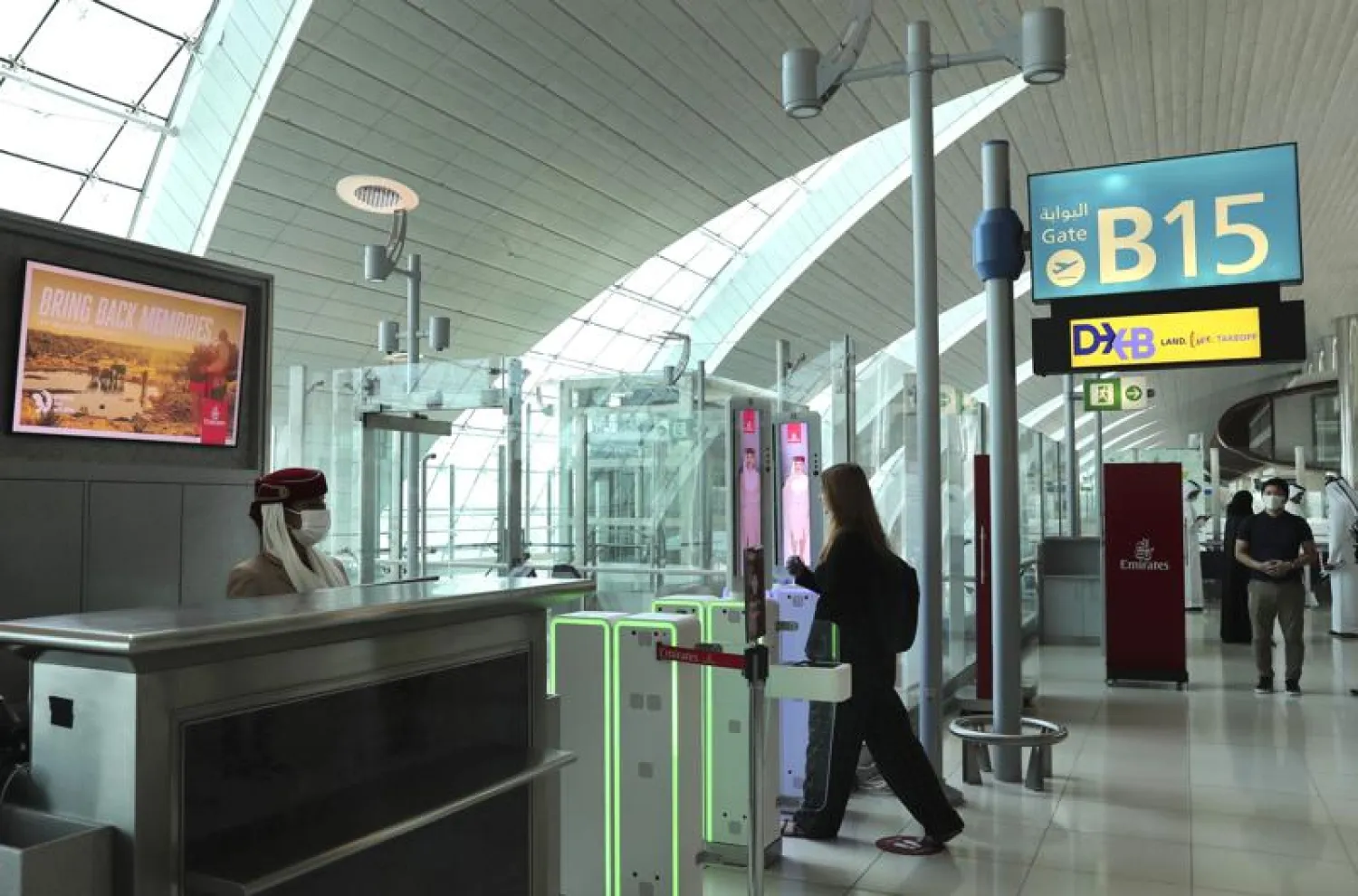

Dubai's Busy Airport Sees Passenger Traffic Drop 40% in 2021

FILE - In this March 7, 2021 file photo, a woman enters the face and iris-recognition gate to board a plane, during a media tour at Dubai Airport, in the United Arab Emirates. (AP Photo/Kamran Jebreili, File)
TT

Dubai's Busy Airport Sees Passenger Traffic Drop 40% in 2021

FILE - In this March 7, 2021 file photo, a woman enters the face and iris-recognition gate to board a plane, during a media tour at Dubai Airport, in the United Arab Emirates. (AP Photo/Kamran Jebreili, File)

Dubai International Airport, the world's busiest airport for international travel, handled some 40% less passenger traffic in the first half of 2021, compared to the same period last year, its chief executive said Wednesday.

The decline came as more contagious coronavirus variants cut off the hub's biggest source markets and continued to clobber the global aviation industry.

However, CEO Paul Griffiths remains optimistic for the crucial east-west transit point as authorities gradually re-open Dubai's key routes to the Indian subcontinent and Britain, reported The Associated Press.

The 10.6 million passengers that passed through the airport over the past six months “is still very positive," Griffiths told The Associated Press. “I think coupled with the restrictions easing that we’re now seeing, (it) will bode very well for a satisfactory end to the year.”

The airport, which saw 86.4 million people squeeze through before the pandemic hit in 2019, has held the title of the world’s busiest since it beat out London's Heathrow seven years ago. It even kept the crown as the virus turned the world’s biggest airports into massive voids. But the once-teeming terminals still have a long way to go before seeing pre-pandemic passenger levels.

The hopes stoked by the United Arab Emirates' speedy vaccination campaign took a hit as the delta variant emerged, prompting familiar border closures and capacity cuts, and hurting the mammoth airport, hub of long-haul carrier Emirates. Dubai World Central, the Gulf city’s second airport that went out of use for commercial flights during the pandemic, appears to be a parking lot for Emirates’ iconic fleet of double-decker Airbus A380s.

Although the UAE recently lifted an entry ban on India, Pakistan, Nepal and Sri Lanka, which are home to most of the vast foreign workforce in the federation, stringent vaccination requirements still bar many from boarding flights to the country.

“All of those South Asian markets are incredibly important to Dubai, they’re a very important transit opportunity, of course, as people go to all parts of northern Europe," said Griffiths. “It’s very important we get those traffic flows back.”
There are reasons to expect a rebound, Griffiths added. One of the airport's two main terminals, mothballed amid the pandemic, returned to use last month to prepare for an influx of holiday-makers escaping wintry weather and attending the World Expo in October.

And after months of frustration and confusion, the UK last week removed the UAE from its “red list” that ordered all travelers to quarantine for 10 days in costly, government-approved hotels. The upgrade to “amber” elicited a strong sigh of relief throughout the federation of seven sheikhdoms, home to some 120,000 British expats. London was ranked as the top destination city for Dubai’s airport in 2020, with 1.15 million customers.

Griffiths declined to put a number on the financial hit, but said the “loss of traffic (to the UK) has had a very, very significant impact on the economy of both countries.”
So thrilled was Emirates about the flight resumption that the airline plopped a woman on the pinnacle of the tallest tower on the planet, Burj Khalifa, and filmed her raising placards that implored Brits to fly Emirates.

The stakes are indeed high for Dubai, where the economy thrives not on oil, like in other Gulf Arab sheikhdoms, but on travel and tourism. Emirates remains the linchpin of the wider empire known as “Dubai Inc.,” an interlocking series of businesses owned by the city-state.

There are signs of looming uncertainty, with the airport yet to hire back any of the 5,000 employees it furloughed during the devastation of the pandemic last year. But when asked whether Dubai Airport would hold onto its title — one of many prized superlatives in the extravagant emirate home to the world's tallest building and biggest mall — Griffiths didn’t miss a beat.

“I have no doubt in my mind,” he said. “We’re gearing up to expect a huge surge in volume."


Microsoft Arabia: Saudi Arabia Accelerates AI Adoption, Turns It Into Competitive Edge

A Microsoft logo is seen a day after Microsoft Corp's $26.2 billion purchase of LinkedIn Corp, in Los Angeles, California, US, June 14, 2016. REUTERS/Lucy Nicholson
TT

Microsoft Arabia: Saudi Arabia Accelerates AI Adoption, Turns It Into Competitive Edge

A Microsoft logo is seen a day after Microsoft Corp's $26.2 billion purchase of LinkedIn Corp, in Los Angeles, California, US, June 14, 2016. REUTERS/Lucy Nicholson

Saudi Arabia has cemented its global standing in artificial intelligence after pouring significant investments into the sector in 2025, accelerating digital transformation and expanding real-world applications across government and the wider economy.

From education and manufacturing to energy and public services, AI is being deployed to advance the diversification goals of Saudi Vision 2030.

Turki Badhris, president of Microsoft Arabia, said the kingdom is experiencing unprecedented momentum in adopting AI as a strategic lever to raise competitiveness and improve performance across vital sectors.

Artificial intelligence has become central to the national transformation journey, he told Asharq Al-Awsat.

Linking transformation

Saudi Arabia’s overhaul spans digital government modernization, the construction of megacities and large-scale projects, industrial development, and the creation of new economic sectors, Badhris said.

AI, he added, is the connective tissue binding these efforts together by enabling smarter infrastructure and more efficient public services.

In 2025, Microsoft expanded cooperation with government and regulatory bodies, as well as major companies, to accelerate the adoption of AI and cloud computing across education, industry, financial services, and government operations.

Turning point year

Badhris described 2025 as a watershed for AI in the kingdom, marked by a shift to broad, sector-wide deployment.

In digital government, training programs implemented with the Digital Government Authority aim to equip more than 100,000 public sector employees with cloud and AI skills, enhancing service delivery and user experience.

In education, AI literacy initiatives have been scaled up in partnership with the Ministry of Education and the Ministry of Communications and Information Technology, alongside the rollout of generative AI tools and digital learning technologies in schools.

Manufacturers have adopted AI-driven predictive maintenance and real-time operational data analysis, cutting downtime and improving efficiency and reliability.

In energy and sustainability, AI solutions are being used to optimize water and energy asset management, including predictive maintenance and intelligent process control, delivering operational savings while supporting emissions reduction and sustainability targets.

Sovereign cloud push

Badhris said the launch of Microsoft’s cloud region in Saudi Arabia, planned for 2026, will mark a qualitative leap by allowing government entities and regulated sectors to run critical workloads in a secure local environment, ensuring data sovereignty and enabling low-latency innovation.

He added that regulatory frameworks developed by relevant authorities have bolstered trust in AI adoption by balancing individual protection with incentives for innovation.

From tools to partners

Looking ahead, Badhris said 2026 will see AI evolve from support tools into “work partners” capable of collaboration and initiative in complex tasks.

The shift will be felt across government services, industry, megaprojects such as Qiddiya and The Red Sea Project, and healthcare.

Advanced AI systems, he said, will sharpen operational efficiency, lift productivity, and enhance service quality, while moving from reactive oversight to proactive governance frameworks that ensure safe and responsible use.

Saudi Arabia, Badhris said, is not simply adopting AI but helping shape its future, investing in sovereign infrastructure, building national capabilities, and embedding responsible-use principles to drive sustainable economic growth and entrench its position as a global technology power.


Lockheed Martin: Saudi Arabia Is Strategic Choice for Global Defense Hub

Lockheed Martin took part in the recent World Defense Show in Riyadh. (Asharq Al-Awsat)
TT

Lockheed Martin: Saudi Arabia Is Strategic Choice for Global Defense Hub

Lockheed Martin took part in the recent World Defense Show in Riyadh. (Asharq Al-Awsat)

Saudi Arabia’s push to localize half of its defense spending under Vision 2030 is drawing deeper commitments from US defense giant Lockheed Martin, which says it will expand local manufacturing, transfer advanced technologies, and further integrate the Kingdom into its global aerospace and defense supply chains.

Building Saudi partnerships

Steve Sheehy, vice president for international business development at Lockheed Martin’s aeronautics division, said the company is stepping up efforts to partner with both established and emerging Saudi aerospace firms.

Lockheed Martin is looking to build partnerships across maintenance, repair and overhaul, as well as component manufacturing and repair, particularly in advanced avionics, Sheehy told Asharq Al-Awsat.

Speaking after the company’s participation in the World Defense Show in Riyadh, he said Lockheed Martin is also targeting emerging fields such as additive manufacturing, from plastics to metals, and advanced composite materials.

The goal, he said, is twofold: plug gaps in the company’s global supply chain while transferring know-how and strengthening local capabilities in a mutually beneficial model.

Sheehy described the Saudi aerospace sector as established and growing. He also noted that it has a solid base in maintenance and manufacturing, as well as a clear shift toward advanced technologies, creating room for deeper collaboration between national firms and global industry leaders.

Alignment with Vision 2030

Retired Brigadier General Joseph Rank, chief executive of Lockheed Martin in Saudi Arabia and Africa, said the company’s strategy in the Kingdom is rooted in a long-term partnership aligned with Vision 2030, especially the target of localizing 50 percent of defense spending.

Lockheed Martin, he said, is focused on transferring knowledge and advanced technologies, developing local industrial capabilities and building an integrated defense ecosystem that positions Saudi Arabia firmly within global supply chains.

Rank said the company is working closely with government entities and national companies to strengthen local manufacturing, empower Saudi talent and establish a sustainable industrial base that supports innovation and creates high-quality jobs.

Lockheed Martin is advancing manufacturing and repair work on defense equipment, including components of the THAAD air defense system, missile launch platforms, and interceptor missile canisters, in cooperation with Saudi partners, Rank said.

The company has also opened a maintenance center in Riyadh for the Sniper Advanced Targeting Pod system, the first of its kind in the Middle East, to enhance maintenance and technical support capabilities.

Beyond hardware, Lockheed Martin is investing in transferring and localizing advanced technologies in air defense, command and control, and digital manufacturing. It is also supporting science, technology, engineering and mathematics programs and hands-on training in cooperation with national universities.

Broad local network

Rank said the company relies on a wide network of partners in the Kingdom. At the forefront are the General Authority for Military Industries, the main government partner in localization agreements, and Saudi Arabian Military Industries, a key manufacturing and technology transfer partner.

Other collaborators include the Advanced Electronics Company for advanced systems maintenance, the Middle East Propulsion Company and AIC Steel for producing THAAD components and platforms, and the National Company for Mechanical Systems for advanced manufacturing technologies.

Academic partnerships extend to King Abdullah University of Science and Technology, King Saud University, King Fahd University of Petroleum and Minerals, and Princess Nourah bint Abdulrahman University, supporting research and developing national talent.

Localizing aerospace manufacturing

Rank said localizing aerospace manufacturing is a strategic priority. Lockheed Martin has launched projects to produce interceptor missile launch platforms and canisters inside the Kingdom and awarded contracts for key components to Saudi companies, qualifying them to join its global supply network beyond the US.

The company is evaluating and qualifying hundreds of Saudi firms to produce defense equipment to international standards, focusing on technology transfer and building local expertise as a step toward manufacturing more integrated systems in the future.

Company officials said the approach goes beyond supplying systems. It centers on technology transfer, digital manufacturing, and command-and-control systems, laying the groundwork for the production of integrated systems in the Kingdom and strengthening Saudi Arabia’s position as a regional hub for aerospace and defense.


Türkiye TPAO, Shell Sign Deal to Carry out Exploration Work offshore Bulgaria

A Shell logo is seen at a gas station in Buenos Aires, Argentina, March 12, 2018. (Reuters)
TT

Türkiye TPAO, Shell Sign Deal to Carry out Exploration Work offshore Bulgaria

A Shell logo is seen at a gas station in Buenos Aires, Argentina, March 12, 2018. (Reuters)

Türkiye Petrolleri (TPAO) has signed a partnership agreement with Shell to carry out exploration work in Bulgaria's maritime zone, the Turkish energy ministry and British oil major said on Wednesday.

European Union member Bulgaria, which had been totally dependent on Russian gas until 2022, has been seeking to diversify its gas supplies and find cheaper sources, Reuters reported.

TPAO and Shell will jointly explore the Khan Tervel block, located near Türkiye's Sakarya gas field, and will hold a five-year licence in Bulgaria's exclusive economic zone, Minister Alparslan Bayraktar said.

Shell will continue as operator of the block, while TPAO will take a 33% interest in the licence, a Shell spokesperson said.

Since the start of this year, TPAO has signed energy cooperation agreements with ExxonMobil, Chevron and BP for possible exploration work in the Black Sea and the Mediterranean.

In April, Shell signed a contract with Bulgaria's government to allow the oil major to explore 4,000 square metres in the block.
