

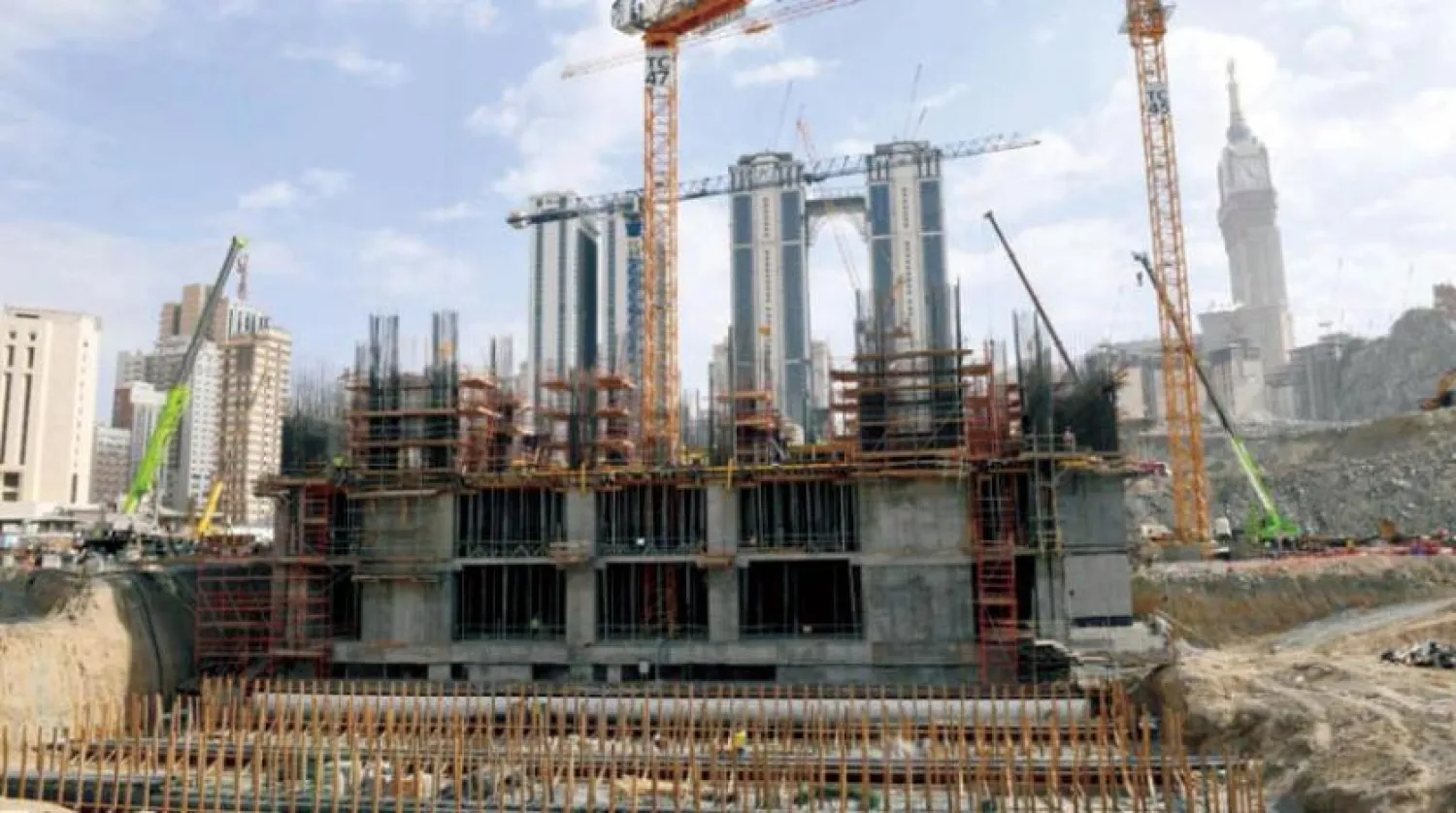

Saudi Arabia Develops Contracting Sector by Adopting Gov’t Classification System

Saudi Arabia supports the reform of the contracting sector by adopting the government classification (Asharq Al-Awsat)
TT

Saudi Arabia Develops Contracting Sector by Adopting Gov’t Classification System

Saudi Arabia supports the reform of the contracting sector by adopting the government classification (Asharq Al-Awsat)

With Saudi Arabia’s Shura Council having greenlit the contractor classification system, experts confirm to Asharq Al-Awsat that the new scheme will compel contractors to raise the degree of classification in the targeted sectors systematically.

According to specialists, this reduces the number of stumbling projects and aligns with the Kingdom’s aspirations.

The Minister of Municipal, Rural Affairs, and Housing Majed Al-Hogail said that the system is based on a balanced assessment that combines quantitative and qualitative criteria.

It enhances competition between contractors and gives new players with distinguished competencies more significant opportunities, added Al-Hogail.

Earlier, the Ministry of Municipal, Rural Affairs, and Housing had launched a point system for contractors to increase healthy competition and sustainability in the Kingdom’s construction sector.

The ministry also filled in the private sector on the point system linked to an e-platform.

As for the Shura Council approving the contractor classification system, the Chairman of Riyadh Contracting Committee Fahad Nasban said that the move reflects a great leap for boosting private sector quality production and performance.

Nasban pointed out that the new system will help raise the level of localization, employee wages, and the level of experience enjoyed by technicians, engineers, project managers, and marketers.

It will also enhance the quality of implemented projects, added Nasban.

The new system will also force contractors to adhere to specific conditions and fulfill several requirements before taking on quality implementation of projects, real estate expert Ibrahim al-Sahn told Asharq Al-Awsat.

High-quality implementation of projects, according to al-Sahn, is vital for realizing the national transformation plan, dubbed Vision 2030.

Al-Sahn maintained that government agencies carefully select contractors to implement their projects and pay attention to high-quality standards in cooperation with competent public authorities.



Standard Chartered CEO Seeks to Reassure Staff over AI-linked Job Cuts

FILED - 11 January 2012, China, Hong Kong: FILE PHOTO - A general view of the facade of Standard Chartered Bank branch in Hong Kong. Photo: Jens Kalaene/dpa-Zentralbild/dpa
TT

Standard Chartered CEO Seeks to Reassure Staff over AI-linked Job Cuts

FILED - 11 January 2012, China, Hong Kong: FILE PHOTO - A general view of the facade of Standard Chartered Bank branch in Hong Kong. Photo: Jens Kalaene/dpa-Zentralbild/dpa

Standard Chartered CEO Bill Winters sought to assuage staff concerns on Wednesday, a day after saying that the bank will cut thousands of jobs over the next four years as it moves to replace "lower-value human capital" with technology.

"Many of you will have seen media coverage following the Investor Event in Hong Kong, particularly the reporting around automation, AI, and workforce changes," Winters said in a memo to the bank's ⁠staff reviewed by ⁠Reuters.

"I know this may be unsettling when reduced to simple headlines or a quote out of context," he said.

A spokesperson for the bank confirmed the memo's content.

StanChart said on Tuesday it would cut 15% of ⁠its corporate function roles by 2030, which, according to a Reuters calculation, would result in nearly 8,000 redundancies out of its more than 52,000 staff in such roles.

The bank cited AI as a driver to slim its operations in its quest to increase profitability and tackle competition.

"It's not cost-cutting. It's replacing in some cases lower-value human capital with the financial capital ⁠and ⁠the investment capital we're putting in," Winters said on Tuesday.

In his memo to staff on Wednesday, Winters said the bank had been open that its workforce will evolve.

"Some roles will reduce in number, some will change, and new opportunities will emerge. We will continue to prioritize investment in reskilling and redeployment wherever we can," he said.

"Where changes do happen, we will handle them with thought and care," he added.


Ukraine Ally Britain Eases Sanctions on Russian Oil as Fuel Prices Surge Over Iran Conflict

A seized suspected Russian oil taker by the French navy is photographed in the Mediterranean Sea in Fos-sur-Mer, southern France, on Jan. 26, 2026. (AP)
TT

Ukraine Ally Britain Eases Sanctions on Russian Oil as Fuel Prices Surge Over Iran Conflict

A seized suspected Russian oil taker by the French navy is photographed in the Mediterranean Sea in Fos-sur-Mer, southern France, on Jan. 26, 2026. (AP)

The UK government has quietly watered down sanctions on Russian oil in an effort to shelter Britons from the cost-of-living squeeze triggered by the closure of the Strait of Hormuz.

A trade license that came into effect Wednesday permits the import of Russian oil that has been refined into jet fuel and diesel in third countries, such as India and Türkiye.

The US-Israeli war on Iran and Iran's closure of the strait, through which about a fifth of the world's oil usually passes, has sent fuel prices soaring around the world and sparked concerns about a shortage of jet fuel.

UK Treasury minister Dan Tomlinson said the changes are “for a time limited period and on a very specific issue.”

Britain has been one of Ukraine's strongest allies since Russia's full-scale invasion in 2022, and the government insist its sanctions against Russia remain among the toughest in the world.

But lawmaker Emily Thornberry, who chairs Parliament’s Foreign Affairs Committee, said Ukrainians would “feel very let down” by the move. She said Ukraine’s allies should keep squeezing Russia’s oil industry, because it “is absolutely crippling their economy.”

The US has also eased Russian sanctions. Earlier this week, Treasury Secretary Scott Bessent extended a 30-day sanctions waiver allowing the purchase of Russian oil shipments already at sea.

On Tuesday, finance ministers from the US, Britain and the other Group of Seven wealthy nations issued a joint statement reaffirming “our unwavering commitment to continue to impose severe costs on Russia in response to its continued aggression against Ukraine.”


QatarEnergy Buys Stakes in Uruguay Offshore Blocks from Shell Subsidiary

3D-printed oil pump jacks and the QatarEnergy logo appear in this illustration taken March 2, 2026. REUTERS/Dado Ruvic/Illustration
TT

QatarEnergy Buys Stakes in Uruguay Offshore Blocks from Shell Subsidiary

3D-printed oil pump jacks and the QatarEnergy logo appear in this illustration taken March 2, 2026. REUTERS/Dado Ruvic/Illustration

QatarEnergy has acquired interests in three offshore exploration blocks in Uruguay from a subsidiary of Shell, marking its first entry into the South American country's upstream energy sector, the state-owned company said on Wednesday without disclosing financial details.

The Qatari energy giant's South American exploration expansion also strengthens its strategic alliance with Shell, one of its key partners in energy projects within Qatar and elsewhere.

The company, the world's largest single LNG producer before the US-Israeli war on ⁠Iran forced production ⁠halts and resulted in damage to some facilities, has been building up an upstream portfolio over several years, including interests in Brazil, Cyprus, Egypt and elsewhere.

Under the agreements, QatarEnergy took 30% stakes in block OFF-2 and block OFF-7, where Shell ⁠is the operator and holds 70% and 40% respectively. QatarEnergy also acquired an 18% interest in block OFF-4.

APA Corporation operates block OFF-4, in which it holds a 50% stake and Shell holds 32%. In block OFF-7, Chevron holds the remaining 30% interest, QatarEnergy said.

"We are pleased to strengthen our relations with our strategic partner Shell through these agreements, which mark our first entry into Uruguay’s ⁠upstream sector," ⁠Reuters quoted QatarEnergy CEO Saad Sherida Al-Kaabi as saying in the statement.

The three blocks are located off Uruguay’s Atlantic coast in water depths ranging from 40 to 4,000 meters. They cover areas of between 11,155 and 18,227 sq km, the company said.

No commercial oil and gas discoveries have yet been struck in Uruguay, but companies hope to replicate the massive recent discoveries made in Namibia, on the direct opposite side of the Atlantic, because of their shared geological history.