Egyptian President Abdel Fattah El-Sisi warned Ethiopia on Sunday against wasting time on negotiations related to the Grand Ethiopian Renaissance Dam (GERD), stressing that his country seeks to reach a balanced agreement on the rules for filling and operating the dam.
Speaking at the opening of the 4th Session of the Cairo Water Week, he said, “I would like to reiterate that we seek to reach, in the shortest time possible and without procrastination, a balanced and legally-binding agreement in this regard, in line with the Presidential Statement (issued on the GERD) by the Security Council in September 2021.”
Last month, the Council urged Egypt, Ethiopia, and Sudan to resume African Union-led talks to reach a binding deal "within a reasonable timeframe" over the operation of the giant hydropower dam on the Blue Nile.
Egypt and Sudan have been negotiating with Ethiopia for almost 10 years to conclude a legal agreement.
In his speech Sunday, the Egyptian President sought to comfort Ethiopia that such agreement would help achieve Addis Ababa's development goals, which Cairo understands and even supports, and at the same time limit the water, environmental, social and economic harm of this dam on Egypt and Sudan, based on respecting the rules of international law and in a manner that strengthens cooperation and coordination.
Sisi said Egypt has already developed the strategic plan for the management of water resources until the year 2037 at an estimated preliminary cost of $50 billion.
According to Sisi, the Egyptian plan is based on four main pillars: improving the quality of water, developing new water resources, rationalizing the use of the available water resources and enhancing the capacity of the Egyptian irrigation system.
“Egypt is one of the driest countries in the world, receiving the least average rainfall among all countries. This makes Egypt rely almost exclusively on the Nile River, which originates outside its borders,” Sisi revealed.
The Egyptian President urged countries sharing international rivers to uphold the principles of integration and participation, activate the rules of justice and fairness and not to harm the interests of their neighbors.
A poster expresses gratitude to Iran for its support to Lebanon. (Asharq Al-Awsat)
The expanded war in Lebanon, which erupted with widespread Israeli bombardment on September 23, 2024, and led to intense clashes and battlefield shifts, has forced a new reality on Hezbollah.
The Iran-backed group's military capabilities, supply lines, and political influence have significantly declined following severe losses within its senior leadership ranks. Furthermore, Hezbollah's deployment on the ground and operations have fundamentally changed compared to its pre-war positioning.
Two years later, the group is navigating a far more complex military landscape. While the loss of a vast portion of its leadership, declining drone and missile capabilities, and shrinking supply lines through Syria have severely weakened its position, the party still retains enough military capacity to continue operating.
It is actively attempting to reorganize its ranks and adapt to an altered battlefield reality - one that stretches from north of the Litani River into broader territory across southern Lebanon and the Western Bekaa.
Speaking to Asharq Al-Awsat, security and defense expert Riad Kahwaji estimated that Hezbollah's capabilities have significantly declined between 2024 and today across its leadership, military structure, political influence, and supply lines, evaluating the scale of this drop to have "exceeded nearly half."
He explained that the group has lost the vast majority of its first- and second-tier leaders, while most of the leaders present today were classified within the third tier in 2024.
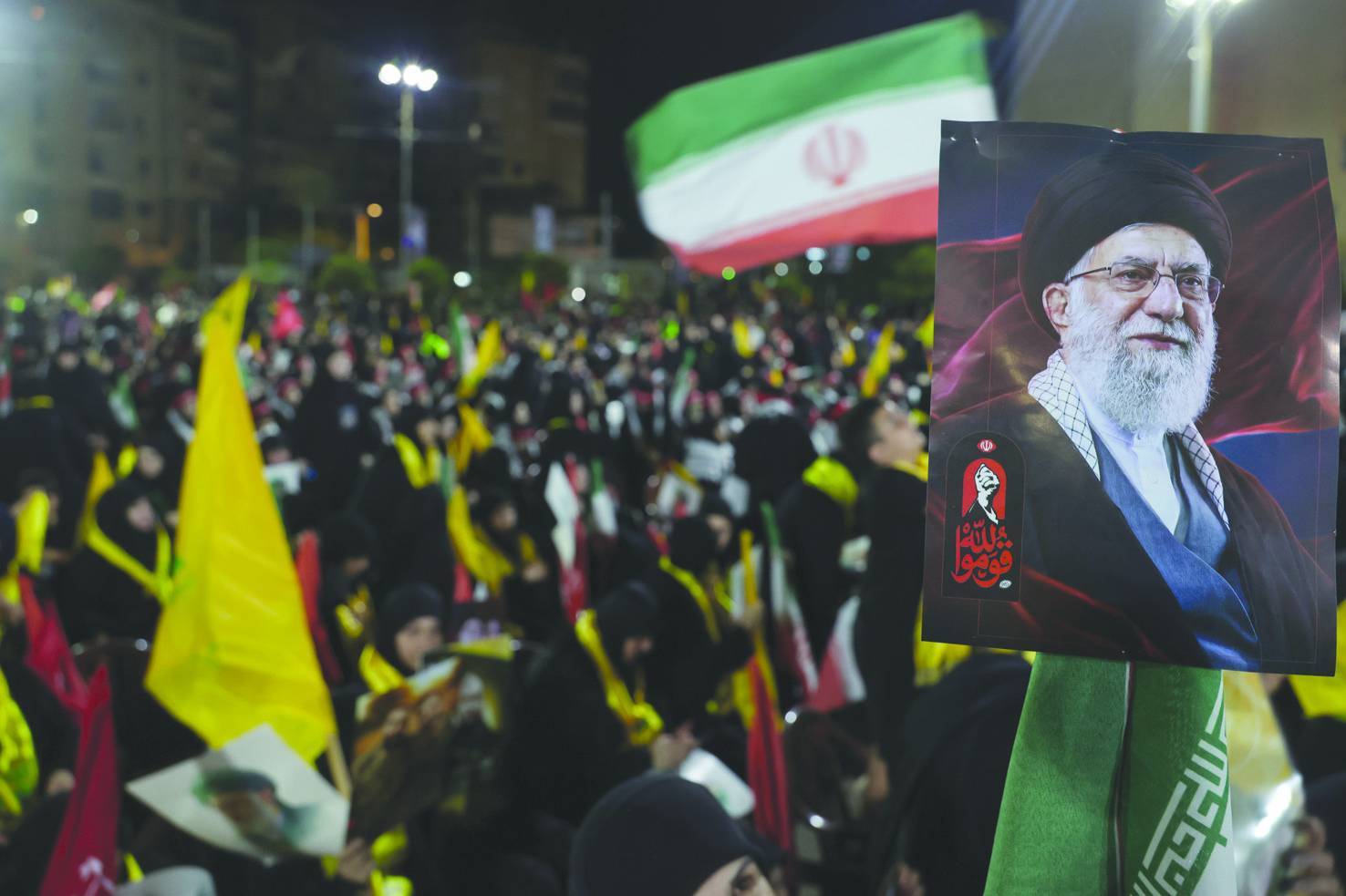
Hezbollah supporters carry posters of slain Iranian supreme leader Ali Khamenei during a rally coinciding with his funeral in Iran in Beirut's southern suburbs. (EPA file)
The nature of management within the group has also changed, as "management in 2024 was local under Iranian guidance, whereas today management and guidance have become directly Iranian," he added.
On the military level, Kahwaji said that "the party's forces have become stationed north of the Litani, after having previously been present directly on the border."
"Nabatieh has practically become the separation line of contact between the group's presence and the Israeli forces," he noted.
Regarding the military arsenal, he said that "missile and drone capabilities still exist, but they have become less than half of what they were before."
He added that Hezbollah's political influence within Lebanon has significantly weakened from its previous levels, noting that one of the most prominent shifts affecting the group is the severe disruption of its supply lines through Syria, which have now been largely cut off.
Since the November 2024 ceasefire up to the current stage, retired Brigadier General Dr. Khalil Helou told Asharq Al-Awsat that the party’s "capabilities have dropped compared to what they were before the war, but it has not lost its military capacity and still possesses capabilities that allow it to continue."
Its limited responses to Israel during the current stage may be a sign that it has entered a new "phase of reorganization and rebuilding of combat readiness," he added.
Helou explained that the period following the November 2024 ceasefire was marked by ongoing Israeli assassinations targeting Hezbollah operatives, while the group largely refrained from retaliating.
This pattern underscores a significant drop in Hezbollah's capabilities compared to its pre-2024 strength, while simultaneously indicating that the group has been undergoing a phase of reorganization, rearmament, and rebuilding of its combat readiness, he noted.
Helou stressed that the strategic landscape shifted following the outbreak of the US war on Iran at the end of February, which Hezbollah joined in early March.
"From that point until the second ceasefire on June 17, the party engaged in the fighting, launching effective retaliatory operations in certain areas and firing missiles into both the Israeli interior and Israeli-occupied territories," Helou said.
He remarked that during that phase, Israel "advanced, made incursions, and established its presence on the ground," while Hezbollah continued to carry out military responses, though the situation following the latest ceasefire has returned to a pattern similar to the period that followed November 2024.
"Today, we have virtually returned to the previous phase, as Hezbollah's responses to Israeli attacks have become almost nonexistent," he stated. "If we review operations over the past two and a half months since the ceasefire, the military operations carried out by the group against Israel are highly limited and can be counted on two hands. This stands in sharp contrast to dozens of daily Israeli operations, including airstrikes, shelling, and assassinations."
Trump, Yemen’s Alimi Discuss Bab al-Mandeb Developmentshttps://english.aawsat.com/arab-world/5321027-trump-yemen%E2%80%99s-alimi-discuss-bab-al-mandeb-developments
A Yemeni government soldier during the battles against the Houthis. (Military media)
TT
TT
Trump, Yemen’s Alimi Discuss Bab al-Mandeb Developments
A Yemeni government soldier during the battles against the Houthis. (Military media)
US President Donald Trump discussed the accelerating military developments in Yemen during a telephone call on Sunday with the Chairman of the Yemeni Presidential Leadership Council Dr. Rashad al-Alimi.
The talks focused on the advance of Iran-backed Houthis near the Bab al-Mandeb Strait, according to news agencies citing identical sources.
On the ground, battles are escalating in the highlands between western Taiz and northern Lahj.
Government and southern forces thwarted a Houthi advance towards al-Shamayatayn. They said they repelled repeated attacks, recaptured mountainous positions, and inflicted casualties among the Houthis.
Dozens of Houthis were killed in the past 24 hours, said field sources.
The government's Giants Brigades announced the destruction of five Houthi vehicles in the Kahbub mountains near Bab al-Mandeb, including a vehicle carrying a militant commander and another carrying an anti-aircraft weapon. All others on board were killed.
The government's National Shield Forces also announced the downing of two drones during the fighting.
In western Taiz, the fighting centered around Sharira, Mount Al-Mirzam, and Jardad, with Houthi infiltration attempts and attacks being thwarted.
In Marib, clashes and artillery shelling continue in Harib, Malaa, and Umm Reesh, with no change in the lines of control.
Government forces announced strikes on Houthi gatherings, fortifications, and artillery positions, as well as airstrikes and drone attacks in Marib and Al-Bayda.
Gaza Health Officials Say Israeli Fire Kills Three, Including Childhttps://english.aawsat.com/arab-world/5321022-gaza-health-officials-say-israeli-fire-kills-three-including-child
Displaced Palestinians walk through a tent camp inside a school-turned-shelter in Khan Younis, in the southern Gaza Strip, September 10, 2026. (Reuters)
TT
TT
Gaza Health Officials Say Israeli Fire Kills Three, Including Child
Displaced Palestinians walk through a tent camp inside a school-turned-shelter in Khan Younis, in the southern Gaza Strip, September 10, 2026. (Reuters)
Gaza health officials said Israeli fire killed three people, including a woman and a child, and injured several others across the Palestinian territory on Monday.
Officials at Nasser hospital in the southern city of Khan Younis said the body of a child, Ismail Al-Bardawil, was brought to the medical facility after Israeli tanks opened fire on tents for displaced people in the Al-Mawasi area.
Mahmoud Bassal, the spokesman for Gaza's civil defense agency, which operates as a rescue force under Hamas authority, said the child was 11 years old.
In the central Gaza Strip, Al-Awda hospital officials said 31-year-old Fidaa Toutah died from her wounds after being shot by Israeli forces on Salah al-Din street east of Nuseirat refugee camp.
Officials at Al-Shifa hospital in Gaza City said a man, Mohsen Ahmed Bahjat, died after being shot in the head by a drone in Jabalia in the northern Gaza Strip.
Gaza's civil defense agency confirmed the identities of the dead to AFP.
It said its teams had transported nine wounded people to hospitals following Israeli fire in Khan Younis in the south and Bureij refugee camp in the center of the territory.
When contacted by AFP, the Israeli military said it was checking the reports.
Israel in October last year agreed to a ceasefire brokered by the United States but since then has advanced further into Gaza.
Israeli Prime Minister Benjamin Netanyahu has vowed no let-up in strikes targeting Hamas, which led the unprecedented October 7, 2023 attack against Israel.
The 2023 attack killed 1,221 people, according to an AFP tally based on official Israeli figures.
The massive Israeli offensive in response has left most of Gaza in ruins and killed more than 73,900 people, according to Gaza's health ministry, which is under Hamas authority and whose figures are considered reliable by the United Nations.
Israeli strikes have killed more than 1,300 people since the ceasefire was announced last year, according to the Gaza health ministry.
The Israeli army has identified five deaths in its ranks over the same period, as well as the death of one civilian contractor.
لم تشترك بعد
انشئ حساباً خاصاً بك لتحصل على أخبار مخصصة لك ولتتمتع بخاصية حفظ المقالات وتتلقى نشراتنا البريدية المتنوعة