


US Officials Demand Comprehensive Strategy to Confront Syria’s Illicit Drug Trade

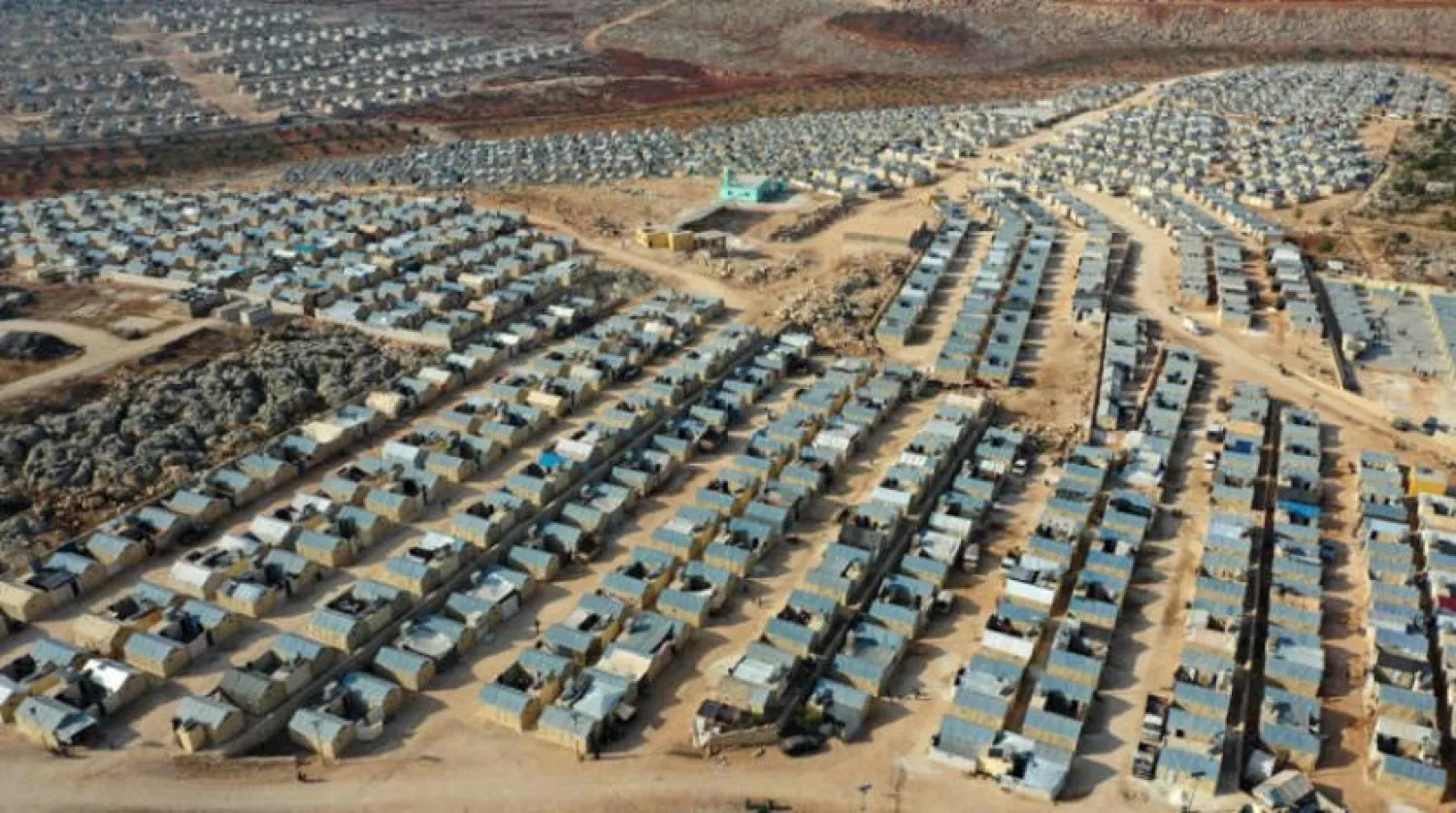
An aerial view shows shelters at the newly-established Watan camp for internally displaced people in the village of Kafr Jales in Syria's northwestern Idlib province, on November 17, 2021. (Photo by Omar HAJ KADOUR / AFP)
TT

US Officials Demand Comprehensive Strategy to Confront Syria’s Illicit Drug Trade

An aerial view shows shelters at the newly-established Watan camp for internally displaced people in the village of Kafr Jales in Syria's northwestern Idlib province, on November 17, 2021. (Photo by Omar HAJ KADOUR / AFP)

Over the course of the Syrian civil war, the Syrian regime had transformed into one of the leading “narcotics institutions” worldwide.

Its production chains and smuggling networks dealt with everything from Hashish to the most profitable drug, Captagon. With narcotics becoming one of the regime’s main exports, many countries were harmed, leaving a harsh reality before US government and legislative institutions which are fighting off this harmful trade.

Captagon, produced in Syria, is a mild stimulant pill that is taken for “recreational purposes” throughout the Middle East.

According to a report issued by the Center for Operational Analysis and Research (COAR), Captagon pills reached a market value of no less than 3.5 billion dollars during 2020.

This figure is five times the value of Syria’s legitimate exports.

Legislators in the US have called for the need to fight Syria’s harmful trade and stand against it within the policy of sanctions against the Syrian regime.

Although the Caesar Syria Civilian Protection Act did not include punishing or disrupting Syrian drug networks, the new 2022 National Authorization Act (NDAA) received some amendments that work towards the goal of curbing Syria’s drug trade.

The 2022 NDAA amendment, proposed by Congressman French Hill (R-AR-2), demands that the US administration develops a strategy among government agencies to disrupt and dismantle the drug trade and smuggling networks linked to the Bashar al-Assad regime in Syria.

This amendment was supported by a majority vote - 316 votes out of 435 - in the House of Representatives and is proposed before the Senate.

According to Hill’s amendment, the Captagon trade linked to the regime in Syria constitutes a transnational security threat, and the US must develop and implement an interagency strategy to dismantle it no later than 180 days from the date of enactment of the abovementioned law.

The 2022 NDAA amendment’s proposal demands that the Department of State, Department of Treasury, Department of Defense, DEA, and other federal agencies present a joint report on a strategy to disrupt and dismantle illicit drug manufacturing in Syria. The report must be submitted to appropriate congressional committees.

The report must also present an infrastructure for executive actions against the Assad regime.

Moreover, the amendment requests using sanctions authorities to target individuals and entities linked directly or indirectly to the illicit drug infrastructure of the Assad regime. It also calls for using US-global diplomatic interactions related to the economic pressure campaign against the Assad regime to target the illicit drug infrastructure.

Although there is still a long way to go before the approval of this bill, the mobilization for its approval may make it binding in the new 2022 National Authorization Act (NDAA).

In a video published by Hill, he urges President Joe Biden’s administration to do everything in its power to stop the systematic drug smuggling operations in Syria, describing the Assad regime as a narcostate.

Hill called on his fellow representatives in Congress to support the amendment.

He explained that the amendment constitutes the first step to end the civil war that has devastated the country.

A State Department spokesperson told Asharq Al-Awsat last month that the US government is concerned about drug trafficking from Syria and is working to combat it, through multiple efforts, including “traditional law enforcement tools and capabilities.”

The spokesperson emphasized that the US government has numerous powers to identify and detect those who lead, facilitate, or partner with drug traffickers and transnational organized crime.

Caroline Rose, a political researcher at the Newlines institute for policy and research in Washington, believes that Hill’s amendment is the first of its kind that addresses the harmful effects of the Captagon trade and its relationship to the Assad regime.

She considered the amendment an important step that defines an interagency process that can review the adverse effects of the Captagon trade.

Rose told Asharq Al-Awsat that this is an attempt on behalf of the US to fill a vacuum in the maximum pressure campaign in Syria.

However, she believes that it will be difficult, as there appears to be a level of paralysis on the democratic side over US policy toward Syria.

Hill has introduced this amendment, but it has been difficult for it to gain bipartisan support, she said.



Israeli Army Reportedly Ignored Oct. 6 Intel Warning of Hamas Attack

(FILES) This aerial view shows displaced Palestinians returning to the war-devastated Jabalia refugee camp in the northern Gaza Strip on January 19, 2025, shortly before a ceasefire deal in the war between Israel and Hamas was implemented. (Photo by Omar AL-QATTAA / AFP)
TT

Israeli Army Reportedly Ignored Oct. 6 Intel Warning of Hamas Attack

(FILES) This aerial view shows displaced Palestinians returning to the war-devastated Jabalia refugee camp in the northern Gaza Strip on January 19, 2025, shortly before a ceasefire deal in the war between Israel and Hamas was implemented. (Photo by Omar AL-QATTAA / AFP)

On October 6, 2023 - less than 24 hours before the Hamas attack that triggered the Gaza war - Israel gathered intelligence indicating the Palestinian group was planning something for the following morning, Israeli Kan public broadcaster has revealed.

The information came through an intelligence-gathering operation, conducted via drones over the Gaza Strip, focused on the Hamas guards operating in the tunnel where Israel believed hostage Avera Mengistu was being held, the report said, according to an article published in The Times of Israel on Saturday.

Mengistu, a member of Israel’s Ethiopian minority and reportedly suffering from mental illness, entered Gaza by crossing a barbed wire fence in 2014, and was then arrested and held by Hamas. He was freed as part of a ceasefire deal in February this year.

The Times of Israel quoted Kan as saying that some piece of information obtained during that drone operation, though unclear, set off a red flag, and it was passed along to the Israeli army’s Southern Command.

The broadcaster, citing “sources,” claimed that the Command dismissed the intelligence as, in all likelihood, indicative of a Hamas training exercise, rather than an imminent attack.

The October 6 operation does not appear in the Israeli army’s records, nor has it been mentioned by probes into the events leading up to and during the subsequent terror onslaught, Kan said, adding that the reason for its omission is not clear.

Kan first reported on the intelligence operation earlier this month, but initially cited a source privy to the matter who said it had brought neither an intelligence breakthrough on Mengistu nor any indication of the imminent Hamas attack, The Times of Israel said.

It added that the Kan report comes about two weeks after Israeli Chief of Staff Lt. Gen. Eyal Zamir appointed a panel of experts to investigate the military’s failed handling of intelligence reports received since 2018, which outlined Hamas’s intent to launch a wide-scale attack against Israel, a topic not included in the army’s initial probes into the October 7, 2023, onslaught.


Tetteh Accuses Libyan Stakeholders of Stalling Political Progress

Special Representative of the Secretary-General for Libya Hanna Tetteh (Getty)
TT

Tetteh Accuses Libyan Stakeholders of Stalling Political Progress

Special Representative of the Secretary-General for Libya Hanna Tetteh (Getty)

Special Representative of the Secretary-General for Libya and Head of the United Nations Support Mission in Libya Hanna Tetteh has accused Libya’s stakeholders of stalling political progress on the UN-backed roadmap intended to lead the country toward national election.

“Four months have elapsed since I first presented the Roadmap to this Council on 21 August and UNSMIL has been engaging Libyan stakeholders with regard to its implementation, which I admit has been quite challenging,” Tetteh told the Security Council in New York on Friday.

She said efforts to advance electoral preparations had failed to meet agreed timelines, despite repeated engagement with Libya’s rival political bodies.

She recalled that committees from the House of Representatives and the High Council of State had agreed in October to reconstitute the High National Elections Commission within two weeks, but “despite multiple efforts and engagements with these institutions, this did not happen.”

Tetteh said a subsequent agreement signed last November, under UN auspices, established a mechanism to select new HNEC board members, with a deadline of December 11 to finalize the process. That deadline also passed without action.

“It is my assessment that the delays are a manifestation of the lack of trust between the two institutions, their own internal divisions, and the inability to overcome their differences and agree on the way forward to resolve the current impasse,” Tetteh said.

She listed the obstacles facing the amendment of the constitutional and legal framework for elections.

Despite the setbacks, Tetteh highlighted the launch of a new UN-facilitated dialogue process held in Libya earlier this month, describing it as a key component of the roadmap.

On December 14 and 15 “UNSMIL launched the inaugural meeting of the Structured Dialogue which is one of the three core components of the Roadmap,” she said. “This is the first process of this magnitude to be held on Libyan soil.”

She said 124 participants included representatives from sovereign institutions, civil society, political parties, academia and cultural and linguistic groups, alongside other state institutions.

The dialogue aimed to define guiding principles for state-building, formulate political and legislative recommendations covering governance, economy, security, and national reconciliation.

On the economy, Tetteh said Libya's persistent financial fragmentation continues to undermine its dinar.

The UN envoy also said that the security environment in Tripoli has stabilized to a certain extent, however the situation remains fragile with sporadic outbreaks of armed clashes in southern Tripoli and elsewhere.

Tetteh commented on UN Security Council Resolution 2796 (2025) of October 31, which extended UNSMIL’s mandate for one year.

She said UNISMIL formed an internal task force to gradually implement key decisions and recommendations, due to limited resources.


Sanaa's GPC Wing Deepens Submission to Houthis

A view of previous meetings of the General People’s Congress wing in Sanaa (local media)
TT

Sanaa's GPC Wing Deepens Submission to Houthis

A view of previous meetings of the General People’s Congress wing in Sanaa (local media)

A wing of Yemen’s General People’s Congress (GPC) operating in areas under Houthi control has moved to consolidate its alignment with the Iran-backed group, dismissing the party’s secretary general, Ghazi Ali al-Ahwal, and replacing Ahmed Ali Saleh, son of the late Yemeni president, with a figure closely associated with the Houthis in the post of deputy party leader.

The party’s General Committee, its political bureau, held a meeting in Sanaa on Thursday, chaired by Sadiq Amin Abu Ras, head of the party wing in Houthi-controlled areas.

The meeting ended with the selection of Abdulaziz bin Habtoor, the former head of the unrecognized Houthi government, as deputy party leader.

The move was widely seen as a direct response to public Houthi demands to remove the former president’s son, coupled with repeated threats to shut down the party and ban its activities.

The decision to sideline Ahmed Ali Saleh came after weeks of mounting pressure by the Houthis on the wing’s leadership.

Measures included tight security restrictions on Abu Ras’s movements and threats to dissolve the party and seize what remained of its political and organizational activity, citing the group’s full control over party headquarters and finances in Sanaa and other areas under its influence.

According to party sources, the Houthis did not stop at imposing the removal, but also demanded the appointment of a loyal figure as deputy leader in an effort to tighten their grip on what remains of the party’s decision-making structures and to prevent any potential communication with party leaders abroad or with rival political forces.

The most controversial decision was the final expulsion of al-Ahwal from party membership, around four months after his arrest by the Houthis on charges of communicating with party leaders outside the country, foremost among them Ahmed Ali Saleh.

At an earlier meeting, the wing had approved the appointment of Yahya al-Raai as secretary general to replace al-Ahwal, in addition to his role as deputy party leader alongside Abu Ras.

The party’s Organizational Oversight Authority submitted a report to the General Committee accusing al-Ahwal of harming party unity and national unity, violating internal regulations, the constitution and national principles.

The leadership used the report to justify the expulsion decision, which it said was taken unanimously, despite criticism that the secretary general remains detained under unlawful conditions without even minimal guarantees of defense or trial.

Houthi grip

Political sources in Sanaa said the appointment of bin Habtoor as deputy party leader was an attempt by the wing’s leadership to ease pressure and avoid a scenario in which the Houthis imposed a more hardline and openly loyal figure, such as Hussein Hazeb, whom the group had been pushing to appoint as first deputy leader or secretary general.

However, the same sources said the move did not prevent the Houthis from pressing ahead with their demand to permanently expel al-Ahwal, underscoring how limited the leadership’s room for maneuver has become and how key decisions are effectively made outside the party’s organizational framework.

In an apparent attempt to justify the moves, the General Committee said the General People’s Congress “has always been and will remain keen to resolve disputes within the framework of national unity,” speaking of visions related to decentralized governance and reducing centralization.

By contrast, senior party figure Jamal al-Humairi, who is based abroad, said the recent decisions were “an extension of a clear trajectory of Houthi pressure,” stressing that they were issued in a “kidnapped political and security reality” where intimidation and blackmail are used to subjugate a long-established party and strip it of its historic leadership.

He said organizational legitimacy “is derived from the grassroots, not from decisions imposed by force,” adding that the decisions “do not represent the party or its base.”

Internal anger

Inside Sanaa, party sources said there was widespread anger and rejection among party cadres over the decision to expel al-Ahwal, as well as criticism of the General Committee meeting for failing to address his detention or demand his release. They also cited frustration over the failure to address the siege imposed on the home of the wing’s leader and other senior figures.

Observers say the treatment of the Sanaa-based wing reflects a broader picture of political life being stifled in Houthi-controlled areas, where a single ideological vision is imposed on parties and only a narrow margin of activity is allowed for organizations that orbit the group.

Since the killing of former president Ali Abdullah Saleh at the end of 2017, the General People’s Congress has been deeply divided. Most of its historic leadership left Houthi-controlled areas without agreeing on a unified leadership abroad, while the Sanaa wing opted to adapt to the reality of Houthi dominance.

Meanwhile, Tareq Saleh formed a political bureau for the National Resistance Forces on the Red Sea coast, which has attracted party figures and members of parliament.

Analysts agree that the latest decisions mark a new stage in the dismantling of the party in Sanaa, turning it into a body stripped of independent will and operating under Houthi conditions, further entrenching the erosion of political pluralism in Yemen.