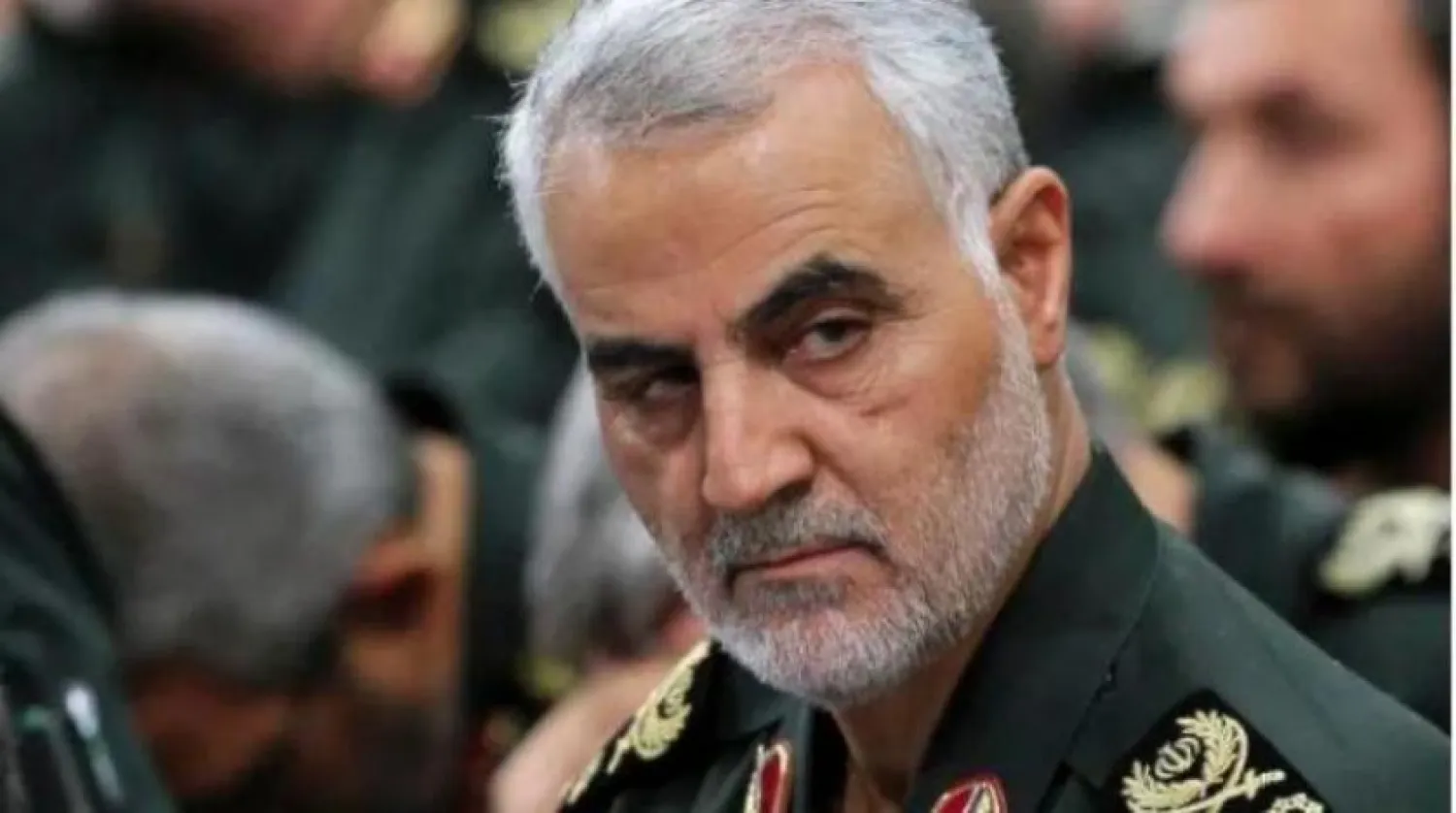
Iran Imposes Sanctions on Americans over Soleimani Killing

AP file photo of General Qassem Soleimani
TT

Iran Imposes Sanctions on Americans over Soleimani Killing

AP file photo of General Qassem Soleimani

Iran on Saturday imposed sanctions on dozens more Americans, many of them from the US military, over the 2020 killing of General Qassem Soleimani in a drone strike.

Iran's Foreign Ministry said the 51 Americans had been targeted for what it called "terrorism" and human rights violations. The step lets Iranian authorities seize any assets they hold in Iran, but the apparent absence of such assets means it will likely be symbolic.

The ministry said in a statement carried by local media that the 51 had been targeted for "their role in the terrorist crime by the United States against the martyred General Qassem Soleimani and his companions and the promotion of terrorism and violations of fundamental human rights".

Soleimani, the commander of Iran's Quds Force, the overseas arm of the Revolutionary Guards, was killed in Iraq in a drone strike on Jan. 3, 2020, ordered by then President Donald Trump.

Those added to Iran's sanctions list included US General Mark Milley, chairman of the Joint Chiefs of Staff and former White House national security adviser Robert O'Brien, Reuters reported.

In a similar move announced a year ago, Iran imposed sanctions on Trump and several senior US officials over what it called "terrorist and anti-human rights" acts.

Iranian President Ebrahim Raisi, speaking on the second anniversary of Soleimani's assassination, said this week Trump must face trial for the killing or Tehran would take revenge.


Türkiye’s Erdogan Distances Govt from Main Opposition Crisis, Warns Against Unrest

30 October 2025, Türkiye, Ankara: Recep Tayyip Erdogan, President of Türkiye, speaks at the press conference with German Chancellor Friedrich Merz after talks at the presidential palace. (dpa)
TT

Türkiye’s Erdogan Distances Govt from Main Opposition Crisis, Warns Against Unrest

30 October 2025, Türkiye, Ankara: Recep Tayyip Erdogan, President of Türkiye, speaks at the press conference with German Chancellor Friedrich Merz after talks at the presidential palace. (dpa)

President Recep Tayyip Erdogan said on Monday that the government would not be drawn into disputes within Türkiye's main opposition CHP and would not allow unrest on the streets, in ‌his first ‌public comments ‌since ⁠a court ruling last ⁠month annulled the party's 2023 congress and removed its leadership.

The court ruling effectively reinstated former CHP ⁠chairman Kemal Kilicdaroglu, a divisive ‌figure ‌within the party who ‌lost a presidential election ‌to Erdogan in 2023.

Speaking after a cabinet meeting in Ankara, Erdogan said ‌the government had no part in a ⁠political ⁠and legal struggle that had "spilled from party congress halls into court corridors" and would not allow "the streets to be thrown into turmoil" or the public to be pitted against security forces.


Mandelson Documents Cast Light on Government Work, Appointment of US Ambassador

Former UK ambassador to the United States, Peter Mandelson, is pictured as he walks his dog near his residence in central London on April 20, 2026. (AFP)
TT

Mandelson Documents Cast Light on Government Work, Appointment of US Ambassador

Former UK ambassador to the United States, Peter Mandelson, is pictured as he walks his dog near his residence in central London on April 20, 2026. (AFP)

Britain's government released reams of documents on Monday relating to the appointment of Peter Mandelson as ambassador to the United States, offering a glimpse into the often acerbic world of Westminster and his messy clearance for the job.

The Mandelson saga, which forced the departure of Prime Minister Keir Starmer's closest aide, has become a focus for criticism of Britain's prime minister, who is fighting for his political survival against a probable leadership challenge.

In a 1,504-page document, the government released messages — ranging from vetting emails to personal WhatsApps — in a data dump it hopes will take some of the focus off Starmer and show that ‌Mandelson was ‌less than frank over his ties to the late convicted sex ‌offender ⁠Jeffrey Epstein.

MANDELSON: 'YOU WILL ⁠NEVER REGRET' THE APPOINTMENT

In one document, the government said it had written to Mandelson on March 31 to request any information held on his personal phone as part of an investigation into his appointment and work - something he had declined to hand over.

Private messages from Mandelson - who was twice sacked from cabinet under Labour's longest-serving prime minister, Tony Blair - show him regularly chatting to Labour insiders, pressing his case and sometimes exchanging criticisms of ⁠the government.

In a handwritten note to then-foreign minister David Lammy on ‌November 18, 2024, Mandelson writes: "I just wanted you ‌to know that if you were minded to appoint me (as ambassador), I would make sure you ‌never regret it."

He also said he went "tonto" over the government's failure to immediately approve ‌a personalized red ministerial box as a gift to US President Donald Trump, using a slang term for going crazy.

He also took a swipe at Starmer, telling senior minister Pat McFadden he believed "Keir is not leading from the front".

In the same exchange, McFadden told Mandelson the government was "asking ‌the wrong questions", saying that every meeting was about "who can we tax in order to pay benefits to others".

The government ⁠hopes the release ⁠of the documents and his messages will put an end to questions surrounding Starmer's judgment in appointing a man whose friendship with Epstein was known. But they are unlikely to silence calls for the prime minister to stand down after Labour lost in local elections last month.

Mandelson is under police investigation for allegedly leaking government documents to the late Epstein. He does not face allegations of sexual misconduct.

An initial tranche of documents was released in March, which showed Starmer was warned of the risks of the appointment, not just over Mandelson's ties to Epstein but also because of the Labour veteran's support for closer ties with China.

Starmer now faces a possible leadership challenge later this year, if his main rival, Greater Manchester mayor Andy Burnham, wins a seat in parliament in an election on June 18.


‘We Need to Act Now’: Race to Develop Ebola Vaccine Heats Up

Health workers receive boxes of tents at the Evangelical Medical Center, one of the facilities at the forefront of the response to the Ebola outbreak, as agencies intensify efforts to contain a new Ebola outbreak caused by the Bundibugyo virus strain, in Bunia, Ituri province, Democratic Republic of Congo, May 31, 2026. (Reuters)
TT

‘We Need to Act Now’: Race to Develop Ebola Vaccine Heats Up

Health workers receive boxes of tents at the Evangelical Medical Center, one of the facilities at the forefront of the response to the Ebola outbreak, as agencies intensify efforts to contain a new Ebola outbreak caused by the Bundibugyo virus strain, in Bunia, Ituri province, Democratic Republic of Congo, May 31, 2026. (Reuters)

Several non-profit organizations announced Monday they are ramping up efforts to rapidly develop a vaccine for the rare strain of Ebola driving a deadly outbreak in the Democratic Republic of Congo.

Nearly 250 people are suspected to have died and more than 1,100 infected with the strain in the DRC and neighboring Uganda, though the true spread of the virus is feared to be much wider.

While it marks the 17th Ebola outbreak in the DRC, it is just the third caused by the Bundibugyo strain, for which there are no approved vaccines or treatments.

The escalating nature of the outbreak has sparked a race to find a vaccine that can be quickly developed, manufactured then tested in humans during clinical trials in the affected region.

The World Health Organization said on Saturday that its experts had determined "the most promising candidate vaccine" was a single-dose shot using the rVSV platform.

The only licensed Ebola vaccine, which targets the more common Zaire strain, uses the same platform.

The non-profit International AIDS Vaccine Initiative (IAVI) announced Monday it had reached a deal with the University of Texas Medical Branch to develop the rVSV candidate.

The university's Thomas Geisbert led work on both the Bundibugyo candidate and the licensed Zaire jab.

Geisbert told AFP last month that 2013 research demonstrated his jab provided very strong protection against Bundibugyo in monkeys.

However the vaccine "just sat there" for more than a decade because of a lack of interest, in particular from pharmaceutical firms, the virologist added.

The WHO estimated it would take seven to nine months before the rVSV vaccine is ready to be tested in humans.

- 'Fast-track' -

Also on Monday, the Coalition for Epidemic Preparedness Innovations (CEPI) announced funding to "fast-track" development of three Bundibugyo vaccine candidates, including $3.2 million towards the rVSV jab.

WHO chief Tedros Adhanom Ghebreyesus, who visited the epicenter of the outbreak in the DRC on the weekend, said in a statement the funding was "an important step forward".

Another vaccine candidate receiving CEPI funding was developed on the University of Oxford's ChAdOx1 platform, which also underpinned AstraZeneca's Covid vaccine.

This viral vector jab -- which will be manufactured by the huge Serum Institute of India -- could become available for clinical trials within two to three months, the WHO said.

CEPI also said it had committed $50 million to a vaccine candidate being developed by US pharma giant Moderna which uses the mRNA technology pioneered in its Covid vaccine.

In a preprint paper published online last week, researchers at France's INSERM institute called for trials to see if the licensed Zaire vaccine could also help fight Bundibugyo.

- $50 million pledge -

Also on Monday, the Gavi vaccine alliance announced it would make up to $50 million available for Bundibugyo vaccine efforts.

"We need to act now to ensure that, once one or more vaccine candidates are ready, manufacturers are in a position to start producing doses at scale," Gavi CEO Sania Nishtar said in a statement.

IAVI president Mark Feinberg told a press conference on Monday that Gavi's new commitment could fund the production of roughly 500,000 doses.

It also provided a "signal to manufacturers they can make this investment and not carry excessive risk," he added.

Even once doses for a trial are ready, there will be challenges in deploying them in a vast, remote area of the DRC that is already suffering crises including hunger, malaria and conflict.

Gaining the trust of communities where vaccines will be trialed will be crucial, the WHO emphasized.

And once a trial is finally carried out, there is no guarantee it will demonstrate the vaccine works.

"We have reasons to believe that we can generate effective vaccines, but we don't want to downplay at all that we have to treat them as investigational products," CEPI CEO Richard Hatchett said last week.

There are also several efforts to quickly trial several Bundibugyo treatments, including antivirals called remdesivir and obeldesivir, and the monoclonal antibody MBP134.