


Japan Widens Virus Restrictions as Omicron Surges in Cities

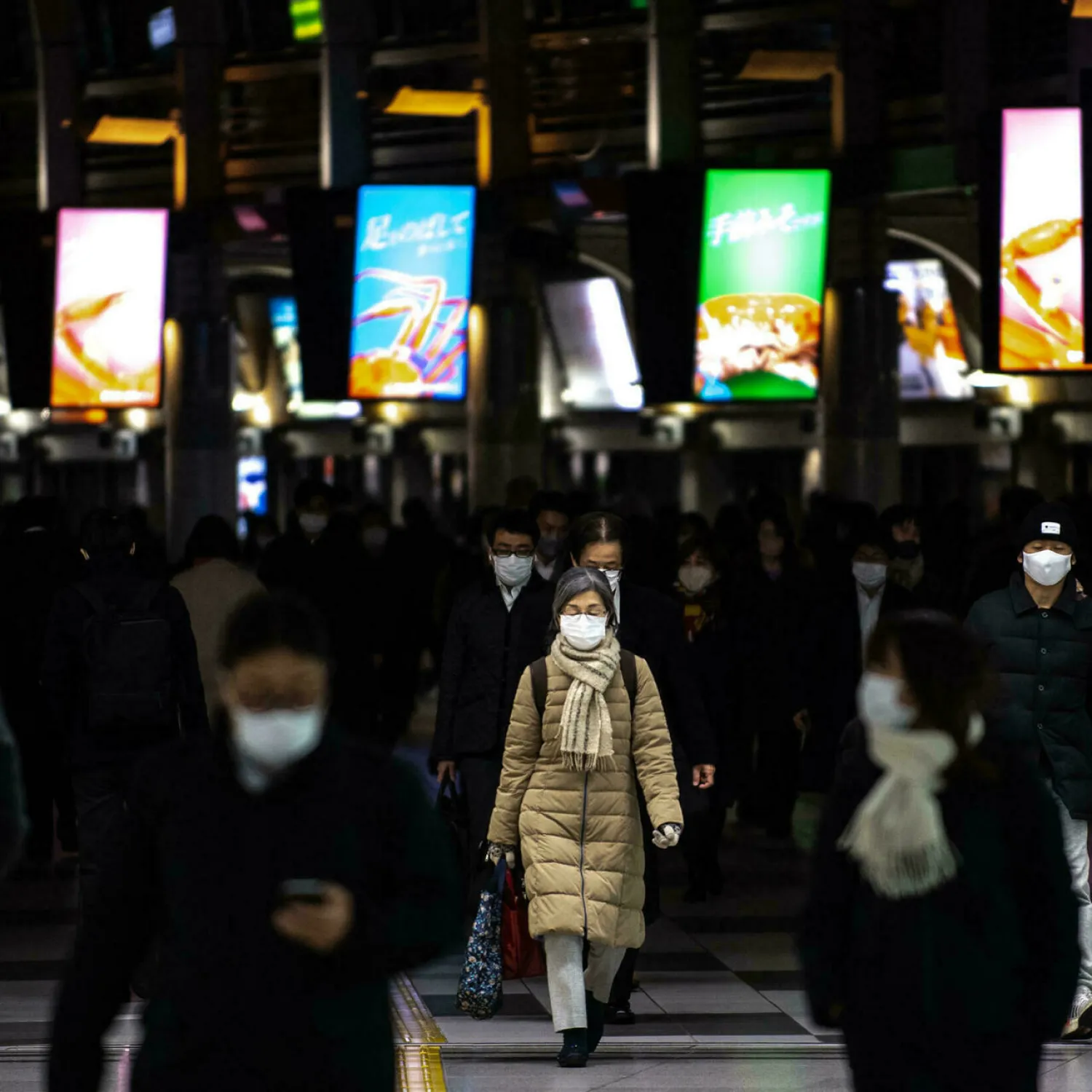
Japan will approve new virus rules in the capital and other regions over surging Covid infections. Philip FONG AFP
TT

Japan Widens Virus Restrictions as Omicron Surges in Cities

Japan will approve new virus rules in the capital and other regions over surging Covid infections. Philip FONG AFP

Restaurants and bars will close early in Tokyo and a dozen other areas across Japan beginning Friday as the country widens COVID-19 restrictions due to the omicron variant, which has caused cases to surge to new highs in metropolitan areas.

The restraint, which is something of a pre-state of emergency, is the first since September and is scheduled to last through Feb. 13. With three other prefectures — Okinawa, Hiroshima and Yamaguchi — under similar measures since early January, the state of restraint now covers 16 areas, or one-third of the country.

While many Japanese adults are fully vaccinated against COVID-19, few have gotten a booster shot, which has been a vital protection from the highly contagious omicron variant of the coronavirus, The Associated Press said.

The Health Ministry on Friday approved Pfizer vaccinations for children aged 5-11, who are increasingly vulnerable to infection.

Throughout the pandemic, Japan has resisted the use of lockdowns to limit the spread of the virus and has focused on requiring eateries to close early and not serve alcohol, and on urging the public to wear masks and practice social distancing, as the government seeks to minimize damage to the economy.

Under the latest measures, most eateries are asked to close by 8 or 9 p.m., while large events can allow full capacity if they have anti-virus plans. In Tokyo, certified eateries that stop serving alcohol can stay open until 9 p.m. while those serving alcohol must close an hour earlier.

Restaurants that close at 9 p.m. and don't serve alcohol receive 30,000 yen ($263) per day in government compensation, while those that close at 8 p.m. get 25,000 yen ($220) per day.

Critics say the measures, which almost exclusively target bars and restaurants, make little sense and are unfair.

Mitsuru Saga, the manager of a Japanese-style “izakaya” restaurant in downtown Tokyo, said he chose to serve alcohol and close at 8 p.m. despite receiving less compensation from the government.

“We cannot make business without serving alcohol,” Saga said in an interview with Nippon Television. “It seems only eateries are targeted for restraints.”

Some experts question the effectiveness of placing restraints only on eateries, noting that infections show no signs of slowing in the three prefectures that have already been subjected to the measures for nearly two weeks.

After more than two years of repeated restraints and social distancing requests, Japanese are increasingly becoming less cooperative to such measures. People are back to commuting on packed trains and shopping at crowded stores.

Tokyo's main train station of Shinagawa was packed as usual with commuters rushing to work Friday morning.

Japan briefly eased border controls in November but quickly reversed them to ban most foreign entrants when the omicron variant began spreading in other countries. Japan says it will stick to the stringent border policy through the end of February as the country tries to reinforce medical systems and treatment.

The tough border controls have triggered criticism from foreign students and scholars who say the measures are not scientific.

A group of scholars and Japan-US experts recently launched a petition, led by Japan Society head Joshua Walker, calling on Prime Minister Fumio Kishida and his government to allow foreign scholars and students to enter the country again under careful preventive measures.

A letter to Kishida, signed by hundreds of academics and experts in Japan-US studies, urged his government to relax border controls to allow educators, students and scholars to enter Japan and pursue their academic activity. Many of them have been forced to give up Japan studies and focus instead on other countries, including South Korea.

“They become the bridges between Japan and other societies. They are future policymakers, business leaders, and teachers. They are the foundation of the US-Japan alliance and other international relationships that support Japan’s core national interests,” the letter said. “The closure is harming Japan’s national interests and international relationships.”

Japan recently announced it will allow 87 students on Japanese government scholarships to enter the country, but petitioners say there are many others on foreign government-sponsored scholarships who still cannot get in.

Tokyo logged 8,638 new cases of coronavirus infection Thursday, exceeding the previous record of 7,377 set the day before.

At a Tokyo metropolitan government task force meeting, experts sounded the alarm at the fast-paced upsurge led by omicron.

Norio Ohmagari, Director of the Disease Control and Prevention Center of National Center for Global Health and an advisor to the Tokyo metropolitan government panel, said Tokyo’s daily new cases may exceed 18,000 within a week if the increase continues at the current pace.

Though only some of the soaring number of infected people are hospitalized and occupying less than one-third of available hospital beds in the Japanese capital, experts say the rapid upsurge of the cases could quickly overwhelm the medical systems once the infections further spread among the elderly population who are more likely to become seriously ill.

Surging infections have begun to paralyze hospitals, schools and other sectors in some areas.

The ministry has trimmed the required self-isolation period from 14 days to 10 for those who come into close contact with someone who tests positive for COVID-19, and to seven days for essential workers if they test negative.

While about 80% of Japanese have received their first two vaccine doses, the rollout of booster shots has been slow and has reached only 1.4 % of the population so far.



Trump Hints at Land Strike as Venezuela Pressure Mounts

A US Air Force C-130J Super Hercules aircraft approaches for landing at Rafael Hernandez Airport, amid tensions between US President Donald Trump's administration and the government of Venezuelan President Nicolas Maduro, in Aguadilla, Puerto Rico, December 28, 2025. (Reuters)
TT

Trump Hints at Land Strike as Venezuela Pressure Mounts

A US Air Force C-130J Super Hercules aircraft approaches for landing at Rafael Hernandez Airport, amid tensions between US President Donald Trump's administration and the government of Venezuelan President Nicolas Maduro, in Aguadilla, Puerto Rico, December 28, 2025. (Reuters)

A throwaway remark last week by President Donald Trump has raised questions about whether US forces may have carried their first land strike against drug cartels in Venezuela.

Trump said the US knocked out a "big facility" for producing trafficking boats, as he was discussing his pressure campaign against Venezuelan President Nicolas Maduro in an interview broadcast Friday.

"They have a big plant or a big facility where they send, you know, where the ships come from," Trump said in an interview with billionaire supporter John Catsimatidis on the WABC radio station in New York.

"Two nights ago we knocked that out. So we hit them very hard."

Trump did not say where the facility was located or give any other details. US forces have carried out numerous strikes in both the Caribbean Sea and eastern Pacific Ocean since September, killing more than 100 people.

The Pentagon referred questions about Trump's remarks to the White House. The White House did not respond to requests for comment from AFP.

There has been no official comment from the Venezuelan government.

Trump has been saying for weeks that the United States will "soon" start carrying out land strikes targeting drug cartels in Latin America, but there have been no confirmed attacks to date.

The Trump administration has been ramping up pressure on Maduro, accusing the Venezuelan leader of running a drug cartel himself and imposing an oil tanker blockade.

Maduro has accused Washington of attempting regime change.


UN Chief Says ‘Get Serious’ in Grim New Year Message

 UN Secretary-General Antonio Guterres. (AFP)
UN Secretary-General Antonio Guterres. (AFP)
TT

UN Chief Says ‘Get Serious’ in Grim New Year Message

 UN Secretary-General Antonio Guterres. (AFP)
UN Secretary-General Antonio Guterres. (AFP)

The United Nations urged global leaders Monday to focus on people and the planet in a New Year's message depicting the world in chaos.

"As we enter the new year, the world stands at a crossroads. Chaos and uncertainty surround us. Division. Violence. Climate breakdown. And systemic violations of international law," UN Secretary-General Antonio Guterres said in a video message.

In 2026, as war rages in Ukraine and elsewhere, world leaders must work to ease human suffering and fight climate change, he added.

"I call on leaders everywhere: Get serious. Choose people and planet over pain," said Guterres, criticizing the global imbalance between military spending and financing for the poorest countries.

Military spending is up nearly 10 percent this year to $2.7 trillion, which is 13 times total world spending on development aid and equivalent to the entire gross domestic product of Africa, he said.

Wars are raging at levels unseen since World War II, he added.

"In this New Year, let's resolve to get our priorities straight. A safer world begins by investing more in fighting poverty and less in fighting wars. Peace must prevail," said Guterres, who will be serving his last year as secretary general.


Türkiye and Armenia Agree to Simplify Visa Procedures to Normalize Ties

Türkiye’s President Recep Tayyip Erdogan, right, and Armenia's Prime Minister Nikol Pashinyan shake hands before a meeting at Prague Castle in Prague, Czech Republic, Thursday, Oct. 6, 2022. (Turkish Presidency via AP, File)
TT

Türkiye and Armenia Agree to Simplify Visa Procedures to Normalize Ties

Türkiye’s President Recep Tayyip Erdogan, right, and Armenia's Prime Minister Nikol Pashinyan shake hands before a meeting at Prague Castle in Prague, Czech Republic, Thursday, Oct. 6, 2022. (Turkish Presidency via AP, File)

Türkiye and Armenia have agreed to simplify visa procedures as part of efforts to normalize ties, Türkiye’s Foreign Ministry announced Monday, making it easier for their citizens to travel between the two countries.

Relations between Türkiye and Armenia have long been strained by historic grievances and Türkiye’s alliance with Azerbaijan. The two neighboring countries have no formal diplomatic ties and their joint border has remained closed since the 1990s.

The two countries, however, agreed to work toward normalization in 2021, appointing special envoys to explore steps toward reconciliation and reopening the frontier. Those talks have progressed in parallel with efforts to ease tensions between Armenia and Azerbaijan.

Türkiye supported Azerbaijan during its 2020 conflict with Armenia for control of the Karabakh region, known internationally as Nagorno-Karabakh, a territorial dispute that had lasted nearly four decades.

The Turkish Foreign Ministry said in a statement posted on social platform X that Ankara and Yerevan agreed that holders of diplomatic, special and service passports from both countries would be able to obtain electronic visas free of charge as of Jan. 1.

“On this occasion, Türkiye and Armenia reaffirm once again their commitment to continue the normalization process between the two countries with the goal of achieving full normalization without any preconditions,” the ministry said.

Türkiye and Armenia also have a more than century-old dispute over the deaths of an estimated 1.5 million Armenians in massacres, deportations and forced marches that began in 1915 in Ottoman Türkiye. Historians widely view the event as genocide.

Türkiye denies the deaths constituted genocide, saying the toll has been inflated and those killed were victims of civil war and unrest. It has lobbied to prevent countries from officially recognizing the massacres as genocide.