


What Happens to Europe’s Energy If Russia Acts?

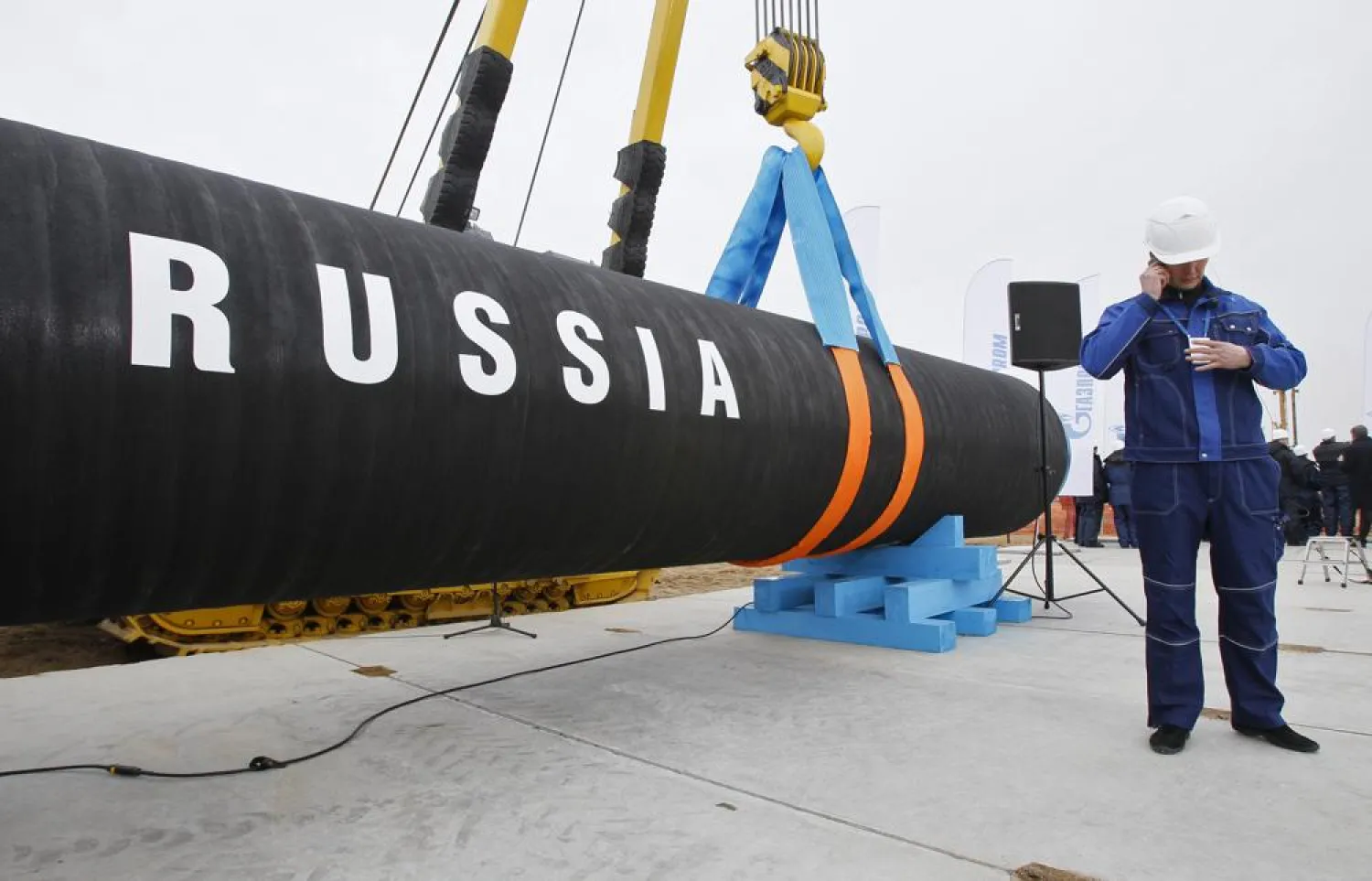
A Russian construction worker speaks on a mobile phone during a ceremony marking the start of Nord Stream pipeline construction in Portovaya Bay some 170 kms (106 miles) north-west from St. Petersburg, Russia on April 9, 2010. (AP)
TT

What Happens to Europe’s Energy If Russia Acts?

A Russian construction worker speaks on a mobile phone during a ceremony marking the start of Nord Stream pipeline construction in Portovaya Bay some 170 kms (106 miles) north-west from St. Petersburg, Russia on April 9, 2010. (AP)

Fears are rising about what would happen to Europe’s energy supply if Russia were to invade Ukraine and then shut off natural gas exports in retaliation for US and European sanctions.

The tensions show the risk of Europe’s reliance on Russia for energy, which supplies about a third of the continent’s natural gas. And Europe’s stockpile is already low. While the US has pledged to help by boosting exports of liquefied natural gas, or LNG, there’s only so much it can produce at once.

It leaves Europe in a potential crisis, with its gas already sapped by a cold winter last year, a summer with little renewable energy generation and Russia delivering less than usual. Prices have skyrocketed, squeezing households and businesses.

Here’s what to know about Europe’s energy supply if tensions boil over into war and Russia is hit with sanctions:

Will Russia cut off gas supplies to Europe?
No one knows for sure, but a complete shutoff is seen as unlikely, because it would be mutually destructive.

Russian officials have not signaled they would consider cutting supplies in the case of new sanctions. Moscow relies on energy exports, and though it just signed a gas deal with China, Europe is a key source of revenue.

Europe is likewise dependent on Russia, so any Western sanctions would likely avoid directly targeting Russian energy supplies.

More likely, experts say, would be Russia withholding gas sent through pipelines crossing Ukraine. Russia pumped 175 billion cubic meters of gas into Europe last year, nearly a quarter of it through those pipelines, according to S&P Global Platts. That would leave pipelines under the Baltic Sea and through Poland still operating.

“I think in the event of even a less severe Russian attack against Ukraine, the Russians are almost certain to cut off gas transiting Ukraine on the way to Germany,” said former US diplomat Dan Fried, who as State Department coordinator for sanctions policy helped craft 2014 measures against Russia when it invaded and annexed Ukraine’s Crimea peninsula.

Russia could then offer to make up the lost gas if Germany approves the new Nord Stream 2 pipeline, whose operators may potentially face US sanctions even though a recent vote to that effect failed. German officials also have said blocking operation of the pipeline would be “on the table” if there’s an invasion.

Interrupting gas supplies beyond the Ukrainian pipelines is less likely: “If they push it too far, they’re going to make a breach with Europe irreparable, and they have to sell the oil and gas someplace,” Fried said.

What can the US do?
It’s a major gas producer and already is sending record levels of liquefied natural gas, or LNG, by ship worldwide. It could only help Europe a little.

“We’re talking about small increases to the size of US exports, whereas the hole that Europe would need to fill if Russia backed away or if Europe cut Russia off would be much larger than that,” said Ross Wyeno, lead analyst for Americas LNG at S&P.

The Biden administration has been talking with gas producers worldwide about whether they can boost output and ship to Europe, and it has been working to identify supplies of natural gas from North Africa, the Middle East, Asia and the US

The administration also is talking with buyers about holding off.

“Is there some other country that was planning to get an LNG shipment that doesn’t need it and could give it to Europe?” said Amy Myers Jaffe, managing director of the Climate Policy Lab at Tufts University, mentioning Brazil or countries in Asia.

Over the past month, two-thirds of American LNG exports went to Europe. Some ships filled with LNG were heading to Asia but turned around to go to Europe because buyers there offered to pay higher prices, S&P said.

Is there enough liquefied gas worldwide to solve the problem?
Not in the event of a full cutoff, and it can’t be increased overnight. Export terminals cost billions of dollars to build and are working at capacity in the US.

Even if all Europe’s LNG import facilities were operating at capacity, the amount of gas would only be about two-thirds of what Russia sends via pipelines, Jaffe said.

And there could be challenges distributing the LNG to parts of Europe that have fewer pipeline connections.

If Russia stopped sending just the gas that goes through Ukraine, it would take the equivalent of about 1.27 shiploads of additional LNG per day to replace that supply, said Luke Cottell, senior LNG analyst at S&P. Russia also could reroute some of that gas through other pipelines, reducing the need for additional LNG to about a half-shipload per day, he said.

Is Russia already supplying less gas?
Russia has been fulfilling its long-term contracts to supply gas to Europe, but it’s been selling less on the spot market and hasn’t been filling the storage containers it owns in Europe, experts say.

“It’s already happened. It’s not theoretical,” Jaffe said.

Russian cutbacks to spot gas supplies have contributed to sharply higher natural gas prices in Europe. They went as high as 166 euros ($190) per megawatt hour in December, more than eight times their level at the start of 2021. Prices have fallen to under 80 euros per kilowatt hour as more LNG arrives.

But consumers are feeling the crunch in higher electric and gas bills. European governments are rolling out subsidies and tax breaks to ease the financial stress on households.

Is there impact in the US?
As the US ramped up LNG exports, domestic prices of natural gas also rose. More than 10% of gas produced in the US last year was exported, said Clark Williams-Derry, analyst at the Institute for Energy Economics and Financial Analysis.

US gas prices spiked by more than 30% in the last week of January, primarily because of an approaching winter storm in New England, Williams-Derry said. But prices also were affected by tighter US supplies amid uncertainty over Russia, he said.

“Russia is disturbing European gas markets, with the US talking about exporting basically the next ‘Berlin airlift’ for natural gas to Europe,” he said.

If the US pushes for increased LNG exports, prices at home would likely rise, Williams-Derry added.

Ten Democratic senators, led by Jack Reed of Rhode Island and Angus King of Maine, recently urged the Energy Department to study the effect of higher exports on domestic prices and pause approvals of proposed terminals. They said they understood “geopolitical factors” give rise to sending more gas.

“However, the administration must also consider the potential increase in cost to American families,” the senators said.



Saudi Arabia Consolidates Its Position Among the World’s Top 20 Economies in 2026

Riyadh, Saudi Arabia (Reuters) 
TT

Saudi Arabia Consolidates Its Position Among the World’s Top 20 Economies in 2026

Riyadh, Saudi Arabia (Reuters) 

As the global financial landscape is reshaped by accelerating geopolitical shifts, economic data show that Saudi Arabia has firmly consolidated its place among the world’s 20 largest economies in 2026.

This standing reflects the success of Vision 2030 in diversifying income sources and expanding gross domestic product. The Kingdom ranks 19th globally, outperforming several long-established economies, with GDP projected at $1.316 trillion.

According to data based on International Monetary Fund reports released in October 2025, the global economy is expected to reach $123.6 trillion in 2026. Economic power remains highly concentrated, with the world’s five largest economies accounting for more than 55 percent of total global output:

United States: Continues to lead with GDP of $31.8 trillion, supported by a resilient labor market and sustained consumer spending, with real growth projected at 2.1 percent.

China: Ranks second with an estimated GDP of $20.7 trillion, despite demographic challenges and its transition toward advanced manufacturing.

Germany: Retains Europe’s top position in third place with GDP of $5.3 trillion, despite pressure from high energy costs.

India: The “rising star,” securing fourth place globally with GDP of $4.5 trillion and posting the fastest growth among major economies at 6.2 percent.

Japan: Slips to fifth place with GDP of $4.4 trillion, facing demographic headwinds despite strengths in robotics and automotive industries.

Linked to recent IMF assessments, Saudi Arabia stands out as a key pillar in what experts describe as a new “economic geography.” While many emerging markets have struggled with interest-rate volatility and inflation distortions in advanced economies - particularly the United States - the Kingdom has demonstrated a strong ability to absorb external shocks.

The IMF views Saudi Arabia’s large-scale investments in high-potential sectors not merely as a driver of domestic growth, but as part of a broader global shift in capital flows toward destinations offering stability and long-term attractiveness.

The data also underscore the strong performance of other economies on the list. Brazil ranks 11th with GDP exceeding $2.2 trillion, while Türkiye and Indonesia continue to compete closely in 16th and 17th place, respectively.


Saudi Industrial Production Index Records Highest Growth Since Early 2023

A facility operated by the Saudi International Petrochemical Company (Sipchem). (Sipchem)
TT

Saudi Industrial Production Index Records Highest Growth Since Early 2023

A facility operated by the Saudi International Petrochemical Company (Sipchem). (Sipchem)

Saudi Arabia’s Industrial Production Index posted a year-on-year increase of 10.4 percent in November 2025, compared with the same month a year earlier, marking its highest growth rate since the beginning of 2023, according to preliminary data. On a monthly basis, however, the index declined by 0.7 percent.

Data released by the General Authority for Statistics on Sunday showed that the index for oil-related activities rose by 12.9 percent year on year in November, while the index for non-oil activities increased by 4.4 percent compared with the same month of the previous year.

Month on month, the index for oil activities recorded a rise of 0.5 percent, while the non-oil activities index fell by 3.4 percent compared with October 2025.

In November, the sub-index for mining and quarrying activities climbed 12.6 percent year on year, driven by higher oil production during the month. Saudi oil output rose to 10.1 million barrels per day, compared with 8.9 million barrels per day in November last year.

On a monthly basis, the mining and quarrying sub-index also increased by 0.5 percent.

The manufacturing sub-index recorded an annual rise of 8.1 percent, supported by a 14.5 percent increase in the manufacture of coke and refined petroleum products, as well as a 10.9 percent rise in the manufacture of chemicals and chemical products.

In monthly terms, preliminary results showed the manufacturing sub-index edged up by 0.3 percent, buoyed by a 0.3 percent increase in the manufacture of coke and refined petroleum products and a 1.0 percent rise in the manufacture of chemicals and chemical products.

As for other activities, the sub-index for electricity, gas, steam and air-conditioning supply fell by 4.3 percent year on year. In contrast, the sub-index for water supply, sewerage, waste management and remediation activities rose by 10.2 percent compared with November last year.

Compared with October 2025, the electricity, gas, steam and air-conditioning supply sub-index dropped sharply by 28.6 percent, while the water supply, sewerage, waste management and remediation activities sub-index declined by 3.1 percent.


India and Germany Sign Deals to Deepen Economic and Security Ties

German Chancellor Friedrich Merz, left, shakes hands with Indian Prime Minister Narendra Modi following a joint statement to the media in Gandhinagar, India, Monday, Jan. 12, 2026. (AP)
TT

India and Germany Sign Deals to Deepen Economic and Security Ties

German Chancellor Friedrich Merz, left, shakes hands with Indian Prime Minister Narendra Modi following a joint statement to the media in Gandhinagar, India, Monday, Jan. 12, 2026. (AP)

Indian Prime Minister Narendra Modi and German Chancellor Friedrich Merz met on Monday in western Gujarat state to push for deeper economic and security ties between the South Asian nation and Europe’s largest economy.

Modi and Merz held talks in the city of Gandhinagar, where the two countries signed various agreements to enhance cooperation in the defense sector, skill development, health and education, as both nations seek to reduce dependence on China and bolster economic ties.

After the bilateral talks, Modi noted that Germany is India’s most important trading partner in the European Union and said both leaders were seeking to expand those ties.

He said the two countries are pursuing new projects in areas such as climate action, energy and mining of rare earth elements, and have also agreed on a road map to boost cooperation between their defense industries for joint development and production.

“We want to elevate the relations between India and Germany to an even higher level,” Modi said.

Germany has not traditionally had close defense ties with India, but the two sides have been trying to boost cooperation in the sector. Germany’s Thyssenkrupp is expected to partner with Indian firms to build six advanced conventional submarines in India, part of New Delhi’s ongoing efforts to modernize its naval capabilities.

Merz said India and Germany share “tremendous economic potential,” and the two countries are working together to strengthen ties in the field of security policy and defense cooperation.

“India is a desired partner, a partner of choice for Germany,” Merz said, according to a live official translation. He added that negotiations on a free trade agreement between India and the EU need to be concluded to fully realize the potential of economic ties between the two countries.

The two sides also signed an agreement that makes it easier for Indians to work in Germany's health care sector.

Merz’s visit to India — also his first to an Asian country since he took office last year — comes ahead of a planned India-EU summit later this month, where leaders hope to make progress on a long-pending free trade agreement. India hopes to deepen economic engagement with Europe in the face of US tariff rates of 50%.

During his visit, Merz toured the Sabarmati Ashram, once home to independence leader Mahatma Gandhi, and attended the International Kite Festival at the Sabarmati riverfront. Modi and Merz flew kites during the event.