

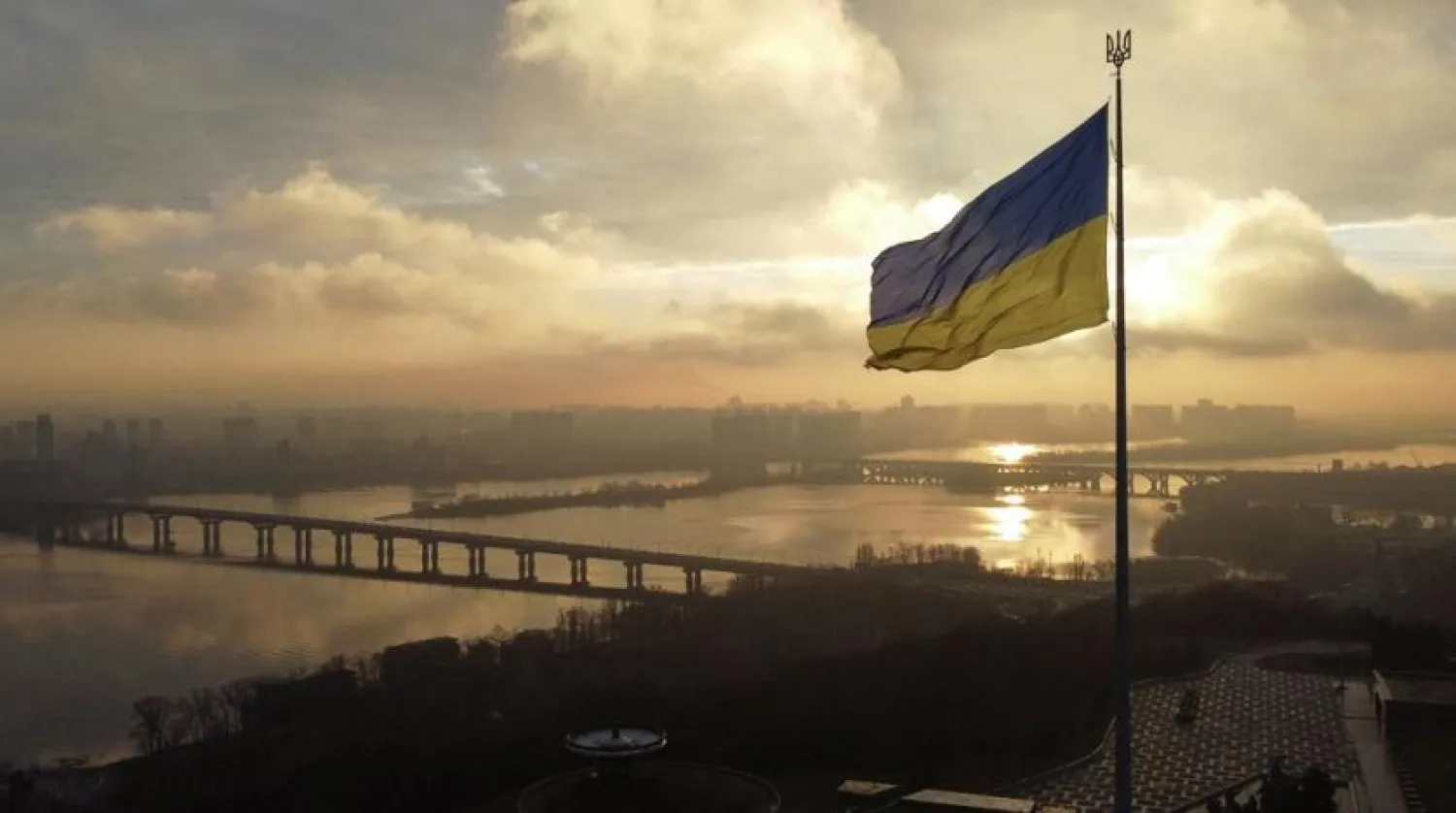

Ukraine Declares State of Emergency, Summons Citizens Home from Russia

Ukraine's biggest national flag on the country's highest flagpole is seen at a compound of the World War II museum in Kyiv, Ukraine, December 16, 2021. Picture taken with a drone. (Reuters)
TT

Ukraine Declares State of Emergency, Summons Citizens Home from Russia

Ukraine's biggest national flag on the country's highest flagpole is seen at a compound of the World War II museum in Kyiv, Ukraine, December 16, 2021. Picture taken with a drone. (Reuters)

Ukraine declared a state of emergency on Wednesday and told its citizens in Russia to flee, while Moscow began evacuating its Kyiv embassy in the latest ominous signs for Ukrainians who fear an all-out Russian military onslaught.

Shelling intensified at the line of contact in eastern Ukraine, where Russian President Vladimir Putin recognized the independence of two Moscow-backed rebel regions this week and has ordered the deployment of Russian troops as "peacekeepers".

But there was still no clear indication of whether he plans to follow that up with a massed assault on Ukraine involving the tens of thousands of troops he has gathered near his neighbor's borders.

The uncertainty and a mostly incremental first volley of sanctions on Russian interests by Washington and its allies have roiled financial markets. Oil prices reversed earlier losses on Wednesday. However, global stocks broke a four-day slide and demand for safe-haven assets waned as Western leaders and Ukraine awaited Putin's next move.

"Predicting what might be the next step of Russia, the separatists or the personal decisions of the Russian president - I cannot say," Ukraine's President Volodymyr Zelenskiy said.

The 30-day state of emergency could restrict the freedom of movement of conscripted reservists, see curbs imposed on the media and lead to personal document checks, according to a draft text that needs to be approved by parliament.

The restrictions would come into force from Thursday.

The Ukrainian government has also announced compulsory military service for all men of fighting age.

Ukrainian government and state websites, which have experienced outages in recent weeks blamed by Kriv on cyber attacks, were again offline on Wednesday. Ukraine's parliament, cabinet and foreign ministry websites were affected.

Moscow denies planning an invasion and has described warnings as anti-Russian hysteria. But it has taken no steps to withdraw the troops deployed along Ukraine's frontiers.

On Wednesday, it took down flags from its embassy in Kyiv, having ordered its diplomats to evacuate for safety reasons.

Sanctions

Washington has described Russia's actions as the start of an "invasion", but along with allies has so far unveiled mostly incremental sanctions, while making clear they were keeping tougher measures in reserve in case of a full-scale invasion.

European Union sanctions approved on Wednesday will add all members of Russia's lower house of parliament who voted to recognize the separatist regions in Ukraine to a blacklist, freezing their assets and banning travel.

EU leaders will also hold an emergency summit on Thursday to discuss what to do next.

Britain announced new restrictions banning Russia from the issuing of new bonds in its security markets, and called for its broadcasting regulator to investigate Russia's RT international television news channel as a propaganda outlet.

"There will be even more tough sanctions on key oligarchs, on key organizations in Russia, limiting Russia's access to the financial markets, if there is a full scale invasion of Ukraine," British Foreign Secretary Liz Truss said.

The steps follow measures announced on Tuesday, including freezing the approval of a new Russian gas pipeline by Germany, and imposing new US sanctions on Russian banks.

But none of the measures announced so far directly targets Putin himself, or is expected to have serious medium-term consequences for Moscow, which is sitting on more than $630 billion in international reserves. The rouble fell, but not by much.

Western countries have been warning for weeks about the possibility of the bloodiest war in Europe for decades. That has not materialized but the apparent threat remains, leaving policymakers to struggle with calibrating their response.

Fresh troops deployed

Ukraine's military said one soldier had been killed and six wounded in increased shelling by pro-Russian separatists using heavy artillery, mortar bombs and Grad rocket systems in the two breakaway areas over the previous 24 hours.

New satellite imagery showed several fresh troop and equipment deployments in western Russia and more than 100 vehicles at a small airfield in southern Belarus, which borders Ukraine, according to US firm Maxar.

For months, Russia has presented the crisis mainly as a dispute with the West, demanding security guarantees, including a promise never to allow Ukraine to join NATO.

But the recognition of the separatist regions was accompanied by much stronger language against Ukraine, including personally from Putin.

In a TV address on Monday, Putin rambled across centuries of history to characterize the Ukrainian state as an artificial construct wrongly carved out of Russia by its enemies.

Some who saw the speech said they now feel menaced by a leader making decisions which no longer appear rational.

"In the case of Putin, this is not a struggle for money or power: It's about pride. Which means the mind is switched off. He can't stop, and he can't be stopped," said Lilia, 72, a pensioner in the Kyiv suburb of Brovary.

German Foreign Minister Annalena Baerbock said Russia was heading down a path that would make it a global pariah, urging it not to "completely isolate yourself worldwide."

Diplomacy has now faltered. US Secretary of State Antony Blinken and French Foreign Minister Jean-Yves Le Drian cancelled separate meetings with Russian Foreign Minister Sergei Lavrov. A summit between US President Joe Biden and Putin, floated by France at the start of the week, now seems unlikely.

Putin said he was always open to finding diplomatic solutions but that "the interests of Russia and the security of our citizens are unconditional for us."



China, Russia and Iran Join South Africa for Naval Drills as Tensions Run High

 The Chinese guided-missile destroyer Tangshan, left, and the Russian corvette Stoikiy, right, in the Simon's Town harbor, in Cape Town, South Africa, Friday, Jan. 9, 2026. (AP)
The Chinese guided-missile destroyer Tangshan, left, and the Russian corvette Stoikiy, right, in the Simon's Town harbor, in Cape Town, South Africa, Friday, Jan. 9, 2026. (AP)
TT

China, Russia and Iran Join South Africa for Naval Drills as Tensions Run High

 The Chinese guided-missile destroyer Tangshan, left, and the Russian corvette Stoikiy, right, in the Simon's Town harbor, in Cape Town, South Africa, Friday, Jan. 9, 2026. (AP)
The Chinese guided-missile destroyer Tangshan, left, and the Russian corvette Stoikiy, right, in the Simon's Town harbor, in Cape Town, South Africa, Friday, Jan. 9, 2026. (AP)

Chinese, Russian and Iranian warships launched a week of naval drills with host South Africa off the Cape Town coast Friday as geopolitical tensions run high over the United States' intervention in Venezuela and its move to seize tankers carrying Venezuelan oil.

The Chinese-led drills were organized last year under the BRICS bloc of developing nations and South Africa's armed forces said the maneuvers will practice maritime safety and anti-piracy operations and “deepen cooperation.”

China, Russia and South Africa are longtime members of BRICS, while Iran joined the group in 2024.

The Iranian navy was taking part in the drills while protests grow back home against the country's leadership.

It was not immediately clear if other countries from the BRICS group would take part in the drills. A spokesperson for the South African armed forces said he wasn't yet able to confirm all the countries participating in the drills, which are due to run until next Friday.

Chinese, Russian and Iranian ships were seen moving in and out of the harbor that serves South Africa's top naval base in Simon's Town, south of Cape Town, where the Indian Ocean meets the Atlantic Ocean. China's ships include the Tangshan, a 161-meter (528-foot) -long destroyer class vessel. Russia's Baltic Fleet said it sent a smaller warship, the Stoikiy, and a replenishment tanker to South Africa.

South Africa also hosted Chinese and Russian ships for navy drills in 2023.

The latest drills were meant to happen in late November but were delayed for diplomatic reasons because South Africa hosted Western and other world leaders for the Group of 20 summit around the same time.

The drills are bound to further strain ties between the US and South Africa, which is the most advanced economy in Africa and a leading voice for the continent but has been especially targeted for criticism by the Trump administration.

US President Donald Trump said in an executive order in February that South Africa supports "bad actors on the world stage" and singled out its ties with Iran as one of the reasons for the US cutting funding to the country. China and Russia have often used BRICS forums to launch criticism of the US and the West.

South Africa has long claimed it follows a nonaligned foreign policy and remains neutral, but Russian presence on the southern tip of Africa has strained its relationship with the US before. The Biden administration accused South Africa in 2023 of allowing a sanctioned Russian ship to dock at the Simon's Town naval base and load weapons to be taken to Russia for the war in Ukraine. South Africa denied the allegation.

South Africa's willingness to host Russian and Iranian warships has also been criticized inside the country. The Democratic Alliance, the second biggest political party in the coalition government, said it was opposed to hosting drills that included “heavily sanctioned” Russia and Iran.

“Calling these drills ‘BRICS cooperation’ is a political trick to soften what is really happening: Government is choosing closer military ties with rogue and sanctioned states such as Russia and Iran,” the Democratic Alliance said.


Iran Shuts off Internet as Protests Blaze Across Country

 This frame grab from a video released by Iran state TV shows vehicles burning amid night of mass protests in Tehran, Iran, Thursday, Jan. 8, 2026. (Iran state TV via AP)
This frame grab from a video released by Iran state TV shows vehicles burning amid night of mass protests in Tehran, Iran, Thursday, Jan. 8, 2026. (Iran state TV via AP)
TT

Iran Shuts off Internet as Protests Blaze Across Country

 This frame grab from a video released by Iran state TV shows vehicles burning amid night of mass protests in Tehran, Iran, Thursday, Jan. 8, 2026. (Iran state TV via AP)
This frame grab from a video released by Iran state TV shows vehicles burning amid night of mass protests in Tehran, Iran, Thursday, Jan. 8, 2026. (Iran state TV via AP)

Iran was largely cut off from the outside world on Friday after authorities blacked out the internet to curb growing unrest, as video showed buildings aflame in anti-government protests raging in cities across the country. 

Rights groups have already documented dozens of deaths of protesters in nearly two weeks and, with Iranian state TV showing clashes and fires, the semi-official Tasnim news agency reported that several police officers had been killed overnight. 

In a televised address, Supreme Leader Ali Khamenei vowed not to back down, accusing demonstrators of acting on behalf of émigré opposition groups and the United States, and a public prosecutor threatened death sentences. 

DOZENS KILLED IN TWO WEEKS OF PROTEST 

The protests pose the biggest internal challenge in at least three years to Iran's clerical rulers, who look more vulnerable than during past bouts of unrest amid a dire economic situation and after last year's war with Israel and the United States. 

While the initial protests were focused on the economy, with the rial currency losing half its value against the dollar last year and inflation topping 40% in December, they have morphed to include slogans aimed directly at the authorities. 

Iranian rights ‌group HRANA said ‌on Friday it had documented the deaths of at least 62 people including 14 security personnel and ‌48 ⁠protesters since demonstrations began ‌on December 28. 

The internet blackout has sharply reduced the amount of information flowing out of the country. Phone calls into Iran were not getting through. At least 17 flights between Dubai and Iran were cancelled, Dubai Airport's website showed. 

Images published by state television overnight showed what it said were burning buses, cars and motorbikes as well as fires at underground railway stations and banks. 

Videos verified by Reuters as having been taken in the capital Tehran showed hundreds of people marching. In one of the videos, a woman could be heard shouting "Death to Khamenei!" 

Other chants included slogans in support of the monarchy. 

Iranian rights group Hengaw reported that a protest march after Friday prayers in Zahedan, where the Baluch minority predominates, was met with gunfire that wounded several people. 

Authorities have tried a dual approach - describing protests over the economy as ⁠legitimate while condemning what they call violent rioters and cracking down with security forces. 

Last week President Masoud Pezeshkian urged authorities to take a "kind and responsible approach", and the government offered modest financial incentives to help ‌counter worsening impoverishment as inflation has soared. 

But with unrest spreading and clashes appearing more violent, the ‍Supreme Leader, the ultimate authority in Iran, above the elected president and ‍parliament, used much tougher language on Friday. 

"The Islamic Republic came to power through the blood of hundreds of thousands of honorable people. It will not ‍back down in the face of vandals," he said, accusing those involved in unrest of seeking to please US President Donald Trump. 

Tehran's public prosecutor said those committing sabotage, burning public property or engaging in clashes with security forces would face the death penalty. 

FRAGMENTED OPPOSITION 

Iran's fragmented external opposition factions called for more protests, and demonstrators have chanted slogans including "Death to the dictator!" and praising the monarchy that was overthrown in 1979. 

Reza Pahlavi, exiled son of the late shah, told Iranians in a social media post: "The eyes of the world are upon you. Take to the streets." 

However, the extent of support inside Iran for the monarchy or for the MKO, the most vocal of émigré opposition groups, is disputed. A spokesperson for the MKO said units with the group had taken ⁠part in the protests. 

"The sense of hopelessness in Iranian society is something today that we haven't seen before. I mean, that sense of anger has just deepened over the years and we are at record new levels in terms of how Iranian society is upset," said Alex Vatanka of the Middle East Institute in Washington. 

Trump, who bombed Iran last summer and warned Tehran last week that the US could come to the protesters' aid, said on Friday he would not meet Pahlavi and was "not sure that it would be appropriate" to support him. 

Despite the increased pressure, Iranian Foreign Minister Abbas Araqchi said on Friday the chance of foreign military intervention in Iran was "very low". He said the foreign minister of Oman, which has often interceded in negotiations between Iran and the West, would visit on Saturday. 

UN rights chief Volker Turk said he was "deeply disturbed by reports of violence" and by communications shutdowns. 

Iran has weathered repeated bouts of major nationwide unrest across the decades, including student protests in 1999, mass demonstrations over a disputed election outcome in 2009, demonstrations over economic hardships in 2019, and the Woman, Life, Freedom protests in 2022. 

The 2022 protests, sparked by the killing of a young woman in the custody of Iran's religious morality police, drew a large variety of people onto the ‌streets, with men and women, old and young, rich and poor. 

They were ultimately suppressed, with hundreds of people reported killed and thousands imprisoned, but authorities also subsequently ceded some ground with women now routinely disobeying public dress codes. 


US Announces Aid to Bolster Thailand, Cambodia Truce

This handout photograph taken and released by Agence Kampuchea Press (AKP) on January 2, 2026 shows a general view of damaged houses following clashes between Cambodian and Thai soldiers, in Chouk Chey village in Banteay Meanchey province. (Agence Kampuchea Press (AKP) / AFP)
TT

US Announces Aid to Bolster Thailand, Cambodia Truce

This handout photograph taken and released by Agence Kampuchea Press (AKP) on January 2, 2026 shows a general view of damaged houses following clashes between Cambodian and Thai soldiers, in Chouk Chey village in Banteay Meanchey province. (Agence Kampuchea Press (AKP) / AFP)

The United States on Friday announced some $45 million in aid as it tries to bolster a fragile truce between Thailand and Cambodia.

Michael DeSombre, the top State Department official for East Asia, was visiting Thailand and Cambodia to discuss ways to strengthen the ceasefire, which President Donald Trump has sought to highlight as an achievement.

DeSombre said the United States would offer $20 million to help both countries combat drug trafficking and cyber scams, which have become a major concern in Cambodia.

He also said the United States would give $15 million to help support people displaced by the recent fighting as well as $10 million for demining, AFP said.

"The United States will continue to support the Cambodian and Thai governments as they implement the Kuala Lumpur Peace Accords and pave the way for a return to peace, prosperity and stability for their people and the region," DeSombre said in a statement.

He was referring to an agreement signed between the two countries in the presence of Trump during an October visit to Malaysia, then head of the ASEAN regional bloc.

Major new clashes erupted last month. The two sides reached a truce on December 27 after three weeks of fighting, although Thailand accused Cambodia of violating in apparent accidental fire.

Cambodia has called on Thailand to pull out its forces from several border areas that Phnom Penh claims as its own.

The nations' long-standing conflict stems from a dispute over the colonial-era demarcation of their 800-kilometer (500-mile) border, where both sides claim territory and centuries-old temple ruins.

Trump has listed the conflict as one of a number of wars he says he has solved as he loudly insists he deserves the Nobel Peace Prize.

Trump on taking office drastically slashed foreign aid, including for months freezing longstanding assistance to Cambodia for demining, with the administration saying it will provide money only in support of narrow US interests.