


Russia Steps up Bombardment of Kyiv, Civilians Flee Mariupol

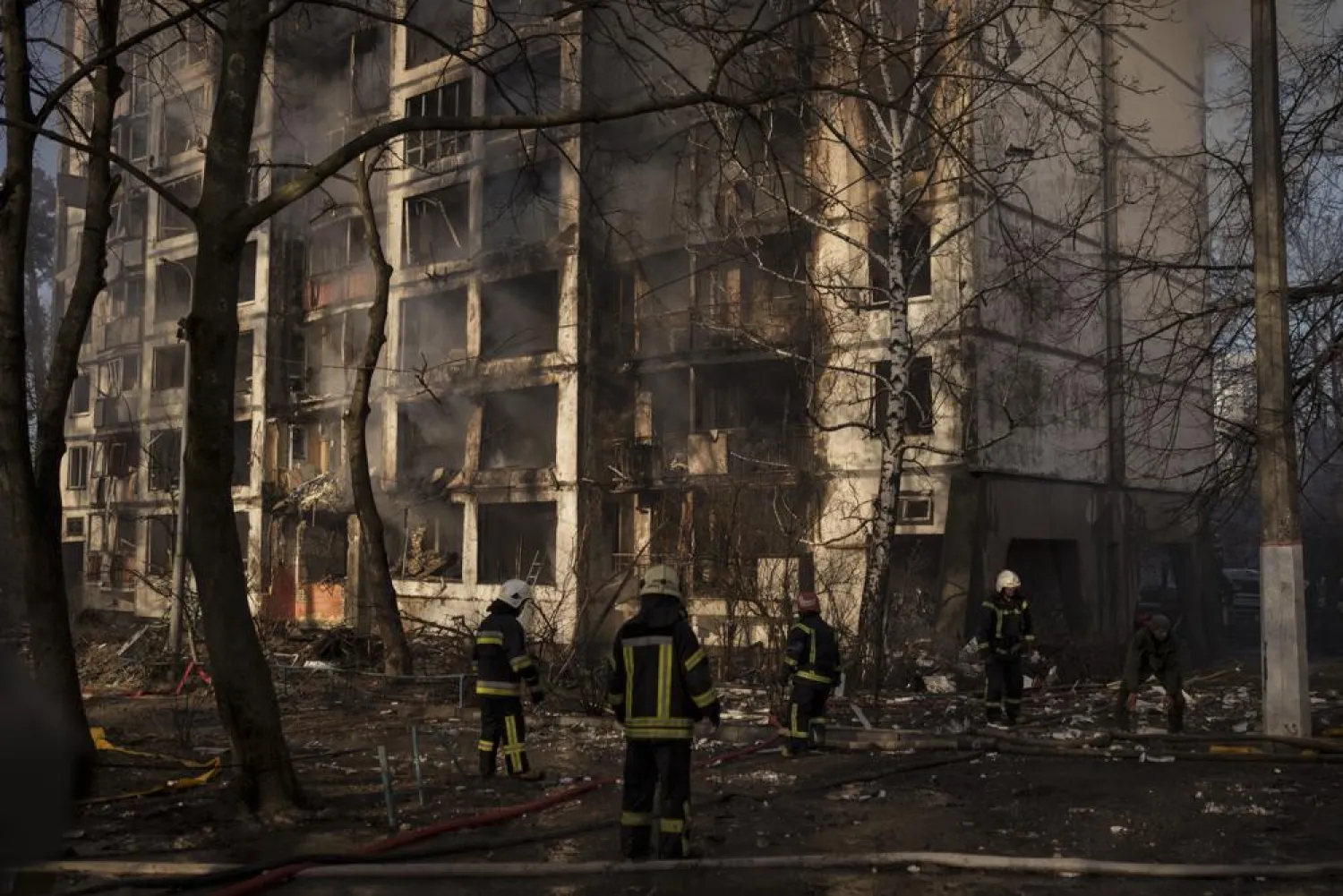
Firefighters work at the scene of an apartment building bombing in Kyiv, Ukraine, Tuesday, March 15, 2022. (AP)
TT

Russia Steps up Bombardment of Kyiv, Civilians Flee Mariupol

Firefighters work at the scene of an apartment building bombing in Kyiv, Ukraine, Tuesday, March 15, 2022. (AP)

Russia stepped up its bombardment of Kyiv on Tuesday, smashing apartments and a subway station, while civilians in 2,000 cars fled Mariupol along a humanitarian corridor in what was believed to be the biggest evacuation yet from the desperately besieged seaport.

On the diplomatic front, another round of talks began between Russia and Ukraine via video, and the leaders of three European Union countries — including Poland, a NATO member on Ukraine's doorstep — planned a visit to the embattled capital in a bold show of support.

With the number of people driven from the country by the war eclipsing 3 million, large explosions thundered across Kyiv before dawn from what Ukrainian authorities said were artillery strikes, as Russia’s assault on the capital appeared to become more systematic and edged closer to the city center.

Ukrainian President Volodymyr Zelenskyy said barrages hit four multi-story buildings in the city and killed dozens of people. The shelling ignited a huge fire in a 15-story apartment building and spurred a frantic rescue effort.

The strikes, carried out of the 20th day of Russia's invasion, targeted a western district of Kyiv, disrupting a relative calm that returned after an initial advance by Moscow's forces was stopped in the early days of the war.

The UN said close to 700 civilians in Ukraine have been confirmed killed, with the true figure probably much higher.

Fox News video journalist Pierre Zakrzewski was killed when the vehicle he was traveling in was hit by fire Monday on the outskirts of Kyiv, the network said. He was the second journalist killed in Ukraine in two days.

The leaders of Poland, the Czech Republic and Slovenia set out for Kyiv by train despite the security risks, in a visit EU officials said was not sanctioned by other members of the 27-nation bloc.

“The aim of the visit is to express the European Union’s unequivocal support for Ukraine and its freedom and independence,” Czech Prime Minister Petr Fiala said in a tweet. He was joined by fellow Prime Ministers Janez Jansa of Slovenia and Mateusz Morawiecki of Poland, as well as Jaroslaw Kaczynski, Poland’s de facto leader.

New efforts to bring civilians to safety and deliver aid were underway around the country. The Red Cross said it was working to evacuate people from the northeastern town of Sumy near the Russian border in about 70 buses.

One of the most desperate situations is in Mariupol, the southern city of 430,000 where officials say a weekslong siege has killed more than 2,300 people and left residents struggling for food, water, heat and medicine.

The Mariupol city council reported that 2,000 civilian cars had managed to leave along a humanitarian corridor that runs for more than 260 kilometers (160 miles) west to the city of Zaporizhzhia. Another 2,000 cars were waiting to leave along the route, the council said.

As for the latest round of talks, Ukrainian presidential aide Mykhailo Podolyak said they were discussing a cease-fire and Russian troop withdrawal. Russian Foreign Minister Sergei Lavrov said Moscow would press its demands that Ukraine drop its bid to join NATO, adopt a neutral status and “demilitarize.”

Zelenskyy told European leaders gathered in London that his country realizes it can't join NATO.

“We have heard for many years about the open doors, but we also heard that we can’t enter those doors," he said. "This is the truth, and we have simply to accept it as it is.”

When Russia launched the war three weeks ago, fear of an imminent invasion gripped the Ukrainian capital, and residents slept in subway stations or crammed onto trains to flee. But as the Russian offensive bogged down, Kyiv saw a relative lull. US officials said Russian forces were about 15 kilometers (9 miles) from the center of the city as of Monday.

Fighting has intensified on Kyiv's outskirts in recent days, and air raid sirens wailed inside the capital. Mayor Vitali Klitschko announced a 35-hour curfew extending through Thursday morning.

Tuesday's artillery strikes hit the Svyatoshynskyi district of western Kyiv, adjacent to the suburb of Irpin, which has seen some of the worst fighting of the war.

Flames shot out of the 15-story apartment building and smoke choked the air as firefighters climbed ladders to rescue people. The assault blackened several floors of the building, ripped a hole in the ground outside and blew out windows in neighboring apartment blocks. Rescue workers said at least one person was killed.

“Yesterday we extinguished one fire, today another. It is very difficult,” a firefighter who gave only his first name, Andriy, said outside the building, tears falling from his eyes. “People are dying, and the worst thing is that children are dying. They haven’t lived their lives and they have already seen this.”

Resident Volodymr Trophimov said he watched as a building was hit. "And then there was a howl, and I watched out of the window, and it crashed into the building and all the windows were smashed,” he said.

Shockwaves from an explosion also damaged the entry to a downtown subway station that has been used as a bomb shelter. City authorities tweeted an image of the blown-out facade and said trains would no longer stop at the station.

A 10-story apartment building in the Podilsky district of Kyiv, north of the government quarter, was damaged. Russian forces also stepped up strikes overnight on Irpin and the northwest Kyiv suburbs of Hostomel and Bucha, said the head of the capital region, Oleksiy Kuleba.

“Many streets have been turned into a mush of steel and concrete. People have been hiding for weeks in basements, and are afraid to go out even for evacuations,” Kuleba said on Ukrainian television.

In the country's east, Russian forces launched more than 60 strikes overnight on Ukraine’s second-largest city, Kharkiv, according to regional administration chief Oleh Sinehubov. The strikes hit the city’s historical center, including the main marketplace.

Sinehubov said fires were raging and rescuers pulled dozens of bodies of civilian from the ruins of destroyed apartment buildings.

Ukraine's parliament voted to extend martial law for another month, until April 24. Under the measure, requested by Zelenskyy, men between 18 and 60 are barred from leaving the country so they can be called up to fight.

In Mykolaiv, a strategic southern city near the Black Sea where airstrikes killed nine people Sunday, residents braced for more attacks. Volunteers prepared food and sorted donated clothes at an abandoned naval yard that was turned into a support center for troops. Molotov cocktails were on hand to take on invaders.

“We are bombed during the day and during the night,” said Svetlana Gryshchenko, whose soldier son was killed in the fighting. “It's a nightmare what Russia is doing on the territory of Ukraine.”



Freed Gaza Flotilla Activists Allege Israeli Abuse Including Rape

 Italian members of the Global Sumud Flotilla arrive at the Fiumicino Airport in Rome on Thursday, May 21, 2026, after they were released and deported by the Israeli government after attempting to reach Gaza. (Cecilia Fabiano/LaPresse via AP)
Italian members of the Global Sumud Flotilla arrive at the Fiumicino Airport in Rome on Thursday, May 21, 2026, after they were released and deported by the Israeli government after attempting to reach Gaza. (Cecilia Fabiano/LaPresse via AP)
TT

Freed Gaza Flotilla Activists Allege Israeli Abuse Including Rape

 Italian members of the Global Sumud Flotilla arrive at the Fiumicino Airport in Rome on Thursday, May 21, 2026, after they were released and deported by the Israeli government after attempting to reach Gaza. (Cecilia Fabiano/LaPresse via AP)
Italian members of the Global Sumud Flotilla arrive at the Fiumicino Airport in Rome on Thursday, May 21, 2026, after they were released and deported by the Israeli government after attempting to reach Gaza. (Cecilia Fabiano/LaPresse via AP)

Activists released from Israeli custody after being detained on a flotilla trying to bring aid to Gaza were subjected to abuse, organizers said on Friday, with several hospitalized with injuries and at least 15 reporting sexual assaults, including rape.

Israel's prison service denied the allegations, and Reuters was not able to verify them independently.

Germany said some of its nationals had been injured and that some accusations were "serious", without giving further details. A legal source in Italy said prosecutors there were investigating possible crimes including kidnapping and sexual assault.

"The allegations raised are false and entirely without factual basis," an Israeli prison service spokesperson said in a statement.

"All prisoners and detainees are held in accordance with the law, with full regard for their basic rights and under the supervision of professional and trained prison staff," it said. "Medical care is provided according to professional medical judgment and in accordance with Ministry of Health guidelines."

The Israeli military referred queries to the foreign ministry, which referred them to the prison service.

Israeli forces arrested 430 people on board 50 ships in international waters on Tuesday to halt a flotilla of ‌volunteers trying to bring ‌aid supplies to the Gaza Strip.

The allegations of abuse will add to pressure on Israeli authorities to ‌explain the ⁠treatment of the ⁠detainees, after video of an Israeli cabinet minister in a prison mocking some of the activists sparked an international outcry. Italy said EU members were discussing imposing sanctions on the minister, Itamar Ben-Gvir.

ALLEGATIONS OF SEXUAL ABUSE

Global Sumud Flotilla, the organizers of the aid shipment, said the group had documented at least 15 cases of sexual abuse, with the worst occurring on one Israeli landing craft which had been converted into a makeshift prison with barbed wire and shipping containers.

Detainees were thrown into the containers and beaten over the head and ribs, the group said in a statement.

They suffered multiple cases of sexual abuse, including "humiliating strip searches, sexual taunting, groping and pulling of genitals, and multiple accounts of rape."

"At least 12 sexual assaults have been documented on that vessel alone, including anal rape and forcible penetration ⁠by a handgun," it added.

The statement was released after the Israeli prison service's blanket denial of mistreatment, rape and ‌sexual assault allegations. Reuters sent the additional specific allegations to the prison service but did not receive ‌a reply after hours on Friday, a holiday in Israel.

Ilaria Mancosu, an Italian activist, said the flotilla members were removed from their boats to two so-called prison ships. ‌Those put on one of the ships suffered more violence than the other. They were locked in a container and beaten by five soldiers, ‌suffering fractures to the ribs and arms. Some had serious injuries to their eyes and ears caused by tasers.

She said they spent two days on the prison ships with no running water and used cardboard and plastic to keep warm at night, since they had no blankets and were stripped of most of their clothes.

Once on land they were made to kneel for several hours and kicked and shoved if they moved or spoke. They were then taken to a prison where they were ‌moved from room to room periodically to keep them from sleeping, she said.

ROME PROSECUTORS INVESTIGATING POSSIBLE CRIMES

Rome prosecutors are investigating the possible crimes of kidnapping, torture and sexual assault and will hear testimony from activists ⁠who have returned to Italy over ⁠the coming days, the Italian legal source said.

A German Foreign Ministry spokesperson said consular officials who met German activists on their arrival in Istanbul reported that a number had injuries and were undergoing medical checks.

Humane treatment of German nationals was an "absolute priority," the spokesperson said, and "we naturally expect a full explanation, as some of the allegations that have been made are serious".

Sabrina Charik, who helped organize the return of 37 French citizens from the flotilla, told Reuters five French participants had been hospitalized in Türkiye, some with broken ribs or fractured vertebrae. Some had made detailed accusations of sexual violence, including of rape, she said.

In an Instagram post by an activist group verified by Reuters, French national Adrien Jouen showed bruises across his back and on his forearms.

Activists said some of the alleged abuse took place at sea after their interception by Israeli naval forces, and some following their arrest and imprisonment in Israel.

Spain's Foreign Minister Jose Manuel Albares told reporters that 44 Spanish flotilla members were expected to arrive on Friday on flights from Istanbul to Madrid and Barcelona. Four of them had received medical treatment for injuries, he added.

Western governments on Thursday had expressed their anger after Ben-Gvir posted a video of himself mocking activists being pinned to the ground in a prison.

Italian Foreign Minister Antonio Tajani said on the sidelines of the NATO meeting in Sweden that he was in touch with all his EU counterparts "so that there may be a quick decision to impose sanctions" on Ben-Gvir.


Ebola Risk Now at Highest Level in DR Congo, Says WHO

Medical staff wearing personal protective equipment (PPE) are seen at the hospital in Rwampara on May 21, 2026. (AFP)
TT

Ebola Risk Now at Highest Level in DR Congo, Says WHO

Medical staff wearing personal protective equipment (PPE) are seen at the hospital in Rwampara on May 21, 2026. (AFP)

The risk from the deadly Ebola outbreak has been raised to the highest level for the Democratic Republic of Congo, the World Health Organization said Friday, as the toll continues to rise.

The WHO upgraded its risk assessment level from high to very high for the DR Congo, while keeping the regional risk level at high and the global risk level at low.

WHO chief Tedros Adhanom Ghebreyesus said the situation was "deeply worrisome".

He said there were now nearly 750 suspected cases in the DR Congo and 177 suspected deaths, as health workers scramble to track down contacts of everyone thought to be infected with the virus.

"The Ebola outbreak in the Democratic Republic of the Congo is spreading rapidly," he told a press conference.

"So far, 82 cases have been confirmed in DRC, with seven confirmed deaths.

"But we know the epidemic in DRC is much larger. There are now almost 750 suspected cases and 177 suspected deaths."

He said the situation in Uganda was "stable", with two cases confirmed in people who travelled from DRC and one death.

Measures taken in Uganda, including "intense contact tracing" and calling off the Martyrs' Day commemorations, "appear to have been effective in preventing the further spread of the virus", Tedros added.

While a US national who was working in the DRC has tested positive and been transferred to Germany for care, Tedros said another US national deemed to be a high-risk contact had been transferred to the Czech Republic.

Besides national staff already in the DRC, he said 22 international staff had been deployed to the field, "including some of our most experienced people".

Tedros said that violence and insecurity was impeding the response to the outbreak in the DRC.

- Treatment trials planned -

Ebola is a deadly viral disease spread through direct contact with bodily fluids. It can cause severe bleeding and organ failure.

There are no approved vaccines or therapeutics for the Bundibugyo strain of Ebola behind the current outbreak.

There have only been two previous outbreaks of Bundibugyo, in Uganda in 2007 and DRC in 2012.

WHO chief scientist Sylvie Briand said the UN agency was making an inventory of all existing tools which might be useful in combating the outbreak and then prioritizing them, with safety and efficacy the main criteria.

The WHO research and development branch has convened its technical advisory group on treatments, which recommended the prioritization of two monoclonal antibodies for clinical trials.

It also recommended evaluating the antiviral obeldesivir in clinical trials as post-exposure prophylaxis for people who are high-risk contacts.

Briand said it looked "promising" as something that might be able to prevent infected contacts from going on to develop disease from that infection.

The WHO is also in talks with partners on developing eventual vaccines that work against Bundibugyo.


Ukraine Hits College in Russian-Occupied Town, Killing 6

22 May 2026, Ukraine, Starobelsk: Emergency workers search through the rubble of the dormitory of the Starobelsk Professional College, part of the Lugansk State Pedagogical University, which was hit and destroyed in a Ukrainian drone strike on Starobelsk. (Alexander Reka/TASS via ZUMA Press/dpa)
TT

Ukraine Hits College in Russian-Occupied Town, Killing 6

22 May 2026, Ukraine, Starobelsk: Emergency workers search through the rubble of the dormitory of the Starobelsk Professional College, part of the Lugansk State Pedagogical University, which was hit and destroyed in a Ukrainian drone strike on Starobelsk. (Alexander Reka/TASS via ZUMA Press/dpa)

Ukrainian drones struck a college dormitory in the Russian-occupied region of Lugansk early Friday, killing six people and wounding dozens of others, Russian officials said.

As many as 15 others remained missing as of Friday afternoon, Russian President Vladimir Putin said in televised comments, describing the incident as a "terrorist" attack.

Putin ordered his defense ministry to prepare a response, without elaborating.

The Lugansk region is in east Ukraine, but is almost entirely occupied by Russia, which claims it as its own.

Images released by the region's Russian-installed governor showed what appeared to be a college in the town of Starobilsk with its windows blown out, flames visible in one of them.

There was no immediate comment from Ukraine.

"Enemy drones attacked the academic building and dormitory of Starobelsk Professional College," Moscow-installed governor Leonid Pasechnik said in a post on Russia's MAX messenger, using the Russian name for the town.

"At the time of the strike, 86 children aged 14 to 18 were there," he added.

Starobilsk lies about 65 kilometers (40 miles) from the front line in east Ukraine.

Russian forces captured the town in 2022, shortly after launching their full-scale offensive.

AFP was not able to immediately verify information about the college that was hit.

- 'No leniency' -

Putin said the attack took place as the students were sleeping.

"At the moment, it is known that six people were killed, 39 were wounded and 15 people are unaccounted for, as the search through the rubble is still ongoing," he said in televised comments.

"There are no military facilities, special services, or related services near the dormitory," he added.

Russia's foreign ministry said that those responsible would face "face inevitable and severe punishment".

"There will be no leniency," it said.

Russia's Investigative Committee accused the Ukrainian military of having fired multiple drones at the building.

"As a result of the attack, the five-storey building collapsed to the second floor," it said.

Ukraine, which denies targeting civilians, regularly fires drones at Russian-controlled areas in retaliation for mass Russian strikes on its own people.

The United Nations Human Rights Monitoring Mission in Ukraine has recorded more than 60,000 civilian casualties since 2022, almost 90 percent of which were in areas controlled by Ukraine.

A massive Russian attack on Ukraine's capital Kyiv last week killed 24 people, including three children, according to Ukrainian authorities.

Russia fired more than 100 drones at Ukraine between late Thursday and early Friday, according to the Ukrainian air force.