


Russia Says it Will Scale Back Near Kyiv as Talks Progress

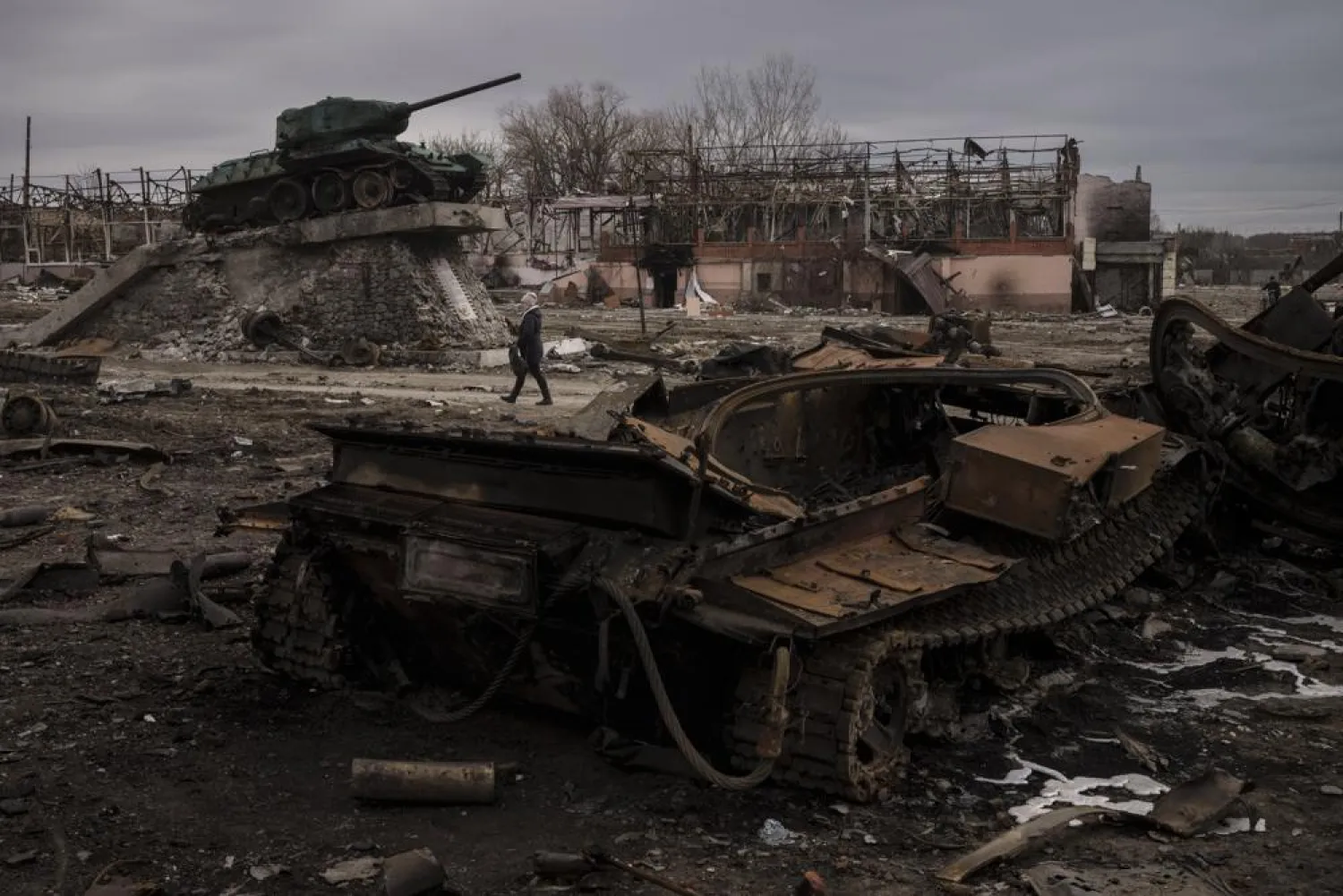
A woman walks past a destroyed tank in the town of Trostsyanets, Ukraine, Monday, March 28, 2022. (AP)
TT

Russia Says it Will Scale Back Near Kyiv as Talks Progress

A woman walks past a destroyed tank in the town of Trostsyanets, Ukraine, Monday, March 28, 2022. (AP)

Russia announced Tuesday it will “fundamentally" scale back military operations near Ukraine’s capital and a northern city, as talks to end the grinding war brought the outlines of a possible deal into view.

Deputy Defense Minister Alexander Fomin said the change on the battlefield was meant to increase trust at the talks after several rounds of negotiations failed to halt what has devolved into a bloody campaign of attrition.

The announcement was met with skepticism from the US. and others.

While Moscow portrayed it as a goodwill gesture, its ground troops have become bogged down and taken heavy losses in their bid to seize Kyiv and other cities. Last week and again on Tuesday, the Kremlin seemed to lower its war aims, saying its “main goal” now is gaining control of the mostly Russian-speaking Donbas region in eastern Ukraine.

US Secretary of State Antony Blinken said he had not seen anything indicating talks were progressing in a “constructive way,” and he suggested Russian indications of a pullback could be an attempt by Moscow to “deceive people and deflect attention.”

“There is what Russia says and there is what Russia does, and we’re focused on the latter,” Blinken said in Morocco. “And what Russia is doing is the continued brutalization of Ukraine.”

He added: “If they somehow believe that an effort to subjugate only the eastern part of Ukraine or the southern part of Ukraine ... can succeed, then once again they are profoundly fooling themselves.”

Western officials say Moscow is reinforcing troops in the Donbas in an attempt to encircle Ukraine’s best-trained and best-equipped forces, which are concentrated in the east.

Even as negotiators from the two sides assembled in Istanbul, Russian President Vladimir Putin's forces hit an oil depot in western Ukraine late Monday and blasted a gaping hole Tuesday morning in a nine-story government administration building in the southern port city of Mykolaiv. At least seven people were killed in that attack, Ukrainian President Volodymyr Zelenskyy said.

“It’s terrible. They waited for people to go to work” before striking the building, said regional governor Vitaliy Kim. “I overslept. I’m lucky.”

Fomin said Moscow has decided to “fundamentally ... cut back military activity in the direction of Kyiv and Chernihiv” to “increase mutual trust and create conditions for further negotiations.” He did not immediately spell out what that would mean in practical terms.

Ukraine’s military said it has noted withdrawals of some forces around Kyiv and Chernihiv. Pentagon spokesman John Kirby told CNN “we haven’t seen anything to corroborate” reports of Russia pulling back significant forces from around Kyiv. “But what we have seen over the last couple of days is they have stopped trying to advance on Kyiv.”

Rob Lee, a military expert at the US-based Foreign Policy Research Institute, tweeted: “This sounds like more of an acknowledgment of the situation around Kyiv where Russia’s advance has been stalled for weeks and Ukrainian forces have had recent successes. Russia doesn’t have the forces to encircle the city.”

The meeting in Istanbul was the first time negotiators from Russia and Ukraine talked face-to-face in two weeks. Earlier talks, held in person in Belarus or by video, made no progress toward ending the more than month-long war that has killed thousands and driven over 10 million Ukrainians from their homes, including almost 4 million who have fled the country.

Ukraine’s delegation set out a detailed framework for a peace deal under which the nation would remain neutral but its security would be guaranteed by a group of third countries, including the US, Britain, France, Turkey, China and Poland, in an arrangement similar to NATO’s “an attack on one is an attack on all” principle.

Ukraine said it would also be willing to hold talks over a 15-year period on the future of the Crimean Peninsula, seized by Russia in 2014.

The Kremlin has demanded among other things that Ukraine drop any hope of joining NATO.

Vladimir Medinskiy, the head of the Russian delegation, said on Russian TV that the Ukrainian proposals are a “step to meet us halfway, a clearly positive fact.” He cautioned that the parties are still far from reaching an agreement, but said: “We know now how to move further toward compromise. We aren’t just marking time in talks.”

Fomin likewise suggested there had been progress, saying “negotiations on preparing an agreement on Ukraine’s neutrality and non-nuclear status, as well as on giving Ukraine security guarantees, are turning to practical matters.”

In other developments:

— In what appeared to be a coordinated action to tackle Russian espionage, the Netherlands, Belgium, the Czech Republic, Ireland and North Macedonia expelled scores of Russian diplomats.

— The head of the UN nuclear watchdog agency arrived in Ukraine to try to ensure the safety of the country’s nuclear facilities. Russian forces have taken control of the decommissioned Chernobyl plant, site in 1986 of the world’s worst nuclear accident, and of the active Zaporizhzhia plant, where a building was damaged in fighting.

— Russia has destroyed more than 60 religious buildings across the country in just over a month of war, with most of the damage concentrated near Kyiv and in the east, Ukraine’s military said.

— In the room at the Istanbul talks was Roman Abramovich, a longtime Putin ally who has been sanctioned by Britain and the European Union. Kremlin spokesman Dmitry Peskov said the Chelsea football team owner has been serving as an unofficial mediator approved by both countries. But mystery about his role has been deepened by news reports that he may have been poisoned during an earlier round of talks.

Over the past several days, Ukrainian forces have mounted counterattacks and reclaimed ground on the outskirts of Kyiv and other areas. They retook Irpin, a key suburb northwest of the capital, Zelenskyy said Monday. But he warned that Russian troops were regrouping to take the area back.

Ukrainian soldiers gathered in a trench for photos with Col. Gen. Oleksandr Syrskyi, who said that Ukraine controls a vast majority of Irpin.

“We defend our motherland because we have very high morale,” said Syrskyi, the top military commander in charge of defense of Kyiv. “And because we want to win.”

Ukrainian forces also seized back Trostyanets, south of Sumy in the northeast, after weeks of Russian occupation that left a devastated landscape.

Arriving in the town Monday shortly afterward, The Associated Press saw the bodies of two Russian soldiers in the woods, and Russian tanks sat burned and twisted. A red “Z” marked a Russian truck, its windshield fractured, near stacked boxes of ammunition. Ukrainian forces on top of a tank flashed victory signs. Dazed residents lined up amid charred buildings, seeking aid.

Putin’s ground forces have been thwarted not just by stronger-than-expected Ukrainian resistance, but by what Western officials say are Russian tactical missteps, poor morale, shortages of food, fuel and cold weather gear, and other problems.

Reinforcing what the military said last week, Russian Defense Minister Sergei Shoigu said Tuesday that “liberating Donbas” is now Moscow’s chief objective.

While that presents a possible face-saving exit strategy for Putin, it has also raised Ukrainian fears the Kremlin aims to split the country and force it to surrender a swath of its territory.



Iranians Chant Slogans Against Supreme Leader at Memorials for Slain Protesters

An Iranian man holds the Iranian national flag during a memorial ceremony for those killed in anti-government protests earlier last month, at the Mosalla mosque in Tehran, Iran, 17 February 2026. (EPA)
TT

Iranians Chant Slogans Against Supreme Leader at Memorials for Slain Protesters

An Iranian man holds the Iranian national flag during a memorial ceremony for those killed in anti-government protests earlier last month, at the Mosalla mosque in Tehran, Iran, 17 February 2026. (EPA)

Iranians shouted slogans against Supreme Leader Ali Khamenei on Tuesday as they gathered to commemorate protesters killed in a crackdown on nationwide demonstrations that rights groups said left thousands dead, according to videos verified by AFP.

The country's clerical authorities also staged a commemoration in the capital Tehran to mark the 40th day since the deaths at the peak of the protests on January 8 and 9.

Officials acknowledge more than 3,000 people died during the unrest, but attribute the violence to "terrorist acts", while rights groups say many more thousands of people were killed, shot dead by security forces in a violent crackdown.

The protests, sparked by anger over the rising cost of living before exploding in size and anti-government fervor, subsided after the crackdown, but in recent days Iranians have chanted slogans from the relative safety of homes and rooftops at night.

On Tuesday, videos verified by AFP showed crowds gathering at memorials for some of those killed again shouting slogans against the theocratic government in place since the 1979 revolution.

In videos geolocated by AFP shared on social media, a crowd in Abadan in western Iran holds up flowers and commemorative photos of a young man as they shout "death to Khamenei" and "long live the shah", in support of the ousted monarchy.

Another video from the same city shows people running in panic from the sounds of shots, though it wasn't immediately clear if they were from live fire.

In the northeastern city of Mashhad a crowd in the street chanted, "One person killed, thousands have his back", another verified video showed.

Gatherings also took place in other parts of the country, according to videos shared by rights groups.

- Official commemorations -

At the government-organized memorial in Tehran crowds carried Iranian flags and portraits of those killed as nationalist songs played and chants of "Death to America" and "Death to Israel" echoed through the Khomeini Grand Mosalla mosque.

Iranian President Masoud Pezeshkian attended a similar event at the Imam Reza shrine in Mashhad.

Authorities have accused sworn enemies the United States and Israel of fueling "foreign-instigated riots", saying they hijacked peaceful protests with killings and vandalism.

Senior officials, including First Vice President Mohammad Reza Aref and Revolutionary Guards commander Esmail Qaani, attended the ceremony.

"Those who supported rioters and terrorists are criminals and will face the consequences," Qaani said, according to Tasnim news agency.

International organizations have said evidence shows Iranian security forces targeted protesters with live fire under the cover of an internet blackout.

The US-based Human Rights Activists News Agency (HRANA) has recorded more than 7,000 killings in the crackdown, the vast majority protesters, though rights groups warn the toll is likely far higher.

More than 53,500 people have been arrested in the ongoing crackdown, HRANA added, with rights groups warning protesters could face execution.

Tuesday's gatherings coincided with a second round of nuclear negotiations between Iran and the United States in Geneva, amid heightened tensions after Washington deployed an aircraft carrier group to the Middle East following Iran's crackdown on the protests.


Independent UN Body Condemns ‘Vicious Attacks’ on UN Expert on Palestinian Rights

United Nations (UN) Special Rapporteur on the occupied Palestinian territories Francesca Albanese looks on at the end of a press conference on the human rights situation in Gaza in Geneva on September 15, 2025. (AFP)
TT

Independent UN Body Condemns ‘Vicious Attacks’ on UN Expert on Palestinian Rights

United Nations (UN) Special Rapporteur on the occupied Palestinian territories Francesca Albanese looks on at the end of a press conference on the human rights situation in Gaza in Geneva on September 15, 2025. (AFP)

An ‌independent United Nations body on Tuesday condemned what it described as vicious attacks based on disinformation by several European ministers against the organization's special rapporteur for Palestine, Francesca Albanese.

In the past week several European countries, including Germany, France and Italy, called for Albanese’s resignation over her alleged criticism of Israel. Albanese, an Italian lawyer, denies making the remarks.

On Friday, the Czech Republic's Foreign Minister Petr Macinka quoted Albanese on X as having called Israel a "common enemy of humanity", and he ‌also called for ‌her resignation.

A transcript of Albanese's remarks ‌made ⁠in Doha on ⁠February 7 seen by Reuters did not characterize Israel in this way, although she has consistently criticized the country in the past over the Gaza conflict.

The UN Coordination Committee - a body of six independent experts which coordinates and facilitates the work of Special Rapporteurs - accused European ministers of relying on "manufactured ⁠facts".

"Instead of demanding Ms. Albanese's resignation ‌for performing her mandate...these government representatives ‌should join forces to hold accountable, including before the International Criminal Court, ‌leaders and officials accused of committing war crimes and ‌crimes against humanity in Gaza," the Committee said.

It said the pressure exerted on Albanese was part of an increasing trend of politically motivated and malicious attacks against independent human rights experts, UN officials ‌and judges of international courts.

US President Donald Trump's administration imposed sanctions on Albanese after she wrote ⁠letters ⁠to US companies accusing them of contributing to gross human rights violations by Israel in Gaza and the West Bank.

UN experts are commissioned by the Geneva-based Human Rights Council to monitor and document specific human rights crises but are independent of the organization itself.

There is no precedent for removing a special rapporteur during their term, although diplomats said that states on the 47-member council could in theory propose a motion to do so.

However, they said strong support for Palestinian rights within the body means that such a motion was unlikely to pass.


US Plans to Deploy More Missile Launchers to the Philippines Despite China’s Alarm 

A US M142 High Mobility Artillery Rocket System (HIMARS) fires a missile during a Combined Joint Littoral Live Fire Exercise at the joint military exercise called "Balikatan", Tagalog for shoulder-to-shoulder in a Naval station in Zambales province, northern Philippines on Wednesday, April 26, 2023. (AP)
TT

US Plans to Deploy More Missile Launchers to the Philippines Despite China’s Alarm 

A US M142 High Mobility Artillery Rocket System (HIMARS) fires a missile during a Combined Joint Littoral Live Fire Exercise at the joint military exercise called "Balikatan", Tagalog for shoulder-to-shoulder in a Naval station in Zambales province, northern Philippines on Wednesday, April 26, 2023. (AP)

The United States plans to deploy more high-tech missile systems to the Philippines to help deter aggression in the South China Sea, where the treaty allies on Tuesday condemned what they called China’s "illegal, coercive, aggressive, and deceptive activities."

Beijing has repeatedly expressed alarm over the installation in the northern Philippines of a US mid-range missile system called the Typhon in 2024 and of an anti-ship missile launcher last year. It said the US weapons were aimed at containing China’s rise and warned that these were a threat to regional stability.

China has asked the Philippines to withdraw the missile launchers from its territory, but officials led by President Ferdinand Marcos Jr. have rejected the demand.

US and Philippine officials held annual talks Monday in Manila on broadening security, political and economic engagements and boosting collaboration with regional security allies.

The US and the Philippines outlined in a joint statement Tuesday specific defense and security plans for this year, including joint military exercises, Washington's support to help modernize the Philippine military and efforts "to increase deployments of US cutting-edge missile and unmanned systems to the Philippines."

The longtime allies "underscored their support for preserving freedom of navigation and overflight, unimpeded lawful commerce and other lawful uses of the sea for all nations," the statement said.

"Both sides condemned China’s illegal, coercive, aggressive and deceptive activities in the South China Sea, recognizing their adverse effects on regional peace and stability and the economies of the Indo-Pacific and beyond," it added.

Confrontations between Chinese and Philippine coast guard forces have spiked in the disputed waters in recent years. Vietnam, Malaysia, Brunei and Taiwan are also involved in the territorial standoffs.

Neither side elaborated on the planned missile deployments but Philippine ambassador to Washington, Jose Manuel Romualdez, who took part in Monday’s talks, said US and Filipino defense officials discussed the possible deployment this year of "upgraded" types of US missile launchers that the Philippines may eventually decide to purchase.

"It’s a kind of system that’s really very sophisticated and will be deployed here in the hope that, down the road, we will be able to get our own," Romualdez told The Associated Press.

The Typhon missile system that the US Army deployed to the main northern Philippine region of Luzon in April 2024 and an anti-missile launcher called the Navy Marine Expeditionary Ship Interdiction System that was deployed in April last year also to Luzon have remained in the Philippines, Romualdez said.

During joint drills, US forces have exhibited the missile systems to batches of Filipino forces to familiarize them with the weapons’ capabilities and usage, military officials said.

Romualdez said the US missile deployments to the Philippines did not aim to antagonize any country.

"It’s purely for deterrence," he said. "Every time the Chinese show any kind of aggression, it only strengthens our resolve to have these types."

The Typhon missile launchers, a land-based weapon, can fire the Standard Missile-6 and the Tomahawk Land Attack Missile. Tomahawk missiles can travel over 1,000 miles (1,600 kilometers), which places China within their target range, from the northern Philippine region of Luzon.

Last year, the US Marines deployed the anti-ship missile launcher, the Navy Marine Expeditionary Ship Interdiction System, to Batan island in the northernmost Philippine province of Batanes, which faces the Bashi Channel just south of Taiwan.

The sea passage is a critical trade and military route that the US and Chinese militaries have tried to gain strategic control of.