

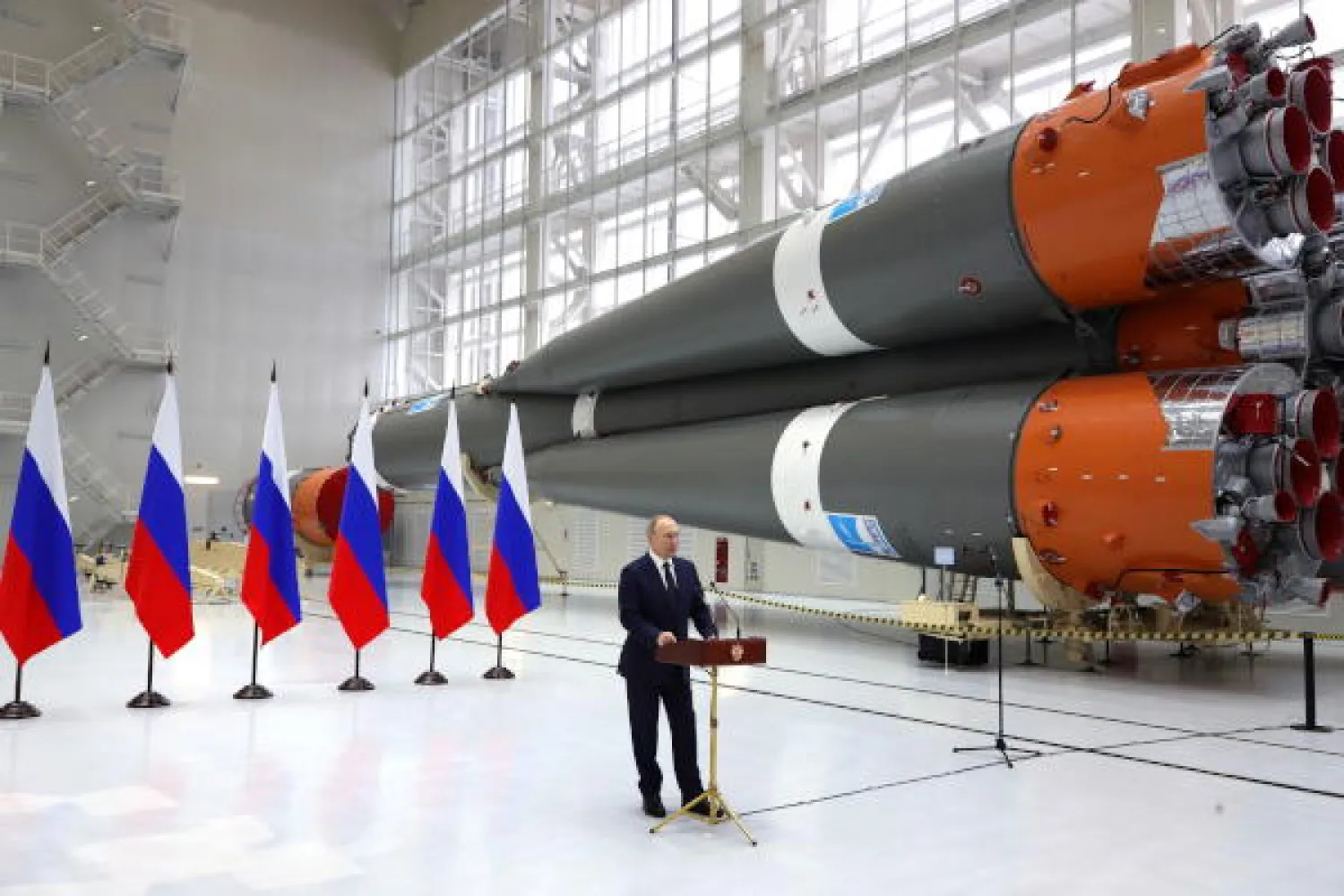

Putin Vows War Will Continue as Russian Troops Mount in East

Russian President Vladimir Putin delivers a speech, as he visits the Vostochny cosmodrome outside the city of Tsiolkovsky, some 180 km north of Blagoveschensk, in the far eastern Amur region, Russia, 12 April 2022. EPA/MIKHAIL KLIMENTYEV
TT

Putin Vows War Will Continue as Russian Troops Mount in East

Russian President Vladimir Putin delivers a speech, as he visits the Vostochny cosmodrome outside the city of Tsiolkovsky, some 180 km north of Blagoveschensk, in the far eastern Amur region, Russia, 12 April 2022. EPA/MIKHAIL KLIMENTYEV

Russia vowed to continue its bloody offensive in Ukraine as the war neared its seventh week Wednesday, as President Vladimir Putin insisted the campaign was going as planned despite a major withdrawal and significant losses.

Thwarted in their push toward the capital, Kyiv, Russian troops focused on the eastern region of Donbas, where Ukraine said it was investigating a claim that a poisonous substance had been dropped on its troops. It was not clear what the substance might be, but Western officials warned that any use of chemical weapons by Russia would be a serious escalation of the already devastating war.

Russia invaded on Feb. 24 with the goal, according to Western officials, of taking Kyiv, toppling the government and installing a Moscow-friendly regime. In the six weeks since, the ground advance stalled and Russian forces lost potentially thousands of fighters and were accused of killing civilians and other atrocities.

Putin said Tuesday that Moscow “had no other choice” and that the invasion aimed to protect people in parts of eastern Ukraine and to “ensure Russia’s own security.” He vowed it would “continue until its full completion and the fulfillment of the tasks that have been set.”

Meanwhile Wednesday, Ukrainian President Volodymyr Zelenskyy was expected to receive the presidents of Poland, Lithuania, Latvia and Estonia — his staunch European allies.

“We are visiting Ukraine to show strong support for the Ukrainian people, will meet dear friend President Zelenskyy,“ Estonian President Alar Karis tweeted.

For now, Putin’s forces are gearing up for a major offensive in the Donbas, where Russian-allied separatists and Ukrainian forces have been fighting since 2014, and where Russia has recognized the separatists’ claims of independence. Military strategists say Moscow believes local support, logistics and the terrain in the region favor its larger, better-armed military, potentially allowing Russia to finally turn the tide in its favor.

In Mariupol, a strategic port city in the Donbas, a Ukrainian regiment defending a steel mill alleged that a drone dropped a poisonous substance on the city. The assertion by the Azov Regiment, a far-right group now part of the Ukrainian military, could not be independently verified. The regiment indicated there were no serious injuries.

Zelenskyy said that while experts try to determine what the substance might be, “The world must react now.”

The claims came after a Russia-allied separatist official appeared to urge the use of chemical weapons, telling Russian state TV on Monday that separatist forces should seize the plant by first blocking all the exits. “And then we’ll use chemical troops to smoke them out of there,” the official, Eduard Basurin, said. He denied Tuesday that separatist forces had used chemical weapons in Mariupol.

Ukrainian Deputy Defense Minister Hanna Maliar said officials were investigating, and it was possible phosphorus munitions — which cause horrendous burns but are not classed as chemical weapons — had been used in Mariupol, which has been pummeled by weeks of Russian assaults.

Western leaders warned that if chemical weapons are found to have been used, it would amount to a grievous breach of international law.

President Joe Biden for the first time referred to Russia’s invasion as a “genocide” and said “Putin is just trying to wipe out the idea of even being a Ukrainian.”

The Pentagon said it could not confirm the drone report but reiterated US concerns about Russia using chemical agents. Britain, meanwhile, has warned that Russia may resort to phosphorus bombs, which are banned in civilian areas under international law, in Mariupol.

Most armies use phosphorus munitions to illuminate targets or to produce smoke screens. Deliberately firing them into an enclosed space to expose people to fumes could breach the Chemical Weapons Convention, said Marc-Michael Blum, a former laboratory head at the Netherlands-based Organization for the Prohibition of Chemical Weapons.

“Once you start using the properties of white phosphorus, toxic properties, specifically and deliberately, then it becomes banned,” he said.

In Washington, a senior US defense official said the Biden administration was preparing another package of military aid for Ukraine to be announced in the coming days, possibly totaling $750 million.
The official spoke on condition of anonymity to discuss plans not yet publicly announced. Delivery is due to be completed this week of $800 million in military assistance approved by Biden a month ago.

In the face of stiff resistance by Ukrainian forces bolstered by Western weapons, Russian forces have increasingly relied on bombarding cities, flattening many urban areas and killing thousands. The war has driven more than 10 million Ukrainians from their homes — including nearly two-thirds of the country’s children.

Ukraine's Deputy Prime Minister Iryna Vereshchuk said humanitarian corridors used to get people out of cities under Russian attack will not operate on Wednesday because of poor security.

She said that in the southeast Zaporizhzhia region, Russian troops blocked evacuation buses, and in the Luhansk region, they were violating the cease-fire.

"The occupiers not only disregard the norms of international humanitarian law, but also cannot properly control their people on the ground. All this creates such a level of danger on the routes that we are forced to refrain from opening humanitarian corridors today.”

Moscow’s retreat from cities and towns around Kyiv led to the discovery of large numbers of apparently massacred civilians, prompting widespread condemnation and accusations of war crimes.
Zelenskyy said evidence of “inhuman cruelty” toward women and children in Bucha and other suburbs of Kyiv continued to surface, including alleged rapes.

“Not all serial rapists reach the cruelty of Russian soldiers,” Zelenskyy said.

More than 720 people were killed in Kyiv suburbs that had been occupied by Russian troops and over 200 were considered missing, the Interior Ministry said early Wednesday.
In Bucha alone, Mayor Anatoliy Fedoruk said 403 bodies had been found and the toll could rise as minesweepers comb the area.

In the Chernihiv region, villagers said more than 300 people had been trapped for almost a month by the occupying Russian troops in the basement of a school and only allowed outside to go to the toilet or cook on open fires.

Valentyna Saroyan told The Associated Press she saw at least five people die in Yahidne, 140 kilometers (86 miles) north of Kyiv. In one of the rooms, the residents wrote the names of those who perished during the ordeal — the list counted 18 people.

Villagers say they don’t know the cause of the deaths. Russian soldiers allowed them to remove the bodies from time to time in order to bury them in a mass grave at the local cemetery.

Julia Surypak said the Russians only allowed some people to make a short trip home if they sang the Russian anthem. Another resident, Svitlana Baguta, said a Russian soldier made her drink from a flask pointing a gun at her face.

Ukraine’s prosecutor-general’s office said Tuesday it was also looking into events in the Brovary district, which lies to the northeast. It said the bodies of six civilians were found with gunshot wounds in a basement in the village of Shevchenkove and Russian forces were believed to be responsible.

Prosecutors are also investigating allegations that Russian forces fired on a convoy of civilians trying to leave by car from the village of Peremoha in the Brovary district, killing four people including a 13-year-old boy. In another attack near Bucha, five people were killed including two children when a car was fired upon, prosecutors said.

Putin falsely claimed Tuesday that Ukraine’s accusation that hundreds of civilians were killed by Russian troops in the town of Bucha were “fake.”

Associated Press journalists saw dozens of bodies in and around the town, some of whom had their hands bound and appeared to have been shot at close range.



Iranians Chant Slogans Against Supreme Leader at Memorials for Slain Protesters

An Iranian man holds the Iranian national flag during a memorial ceremony for those killed in anti-government protests earlier last month, at the Mosalla mosque in Tehran, Iran, 17 February 2026. (EPA)
TT

Iranians Chant Slogans Against Supreme Leader at Memorials for Slain Protesters

An Iranian man holds the Iranian national flag during a memorial ceremony for those killed in anti-government protests earlier last month, at the Mosalla mosque in Tehran, Iran, 17 February 2026. (EPA)

Iranians shouted slogans against Supreme Leader Ali Khamenei on Tuesday as they gathered to commemorate protesters killed in a crackdown on nationwide demonstrations that rights groups said left thousands dead, according to videos verified by AFP.

The country's clerical authorities also staged a commemoration in the capital Tehran to mark the 40th day since the deaths at the peak of the protests on January 8 and 9.

Officials acknowledge more than 3,000 people died during the unrest, but attribute the violence to "terrorist acts", while rights groups say many more thousands of people were killed, shot dead by security forces in a violent crackdown.

The protests, sparked by anger over the rising cost of living before exploding in size and anti-government fervor, subsided after the crackdown, but in recent days Iranians have chanted slogans from the relative safety of homes and rooftops at night.

On Tuesday, videos verified by AFP showed crowds gathering at memorials for some of those killed again shouting slogans against the theocratic government in place since the 1979 revolution.

In videos geolocated by AFP shared on social media, a crowd in Abadan in western Iran holds up flowers and commemorative photos of a young man as they shout "death to Khamenei" and "long live the shah", in support of the ousted monarchy.

Another video from the same city shows people running in panic from the sounds of shots, though it wasn't immediately clear if they were from live fire.

In the northeastern city of Mashhad a crowd in the street chanted, "One person killed, thousands have his back", another verified video showed.

Gatherings also took place in other parts of the country, according to videos shared by rights groups.

- Official commemorations -

At the government-organized memorial in Tehran crowds carried Iranian flags and portraits of those killed as nationalist songs played and chants of "Death to America" and "Death to Israel" echoed through the Khomeini Grand Mosalla mosque.

Iranian President Masoud Pezeshkian attended a similar event at the Imam Reza shrine in Mashhad.

Authorities have accused sworn enemies the United States and Israel of fueling "foreign-instigated riots", saying they hijacked peaceful protests with killings and vandalism.

Senior officials, including First Vice President Mohammad Reza Aref and Revolutionary Guards commander Esmail Qaani, attended the ceremony.

"Those who supported rioters and terrorists are criminals and will face the consequences," Qaani said, according to Tasnim news agency.

International organizations have said evidence shows Iranian security forces targeted protesters with live fire under the cover of an internet blackout.

The US-based Human Rights Activists News Agency (HRANA) has recorded more than 7,000 killings in the crackdown, the vast majority protesters, though rights groups warn the toll is likely far higher.

More than 53,500 people have been arrested in the ongoing crackdown, HRANA added, with rights groups warning protesters could face execution.

Tuesday's gatherings coincided with a second round of nuclear negotiations between Iran and the United States in Geneva, amid heightened tensions after Washington deployed an aircraft carrier group to the Middle East following Iran's crackdown on the protests.


Independent UN Body Condemns ‘Vicious Attacks’ on UN Expert on Palestinian Rights

United Nations (UN) Special Rapporteur on the occupied Palestinian territories Francesca Albanese looks on at the end of a press conference on the human rights situation in Gaza in Geneva on September 15, 2025. (AFP)
TT

Independent UN Body Condemns ‘Vicious Attacks’ on UN Expert on Palestinian Rights

United Nations (UN) Special Rapporteur on the occupied Palestinian territories Francesca Albanese looks on at the end of a press conference on the human rights situation in Gaza in Geneva on September 15, 2025. (AFP)

An ‌independent United Nations body on Tuesday condemned what it described as vicious attacks based on disinformation by several European ministers against the organization's special rapporteur for Palestine, Francesca Albanese.

In the past week several European countries, including Germany, France and Italy, called for Albanese’s resignation over her alleged criticism of Israel. Albanese, an Italian lawyer, denies making the remarks.

On Friday, the Czech Republic's Foreign Minister Petr Macinka quoted Albanese on X as having called Israel a "common enemy of humanity", and he ‌also called for ‌her resignation.

A transcript of Albanese's remarks ‌made ⁠in Doha on ⁠February 7 seen by Reuters did not characterize Israel in this way, although she has consistently criticized the country in the past over the Gaza conflict.

The UN Coordination Committee - a body of six independent experts which coordinates and facilitates the work of Special Rapporteurs - accused European ministers of relying on "manufactured ⁠facts".

"Instead of demanding Ms. Albanese's resignation ‌for performing her mandate...these government representatives ‌should join forces to hold accountable, including before the International Criminal Court, ‌leaders and officials accused of committing war crimes and ‌crimes against humanity in Gaza," the Committee said.

It said the pressure exerted on Albanese was part of an increasing trend of politically motivated and malicious attacks against independent human rights experts, UN officials ‌and judges of international courts.

US President Donald Trump's administration imposed sanctions on Albanese after she wrote ⁠letters ⁠to US companies accusing them of contributing to gross human rights violations by Israel in Gaza and the West Bank.

UN experts are commissioned by the Geneva-based Human Rights Council to monitor and document specific human rights crises but are independent of the organization itself.

There is no precedent for removing a special rapporteur during their term, although diplomats said that states on the 47-member council could in theory propose a motion to do so.

However, they said strong support for Palestinian rights within the body means that such a motion was unlikely to pass.


US Plans to Deploy More Missile Launchers to the Philippines Despite China’s Alarm 

A US M142 High Mobility Artillery Rocket System (HIMARS) fires a missile during a Combined Joint Littoral Live Fire Exercise at the joint military exercise called "Balikatan", Tagalog for shoulder-to-shoulder in a Naval station in Zambales province, northern Philippines on Wednesday, April 26, 2023. (AP)
TT

US Plans to Deploy More Missile Launchers to the Philippines Despite China’s Alarm 

A US M142 High Mobility Artillery Rocket System (HIMARS) fires a missile during a Combined Joint Littoral Live Fire Exercise at the joint military exercise called "Balikatan", Tagalog for shoulder-to-shoulder in a Naval station in Zambales province, northern Philippines on Wednesday, April 26, 2023. (AP)

The United States plans to deploy more high-tech missile systems to the Philippines to help deter aggression in the South China Sea, where the treaty allies on Tuesday condemned what they called China’s "illegal, coercive, aggressive, and deceptive activities."

Beijing has repeatedly expressed alarm over the installation in the northern Philippines of a US mid-range missile system called the Typhon in 2024 and of an anti-ship missile launcher last year. It said the US weapons were aimed at containing China’s rise and warned that these were a threat to regional stability.

China has asked the Philippines to withdraw the missile launchers from its territory, but officials led by President Ferdinand Marcos Jr. have rejected the demand.

US and Philippine officials held annual talks Monday in Manila on broadening security, political and economic engagements and boosting collaboration with regional security allies.

The US and the Philippines outlined in a joint statement Tuesday specific defense and security plans for this year, including joint military exercises, Washington's support to help modernize the Philippine military and efforts "to increase deployments of US cutting-edge missile and unmanned systems to the Philippines."

The longtime allies "underscored their support for preserving freedom of navigation and overflight, unimpeded lawful commerce and other lawful uses of the sea for all nations," the statement said.

"Both sides condemned China’s illegal, coercive, aggressive and deceptive activities in the South China Sea, recognizing their adverse effects on regional peace and stability and the economies of the Indo-Pacific and beyond," it added.

Confrontations between Chinese and Philippine coast guard forces have spiked in the disputed waters in recent years. Vietnam, Malaysia, Brunei and Taiwan are also involved in the territorial standoffs.

Neither side elaborated on the planned missile deployments but Philippine ambassador to Washington, Jose Manuel Romualdez, who took part in Monday’s talks, said US and Filipino defense officials discussed the possible deployment this year of "upgraded" types of US missile launchers that the Philippines may eventually decide to purchase.

"It’s a kind of system that’s really very sophisticated and will be deployed here in the hope that, down the road, we will be able to get our own," Romualdez told The Associated Press.

The Typhon missile system that the US Army deployed to the main northern Philippine region of Luzon in April 2024 and an anti-missile launcher called the Navy Marine Expeditionary Ship Interdiction System that was deployed in April last year also to Luzon have remained in the Philippines, Romualdez said.

During joint drills, US forces have exhibited the missile systems to batches of Filipino forces to familiarize them with the weapons’ capabilities and usage, military officials said.

Romualdez said the US missile deployments to the Philippines did not aim to antagonize any country.

"It’s purely for deterrence," he said. "Every time the Chinese show any kind of aggression, it only strengthens our resolve to have these types."

The Typhon missile launchers, a land-based weapon, can fire the Standard Missile-6 and the Tomahawk Land Attack Missile. Tomahawk missiles can travel over 1,000 miles (1,600 kilometers), which places China within their target range, from the northern Philippine region of Luzon.

Last year, the US Marines deployed the anti-ship missile launcher, the Navy Marine Expeditionary Ship Interdiction System, to Batan island in the northernmost Philippine province of Batanes, which faces the Bashi Channel just south of Taiwan.

The sea passage is a critical trade and military route that the US and Chinese militaries have tried to gain strategic control of.