


North Korea’s Kim Offers Rare Praise for South’s Departing Moon

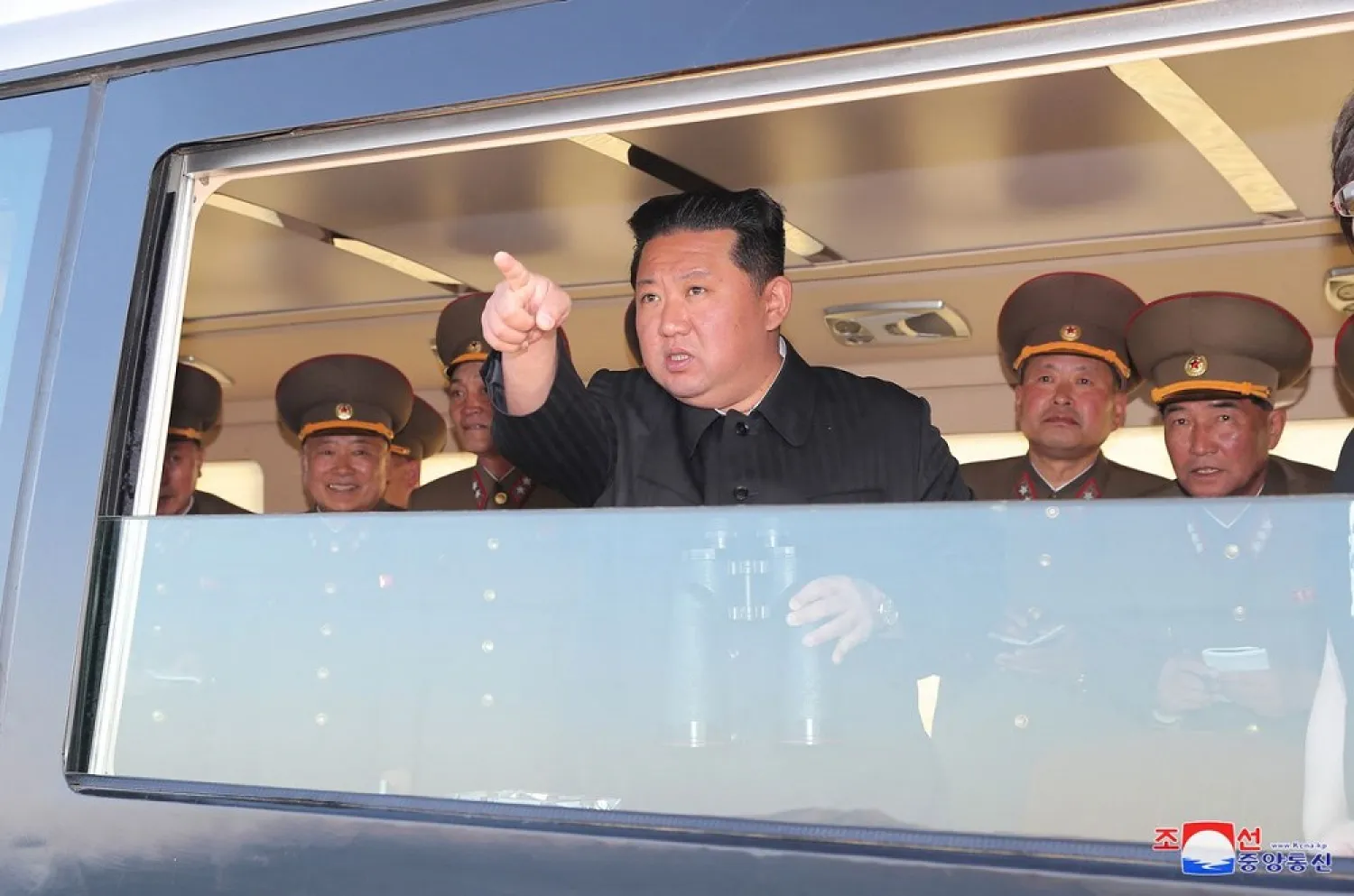
North Korean leader Kim Jong Un gestures as he watches the test-firing of a new-type tactical guided weapon according to state media, North Korea, in this undated photo released on April 16, 2022 by North Korea's Korean Central News Agency (KCNA). KCNA via Reuters
TT

North Korea’s Kim Offers Rare Praise for South’s Departing Moon

North Korean leader Kim Jong Un gestures as he watches the test-firing of a new-type tactical guided weapon according to state media, North Korea, in this undated photo released on April 16, 2022 by North Korea's Korean Central News Agency (KCNA). KCNA via Reuters

North Korean leader Kim Jong Un has thanked South Korea's outgoing president for trying to improve relations, a rare gesture of goodwill but one that analysts said may not be enough to head off growing tension between the two Koreas.

The warm words from North Korea to President Moon Jae-in came in an exchange of letters less than three weeks before Moon leaves office to be replaced by a conservative leader who has already signaled a tougher line on North Korea

Analysts were skeptical that North Korea's message heralded a broader improvement in relations, and warned that the praise for Moon could be a bid to portray his successor, Yoon Suk-yeol, as responsible for any further deterioration in ties.

North Korean state media was the first to report the exchange and the unexpected North Korean plaudits for the stalled effort by Moon and his liberal administration to engage.

"Kim Jong Un appreciated the pains and effort taken by Moon Jae-in for the great cause of the nation until the last days of his term of office," North Korea's KCNA state news agency reported.

The exchange of letters was an "expression of their deep trust", it said.

The letters come against a backdrop of tension since a failed North Korea-US summit in 2019, exacerbated last month when North Korea launched intercontinental ballistic missiles (ICBM), ending a self-imposed 2017 moratorium.

Moon sent a letter on Wednesday and promised to try to lay a foundation for unification based on joint declarations reached at summits in 2018, despite the "difficult situation", KCNA said.

Moon's office confirmed that he had exchanged "letters of friendship" with Kim.

Moon said the "era of confrontation" should be overcome with dialogue, and inter-Korean engagement was now a task for the next administration, his spokeswoman told a briefing. Moon also expressed hope for the swift resumption of US-North Korea denuclearization talks.

Kim said in his reply on Thursday that their "historic" summits gave the people "hope for the future", and the two agreed that ties would develop if both sides "make tireless efforts with hope", KCNA reported.

Pretext for blame?

The exchange came as US Special Representative for North Korea Sung Kim was in South Korea for talks. The US envoy has said he is open to sitting down with the North at any time without preconditions, but it was unclear whether Moon's letter specifically proposed a meeting.

Analysts questioned the North's true intentions.

"This looks more like another step in building the pretext to blame Yoon for more escalation from North Korea, rather than an olive branch to Yoon or Biden," said Markus Garlauskas, a senior fellow with the Atlantic Council think tank and former US national intelligence officer for North Korea.

Yang Moo-jin, a professor at the University of North Korean Studies in Seoul, said the letters could signal to Yoon that the door for cooperation was still open, and a potential seventh nuclear test by the North or any other future action would hinge on Yoon's approach.

Yoon, who takes office on May 10, has said that he is open to dialogue but greater military deterrence and a stronger US alliance are needed to counter the North's "provocations".

Kwon Young-se, Yoon's nominee to oversee cross-border affairs, said the exchange of letters was a "good thing" and Kim offered "positive" views on inter-Korean ties.

"There was some content that the new government would want to hear," he told reporters. "It was very positive that he does not negatively see trust and progress in relations."

Tension escalated when North Korea last month conducted its first full ICBM test since 2017, and there are concerns that it is preparing to restart nuclear testing.

Legacy at stake

Moon staked his legacy on improving inter-Korean ties and helped arrange unprecedented meetings between Kim Jong Un and then US President Donald Trump in 2018 and 2019.

Three summits Kim and Moon held in 2018 promised peace and reconciliation but relations have soured, with the North warning of destructive action and demolishing facilities built by South Korean firms for joint projects.

In 2020, the North spectacularly blew up a joint liaison office on the border, which Moon's government had spent 9.78 billion won ($8.6 million) renovating.

The two leaders tried again to mend ties last year but little progress was made and Pyongyang then criticized Seoul's "double standards" over weapons.

North Korea's statement left open a possibility for Moon to play a role as envoy, but Christopher Green, a Korea specialist at Leiden University in the Netherlands, said it was unlikely to have a positive impact on his reputation.

The statement could stir controversy in the South by portraying Moon as "a deluded peacenik who, after all the weapons tests North Korea has conducted in the last eight months, is still writing convivial letters to Kim", Green said.



Iran War as a New Catalyst...China Secretly Enters Nuclear Arms Race

China asserts that it follows a defensive strategy and is committed to the no-first-use of nuclear weapons (file-Reuters).
TT

Iran War as a New Catalyst...China Secretly Enters Nuclear Arms Race

China asserts that it follows a defensive strategy and is committed to the no-first-use of nuclear weapons (file-Reuters).

When three villagers from China’s Sichuan Province wrote to local officials in 2022 questioning why the government was confiscating their land and evicting them from their homes, they received a brief response: "It is a state secret."

An investigation by CNN revealed that this secret centers on China's plans to significantly expand its nuclear capabilities. More than three years after the citizen evacuations, satellite imagery shows their village has been leveled, replaced by new buildings designed to support some of China’s most critical nuclear weapons production facilities.

CNN reported that the expansion of these sites in Sichuan, observed through satellite imagery and a review of dozens of Chinese government documents, confirms recent allegations by President Donald Trump’s administration that Beijing is conducting its largest nuclear modernization campaign in decades.

President Trump is scheduled to visit Beijing on a historic trip next month, where he is expected to seek a dialogue on an agreement to curb Chinese President Xi Jinping’s nuclear ambitions.

Most Significant New Facilities in Sichuan Province

Among the most prominent of these facilities is a massive, fortified dome built on the banks of the Tongjiang River in less than five years. It appears to still be undergoing outfitting, suggesting it may not yet be operational.

The reinforced dome covers an area of 3,344 square meters (equivalent to 13 tennis courts). It is encased in a concrete and steel structure equipped with radiation monitoring devices and blast-proof doors, with a network of pipes extending from the facility to a building featuring a high ventilation chimney.

According to several experts, these features, along with advanced air-handling equipment, are designed to contain highly radioactive materials, such as uranium and plutonium, within the dome, indicating an expansion of the Chinese nuclear program's production capacity. The facility is also surrounded by three layers of security fencing.

No Sign of Retreat

This development comes at a time of rising international tensions, particularly following the expiration of the latest nuclear arms limitation treaty between the United States and Russia (known as "New START") earlier this year. Trump is seeking to broker a new and improved agreement with Moscow that would also include China.

However, the radical changes witnessed in Sichuan indicate that the Chinese military's nuclear weapons development shows no sign of slowing down, according to the CNN report.

In contrast, China denies the accusations; military spokesperson Jiang Bin emphasized that his country "follows a defensive strategy and is committed to no-first-use of nuclear weapons."

However, experts believe the significant changes on the ground reflect a fundamental shift in the nuclear program. Analyst Decker Eveleth said that this extensive modernization suggests a fundamental restructuring of the technology underpinning the entire system.

Renny Babiarz, Vice President of Analysis and Operations at AllSource Analysis, who reviewed the satellite imagery for CNN, also pointed to the potential development of "new processes and different types of equipment" within these facilities. He said it was clear that there are many changes happening on the ground."

This expansion coincides with directives issued by the Chinese President to accelerate the building of strategic deterrence capabilities amid escalating regional tensions, particularly regarding Taiwan.

Observers believe these moves could lead to a new nuclear arms race more complex than the Cold War era, with China emerging as a major third party. There are also concerns that the United States might overestimate China's capabilities, thereby exacerbating nuclear proliferation.

Jeffrey Lewis, a distinguished scholar in global security at the Middlebury Institute, said some in the US will argue that we need to radically expand our nuclear weapons production capacity to match China..."but we won't be matching what they are doing; we will be matching what we think they are doing. We will be matching our own nightmare. And that is extremely dangerous."

Impact of the Iran War on China’s Nuclear Program

Experts say that the ongoing US-Israeli war on Iran may have strengthened China's resolve to expand its nuclear program.

"If you were Chinese and looked at what is happening, you wouldn't see that disarmament or weakening yourself makes any sense," Lewis said. He added: "One outcome of what the Trump administration is doing in Iran will not be to intimidate or subdue China, but rather to push it to build more nuclear weapons."

Lewis noted that, given these factors, the chances of reaching arms control agreements appear limited, pointing out that China may engage in "formal" dialogues to de-escalate tensions without offering substantial concessions.


India Says Defense Exports Hit 'All-time High' of $4 bn

India said it exported more than $4 billion of defense equipment including missiles, boats and artillery. Dibyangshu SARKAR / AFP
TT

India Says Defense Exports Hit 'All-time High' of $4 bn

India said it exported more than $4 billion of defense equipment including missiles, boats and artillery. Dibyangshu SARKAR / AFP

India's defense exports "skyrocketed" to an all-time high of more than $4 billion in the last fiscal year, as it looks to boost its arms manufacturing sector, the government said Thursday.

The figures mark a rise of more than 60 percent from 2024, the defense ministry said, and provide a shot in the arm for the South Asian country, which is determined to recast itself as a major producer and exporter of weapons, AFP said.

"India is marching ahead towards becoming a global defense manufacturing hub," the ministry quoted Defense Minister Rajnath Singh as saying.

"This big jump... in defense exports reflects the growing global trust in India's indigenous capabilities and advanced manufacturing strength," Singh said, adding that it had hit an "all-time high" in the fiscal year 2025-26 of 38,424 billion rupees ($4.15 billion).

Government defense companies produced nearly 55 percent of the exports, with the rest made by private companies.

"This milestone showcases the power of a collaborative and self-reliant defense ecosystem," Singh said.

India exports defense equipment to more than 100 countries, with the United States, France and Armenia among the top customers, according to the defense ministry.

Shipments range from missiles, boats and artillery to radar systems, rocket launchers and electronic components.

However, the country is still primarily a buyer, not a seller, and remains globally a minor player in exports.

New Delhi earlier this year announced a record $85 billion boost for its defense sector.

But India's arms purchases still make up around eight percent of all imports globally, according to the Stockholm International Peace Research Institute.


Russia Repels Drone Attack on Gas Pipeline to Türkiye, Says Gazprom

File photo: Pipes at the landfall facilities of the Nord Stream 1 gas pipeline are pictured in Lubmin, Germany, March 8, 2022. (Reuters)
TT

Russia Repels Drone Attack on Gas Pipeline to Türkiye, Says Gazprom

File photo: Pipes at the landfall facilities of the Nord Stream 1 gas pipeline are pictured in Lubmin, Germany, March 8, 2022. (Reuters)

Russian forces repelled a drone attack early Thursday on part of the TurkStream gas pipeline connecting Russia and Türkiye, the pipeline's operator Gazprom said in a statement.

"The Russkaya compressor station, which ensures the reliable export of gas via the TurkStream pipeline, came under attack from three aircraft-type unmanned aerial vehicles," Gazprom said. "The attack was repelled and no damage was caused to the Gazprom facility."

The Russkaya compressor station is the starting point of the TurkStream pipeline. Russia has accused Ukraine of targeting it multiple times.