


Some Evacuated from Mariupol; US Lawmaker Pelosi Visits Kyiv

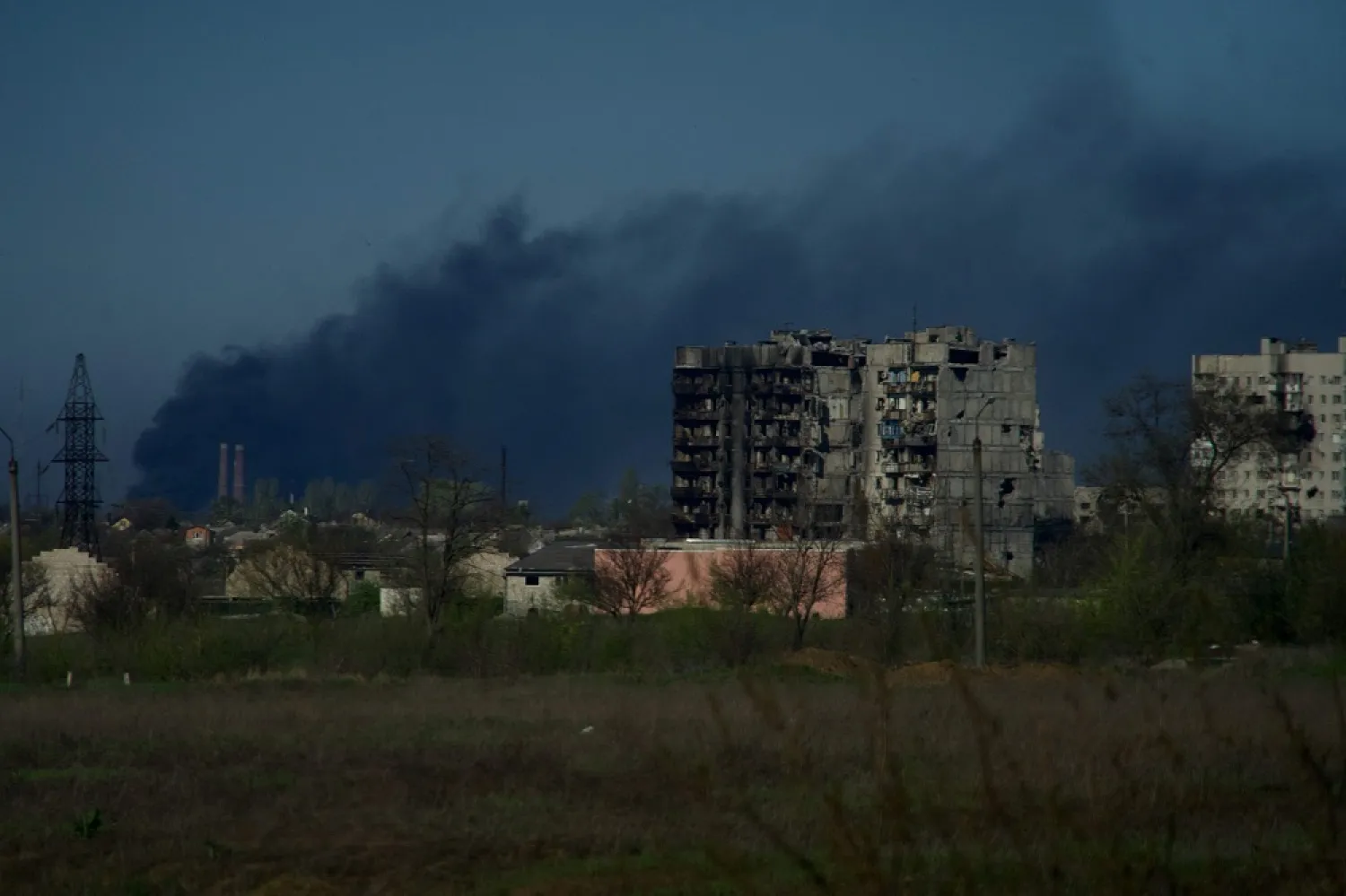
Smoke rises from the grounds of the Azovstal steel plant in the city of Mariupol on April 29, 2022, amid the ongoing Russian military action in Ukraine. (AFP)
TT

Some Evacuated from Mariupol; US Lawmaker Pelosi Visits Kyiv

Smoke rises from the grounds of the Azovstal steel plant in the city of Mariupol on April 29, 2022, amid the ongoing Russian military action in Ukraine. (AFP)

Some women and children have been evacuated from a steel plant that is the last defensive stronghold in the bombed-out ruins of the Ukrainian city of Mariupol, while US House Speaker Nancy Pelosi visited Ukraine's president in the country's capital in a show of American support.

Russia's high-stakes offensive in coastal southern Ukraine and the country’s eastern industrial heartland has Ukrainian forces fighting village by village and more civilians fleeing airstrikes and artillery shelling as the war draws near their doorsteps.

The United Nations was working to evacuate residents from blockaded Mariupol. As many as 100,000 people are believed to still be in the port city, included up to civilians who were hunkered down with an estimated 2,000 Ukrainian fighters beneath a sprawling Soviet-era steel plant that is the only part of the city not occupied by the Russians.

Pelosi, who is second in line to succeed the president, is the most senior American lawmaker to visit Ukraine since the war erupted. Her Saturday trip with a congressional delegation was a sign of unflinching US support and came just days after Russia launched rockets at the capital during a visit by UN Secretary-General António Guterres.

During a Sunday news conference in the Polish city of Rzeszow, Pelosi said she and other members of the delegation applauded the courage of the Ukrainian people and brought Zelenskyy "a message of appreciation from the American people for his leadership."

Russian forces have embarked on a major military operation to seize significant parts of southern and eastern Ukraine following their failure to capture the capital, Kyiv. Mariupol is a major target because of its strategic location near the Crimea Peninsula, which Russia seized from Ukraine in 2014.

Details about the scope of Saturday's evacuations and the possibility of more to come Sunday were unclear given the number of parties involved in the negotiations and the volatile situation on the ground.

Russia’s RIA Novosti news agency said Saturday that 19 adults and six children were transported out of the city but gave no further details. A top official with the Azov Regiment, the Ukrainian unit defending the Azovstal steelworks, said 20 civilians were evacuated Saturday, though it was not clear if he was referring to the same group.

In a video posted on the regiment's Telegram channel, regiment Deputy Commander Sviatoslav Palamar called for the evacuation of wounded Ukrainian fighters as well as civilians. "We don’t know why they are not taken away and their evacuation to the territory controlled by Ukraine is not being discussed," he said.

The UN has not confirmed that people were able to leave Mariupol on Saturday. An Associated Press journalist saw women and children arriving in Bezimenne, a village which is under the control of Moscow-backed separatists in eastern Ukraine.

A Red Cross representative there said 20 civilians were evacuated from the Azovstal steel plant amid a temporary cease-fire observed by Ukrainian and Russian forces. Ukraine has blamed the failure of numerous previous evacuation attempts on continued Russian shelling.

The Russian Defense Ministry said a total of 46 people, groups of 25 and 21, were evacuated from areas near the plant.

Elsewhere in Ukraine's eastern Donbas region, about 20 older adults and children clutching bags along with their dogs and cats boarded a minivan Saturday in the town of Lyman, where at least half the population has fled Russian shelling, The van, marked with a sign reading "evacuation of children" in Ukrainian, sped off toward the city of Dnipro as explosions were heard in the distance.

"The liberators have come and have freed us from what? Our lives?" said Nina Mihaylenko, a professor of Russian language and literature, referring to the Russian forces.

Undeterred by air raid sirens and warnings to shelter at home, people in the southeastern city of Zaporizhzhia visited cemeteries Sunday, when Ukrainians observed the Orthodox Christian day of the dead.

"If our dead could rise and see this, they would say, ‘It’s not possible, they’re worse than the Germans,’" Hennadiy Bondarenko, 61, said while marking the day with his family at a picnic table among the graves. "All our dead would join the fighting, including the Cossacks."

In his nightly video address late Saturday, Zelenskyy warned that Russia was "gathering additional forces for new attacks against our military in the east of the country." He urged Russian troops not to fight in Ukraine, saying even their generals expect that thousands more of them will die.

"But why do the Russian soldiers need this? Why do their families need this?" Zelenskyy said in Russian.

Getting a full picture of the unfolding battle in eastern Ukraine has been difficult because airstrikes and artillery barrages have made it extremely dangerous for reporters to move around. Also, both Ukraine and Moscow-backed rebels have introduced tight restrictions on reporting from the combat zone.

But Western military analysts have suggested that the offensive in the Donbas region, which includes Mariupol, was going much slower than planned. So far, Russian troops and the separatists appeared to have made only minor gains in the month since Moscow said it would focus its military strength in the east.

Video and images from inside the Mariupol steel plant, shared with The Associated Press by two Ukrainian women who said their husbands are among the fighters refusing to surrender there, showed unidentified men with stained bandages; others had open wounds or amputated limbs.

A skeleton medical staff was treating at least 600 wounded people, said the women, who identified their husbands as members of the Azov Regiment of Ukraine’s National Guard. Some of the wounds were rotting with gangrene, they said.

The AP could not independently verify the date and location of the video, which the women said was taken in the last week in the maze of corridors and bunkers beneath the plant.

Numerically, Russia’s military manpower vastly exceeds Ukraine’s. In the days before the war began, Western intelligence estimated Russia had positioned near the border as many as 190,000 troops; Ukraine’s standing military totals about 200,000, spread throughout the country.

With plenty of firepower still in reserve, Russia’s offensive still could intensify and overrun the Ukrainians. Overall the Russian army has an estimated 900,000 active-duty personnel. Russia also has a much larger air force and navy.

Hundreds of millions of dollars in military assistance has flowed into Ukraine since the war began, but Russia's vast armories mean Ukraine will continue to require huge amounts of support.



Poland Bars Chinese-Made Cars from Military Sites Over Data Security Fears 

A soldier from the 18th Mechanized Division stands guard on a Light Strike Vehicle "Zmija" during a media tour organized by the country's military to demonstrate the security measures on the Polish Belarusian border, near Bialowieza, Poland, January 10, 2025. (Reuters)
TT

Poland Bars Chinese-Made Cars from Military Sites Over Data Security Fears 

A soldier from the 18th Mechanized Division stands guard on a Light Strike Vehicle "Zmija" during a media tour organized by the country's military to demonstrate the security measures on the Polish Belarusian border, near Bialowieza, Poland, January 10, 2025. (Reuters)

Poland has barred Chinese-made vehicles from entering military facilities due to concerns their onboard sensors could be used to collect sensitive data, the Polish Army said on Tuesday evening.

The army said in ‌a statement ‌that such vehicles ‌may ⁠still be allowed onto ⁠secured sites if specified functions are disabled and other safeguards required under each facility's security rules are in place.

To ⁠limit the risk ‌of ‌exposing confidential information, the military has ‌also banned connecting company ‌phones to infotainment systems in vehicles manufactured in China.

The restrictions do not apply ‌to publicly accessible military locations such as hospitals, ⁠clinics, ⁠libraries, prosecutors' offices or garrison clubs, the army said.

It added that the measures are precautionary and align with practices used by NATO members and other allies to ensure high standards of protection for defense infrastructure.


Starmer, Trump discussed Russia-Ukraine, Iran after Geneva Talks, Downing Street Says 

US President Donald Trump and British Prime Minister Keir Starmer announce an agreement between the two countries as they hold a press conference at Chequers at the conclusion of a state visit on September 18, 2025 in Aylesbury, Britain. (Reuters)
TT

Starmer, Trump discussed Russia-Ukraine, Iran after Geneva Talks, Downing Street Says 

US President Donald Trump and British Prime Minister Keir Starmer announce an agreement between the two countries as they hold a press conference at Chequers at the conclusion of a state visit on September 18, 2025 in Aylesbury, Britain. (Reuters)

British ‌Prime Minister Keir Starmer spoke to US President Donald Trump on Tuesday night about US-mediated Russia-Ukraine peace talks in Geneva, as well as talks between the US and Iran on ‌their nuclear ‌dispute, a Downing Street ‌spokesperson ⁠said.

Starmer also discussed ⁠Gaza with Trump and stressed on the importance of securing further access for humanitarian aid, the spokesperson said.

Negotiators ⁠from Ukraine and ‌Russia ‌concluded the first of two days ‌of the US-mediated ‌peace talks in Geneva on Tuesday, with Trump pressing Kyiv to act fast ‌to reach a deal.

Separately, Iranian Foreign Minister ⁠Abbas ⁠Araqchi said Tehran and Washington reached an understanding on Tuesday on "guiding principles" aimed at resolving their longstanding nuclear dispute, but that did not mean a deal is imminent.


Japan PM Takaichi Reappointed Following Election

Sanae Takaichi gestures at the Lower House of the Parliament in Tokyo, Japan, 18 February 2026. EPA/FRANCK ROBICHON
TT

Japan PM Takaichi Reappointed Following Election

Sanae Takaichi gestures at the Lower House of the Parliament in Tokyo, Japan, 18 February 2026. EPA/FRANCK ROBICHON

Japan's lower house formally reappointed Sanae Takaichi as prime minister on Wednesday, 10 days after her historic landslide election victory.

Takaichi, 64, became Japan's first woman premier in October and won a two-thirds majority for her party in the snap lower house elections on February 8.

She has pledged to bolster Japan's defenses to protect its territory and waters, likely further straining relations with Beijing, and to boost the flagging economy.

Takaichi suggested in November that Japan could intervene militarily if Beijing sought to take Taiwan by force.

China, which regards the democratic island as part of its territory and has not ruled out force to annex it, was furious.

Beijing's top diplomat Wang Yi told the Munich Security Conference on Saturday that forces in Japan were seeking to "revive militarism".

In a policy speech expected for Friday, Takaichi will pledge to update Japan's "Free and Open Indo-Pacific" strategic framework, local media reported.

"Compared with when FOIP was first proposed, the international situation and security environment surrounding Japan have become significantly more severe," chief government spokesman Minoru Kihara said Monday.

In practice this will likely mean strengthening supply chains and promoting free trade through the Trans-Pacific Partnership (CPTPP) that Britain joined in 2024.

Takaichi's government also plans to pass legislation to establish a National Intelligence Agency and to begin concrete discussions towards an anti-espionage law, the reports said.

Takaichi has promised too to tighten rules surrounding immigration, even though Asia's number two economy is struggling with labor shortages and a falling population.

On Friday Takaichi will repeat her campaign pledge to suspend consumption tax on food for two years in order to ease inflationary pressures on households, local media said, according to AFP.

This promise has exacerbated market worries about Japan's colossal debt, with yields on long-dated government bonds hitting record highs last month.

Rahul Anand, the International Monetary Fund chief of mission in Japan, said Wednesday that debt interest payments would double between 2025 and 2031.

"Removing the consumption tax (on food) would weaken the tax revenue base, since the consumption tax is an important way to raise revenues without creating distortions in the economy," Anand said.

To ease such concerns, Takaichi will on Friday repeat her mantra of having a "responsible, proactive" fiscal policy and set a target on reducing government debt, the reports said.

She will also announce the creation of a cross-party "national council" to discuss taxation and how to fund ageing Japan's ballooning social security bill.

But Takaichi's first order of business will be obtaining approval for Japan's budget for the fiscal year beginning on April 1 after the process was delayed by the election.

The ruling coalition also wants to pass legislation that will outlaw destroying the Japanese flag, according to the media reports.

It wants too to accelerate debate on changing the constitution and on revising the imperial family's rules to ease a looming succession crisis.

Takaichi and many within her Liberal Democratic Party (LDP) oppose making it possible for a woman to become emperor, but rules could be changed to "adopt" new male members.