

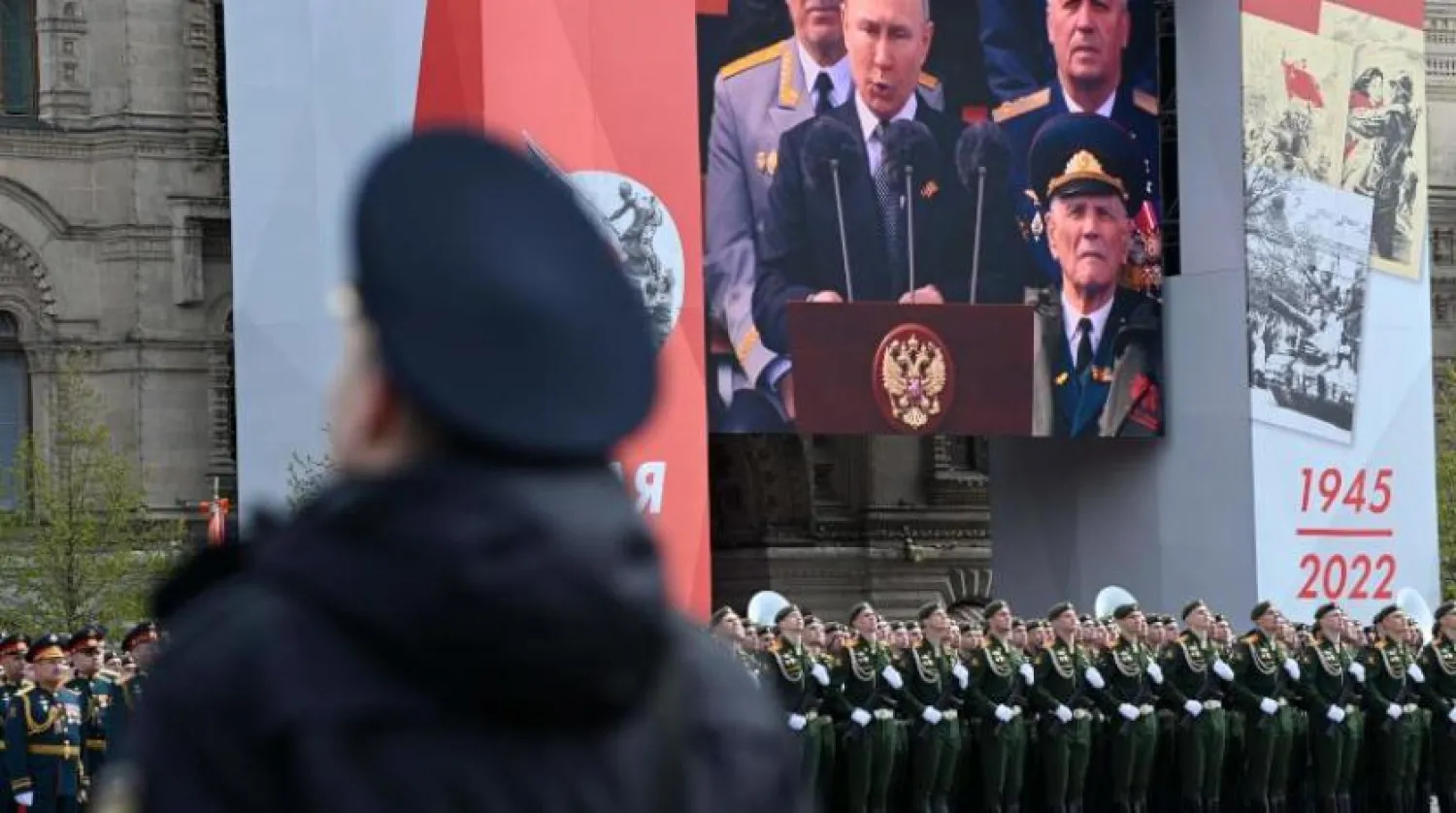

No End in Sight for Ukraine War as Putin Hails Victory Day

A screen shows Russian President Vladimir Putin giving a speech as servicemen line up on Red Square during the Victory Day military parade in central Moscow on May 9, 2022. (Photo by Kirill KUDRYAVTSEV / AFP)
TT

No End in Sight for Ukraine War as Putin Hails Victory Day

A screen shows Russian President Vladimir Putin giving a speech as servicemen line up on Red Square during the Victory Day military parade in central Moscow on May 9, 2022. (Photo by Kirill KUDRYAVTSEV / AFP)

Russian President Vladimir Putin used his country's biggest patriotic holiday Monday to again justify his war in Ukraine but did not declare even a limited victory or signal where the conflict is headed, as his forces pressed their offensive with few signs of progress.

The Russian leader oversaw a Victory Day parade on Moscow's Red Square, with troops marching in formation and military hardware on display to celebrate the Soviet Union's role in the 1945 defeat of Nazi Germany.

But his much-anticipated speech offered no new insights into how he intends to salvage the grinding war, and he instead stuck to allegations that Ukraine posed a threat to Russia, even though Moscow’s nuclear-armed forces are far superior in number and firepower.

"The danger was rising by the day," Putin said. "Russia has given a preemptive response to aggression. It was forced, timely and the only correct decision."

He steered clear of battlefield specifics, failing to mention the potentially pivotal battle for the vital southern port of Mariupol and not even uttering the word "Ukraine."

On the ground, meanwhile, intense fighting raged in Ukraine's east, the vital Black Sea port of Odesa in the south came under bombardment again, and Russian forces sought to finish off the Ukrainian defenders making their last stand at a steel plant in Mariupol.

Putin has long bristled at NATO’s creep eastward into former Soviet republics, and argued Monday that Russia had to invade Ukraine before an "inevitable" clash. Ukrainian leaders and their Western backers have denied that Kyiv or NATO posed any threat.

As he has done all along, Putin falsely portrayed the fighting as a battle against Nazism, thereby linking the war to what many Russians regard as their finest hour: the triumph over Nazi Germany. The Soviet Union lost 27 million people in what Russia refers to as the Great Patriotic War.

He also sought to depict the offensive underway for control of the Donbas region in the east - Moscow’s focus after its abortive attempt to storm the capital, Kyiv - as a fight on Russia's "historic lands." He has long sought to deny Ukraine’s own 1,000-year history.

Progress in the east, though, has been slow-going, and many analysts had suggested Putin might use his speech to declare some sort of victory - potentially in Mariupol - to counter discontent over Russia's heavy casualties and the punishing effects of Western sanctions at home.

Others suggested he might declare the fighting a war, not just a "special military operation," and order a nationwide mobilization, with a call-up of reserves, to replenish the depleted ranks for an extended conflict.
Neither step was announced.

Critics said the speech skirted some uncomfortable realities that Putin is facing: With the campaign in Ukraine faltering, he has not asked Russians to accept sacrifices to weather the sanctions and diplomatic isolation.

He also left unanswered the question of whether and how Russia will marshal more forces in the face of significant losses.

"Without concrete steps to build a new force, Russia can’t fight a long war, and the clock starts ticking on the failure of their army in Ukraine," tweeted Phillips P. O’Brien, professor of strategic studies at the University of St. Andrews in Scotland.

Despite Russia's efforts to crack down on dissent, antiwar sentiment has seeped through. A few scattered protesters were detained around the country on Victory Day, and editors at one pro-Kremlin media outlet revolted by briefly publishing a few dozen stories criticizing Putin and the invasion.

In Warsaw, anti-war protesters splattered Russia’s ambassador to Poland with what appeared to be red paint as he arrived at a cemetery to pay respects to Red Army soldiers who died during World War II.

As Putin laid a wreath in Moscow, air raid sirens echoed again in the Ukrainian capital. But Ukrainian President Volodymyr Zelenskyy declared in his own Victory Day address that his country would eventually defeat the Russians.

"Very soon there will be two Victory Days in Ukraine," he said in a video. He added: "We are fighting for freedom, for our children, and therefore we will win."

Russia has about 97 battalion tactical groups in Ukraine, largely in the east and the south, a slight increase over last week, according to a senior US official, speaking on condition of anonymity to discuss the Pentagon's assessment. Each unit has roughly 1,000 troops, according to the Pentagon.

The official said that overall, the Russian effort in the Donbas hasn’t achieved any significant progress in recent days and continues to face stiff resistance from Ukrainian forces.

The Ukrainian military warned of a high probability of missile strikes around the holiday, and some cities imposed curfews or warned people not to gather in public places.

More than 60 people were feared dead over the weekend after Russian bombardment flattened a Ukrainian school being used as a shelter in the eastern village of Bilohorivka, Ukrainian officials said.

With the war in its 11th week, Russia was perhaps closest to a victory in Mariupol. The US official said roughly 2,000 Russian forces were around Mariupol, and the city was being pounded by airstrikes. As many as 2,000 Ukrainian defenders were believed to be holding out at the steel plant, the city's last stronghold of resistance.

The fall of Mariupol would deprive Ukraine of a vital port, allow Russia to complete a land corridor to the Crimean Peninsula, and free up troops to fight elsewhere in the Donbas. It would also give the Kremlin a badly needed success.

Odesa, too, has increasingly come under bombardment in recent days. Ukrainian officials said Russia fired four cruise missiles targeting the city Monday from Crimea. It said no civilians were wounded but did not elaborate on what was struck.

The war in the country long known as the "breadbasket of Europe" has disrupted global food supplies.

"I saw silos full of grain, wheat and corn ready for export," Charles Michel, president of the European Council, lamented in a tweet after a visit to Odesa. "This badly needed food is stranded because of the Russian war and blockade of Black sea ports. Causing dramatic consequences for vulnerable countries."



Ukraine’s New Defense Minister Reveals Scale of Desertions as Millions Avoid the Draft

Ukraine's newly appointed Defense Minister Mykhailo Fedorov attends a parliamentary session in Kyiv, Ukraine, 14 January 2026. (EPA)
TT

Ukraine’s New Defense Minister Reveals Scale of Desertions as Millions Avoid the Draft

Ukraine's newly appointed Defense Minister Mykhailo Fedorov attends a parliamentary session in Kyiv, Ukraine, 14 January 2026. (EPA)

Wide-scale desertions and 2 million draft-dodgers are among a raft of challenges facing Ukraine's military as Russia presses on with its invasion of its neighbor after almost four years of fighting, the new defense minister said Wednesday.

Mykhailo Fedorov told Ukraine's parliament that other problems facing Ukraine’s armed forces include excessive bureaucracy, a Soviet-style approach to management, and disruptions in the supply of equipment to troops along the about 1,000-kilometer (600-mile) front line.

“We cannot fight a war with new technologies but an old organizational structure,” Fedorov said.

He said the military had faced some 200,000 troop desertions and draft-dodging by around 2 million people.

President Volodymyr Zelenskyy appointed 34-year-old Fedorov at the start of the year. The former head of Ukraine’s digital transformation policies is credited with spearheading the army's drone technology and introducing several successful e-government platforms.

His appointment was part of a broad government reshuffle that the Ukrainian leader said aimed to sharpen the focus on security, defense development and diplomacy amid a new US-led push to find a peace settlement.

Fedorov said the defense ministry is facing a shortfall of 300 billion hryvnia ($6.9 billion) in funding needs.

The European Union will dedicate most of a massive new loan program to help fund Ukraine’s military and economy over the next two years, European Commission President Ursula von der Leyen said Wednesday.

Fedorov said Ukraine’s defense sector has expanded significantly since Russia’s full-scale invasion in February 2022. At the start of the war, he said, the country had seven private drone companies and two firms developing electronic warfare systems. Today, he said, there are nearly 500 drone manufacturers and about 200 electronic warfare companies in Ukraine.

He added that some sectors have emerged from scratch, including private missile producers, which now number about 20, and more than 100 companies manufacturing ground-based robotic systems.


France Explores Sending Eutelsat Terminals to Iran Amid Internet Blackout

 Protesters hold up placards with pictures of victims as they demonstrate in support of anti-government protests in Iran, outside Downing Street, in London, Wednesday, Jan. 14, 2026. (AP)
Protesters hold up placards with pictures of victims as they demonstrate in support of anti-government protests in Iran, outside Downing Street, in London, Wednesday, Jan. 14, 2026. (AP)
TT

France Explores Sending Eutelsat Terminals to Iran Amid Internet Blackout

 Protesters hold up placards with pictures of victims as they demonstrate in support of anti-government protests in Iran, outside Downing Street, in London, Wednesday, Jan. 14, 2026. (AP)
Protesters hold up placards with pictures of victims as they demonstrate in support of anti-government protests in Iran, outside Downing Street, in London, Wednesday, Jan. 14, 2026. (AP)

France is looking into sending Eutelsat satellite terminals to Iran to help citizens after Iranian authorities imposed a blackout of internet services in a bid to quell the country's most violent domestic unrest in decades.

"We are exploring all options, and the one you have mentioned is among them," French Foreign Minister Jean-Noel Barrot said on Wednesday in ‌the lower house ‌after a lawmaker asked whether France ‌would ⁠send Eutelsat ‌gear to Iran.

Backed by the French and British governments, Eutelsat owns OneWeb, the only low Earth orbit constellation, or group of satellites, besides Elon Musk's Starlink.

The satellites are used to beam internet service from space, providing broadband connectivity to businesses, governments and consumers in underserved areas.

Iranian authorities in recent days have ⁠launched a deadly crackdown that has reportedly killed thousands during protests against clerical rule, ‌and imposed a near-complete shutdown of internet ‍service.

Still, some Iranians have ‍managed to connect to Starlink satellite internet service, three people ‍inside the country said.

Even Starlink service appears to be reduced, Alp Toker, founder of internet monitoring group NetBlocks said earlier this week.

Eutelsat declined to comment when asked by Reuters about Barrot's remarks and its activities in Iran.

Starlink’s more than 9,000 satellites allow higher speeds than Eutelsat's fleet of over 600, ⁠and its terminals connecting users to the network are cheaper and easier to install.

Eutelsat also provides internet access to Ukraine's military, which has relied on Starlink to maintain battlefield connectivity throughout the war with Russia.

Independent satellite communications adviser Carlos Placido said OneWeb terminals are bulkier than Starlink’s and easier to jam.

"The sheer scale of the Starlink constellation makes jamming more challenging, though certainly not impossible," Placido said. "With OneWeb it is much easier to predict which satellite will become online over a given ‌location at a given time."


China Says It Opposes Outside Interference in Iran’s Internal Affairs

Iranians walk next to a billboard reading "Iran is our Homeland" at Enqelab Square in Tehran, Iran, 13 January 2026. (EPA)
TT

China Says It Opposes Outside Interference in Iran’s Internal Affairs

Iranians walk next to a billboard reading "Iran is our Homeland" at Enqelab Square in Tehran, Iran, 13 January 2026. (EPA)

China opposes any outside interference in Iran's ​internal affairs, the Chinese foreign ministry said on Wednesday, after US President Donald Trump warned that Washington ‌would take "very ‌strong action" ‌against Tehran.

China ⁠does ​not ‌condone the use or the threat of force in international relations, Mao Ning, spokesperson at ⁠the Chinese foreign ministry, said ‌at a ‍regular ‍news conference when ‍asked about China's position following Trump's comments.

Trump told CBS News in ​an interview that the United States would take "very ⁠strong action" if Iran starts hanging protesters.

Trump also urged protesters to keep protesting and said that help was on the way.